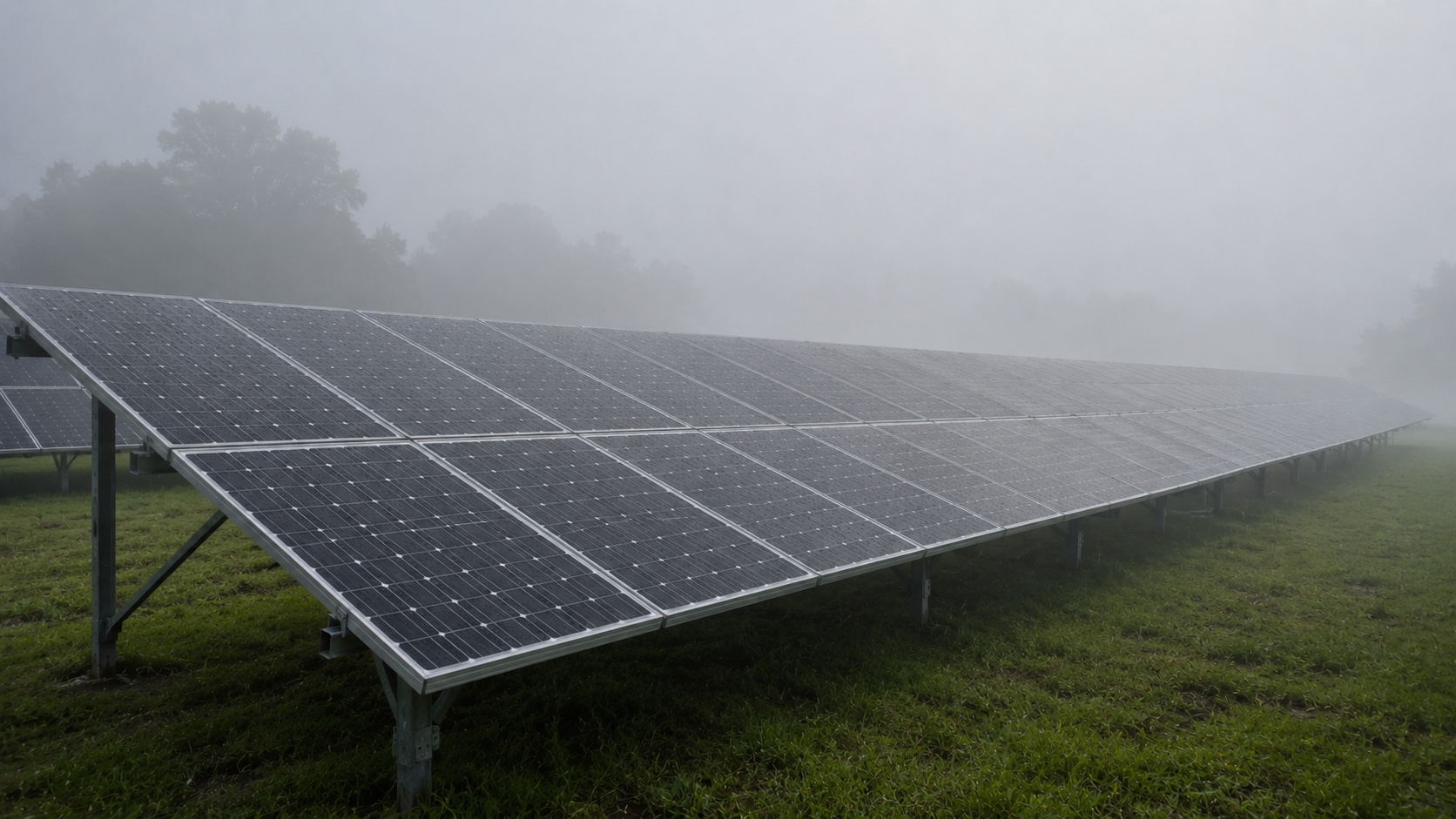
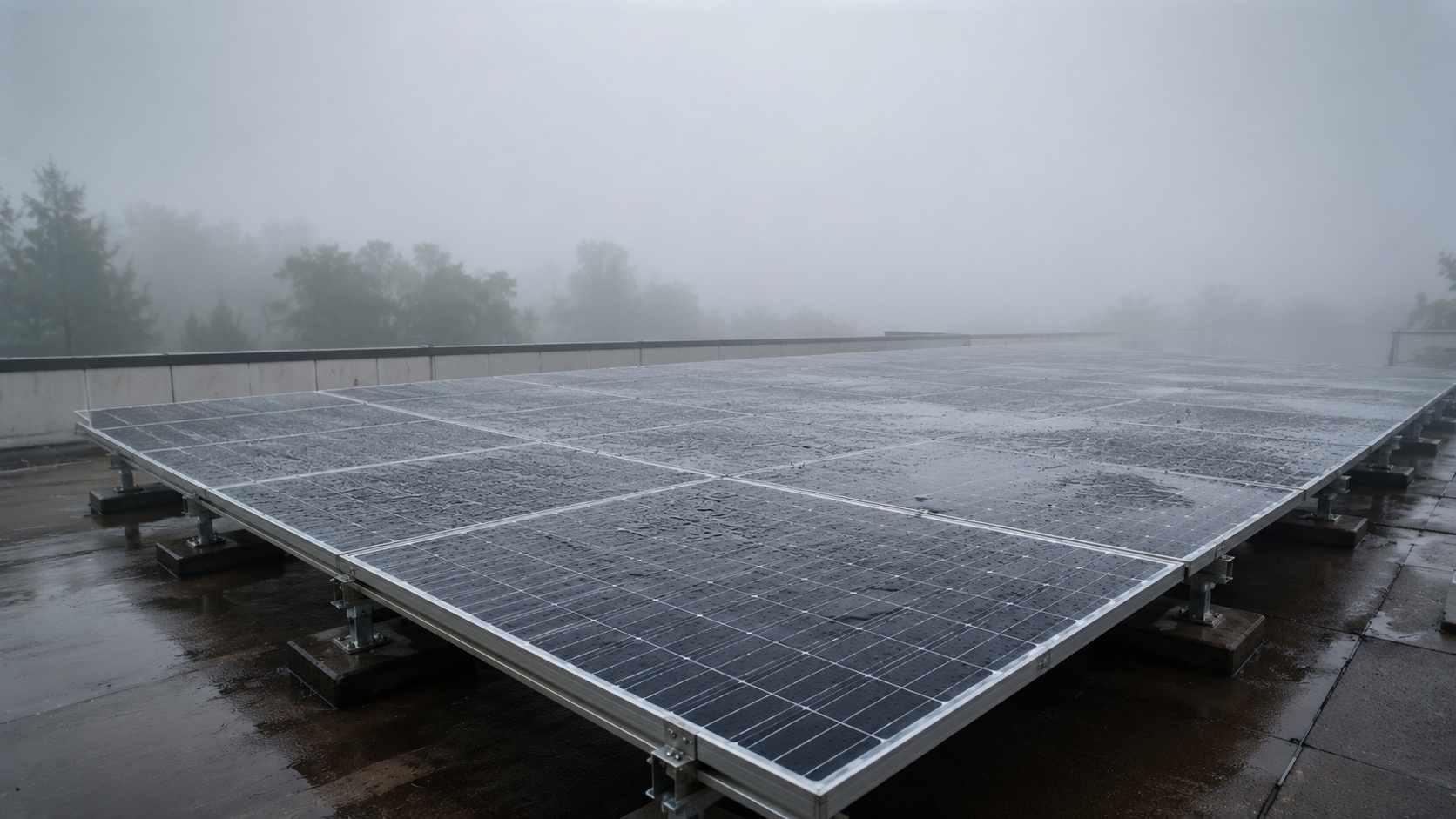
If Riso drops mainly during fog, dew, or rain and rises again after the array dries, moisture is making an existing path to ground more conductive. The weak point may be a module backsheet, cable, connector, junction box, module edge, or other DC component. Drying removes the moisture path, but it does not repair damaged insulation.
For anyone operating or maintaining a PV system, four things are worth watching first: how far Riso drops, how quickly it comes back, whether one string is much worse than the others, and whether the lowest reading is getting worse over time.
Read the Fault Pattern
| What You See | Most Likely Direction to Check |
|---|---|
| Low Riso only around sunrise | Dew, surface contamination, moisture-sensitive insulation |
| Riso drops as soon as rain starts | Exposed cable damage, cracked insulation, leaking connector or enclosure |
| Fault remains after rain stops | Water trapped inside a connector, junction box, gland, or enclosure |
| Riso recovers quickly after the sun appears | Surface moisture is more likely |
| Riso takes hours to recover after surfaces look dry | Absorbed or trapped moisture is more likely |
| Only one string or MPPT is much lower | Localized cable, connector, module, or junction-box fault |
| Several strings fall together | Common environmental exposure, shared equipment, or widespread aging |
| Dry-weather Riso also becomes lower over time | Permanent insulation degradation is becoming more likely |
One low reading on one wet morning tells you very little. If the same string shows the same problem again under similar weather, that is much more useful. At that point, the fault is following a pattern rather than appearing at random.
Use the Riso Number Correctly
Riso is easier to understand if you look at what the number means electrically. Insulation resistance and leakage current follow:
R = V / I
At the same DC voltage, lower resistance means more current can leak toward ground.
| Insulation Resistance | Calculated Leakage at 1,000 V DC |
|---|---|
| 100 MΩ | 10 µA |
| 10 MΩ | 100 µA |
| 5 MΩ | 0.2 mA |
| 2 MΩ | 0.5 mA |
| 1 MΩ | 1 mA |
| 0.5 MΩ | 2 mA |
Take a path that measures 100 MΩ dry and 1 MΩ wet. At 1,000 V, the calculated leakage rises from about 10 µA to 1 mA. That is a 100-fold increase, even though nothing else in the system has changed.
Voltage also matters. The same 1 MΩ path would correspond to about 1 mA at 1,000 V and 1.5 mA at 1,500 V.
These figures come from Ohm's law. They are not inverter trip limits. The acceptable Riso still depends on the inverter, connected array, voltage, grounding arrangement, and applicable requirements.
Know What the Inverter Is Measuring
A common mistake is to see a low-Riso alarm and immediately blame one module. In most cases, the inverter is not measuring one module on its own.
The value can reflect the insulation condition of:
- PV modules;
- DC cables;
- connectors;
- junction boxes;
- combiner boxes;
- DC switches;
- other connected DC equipment.
Field research using inverter monitoring data treats ground insulation as the combined condition of the circuits and modules connected to the inverter.[2]
That is why replacing a module just because the inverter shows low Riso can leave the real fault untouched.
It also helps to confirm what kind of module is actually installed. Some products use rear glass and others use a polymer backsheet. The relevant module specifications show which construction is used.
Account for Array Size
A large array will not show the same insulation resistance as one isolated module. In a simplified insulation model, the individual paths toward ground act in parallel:
1 / Rtotal = 1 / R1 + 1 / R2 + 1 / R3 + ...
| Equal Paths | Resistance of Each Path | Combined Resistance |
|---|---|---|
| 1 | 200 MΩ | 200 MΩ |
| 10 | 200 MΩ | 20 MΩ |
| 20 | 200 MΩ | 10 MΩ |
| 50 | 200 MΩ | 4 MΩ |
| 100 | 200 MΩ | 2 MΩ |
These are mathematical examples, not expected values for a specific PV plant.
The table shows why a large array can have a much lower total Riso than one module without every module being faulty.
The other side of the same calculation is more useful during troubleshooting. Twenty equal 200 MΩ paths combine to about 10 MΩ. Add one wet fault with a 1 MΩ path and the combined value falls to about 0.91 MΩ.
In practice, one local defect can pull down the reading for a much larger part of the array.
Check the Three Moisture Paths
Wet-weather faults usually fall into three groups.
Surface wetting: fog, dew, or rain leaves water on glass, backsheets, cables, connectors, frames, or rails. Salt, dust, or other contamination can make that wet surface much easier for current to cross.
Moisture absorption: backsheets, encapsulants, and other polymer materials can take up moisture from humid air even when there are no visible droplets. As their moisture content changes, their insulation performance can change too.
Water ingress: water gets inside a connector, junction box, cable gland, damaged cable, cracked module edge, or enclosure. This is usually harder to clear because the water may stay trapped after the outside has already dried.
A field study of several PV backsheet constructions found that some groups showed a strong reduction in inverter ground impedance above about 70% relative humidity, while one specific group deteriorated faster above roughly 75% RH.[2]
Those percentages belong to the materials in that study. They should not be used as universal PV alarm thresholds.
Check Dirt, Salt and Pollution
Moisture becomes more conductive when it picks up dissolved material from the site.
Common sources include:
- sea salt;
- soil dust;
- fertilizer residue;
- industrial pollution;
- corrosion products;
- mineral deposits.
NREL testing found that ion-containing water films can increase leakage-related conduction across PV module surfaces and packaging.[1]
That changes what should be checked first at different sites:
- Coastal site: check salt contamination and connector corrosion first.
- Agricultural site: check dust, fertilizer salts, ammonia exposure, and organic contamination.
- Industrial site: check conductive deposits and corrosion.
- Rooftop: check cables and connectors in drainage paths or standing water.
Check the Backsheet
On a glass-backsheet module, the rear polymer layer is part of the electrical insulation system. Age and weather can damage it long before the module stops producing power.
Look for:
- visible cracks;
- fine surface cracking;
- chalky areas;
- brittleness;
- delamination;
- damage close to the junction box or module edge.
Cracked backsheets can increase leakage current, reduce electrical safety, and allow more moisture into the module.[3]
One documented polyamide backsheet population showed cracking after as little as four years and failure rates above 90% within seven years.[3]
That result applies to the material population studied, not to all backsheets.
For B2B operators, this matters because output and insulation are two different maintenance questions. A module can still produce near-normal power while the rear insulation is getting worse. That distinction is also relevant when looking at solar module reliability.
Check for Internal Moisture
If the fault stays after the module surface looks dry, the next question is whether moisture has moved farther inside.
Warning signs include:
- edge damage;
- delamination;
- corrosion;
- discoloration near internal metal parts;
- damage around the junction-box attachment area.
Possible entry routes include damaged edges, cracks, delaminated areas, seals, and polymer layers.
NREL research has shown that leakage current under hot and humid conditions can contribute to corrosion and delamination inside silicon PV modules.[4]
This is why moisture is worth checking when solar module delamination appears together with aging, heat, UV exposure, or weak bonding.
Check Glass-Glass Modules Differently
Glass-glass modules remove one possible failure mode because they do not use a conventional polymer backsheet. They do not remove every path to ground.
For glass-glass products, focus on:
- front and rear glass damage;
- module edges;
- junction-box bonding;
- output leads;
- connectors;
- external DC cabling.
If a glass-glass array shows low Riso, do not jump straight to a laminate problem. Cable, connector, and junction-box faults remain just as relevant.
Check DC Cables
Cable faults are often missed because the damaged section may be hidden under a module or pressed against metal.
Inspect for:
- abrasion against frames;
- sharp rail edges;
- crushed cable sections;
- rodent bites;
- UV damage;
- tight cable ties;
- cables lying in water.
A small cut can behave very differently wet and dry.
At 1,000 V, a hypothetical dry leakage path of 100 MΩ corresponds to about 10 µA. If dew reduces the same path to 5 MΩ, leakage rises to about 0.2 mA—20 times higher.
Once the cable dries, the reading can improve even though the jacket is still damaged. That is why a good afternoon Riso reading does not rule out a cable fault that only appears in the morning.
Check Connectors
Connector problems are usually mechanical first and electrical later. A poor seal, cracked housing, or bad assembly creates the opening; moisture then makes the fault easier to detect.
Inspect connector pairs for:
- incomplete mating;
- cracked housings;
- damaged seals;
- incorrect cable diameter;
- poor crimping;
- loose cable entries;
- corrosion;
- connector pairs sitting in water;
- unapproved mixed connector combinations.
If moisture is only on the outside, Riso may recover quickly. Water inside the connector body can take much longer to clear, especially if corrosion or seal damage is already present.
That is why PV connector cracking matters during a wet-weather Riso inspection: a small crack can give water direct access to a part that should stay sealed.
Check Junction Boxes and Enclosures
If the glass is dry but Riso is still low, move the inspection toward places that can hold water.
Check junction boxes, combiner boxes, DC isolators, surge protection devices, and cable glands for:
- cracked housings;
- failed adhesive;
- loose covers;
- damaged glands;
- corroded terminals;
- condensation marks;
- water trapped at the bottom of an enclosure.
No visible rainwater leak is required. Moist air can enter during normal heating and cooling, then condense inside when the enclosure becomes cold.
Separate Glass Damage from Cell Cracks
Broken module glass and cracked cells are not the same problem.
Glass damage can weaken the protective laminate and make moisture-related insulation problems more likely. Hail, transport impact, edge damage, mounting stress, and mechanical loading can all be involved. Different causes of solar module glass cracking can leave different fracture patterns.
A cell microcrack sits inside the silicon cell. It can reduce power or contribute to hot spots, but it does not automatically create a path to ground if the surrounding laminate and insulation are intact.
For a fog-related Riso alarm, the glass, backsheet, module edge, cable, connector, and junction box normally deserve attention before an isolated cell microcrack.
Use Recovery Time to Narrow the Cause
| Recovery Pattern | More Likely Causes |
|---|---|
| Riso rises soon after exposed surfaces dry | Surface moisture, contamination, exposed cable defect |
| Riso remains low after glass looks dry | Connector, junction box, cable entry, absorbed moisture |
| Riso stays low through prolonged dry weather | Permanent insulation damage, corrosion, severe water ingress |
Do not turn this into a fixed timer. “One hour means surface water” is not a reliable rule. Wind, sunlight, temperature, mounting angle, and enclosure design all change how quickly a wet part dries.
Compare Wet and Dry Measurements
Measured field data shows how large the difference can become.
At a flood-affected thin-film PV plant in Thailand, researchers tested 716 modules in dry conditions. Insulation resistance ranged from 15 to 231 MΩ, with an average of about 75 MΩ.
They directly wet-tested 14 selected modules. Wet values ranged from 2 to 60 MΩ, with an average of about 26 MΩ.[5]
The average wet value in that specific sample was about 65% lower than the dry average.
These numbers are not normal fog limits. The plant had been affected by flooding, the modules were thin-film products, and the direct wet-test sample contained only 14 modules.
What matters here is the size of the wet/dry change, not the absolute reading.
Track the Long-Term Trend
A service team gets more value from comparable readings over time than from one isolated test.
| Example Year | Wet-Weather Riso |
|---|---|
| Year 1 | 15 MΩ |
| Year 3 | 9 MΩ |
| Year 5 | 4 MΩ |
| Year 6 | 2 MΩ |
This is an illustrative example, not an expected degradation rate.
In this example, resistance falls by about 87%. At the same voltage, the leakage current of that path increases by about 7.5 times.
The comparison only makes sense if the weather and circuit are reasonably similar. A dry afternoon measurement and a foggy sunrise measurement should not be treated as a clean year-to-year degradation comparison.
Compare Strings and MPPTs
When several circuits are exposed to the same weather, use them as comparison points.
One string much lower: inspect components unique to that string.
One MPPT much lower: narrow the search to strings connected to that MPPT.
One inverter much worse than neighboring inverters: focus on the DC circuits connected to that inverter.
All circuits fall together: consider common environmental conditions, shared equipment, or widespread aging.
For a large plant, this is usually a faster way to work than checking modules one by one. The search normally moves through:
inverter → MPPT → string → module or component
Do Not Compare Different Riso Tests Directly
An inverter reading and a technician's insulation-resistance test can be different even when both are correct.
The inverter may be looking at many connected strings. A technician may isolate:
- one string;
- one cable;
- one module;
- one section of DC equipment.
The test voltage and moisture condition may also be different.
IEC 62446-1 covers testing and inspection of installed grid-connected PV systems.[6]
IEC 61215 and IEC 61730 cover different module qualification and safety test requirements.[7][8]
Before comparing two Riso values, confirm:
- what was connected;
- what was isolated;
- the test voltage;
- whether the equipment was wet or dry;
- the test procedure used.
Do Not Confuse Low Riso with PID
Potential-Induced Degradation, or PID, can also involve humidity and voltage stress, but it is a different failure mode.
PID is linked to voltage stress inside a PV module and can reduce power. Temperature, humidity, module materials, and leakage paths can influence PID development.[9]
Low Riso means the DC circuit does not have enough insulation from ground.
A low-Riso alarm does not prove PID, and PID does not automatically produce a low-Riso alarm.
Do Not Assume Certification Prevents Field Failure
Qualification testing tells you that a module design passed defined tests. It does not mean every module will remain fault-free for decades in every environment.
IEC 61215-2:2021 covers module design qualification test procedures.[7]
IEC 61730-2:2023 covers safety qualification tests intended to identify failures that can contribute to electric shock, fire, or injury.[8]
A documented NREL case involved polyamide “AAA” backsheets that generally passed the standard reliability tests used at the time but later developed severe cracking after about five to seven years in field operation.[10]
Once modules are in service, they still face installation damage, UV exposure, heat, humidity, pollution, voltage stress, and mechanical load. Those conditions continue long after qualification testing is finished.
Know When Inspection Is Needed
Arrange qualified inspection when:
- the inverter repeatedly fails to start during fog or after rain;
- Riso is falling over time;
- one string or MPPT is consistently much worse;
- backsheet cracks are visible;
- cable insulation is damaged;
- connectors are cracked or show internal moisture;
- junction boxes show corrosion or water ingress;
- module glass is broken;
- the fault remains after several dry periods.
Treat the problem as more urgent if there is:
- suspected voltage on a module frame or mounting structure;
- smoke;
- burning or melted connectors;
- exposed DC conductors;
- serious junction-box damage;
- repeated operation of protective devices.
Record These Details Before Service
- date;
- exact fault time;
- inverter fault code;
- displayed Riso;
- affected inverter;
- affected MPPT, if shown;
- fog or dew conditions;
- recent rainfall;
- time the fault cleared;
- whether the same event happened before.
A record such as “Riso fault at 06:40 after heavy dew; inverter started normally at 09:05” gives a service team something concrete to work with. “The system sometimes fails in the morning” does not.
For inspection and service, the exact module's installation and maintenance documentation should be used because connector, cable, clamping, and maintenance requirements can differ between products.
Follow Basic Safety Limits
- Do not spray water onto the array to reproduce the fault.
- Do not unplug PV connectors under load.
- Do not assume switching off the inverter removes DC voltage from the modules.
- Do not perform insulation-resistance testing without suitable equipment and training.
- Do not touch frames or mounting structures if ground leakage or unexpected voltage is suspected.
PV strings can remain at hazardous DC voltage whenever the modules receive light.
Finally
If Riso falls in fog and returns after drying, do not stop at “the weather caused it.” Look for the part of the DC system that changes most when it gets wet. The numbers show why this matters: at 1,000 V, a path dropping from 100 MΩ to 1 MΩ raises calculated leakage from 10 µA to 1 mA. In the simplified 20-path example, one 1 MΩ wet fault pulls a 10 MΩ combined value down to about 0.91 MΩ. Field data also measured about 75 MΩ dry versus 26 MΩ wet in one flooded thin-film sample.[5] For maintenance decisions, weather pattern, recovery time, string comparison, and long-term Riso trend are more useful than one reading taken on one day.