How Does Encapsulant Quality Impact Solar Modules
The 25-30 year design life of PV modules depends heavily on encapsulation material quality.
EVA (ethylene-vinyl acetate), polyolefin-based encapsulants, and co-extruded EVA/POE structures directly influence module power degradation, moisture resistance, PID risk, backsheet durability, and lifecycle energy yield.
Over 6 years of internal failure analysis, we examined more than 300 batches of field-failed modules. In this project dataset, encapsulation-related power degradation accounted for approximately 27% of cases.
This figure reflects the sampled projects and should not be treated as a universal industry average.
This article reviews three major encapsulation quality issues — EVA yellowing, delamination, and UV protection — along with practical engineering countermeasures.
Quality Issue | Main Risk | Key Engineering Countermeasure |
EVA yellowing | Lower light transmittance, uneven power output, and accelerated power loss | Stable EVA resin, optimized peroxide curing, antioxidant package, UV absorber package, HALS stabilization, and proper crosslinking |
Delamination | Moisture ingress, corrosion, PID, hot spots, and interlayer adhesion failure | Controlled lamination process, clean interfaces, adhesion testing, surface pretreatment, and BOM-level compatibility verification |
UV protection | Encapsulant discoloration, backsheet aging, cell-level UVID, and long-term durability loss | UV-durable encapsulants, UV absorbers, HALS stabilizers, POE/EVA structures, glass-glass module design, and extended UV testing |
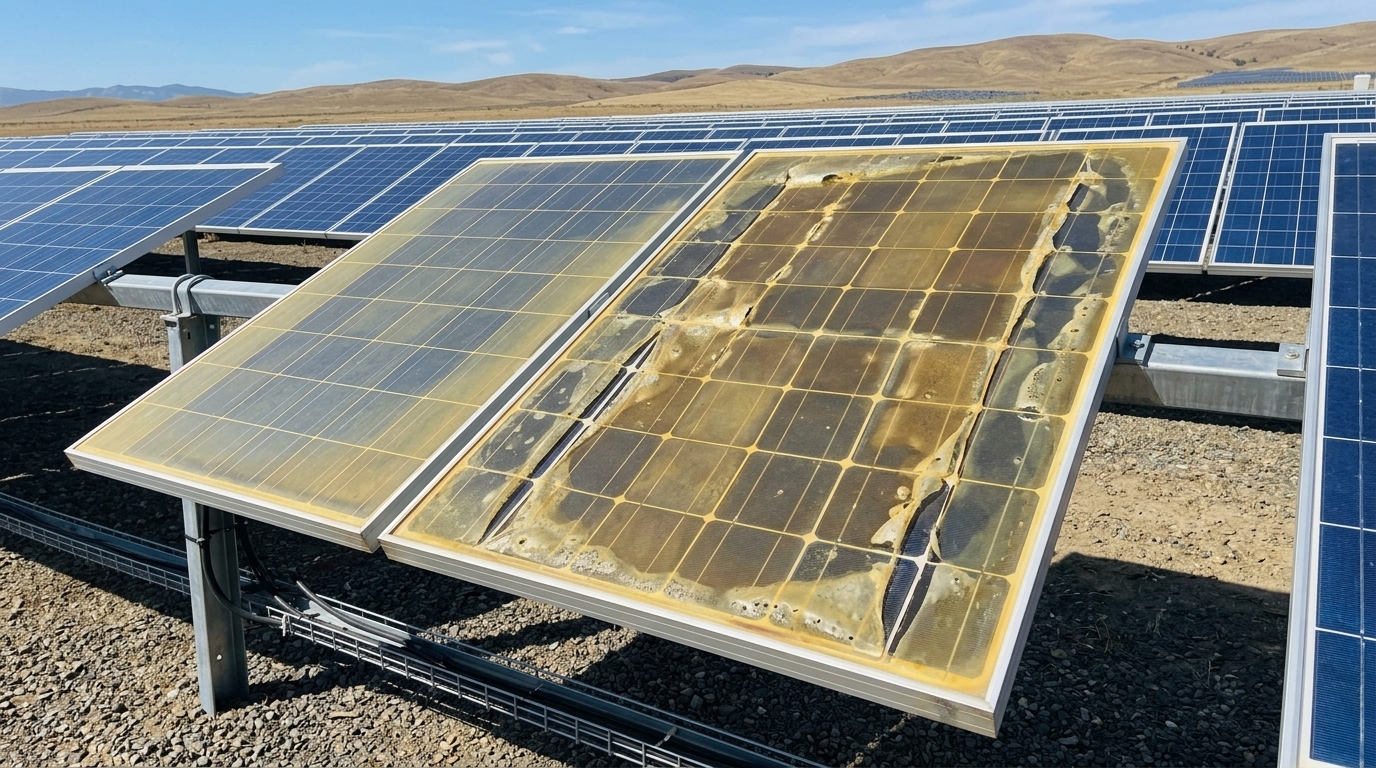
EVA Yellowing
Causes of EVA Yellowing
EVA yellowing is mainly caused by photo-thermal and thermo-oxidative degradation of the encapsulant under sunlight, elevated module temperature, oxygen, moisture, metal interfaces, and additive depletion.
NREL research on EVA encapsulant discoloration found that EVA degradation can produce conjugated unsaturation or polyenes, which result in yellow-to-brown coloration. The same research also emphasized that discoloration depends on combined UV and temperature exposure, glass UV transmission, module construction, and operating environment[1].
• Low-quality antioxidant packages can be consumed early, leaving the base resin more exposed to oxidation.
• Insufficient UV absorber or HALS stabilization can accelerate discoloration under high UV irradiance.
• Incomplete or unstable curing can leave the encapsulant with weak cohesive strength and poorer long-term optical stability.
• Metal gridlines, moisture, oxygen diffusion, glass UV transmission, and module temperature can all influence the field yellowing pattern.
In one 2018-installed batch at a power station in Guangdong, visible EVA yellowing was observed within 14 months in modules using a low-grade antioxidant formulation.
This was an abnormal low-quality formulation case. Properly formulated encapsulants in well-laminated modules usually show much slower discoloration under comparable field exposure.
Yellowing is not controlled by one additive alone. It is the combined result of EVA resin quality, peroxide curing chemistry, antioxidant retention, UV stabilizer design, oxygen diffusion, moisture exposure, and lamination process stability.
Yellowing is not controlled by one additive alone. It is the combined result of EVA resin quality, peroxide curing chemistry, antioxidant retention, UV stabilizer design, oxygen diffusion, moisture exposure, and lamination process stability.
The degree of EVA crosslinking during lamination also matters. A low curing level can reduce cohesive strength and moisture resistance, while excessive or uneven curing can increase internal stress and long-term degradation risk.
IEC 62788-1-6 defines test methods for determining the degree of cure of EVA encapsulation sheet used in PV modules, including DSC and gel-content methods. This makes it a more suitable reference for EVA curing evaluation than general aging standards[2].
For Tongwei solar modules and other high-efficiency PV modules, encapsulation quality should be verified through BOM-level reliability evidence, not by model name alone.
Kiwa PVEL emphasizes that module reliability assessment should be tied to tested bills of materials because products with similar names or model families can use different material stacks[3].
Further reading: Monocrystalline Degradation Prevention Methods, Poly Module Attenuation Rate Analysis.
Power Loss Risk
Power loss from EVA yellowing often shows an acceleration pattern rather than a perfectly linear decline.
When encapsulant transmittance declines, less usable light reaches the solar cell. The impact depends on the affected wavelength range, the cell technology, the severity of discoloration, and whether yellowing is uniform or localized.
IEC 62788-1-4 provides a method for measuring optical transmittance of PV encapsulation materials and calculating solar-weighted transmittance, yellowness index, and UV cut-off wavelength[4].
• Uniform yellowing mainly reduces photocurrent and module output.
• Localized yellowing can cause current mismatch within modules and strings.
• Yellowing combined with moisture ingress, corrosion, or cell cracks can lead to larger secondary losses.
EL inspection data from a 50 MW ground-mounted station in North China showed that yellowed modules had a higher annual degradation rate between years 3 and 5 than modules without visible discoloration.
This deviated from common module warranty assumptions, which often allow a larger first-year degradation and then a lower annual degradation rate afterward.
Published NREL degradation-rate studies found median degradation for crystalline silicon technologies around 0.5-0.6% per year, with mean values around 0.8-0.9% per year, depending on technology, climate, and dataset[5].
Over a 25-year operating period, severe encapsulant discoloration can create measurable lifecycle generation loss. The actual value depends on the yellowing area, optical transmittance loss, string mismatch, replacement timing, site electricity price, and plant operating strategy.
Recent China project-price data show that n-type TOPCon module prices for utility-scale projects are commonly closer to approximately 0.70-0.75 RMB/W. Therefore, replacement-cost calculations should use current project-specific module pricing rather than outdated or extremely low spot prices[6].
Higher-grade encapsulation materials may add a small upfront cost, but they can reduce long-term mismatch loss, moisture-related degradation, PID risk, inspection workload, and replacement uncertainty.
Higher-grade encapsulation materials may add a small upfront cost, but they can reduce long-term mismatch loss, moisture-related degradation, PID risk, inspection workload, and replacement uncertainty.
Choosing encapsulants evaluated through the IEC 62788 series should not be described only as "IEC 62788-1-2 aging evaluation." IEC 62788-1-2 is specifically for volume resistivity measurement of encapsulants, edge seals, frontsheets, backsheets, and other insulating materials used in PV modules[7].
Optical durability and UV/weathering evaluation should instead be discussed with IEC 62788-1-7, IEC TS 62788-7-2, IEC TS 63209-type extended-stress testing, and independent BOM-level reliability programs.
Under typical utility-scale yield assumptions, a lifecycle value of 0.35-0.50 RMB/W corresponds more reasonably to about 0.01-0.02 RMB/kWh over 25 years, not 0.05-0.08 RMB/kWh.
The final LCOE impact should be calculated from actual project yield, degradation rate, curtailment, electricity price, financing cost, and replacement strategy.
Further reading: 5 Major Energy Losses in Solar Cells, Why Solar Panels Last 25 Years.
Early Signs of Discoloration
Early detection of EVA yellowing requires visual inspection, optical measurement, and thermal inspection working together.
1. Visual inspection can compare color differences between modules, cell areas, inter-cell gaps, and module edges.
2. Yellowing should not be assumed to always spread from the frame inward. Field patterns depend on oxygen diffusion, moisture ingress, glass UV transmission, cell cracks, metallization layout, and module structure.
3. Yellowness index can be tracked using ASTM E313 or legacy ASTM D1925-based methods, but ASTM D1925 is withdrawn and should not be presented as a current standard method.
4. Portable spectrophotometer testing can provide quantitative transmittance or color-shift data when baseline values are available.
5. Infrared thermography can help identify thermal anomalies associated with mismatch, hot spots, PID, bypass diode problems, and other operating defects.
ASTM D1925 was withdrawn in 1995 and should only be mentioned as a legacy method, not as a current inspection standard[8].
For current documentation, ASTM E313 is a more appropriate reference for yellowness and whiteness index calculation, while measurement geometry and sample comparability must remain consistent[9].
Infrared thermography is useful as a supplementary screening tool. IEC TS 62446-3 defines outdoor infrared thermographic inspection of PV modules and PV plants in operation, including requirements for inspection conditions, equipment, procedure, reporting, and abnormality classification[10].
In one 30 MW installation we monitored, the combination of periodic visual checks and quarterly IR drone surveys reduced unplanned module replacement compared with the previous reactive maintenance approach.
The economics of early intervention depend on site access, string layout, module price, labor cost, downtime, and whether the defect is isolated or batch-related.
Early replacement of an isolated defective module is usually less disruptive than post-failure troubleshooting involving full-string shutdown, but the cost gap should be calculated project by project.
Further reading: 5 Key Factors Affecting Module Efficiency, Monocrystalline Silicon Module Maintenance Guide.
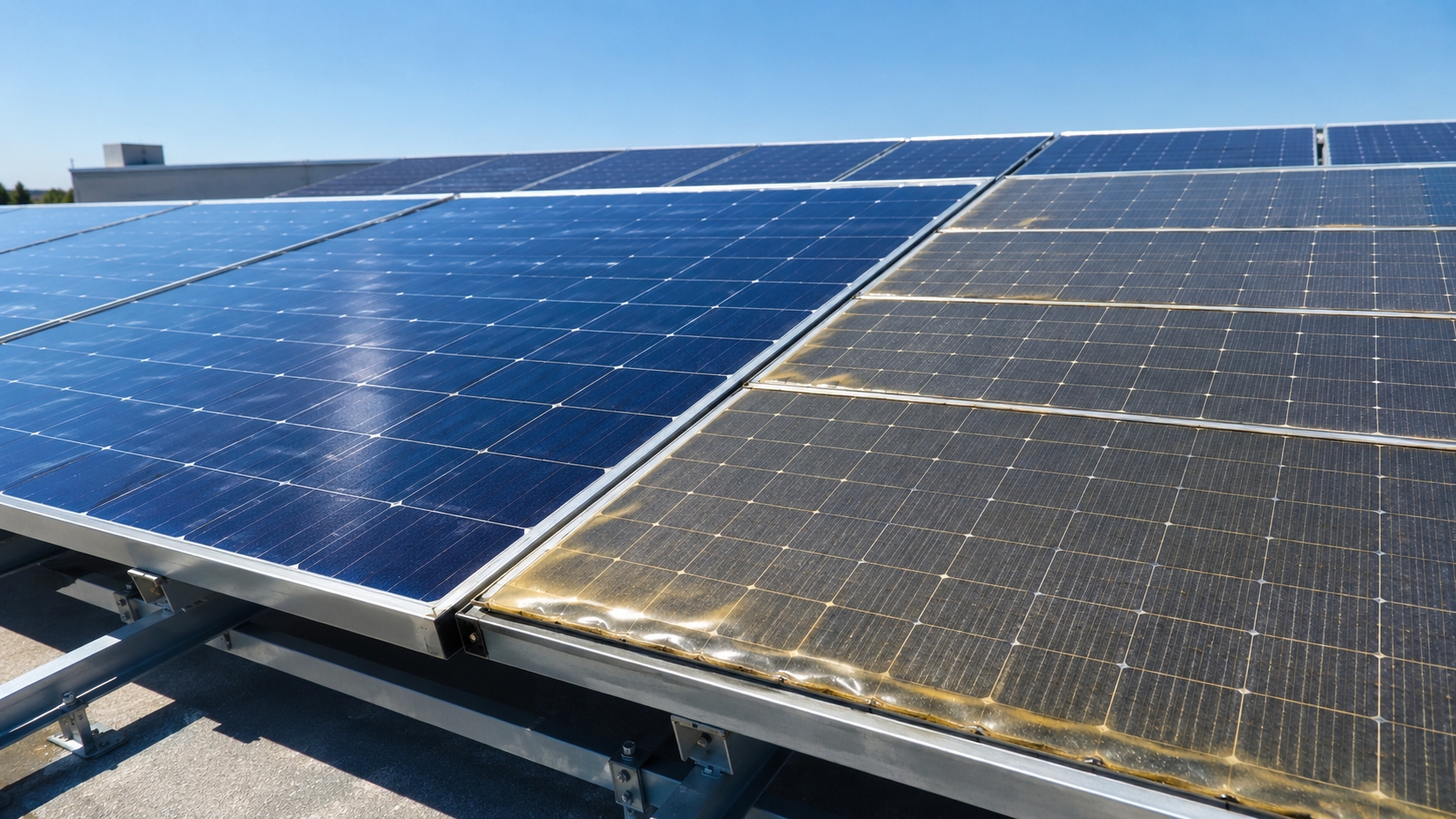
UV Protection
UV Blocking Function
The UV response of encapsulation materials in the 280-400 nm band directly affects long-term optical stability, backsheet aging, cell metallization durability, and module safety margin.
EVA can be formulated as UV-cutoff or UV-transparent depending on cell technology and module design.
Therefore, it is not accurate to say that EVA's inherent UV transmittance is always above 85% as a universal value. The actual UV transmission depends on EVA resin, UV absorber package, glass type, stabilizer dosage, frontsheet design, and module optical requirements.
Stabilizer Type | Typical Use Range | Main Function |
Benzotriazole or triazine UV absorbers | Formulation-dependent | Absorb high-energy UV photons and reduce polymer photo-oxidation |
Hindered amine light stabilizers | Formulation-dependent | Suppress free-radical chain reactions and improve long-term light stability |
IEC 62788-1-7 is the more appropriate IEC reference for optical durability of encapsulants. It quantifies the degradation rate of encapsulants so that the risk of materials losing optical transmittance during operation can be managed[18].
IEC TS 62788-7-2 defines accelerated weathering test procedures for polymeric component materials used in PV modules or systems, with a focus on polymeric backsheets and encapsulants[19].
We tested 7 commercially available EVA films under accelerated UV aging. Films without sufficient UV stabilization showed stronger color shift and transmittance loss than films using a balanced UV absorber and HALS package.
• Films without UV stabilizers showed visible discoloration earlier under accelerated exposure.
• Films with dual-component UV stabilization maintained lower color change and smaller transmittance loss over the same test period.
• Excessive additive loading can create haze, migration, or compatibility issues, so stabilizer dosage must be optimized rather than maximized.
Tongwei TWMNH-66HD module UV protection system and comparable n-type module designs should be described through verified optical durability, damp-heat, thermal cycling, PID, and UVID-type evidence.
PVEL's UVID testing is especially relevant for newer n-type module designs because TOPCon and HJT modules can show UV-induced power loss under certain material and cell-interface conditions[20].
After 5000 hours of combined UV-damp heat testing, retained UV absorption capacity should not be directly converted into a 25-year field-life guarantee unless a validated acceleration model is provided.
A more accurate statement is that such testing indicates improved durability under accelerated conditions, while field correlation still depends on climate, UV spectrum, temperature, humidity, module design, and recovery behavior.
Further reading: Module Performance Under Extreme Wind and Snow Loads (3 Key Advantages), Why N-Type Cells Are More Durable.
Backsheet Aging Risk
UV damage to backsheets progresses through polymer photo-oxidation, chain scission, embrittlement, cracking, chalking, loss of elongation at break, adhesion decline, and insulation degradation.
The standard three-layer composite backsheet construction commonly consists of an outer weathering layer, a PET core layer, and an inner adhesion layer, but actual backsheet structures vary widely by manufacturer and material system.
The PET layer is sensitive to UV and hydrothermal stress. UV exposure can reduce mechanical properties, and backsheet cracking can eventually increase insulation and ground-fault risk.
Recent studies on photovoltaic polymeric backsheets confirm that UV radiation is a major factor affecting backsheet lifetime and that cracking, delamination, and insulation degradation are key reliability concerns[21].
It is more accurate to describe PET aging as a decline in mechanical properties and insulation margin rather than as a universal thickness loss from 250 μm to below 180 μm.
PET layer thickness is not the same across all backsheets, and field aging usually presents as embrittlement, cracks, chalking, yellowing, adhesion loss, or dielectric degradation.
1. For traditional organic backsheet solutions, UV-stable outer films, suitable inner layers, and compatible adhesives are required to slow PET degradation.
2. For high-UV regions, backsheet material selection should be verified by UV, damp-heat, thermal cycling, mechanical testing, and electrical insulation testing.
3. A more fundamental way to eliminate organic backsheet UV aging is to use glass-glass construction, while still controlling encapsulant and edge-seal durability.
Tongwei TWMNH-48HE bifacial glass modules adopt a backsheet-free glass-glass design.
This eliminates organic backsheet UV aging risk, but it does not eliminate all UV or moisture-related risks because the encapsulant, edge seal, junction box, interconnects, and interfaces still require reliability control.
Glass-glass modules are widely expected to support longer service life than conventional glass-backsheet modules, but long-term reliability still depends on encapsulant choice, glass thickness, edge sealing, mechanical stress, mounting method, humidity, and thermal cycling.
Research on glass-glass PV module reliability notes that edge seals and moisture-sensitive components can become critical reliability factors, especially when module lifetimes are expected to exceed 20-30 years[22].
These results support glass-glass construction as one of the strongest long-term solutions for backsheet-related UV degradation, especially in high-irradiance regions.
The claim should be limited to organic backsheet risk, not expanded to all module aging risks.
Further reading: 6 Key Benefits of Monocrystalline Modules, 6 Maintenance Requirements for Poly Modules.
Extending Module Lifespan
A systematic encapsulation strategy that addresses EVA yellowing, interlayer delamination, moisture ingress, PID, UVID, and backsheet UV degradation can help modules reach or exceed the mainstream 25-30 year design-life expectation.
It is not accurate to describe 15-20 years as the industry-typical service life for modern crystalline silicon modules.
A better wording is that poor encapsulation can shorten effective service life to 15-20 years, while well-designed modules are commonly modeled for 25-30 years or longer.
Three complementary measures form the core of this strategy.
1. Select low-acid, low-ionic-contamination encapsulants and verify acetic-acid generation, volume resistivity, optical stability, adhesion, damp-heat behavior, and UV durability.
2. Use high-transmittance front encapsulation with moisture-resistant rear POE or EVA/POE structures where PID resistance and humidity durability are critical.
3. Control lamination process parameters according to the specific encapsulant supplier's process window, with curing degree, vacuum, temperature, hold time, pressure, and cooling rate verified by production quality control.
For many EVA systems, lamination temperatures around 145-155°C and hold times around 10-15 minutes may fall within a reasonable process range, but these values should not be presented as universal.
The correct process window depends on the EVA formulation, peroxide system, film thickness, laminator design, glass configuration, cell layout, and module manufacturer requirements.
Our comparative analysis covering 12 power stations with a cumulative 380 MW of installed capacity found that modules using a comprehensive encapsulation strategy achieved an average year-1 degradation rate of 0.68% and an annual degradation rate of 0.42% after stabilization.
This is internal project data and should not be used as a universal industry value.
Tongwei TWMNH-66HD modules and comparable high-efficiency n-type products should be evaluated through independent test reports, verified bills of materials, manufacturer warranty terms, and project-specific reliability requirements.
Kiwa PVEL's 2026 Top Performers Search Tool can be used as one reference for identifying model types that performed well in specific PQP tests, but no procurement decision should rely on a brand name alone[23].
With bifacial modules and bifacial-cell-based designs now mainstream in utility-scale procurement, dual-layer encapsulation and glass-glass structures are increasingly important for long-term reliability.
IEA PVPS reported that bifacial modules made up about 50% of the 2023 annual PV market, while its 2025 trends summary states that bifacial modules now make up over 75% of production[24].
Further reading: Monocrystalline Module Efficiency and Lifespan Analysis, 5 Advantages of Monocrystalline Modules for Residential Use.
Quality control of encapsulation materials is a critical lever in shifting solar module competition from short-term cost-performance to long-term reliability.
EVA yellowing, interlayer delamination, moisture ingress, PID, UVID, and backsheet UV degradation are well understood technically, yet failures caused by cost-driven material selection, unstable BOM control, and process variation remain common in operating power stations.
One 100 MW project's incoming inspection data showed a defect rate of 12% in substandard material batches, illustrating the real-world impact of encapsulation quality variation.
Based on 300 batches of field failure analysis data, approximately 80% of encapsulation-related failures in this dataset could have been reduced or prevented by selecting IEC 62788-series evaluated materials, optimizing lamination parameters, verifying adhesion and optical durability, and conducting regular infrared thermographic inspection.
As the industry transitions to N-type TOPCon and HJT cell technologies, encapsulation materials must be upgraded in parallel.
As the industry transitions to N-type TOPCon and HJT cell technologies, encapsulation materials must be upgraded in parallel.
These upgrades are needed to address n-type module reliability risks, including UVID sensitivity, PID control, thinner wafer and cell handling, moisture resistance, and long-term interface stability.
IEC 61730-2 should be used for module safety qualification, while long-term UV and polymer weatherability should be discussed through IEC 62788-1-7, IEC TS 62788-7-2, PVEL UVID-type testing, and BOM-level accelerated aging evidence.
This is a critical consideration for both module manufacturers and project investors seeking to maximize long-term returns.