Uneven cleaning can cause a temporary string mismatch because clean, dirty, wet, and partly shaded modules are being asked to work in the same circuit. Modules in one series string have to carry the same current. If some modules receive less usable light, the whole string cannot operate as evenly as it would after cleaning is finished. The practical check is simple: see whether the gap closes afterward. If a string is 4.8% below comparable strings during cleaning but comes back to within about 1% once the work is finished, the mismatch was most likely temporary. If it stays low, look for dirt, shading, wiring, bypass-diode, module, or measurement problems.[1]
A 24-Module String Can Have Three Different Conditions at Once
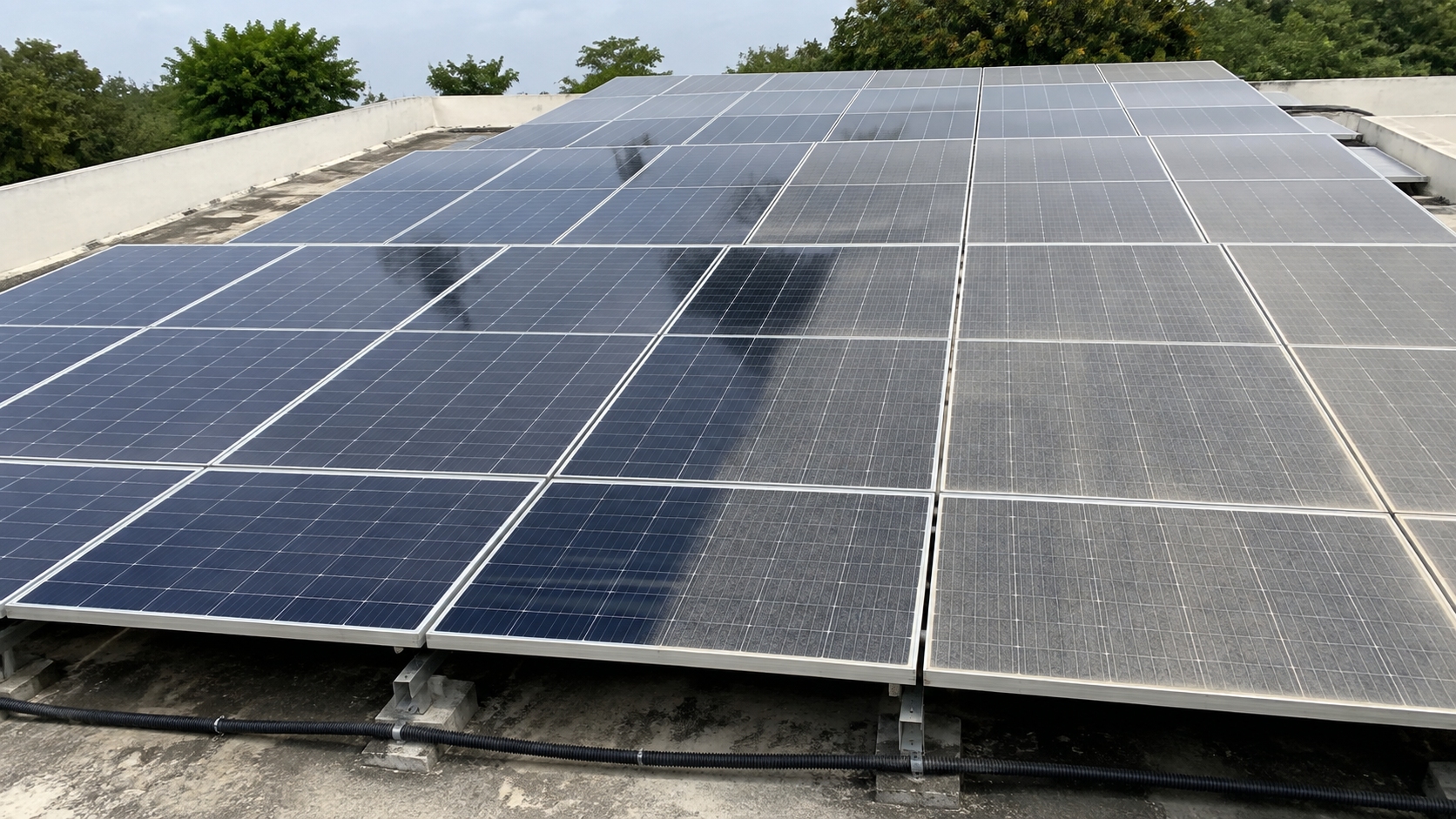
A cleaning crew rarely changes the condition of every module in a string at the same moment. Halfway through the job, a 24-module string could easily look like this:
- 8 modules are already clean;
- 6 modules have just been washed;
- 10 modules are still dirty.
Electrically, those 24 modules are still one string. On the surface, though, they are no longer in the same condition.
Dust, sand, pollen, pollution, bird droppings, and similar deposits block part of the sunlight reaching the cells. IEA PVPS estimates that soiling causes about 4%-7% of global PV energy losses on average, although individual sites can be well below or above this level.[2]
Sandia describes effective irradiance as the irradiance available to the PV device after losses such as soiling and optical effects are considered.[3]
So two modules can sit side by side under the same sky and still receive different usable light. One has been cleaned; the other is still carrying dirt.

Partial cleaning does not automatically mean the string will produce less power than it did before the work started. Usually, some soiling loss has already been removed. The issue is that the string may not recover as much power as it could after uniform cleaning while the modules are still in mixed conditions.
Half-Cleaned String and Clean String Are Different Problems
Not every cleaning-related mismatch happens in the same place. The electrical location matters.
| Condition | Example | Main Electrical Difference |
|---|---|---|
| Inside one string | 12 clean modules + 12 dirty modules | Modules in series have different I-V characteristics |
| Between strings | String A clean, String B dirty | Parallel strings can produce different currents |
| Inside one module | Dense dirt strip across one cell group | Local substring mismatch may occur |
Take the first case. The clean and dirty modules are in the same series circuit, so every module still has to carry the same current. The cleaner modules cannot simply run at one current while the dirtier modules run at another.[1]
That does not mean a module producing 10% less current automatically causes exactly 10% string power loss. Real string behavior depends on the combined I-V curve, how many modules are affected, irradiance, temperature, bypass-diode state, and the inverter operating point.
If the difference is still there after cleaning has finished, it is worth checking the other causes covered in Tongwei's article on PV string mismatch losses rather than assuming the surface is still the only issue.
A 12.5 A Peer String vs. an 11.9 A Partly Cleaned String
For site work, comparing one string with healthy peer strings is usually more useful than looking at one current value on its own.
Suppose comparable strings have a median current of 12.5 A.
| Condition | Example Current | Difference from 12.5 A Peer Median |
|---|---|---|
| Healthy peer median | 12.5 A | 0% |
| Partly cleaned string | 11.9 A | -4.8% |
| After complete cleaning | 12.4 A | -0.8% |
| Persistent weak string | 11.3 A | -9.6% |
These values are examples used to illustrate the comparison method. They are not universal fault limits.
The relative difference can be calculated as:
(Affected string current − peer median current) ÷ peer median current × 100%
For 11.9 A against a 12.5 A peer median:
(11.9 − 12.5) ÷ 12.5 × 100% = -4.8%
Now look at what happens after cleaning. If that same string rises to 12.4 A, the remaining gap is only about 0.8%. That change tells you much more than the first 11.9 A reading. The string was low while conditions were uneven, then moved back toward its peers once the cleaning area was finished.
Bottom-Edge Dirt Can Matter More Than a Thin Dust Film
A module that looks “mostly clean” can still have a useful amount of troubleshooting work left on it.
A thin dust film across the whole glass is not the same as a dense strip across one part of the cell area. The total dirty area may even be smaller, but the local electrical effect can be stronger.
After cleaning, pay particular attention to:
- dirty lower edges;
- missed brush paths;
- mud from dirty runoff;
- remaining bird droppings;
- hard-water spots;
- detergent residue;
- gaps between robot passes.
The lower edge is easy to overlook. During wet cleaning, loose dirt can move downward with the water and collect against the frame. From a few meters away the glass may look clean, while a narrow dark strip is still sitting across part of the active cell area.
Partial-shading research shows that the electrical result depends on the location and pattern of the shaded area, not simply its total size.[4]
That is why routine module cleaning and maintenance need a close look at edges, corners, and missed strips rather than a quick visual check of the middle of the glass.
The Same Dirt Strip Does Not Affect Every Module the Same Way
A visible dirt strip does not translate into one fixed power-loss number.
The result changes with:
- cell layout;
- full-cell or half-cell design;
- substring arrangement;
- bypass-diode layout;
- portrait or landscape mounting;
- the exact position of the dirt;
- irradiance level.
For example, the same horizontal band can cross different electrical sections on two module designs. One layout may spread the effect across several areas, while another may place more of that shading over one substring.
So rules such as “10% of the module is dirty, so power loss is 10%” or “one dirt strip always activates one bypass diode” are not reliable enough for field decisions.
When the internal layout or operating parameters matter, check the installed model against Tongwei's PV module specifications and the matching technical documents instead of assuming every module is wired the same way.
Wet Glass Can Change the Reading, but Usually Only Briefly
A module that has just been washed may not give the same reading as the dry module next to it.
Water can still be sitting on the glass as:
- droplets;
- thin films;
- dirty runoff;
- drying streaks.
Cleaning can also cool the module for a short time. Cell temperature changes the I-V curve and has a strong effect on PV voltage.[5]
In most cleaning jobs, these are secondary effects. The larger difference usually still comes from one part of the array being cleaner than another.
So a reading taken immediately behind a cleaning machine is not a good final result. If the string comes back close to its peers after drying, the short-term difference probably does not need further action. If a film, streak, or dirt deposit is still visible when the surface is dry, inspect the cleaning result instead.
Strings on One MPPT Share Voltage
Now take three parallel strings:
- String A: completely clean;
- String B: partly clean;
- String C: still dirty.
Each string can have a different I-V curve. But if all three are connected to the same MPPT, they operate at the same voltage at their common electrical connection.[1]
The inverter chooses one operating voltage for that MPPT group. Each string then supplies whatever current it can produce at that voltage.
This matters in two practical ways:
- cleaning one complete string removes the clean/dirty mix inside that string, but the clean string can still behave differently from dirty strings on the same MPPT;
- you cannot normally diagnose one directly paralleled string by saying its terminal voltage is independently lower than the others on that MPPT.
If one substring is weak, the problem may show up as abnormal string current, a change in the combined MPPT behavior, or a step when the string is tested separately. That is more useful than trying to read an independent terminal voltage that the parallel string does not really have at the common connection.
Robot or Worker Shade Can Look Like Cleaning Mismatch
A current dip that appears during cleaning is not always a dirt problem.
Temporary shade can come from:
- robot bodies;
- brush assemblies;
- workers;
- hoses;
- service vehicles;
- maintenance equipment.
A narrow hard shadow across a cell group can have a much bigger electrical effect than its physical size suggests. Partial-shading tests also show that bypass-diode behavior can change the resulting I-V curve.[4]
The timing usually helps separate the causes. If current falls as a robot or worker crosses the row and comes back as soon as the shadow moves away, temporary shade is the better explanation.
| Pattern | More Likely Cause |
|---|---|
| Current dip follows robot position and immediately recovers | Moving shade |
| Current remains different after robot leaves but before cleaning is complete | Uneven cleaning condition |
| Current remains weak after complete cleaning and stabilization | Separate fault or remaining contamination |
Light Dust and Bypass-Diode Operation Are Not the Same Problem
A thin, fairly even layer of dust is not enough reason to call the event a bypass-diode problem.
Bypass operation becomes more likely when one group of cells is much more current-limited than the rest. Typical examples are:
- a large bird dropping;
- a leaf;
- thick mud;
- a dense bottom-edge band;
- a hard local shadow.
When a bypass diode conducts, current can go around the strongly limited substring. The module then loses part of the voltage that substring would normally add. On an I-V curve, this can appear as a visible step.[4]
There is no useful universal shortcut such as “5% dirt activates a diode” or “10% shading means one substring is bypassed.” Module layout, dirt position, opacity, irradiance, temperature, and operating point all change the result.
Use Peer Median, Not a Fixed 5% Alarm
A fixed percentage by itself does not tell you whether a string has failed.
Start with strings that are genuinely comparable. They should have the same or very similar:
- module model;
- module count;
- orientation;
- tilt or tracker position;
- irradiance exposure;
- MPPT configuration.
Here is one example:
| String | Before Cleaning | During Cleaning | After Cleaning |
|---|---|---|---|
| A | 11.8 A | 12.5 A | 12.5 A |
| B | 11.9 A | 12.4 A | 12.5 A |
| C | 11.8 A | 11.9 A | 12.4 A |
| D | 11.9 A | 11.8 A | 12.5 A |
| E | 11.8 A | 11.7 A | 11.3 A |
These are example values, not expected values for every system.
Strings A to D finish around 12.4-12.5 A. String E stays at 11.3 A. That remaining gap matters much more than the current spread recorded while cleaning was still under way.
Peer selection matters just as much as the calculation. Do not compare east-facing and west-facing strings, different module counts, or shaded and unshaded rows and then call the difference a cleaning mismatch.
A 2-Minute Current Drop Can Nearly Disappear in 15-Minute Data
SCADA data can make a short event look much smaller than it was in real time.
Suppose a string normally operates at 12.5 A but a cleaning-machine shadow reduces it to 11.0 A for 2 minutes.
If the displayed value is a 15-minute average and the other 13 minutes remain at 12.5 A:
[(11.0 × 2) + (12.5 × 13)] ÷ 15 = 12.3 A
The instantaneous current drop was:
(11.0 − 12.5) ÷ 12.5 × 100% = -12%
But the 15-minute average is only about:
(12.3 − 12.5) ÷ 12.5 × 100% = -1.6%
So a short 12% drop can show up as only about a 1.6% change on the averaged dashboard.
Before matching a cleaning log to a current graph, check how the monitoring system stores and averages the data. Otherwise, a real short-duration event may look too small to matter.
Clean the Irradiance Reference with the Array
The modules are not the only surfaces that matter during a cleaning check.
Two situations can distort an irradiance-normalized comparison:
- the reference cell or pyranometer is cleaned first while the modules remain dirty;
- the modules are cleaned while the reference device remains dirty.
Either case leaves the sensor and array in different surface conditions. The normalized result can then move even if there is no new electrical problem in the string.
Sandia includes soiling when determining effective irradiance and notes the importance of suitable irradiance measurements for PV performance analysis.[3]
For a useful cleaning record, keep the reference-sensor cleaning time together with:
- row cleaning time;
- string or block number;
- weather;
- temporary shading events;
- any repeated cleaning passes.
11.9 A to 12.4 A Is More Useful Than One Low Reading
A single low reading tells you that something was different. Recovery tells you whether that difference was temporary.
A practical check is:
- Choose comparable peer strings.
- Record the peer median before or during the event.
- Record the affected string while cleaning is incomplete.
- Check again after the relevant section has been completely cleaned.
- Repeat the comparison under reasonably stable irradiance.
Using the same example:
| Stage | Affected String | Peer Median | Relative Difference |
|---|---|---|---|
| During uneven cleaning | 11.9 A | 12.5 A | -4.8% |
| After full cleaning | 12.4 A | 12.5 A | -0.8% |
A gap that drops from 4.8% to 0.8% after cleaning is strong evidence that the earlier difference came from temporary cleaning conditions.
There is no fixed number of minutes that defines recovery. Wind, water, ambient temperature, module temperature, cleaning method, and weather all affect how quickly the array settles.
If One String Stays at 11.3 A, Stop Blaming Cleaning
Once the cleaning area has stabilized, a string that is still far below its peers needs a different line of investigation.
If healthy peer strings remain around 12.5 A while the same cleaned string stays around 11.3 A, the gap is about 9.6%.
That figure does not identify the fault on its own. It does tell you that waiting longer for the string to “finish drying” is becoming a weak explanation.
Check for:
- remaining local dirt;
- fixed external shading;
- damaged cells;
- internal interconnection problems;
- bypass-diode faults;
- loose connectors;
- high-resistance connections;
- damaged DC cable;
- incorrect string configuration;
- current-sensor or monitoring-channel errors.
Cleaning can also make an older problem easier to see.
| String | Normalized Before Cleaning | Normalized After Cleaning |
|---|---|---|
| A | 0.92 | 1.00 |
| B | 0.91 | 1.00 |
| C | 0.88 | 0.90 |
These are example normalized values.
Strings A and B recover once the dirt is removed. String C barely moves. In that situation, cleaning did not necessarily damage String C. It removed a common soiling loss and made the existing weakness stand out more clearly.
At this point, broader PV module reliability checks are more useful than continuing to call the difference a temporary cleaning mismatch.
Use I-V and Thermal Tests for a Persistent Outlier
If the SCADA comparison still leaves one string as a clear outlier, field testing can narrow the cause.
An I-V curve gives much more information than one current value. Current-versus-voltage measurements are widely used for PV module electrical performance evaluation.[7]
| Test Result | Useful Next Check |
|---|---|
| Whole curve has lower current | Irradiance, remaining dirt, shading, current-limiting fault |
| Repeatable step in I-V curve | Substring mismatch or bypass behavior |
| Unexpected voltage loss in isolated string test | Bypass state, module count, wiring, temperature correction |
| One hot cell group | Local shading, cell damage, reverse-bias stress |
| Hot connector or junction box | Connection resistance or component fault |
Record irradiance and temperature during I-V testing. Curves taken under very different sunlight should not be treated as if the test conditions were the same.
Thermal imaging can help locate abnormal heating in a cell group, junction box, or connector. It is a locating tool, not a final diagnosis. A hotspot still needs to be checked against current data, I-V results, visual condition, and connections.
Clean by Electrical Section Where Practical
From an operations point of view, leaving several strings half cleaned at the same time makes the data harder to read.
Where site procedures allow, finish a logical cleaning section before moving on. Tongwei's module installation and maintenance manual states that module-cleaning sub-areas should follow the electrical structure of the PV plant and that each cleaning operation should cover all modules in the relevant cleaning area.
The applicable Tongwei PV module installation manual should be checked before changing cleaning methods or maintenance procedures.
Finishing a whole string does not mean the entire MPPT group is now matched. A clean String A can still differ from dirty Strings B and C. The practical benefit is that String A itself no longer contains a mix of clean and dirty modules, so its behavior is easier to interpret.
| Cleaning Method | Mismatch-Related Check |
|---|---|
| Wet manual cleaning | Runoff, missed areas, water film, temporary cooling |
| Dry robotic cleaning | Missed strip, moving shadow, uneven brush contact, dust redistribution |
| Semi-automated cleaning | Pass overlap, edge cleaning, repeated missed areas |
If the same strip stays dirty after every cleaning cycle, it is no longer a one-off mismatch event. Check the cleaning route, brush contact, overlap, or rinsing method.
Do Not Open a Live String to Check a Cleaning Mismatch
A low string-current reading is not a reason for cleaning staff to start opening electrical equipment.
Cleaning personnel should not disconnect DC connectors, open junction boxes, or carry out live electrical work simply because the current looks wrong.
Stop routine cleaning and follow the site's electrical procedure when there are:
- exposed conductors;
- burned connectors;
- damaged junction boxes;
- zero-current strings that do not recover;
- repeated insulation alarms;
- persistent abnormal heating.
Module, inverter, test-equipment, and plant safety procedures take priority over general troubleshooting guidance.
FAQ
Does a 5% current difference mean the string is faulty?
No. There is no universal 5% fault limit. A temporary 4%-5% difference that drops close to 1% after cleaning is very different from a repeatable 5% gap that remains every day. Compare the string with suitable peers and check what happens after conditions stabilize.
Can a completely clean string still mismatch a dirty string?
Yes. If both strings share the same MPPT, they operate at the same common voltage but can contribute different currents because their I-V characteristics are different. Finishing one string removes the clean/dirty mix inside that string, but it does not make the neighboring dirty strings electrically identical.
Can partial cleaning make output lower than it was before cleaning?
Not automatically. Cleaning normally removes some soiling loss. Output can temporarily fall if the work also brings hard shading, dirty runoff, unusual surface coverage, or another short disturbance. More often, uneven cleaning simply stops the string from recovering as much as it would after uniform cleaning.
Can a dirt strip activate a bypass diode?
Yes, if the strip strongly limits one cell group. A dense opaque band, leaf, bird dropping, or hard shadow is more likely to cause bypass behavior than a thin, even dust film. The module's cell and substring layout also matters.
Can the irradiance sensor create a false mismatch result?
Yes. If the sensor and the modules are cleaned at different times, irradiance-normalized performance may temporarily look better or worse than it really is. Keep the sensor cleaning time with the array cleaning record.
When should the string be tested instead of waiting?
Move to normal fault diagnosis when comparable strings have recovered but the same string is still a repeatable outlier under similar irradiance. Zero current, persistent I-V curve steps, electrical alarms, or repeatable thermal abnormalities are also reasons to inspect further.
Finally
The useful question is not whether a string looked different while cleaning was under way, but whether it came back afterward. If comparable strings are around 12.5 A and a partly cleaned string is at 11.9 A, the gap is about 4.8%. If that same string reaches 12.4 A once the section is fully cleaned, the remaining difference is only about 0.8%, which fits a temporary cleaning mismatch. If it stays near 11.3 A while its peers remain around 12.5 A, the gap is about 9.6%. At that point, check remaining dirt, shading, bypass behavior, connectors, wiring, module damage, and monitoring errors rather than waiting for more recovery.