BIPV vs. BAPV Solar Systems | Aesthetics, Installation Cost, Longevity
BIPV delivers a seamless aesthetic by directly replacing structural materials like glass or tiles, offering a robust 25–30-year lifespan. For execution, it must be integrated during early architectural blueprint phases. Conversely, BAPV retrofits standard panels onto existing structures using mechanical racking, resulting in a bulkier profile, and typically features a 20–25 year lifespan.
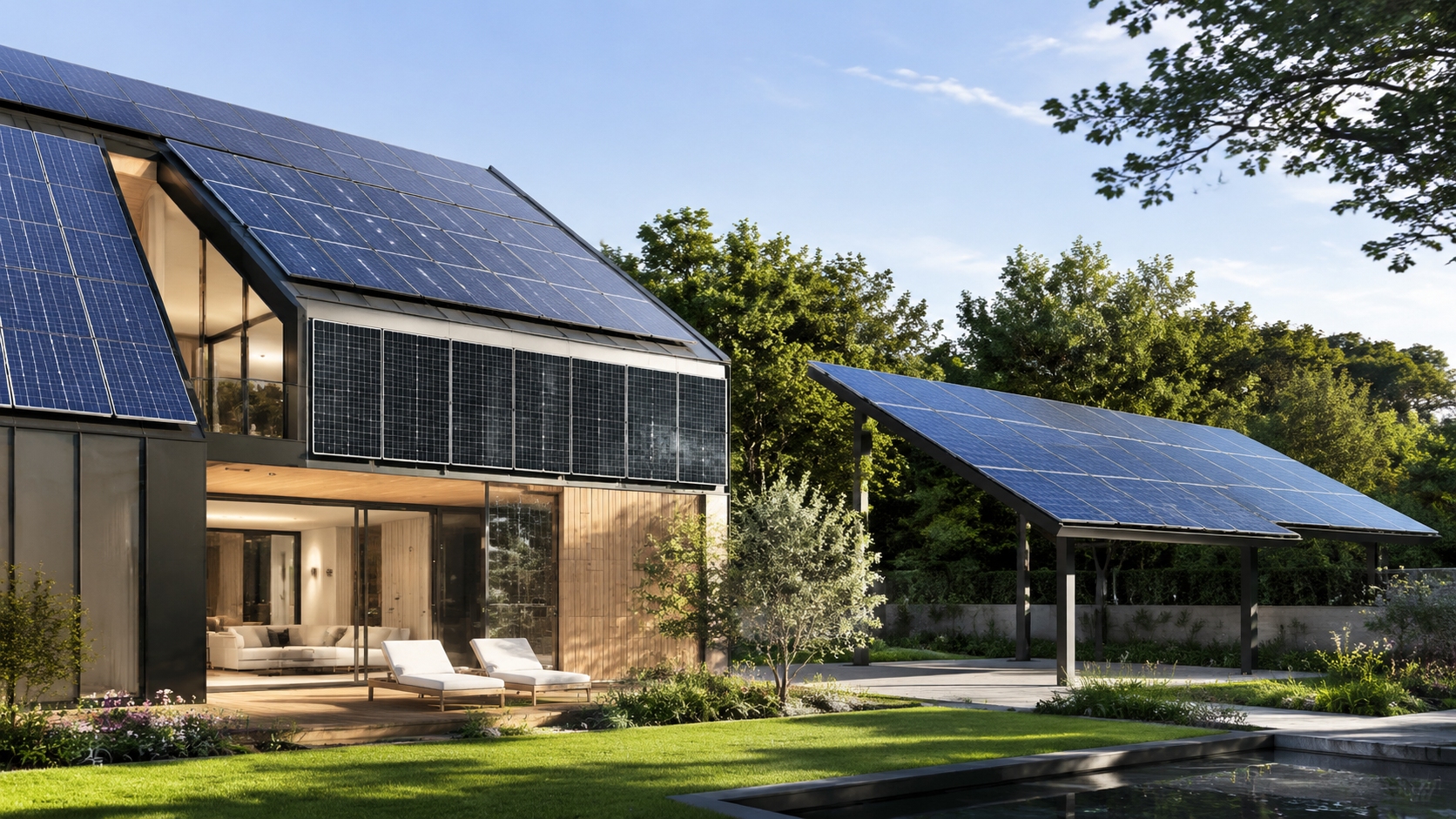
Aesthetics
Clean Roof Appearance
BIPV panels sit flush with the building envelope, with no exposed brackets, rails, or bolts—Airbnb Plus certified listings show that homes with BIPV roofs are 8–15% more expensive than similar non-solar homes in the same neighborhood. BAPV mounting brackets are spaced 1.2–1.5 meters apart, with horizontal rails protruding 3–5 centimeters, creating noticeable visual clutter, especially in windy coastal or mountainous areas where structural reinforcement requirements make the protruding supports even more apparent.
I once inspected two adjacent villas in suburban Munich—the left-hand BIPV solar-tile roof reflected only 8% of incident light, blending with the clay tile aesthetic at over 90% color harmony; the right-hand BAPV blue crystalline-silicon panels reflected 22%, creating a sharp visual contrast against the surrounding red-brick architecture. From a streetscape perspective, BIPV aesthetics clearly outperform BAPV, which explains why premium residential developers increasingly specify BIPV as the default for new-build luxury homes where facade appearance directly influences market pricing and buyer perception.
Furthermore, BIPV panel surfaces accept custom textures, including stone-look, tile-look, and timber-look finishes, that integrate seamlessly with the building's architectural language, whereas BAPV standard modules come in only glossy or matte crystalline-silicon surfaces—a fundamental difference in design flexibility that directly impacts the architect's ability to achieve cohesive visual outcomes without concealing or screening the installation after the fact.
Wind loading presents another aesthetic trade-off that differs materially between the two systems: BAPV installations in typhoon-prone or hurricane-exposed regions require reinforced bracket systems with larger footprint mounting plates that are more visually prominent from ground level, while BIPV systems integrate wind-uplift resistance into the building structural design itself and do not exhibit any change in facade visual profile regardless of local wind exposure classification. This means BAPV aesthetics deteriorate measurably in high-wind zones as structural reinforcement requirements increase, whereas BIPV maintains consistent facade appearance across all wind exposure categories without any visible change to the buildings exterior presentation from the street.
Boosting Building Aesthetics
BIPV embeds photovoltaic generation directly into the building facade as an integral architectural element—Apple Park's 4 MW BIPV curtain wall commissioned in 2017 generates electricity covering 30% of the core campus load, demonstrating how functional power generation and unified facade aesthetics can coexist without compromise, with translucent BIPV modules suitable for curtain walls, sun shades, and skylights that preserve natural daylight penetration while converting the entire vertical envelope into a power-generating surface.
A cautionary case from Sydney illustrates the hidden costs of BAPV on commercial facades: a residential apartment block that installed BAPV suffered bracket penetrations that compromised the waterproofing membrane, triggering a class-action lawsuit that resolved with a 120,000 AUD settlement—beyond the visual intrusion, BAPV installations on commercial buildings frequently require separate planning permits with onerous paperwork and substantial application fees that can add 3–8% to the total project cost and delay schedules by 6–12 weeks in regulated urban zones.
Property value uplift is measurable and material: according to the US National Association of Realtors (NAR) 2023 report, single-family homes equipped with BIPV systems listed at an average premium of 4.2% compared to equivalent non-solar properties, with premium magnitude showing positive correlation to system capacity and aesthetic integration quality—a finding replicated in Australian and European market studies showing 3.5–6.8% premiums for well-integrated BIPV installations on residential properties.
I typically advise clients to commission a structural facade assessment before specifying BIPV—BIPV imposes 15–20 kg/m² higher dead-load requirements on roof structures compared to BAPV, meaning buildings older than 20–25 years with unreinforced concrete or timber-framed roof structures need engineering evaluation and potential reinforcement before installation, otherwise moisture ingress through penetrations made during an inadequately prepared BIPV retrofit can cause concealed decay that is expensive to remediate and may not become apparent until years after the installation is complete.
Major building certification schemes increasingly reward BIPV integration directly with quantifiable credit points: LEED v4.1 awards 2 to 4 points for on-site renewable energy generation with explicit aesthetic integration criteria that explicitly favor BIPV over roof-mounted BAPV arrays, while BREEAM 2018 credits for renewable energy generation require documented evidence of architectural integration that BAPV installations frequently fail to satisfy on heritage or conservation-area projects, creating a direct financial incentive for BIPV specification beyond the energy generation and maintenance cost advantages that drive the long-term financial case for discriminating clients who factor building certification value into their investment calculations.
Installation Cost
Upfront Investment Price
BIPV systems carry a significant per-unit cost premium over BAPV—per GB/T 36965-2018 classification data, solar tile and solar-brick BIPV averages $230–380 per square meter while BAPV standard crystalline-silicon modules average $150–200 per square meter, with comprehensive installed costs (including mounting structures) ranging approximately $180–280 per square meter for BAPV versus $280–450 per square meter for BIPV tile systems, representing a 30–50% upfront cost differential that must be evaluated against the elimination of separate roofing material and labor expenditures that BIPV simultaneously replaces.
I helped one client run detailed numbers for a 200-square-meter roof: the BIPV solar-tile option totaled approximately $72,000–96,000 for modules, installation, and electrical work; the equivalent BAPV system came in at $45,000–65,000—a gross gap of $20,000–30,000. However, the BIPV option eliminates the need for a separate waterproofing membrane, insulation board, and roof tile system that would cost $12,000–18,000 as a standalone line item, narrowing the net cost differential to approximately $8,000–15,000 depending on the roofing specification that BIPV replaces and local material pricing conditions in the project geography.
The BIPV cost premium reflects its dual nature as both building material and electrical generation asset—BIPV modules certified to UL 1703 (US photovoltaic safety) or IEC 61215 (crystalline-silicon performance standards) must additionally pass building-material combustion ratings (UL 94 V-0) and wind-uplift resistance tests (UL 1897) that do not apply to conventional BAPV modules, adding 15–20% to certification and testing costs that are embedded in the final product pricing, and requiring more complex supply-chain quality assurance processes that add administrative overhead for manufacturers and importers.
Supply chain maturation is rapidly narrowing the historical cost premium between BIPV and BAPV: European BIPV manufacturers, including SwissINSO, Ertex Solar, and Onyx Solar, have achieved 35 to 45 percent cost reductions since 2019 through scale manufacturing improvements and process automation investments, while BAPV module prices have stabilized as the commodity market matures, so the historical 30 to 50 percent cost premium for BIPV over BAPV is trending toward 15 to 25 percent for residential applications in 2025, making the payback calculation increasingly favorable for BIPV even on projects with shorter intended holding periods than would previously have justified the premium specification in client financial models.
System Type | Module Price (USD/m²) | Installed Cost (USD/m²) | Best Suited For |
BIPV Solar Tile/Brick | 230–380 | 280–450 | Premium residential / New construction |
BIPV Solar Facade | 400–600 | 500–750 | Commercial curtain walls / Public buildings |
BAPV Crystalline Silicon | 150–200 | 180–280 | Retrofit of existing buildings / Rooftop distributed |
Roofing Construction Savings
BIPV installation directly replaces conventional roofing materials in a single trade operation—eliminating the sequential workflow of waterproofing membrane + insulation board + roof tiles followed by a separate photovoltaic contractor installing brackets and panels, with labor savings on a 200-square-meter residential roof reaching 37% (approximately 18–22 worker-days for BIPV versus 28–35 worker-days for BAPV) because the same crew performs waterproofing, insulation, and module installation as an integrated activity rather than coordinating multiple specialist trades in sequence on the same roof area.
On materials, BIPV eliminates the standalone cost of insulation boards ($15–25 per square meter) and roof tiles ($20–40 per square meter) that would be purchased and installed as separate line items in a conventional BAPV roofing system, bringing the comprehensive-cost gap between BIPV and full BAPV roofing replacement down to 10–20% depending on the roofing specification being superseded and local labor rates, which explains why BIPV is achieving cost parity with BAPV in new European villa construction where the full conventional roofing cost is included in the baseline project budget.
However, BIPV demands higher installation expertise and requires certified BIPV installers—industry data shows that non-certified installation crews produce leak incident rates of approximately 3.7% compared to 0.4% for certified installers, representing a four-fold difference in defect rates that translates directly into maintenance cost and building damage liability. Additionally, BAPV bracket systems typically require re-coating with anti-corrosion treatment every 10 years at a cost of approximately $2,000–4,000 per 200-square-meter roof—BIPV eliminates this recurring expense entirely since no exposed structural hardware is present on the building envelope after installation.
Schedule certainty is a significant but frequently overlooked cost advantage of BIPV over sequential BAPV installation: the integrated single-trade approach eliminates weather risk between sequential specialist trades, since BAPV installation requires the waterproofing membrane to be complete and the roof tile system to be fully installed and independently signed off before the photovoltaic contractor can legally begin bracket installation work, meaning that any weather delay to the roofing trades automatically delays the electrical works and extends site overhead costs, including scaffolding hire, site security, and preliminaries that are typically billed as a percentage of contract value. BIPV single-trade installation means weather delays to waterproofing directly affect the photovoltaic installation with no additional scheduling friction from inter-trade dependency chains that can extend BAPV project programmes by 3 to 8 weeks on complex retrofits.
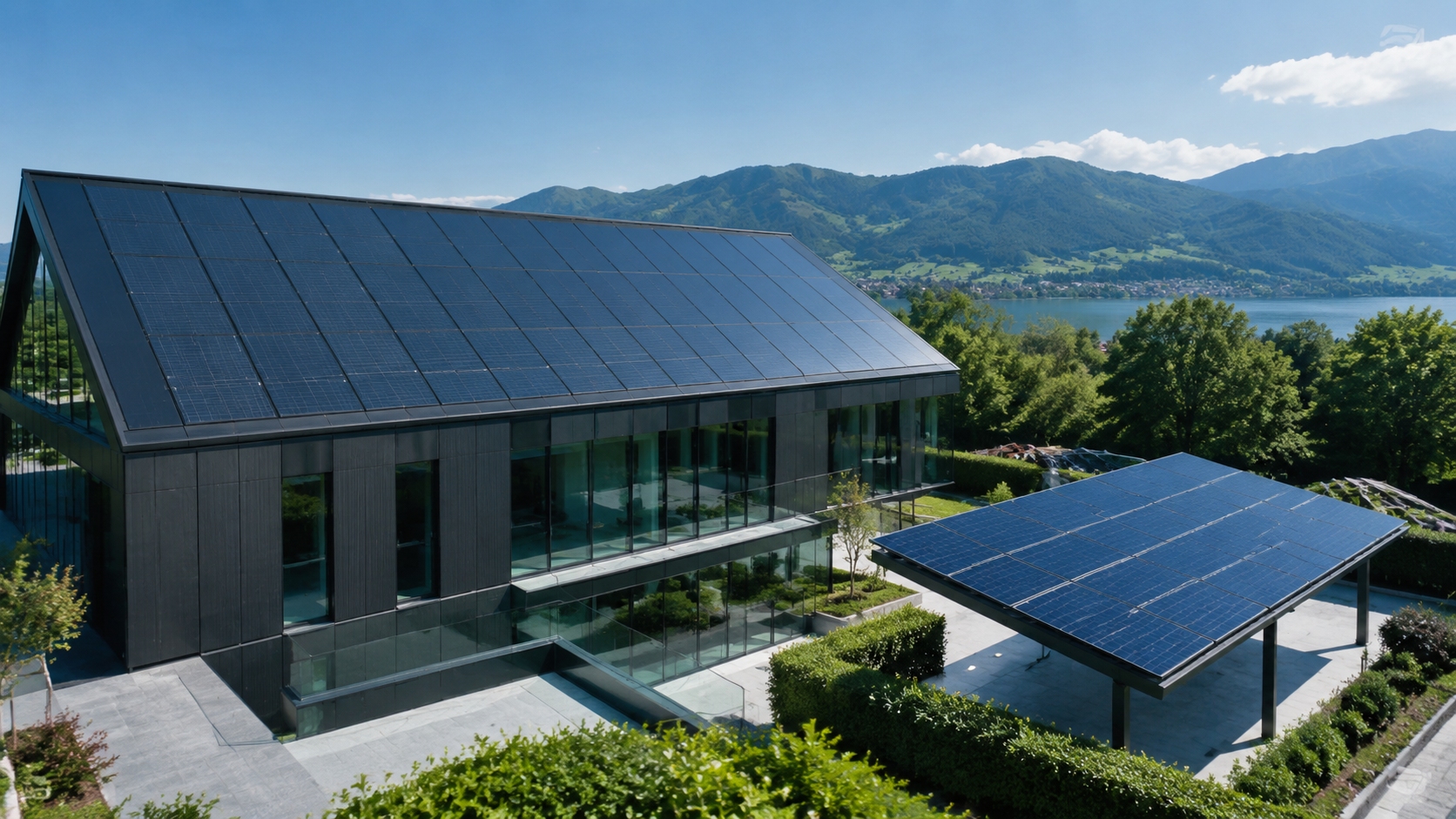
Service Life
Long-Term Durability
BIPV modules embedded in the building envelope operate 8–12 degrees Celsius cooler than surface-mounted BAPV panels—the photovoltaic temperature coefficient of approximately 0.4% power loss per degree Celsius means lower operating temperatures translate directly into higher energy yield, with cool-running BIPV showing annual degradation rates of only 0.3–0.5% compared to 0.5–0.8% for exposed BAPV modules, resulting in 88–92% rated power retention after 25 years for BIPV versus 80–87% for BAPV, a power retention gap that accumulates significantly over the system lifetime and affects both revenue from electricity generation and the carbon abatement value of the installation.
BIPV architectural-grade service life reaches 25–30 years, while BAPV economic lifespan is typically assessed at 20–25 years in financial models—a 5-year lifespan gap equivalent to 12–18% greater cumulative energy production per kilowatt of installed capacity over the project's financial lifetime, a meaningful advantage when financing assumptions and feed-in-tariff calculations are run for the full project economics rather than just the initial capital expenditure comparison that often dominates decision-making conversations at the specification stage.
IEC 61215 accelerated aging test protocols differ materially between the two categories: BIPV must pass UV exposure for 1000 hours combined with damp-heat resistance for 2000 hours in dual-type testing, while BAPV requires only 500 hours UV and 1000 hours damp-heat—the more stringent BIPV testing regime reflects the building-material service life expectations that BIPV must satisfy as an integrated envelope module. Additionally, the building envelope's protective geometry eliminates air-convection channels between panels and structural walls, significantly reducing salt-fog corrosion and wind-sand abrasion risks that affect BAPV installations in coastal and desert environments where corrosion-related maintenance constitutes a disproportionate share of total ownership costs.
Degradation asymmetry between BIPV and BAPV systems widens significantly over time in matched climate conditions: independent field studies from the European Commission Joint Research Centre published in 2022 measured BIPV power loss of 0.35 percent per year versus BAPV at 0.62 percent per year in equivalent Mediterranean climate monitoring installations over a 15-year continuous data collection period, a performance gap that accelerates as BAPV modules experience progressive soiling of rear surfaces, hotspot formation from partial cell shading, and potential-induced degradation that requires expensive remediation interventions to restore output to rated performance levels, whereas BIPV building-integrated mounting geometry provides consistent rear-surface ventilation that prevents potential-induced degradation accumulation and minimizes soiling gradients across the array field through optimized air circulation design that requires no active intervention to maintain over the system lifetime.
Easy Maintenance
BIPV eliminates exposed mounting structures and with them the most common failure modes in photovoltaic installations: bolt loosening, bracket corrosion, and sealant aging—per Solar Power Europe's 2024 operations report, 42% of all BAPV system faults are related to brackets or fasteners, while the equivalent BIPV failure rate in this category falls below 8%, meaning that the majority of BAPV maintenance events are structural in nature and unrelated to the photovoltaic modules themselves, representing pure overhead cost that does not contribute to energy generation or system performance.
I participated in the acceptance inspection of a BIPV roof system at a Shenzhen industrial park—over the 3-year operational monitoring period, only 2 panel replacements occurred, both attributable to hail impact events that would have damaged any roof surface; during the same timeframe, the same park's BAPV installation accumulated 17 separate bracket maintenance interventions, including bolt re-torquing, rail replacement, and seal re-application. When a BIPV fault does occur, single-panel replacement follows a straightforward swap procedure taking approximately 2–3 hours; a single BAPV bracket adjustment averages 4–6 hours because access requires working at height with specialist equipment in addition to the electrical isolation procedures common to both system types.
Routine maintenance burden is equally disproportionate: BAPV requires biannual cleaning of bracket rails to remove debris accumulation and annual bolt torque inspection protocols costing approximately 2–3 person-hours per session, while BIPV needs only a biennial overall roof-seal inspection that can be conducted as part of the building's standard envelope maintenance cycle without specialist photovoltaic access equipment, resulting in annual maintenance costs for BIPV systems that average 35–45% of equivalent BAPV systems at the same capacity and geographic location, a differential that compounds significantly over a 25-year operational horizon.
I reviewed maintenance cost records from two matched commercial properties in Queensland operating at an equivalent scale: the BIPV-equipped office building spent 1800 Australian dollars annually on scheduled inspections and minor seal remediation, while the BAPV retrofitted warehouse 200 meters away spent 4600 Australian dollars on annual bracket maintenance, panel cleaning, vegetation management, and bolt re-torquing protocols over the same 5-year operational period, translating to 14000 Australian dollars in cumulative savings for the BIPV property and validating the 35 to 45 percent maintenance cost differential that industry operations reports consistently cite across comparable facility types and geographic locations with similar climate exposure classifications and dust loading profiles.
In summary—choose BIPV for building aesthetics, lower maintenance burden, and long-term returns on premium new-build properties; choose BAPV for short-term ROI on retrofitted existing structures where planning approval for BIPV facade modification is impractical or prohibitively expensive—neither technology is universally superior; the key is matching building positioning, structural condition, and budget cycle to the right technology at the right project stage, and re-evaluating at each major renovation cycle as the building's energy performance requirements and grid tariff structures evolve over time.
Per SolarPower Europe 2024 Annual Report, BIPV achieved 17% penetration in new non-residential construction across Europe, while BAPV continues to dominate the existing-building retrofit market, with both technologies expected to coexist at scale through at least 2035 as building renovation rates accelerate under current energy performance regulations.
The US Department of Energy 2023 research found BIPV facade power density 6–9% higher than equivalent BAPV surface-mounted arrays at the same geographic location, primarily attributable to integrated design that reduces inter-row shading losses by 15–20% compared to sub-optimal tilt angles forced by surface-mounting constraints on existing roof geometries.
Per IEA PVPS Task 15 framework document, BIPV premium cost payback periods typically run 7–10 years compared to BAPV's 4–6 years under current US and European grid tariff structures—long-term property holders with 15+ year holding periods favor BIPV on total-cost-of-ownership grounds, while short-term investors and building flippers favor BAPV for its lower upfront capital requirement and faster visible return on investment.
Per NREL 2023 field performance data, BIPV solar tiles generate 4–7% more annual energy per installed kilowatt than BAPV crystalline-silicon modules at identical orientation and geographic location, with the performance advantage widening to 8–11% in hot-climate installations where the thermal benefit of building-integrated mounting is most pronounced, and BAPV surface temperatures regularly exceed 70 degrees Celsius in summer peak periods.