How to Choose Between Small Solar Modules | Polycrystalline vs. Monocrystalline Panels
For small-scale applications, monocrystalline panels (over 20% efficiency) maximize limited space, while cost-effective polycrystalline panels (around 17% efficiency) are a practical choice if space allows, with the decision resting on your specific area constraints and budget.
Space Efficiency
In space-constrained applications, such as RV roofs or small off-grid cabins, monocrystalline silicon modules generate about 15-20% more power per square meter than polycrystalline silicon modules.
Based on current mainstream products, the power density of monocrystalline modules can reach 220 watts per square meter, while polycrystalline modules are typically in the range of 180-190 watts per square meter.
Within a limited area of 1.5 square meters, a monocrystalline system can produce nearly 330 watts of electricity, whereas a polycrystalline system can only produce about 270 watts, resulting in a significant gap of 60 watts.
Meaning
Why is this metric particularly important?
In a solar energy system, the available installation area is often the only hardware condition that cannot be changed.
For example, the area of a standard RV roof is approximately between 3.5 and 5 square meters.
Within this fixed range, choosing different technologies yields completely different results.
Suppose there are two options:
l Option A: Modules with a power density of 220 W/m²
l Option B: Modules with a power density of 180 W/m²
On a 4-square-meter roof, Option A can install a total power of 880 watts, while Option B can only install 720 watts.
The difference is 160 watts. This 160-watt power gap is sufficient to simultaneously power a small refrigerator (about 60W) and an LED lighting system (about 30W), with surplus electricity left for charging electronic devices.
This gap directly determines whether users can use high-power appliances without worry during travel or need to start a backup fuel-powered generator.
Technical factors determining space efficiency
· Basic Physical Principle: Monocrystalline silicon has a uniform crystal structure, providing a smoother path for electron flow, reducing energy loss, and thus resulting in higher photoelectric conversion efficiency.
· Industry Data: According to long-term tracking by the US National Renewable Energy Laboratory, over the past decade, the efficiency of commercial monocrystalline silicon modules has increased from about 17% to over 23%, while the efficiency of polycrystalline silicon has grown from about 15% to around 19%.
· Impact of Module Design: To maximize area utilization, manufacturers have adopted more advanced technologies. For example, using half-cut cell technology reduces internal current loss, allowing the cell to output more power within the same physical area.
Overall impact from module to system
1. Balance of System Costs
A complete solar system includes not only panels but also "Balance of System" modules such as mounting structures, cables, and inverters. For the same total power, using modules with higher power density requires fewer physical modules.
For example, consider a small off-grid system requiring 3000 watts of power:
l Using conventional 300W modules requires 10 panels.
l Using 400W high-density modules requires only 8 panels.
The reduction in the number of modules directly brings a chain effect:
l Reduced quantity and length of mounting rails.
l Reduced DC cable usage and wiring complexity.
l Shortened installation labor hours.
2. Performance Consistency
In a limited roof area, if sufficient power cannot be installed due to partial shading from obstacles, users may have to accept an underpowered system.
Modules with higher power density provide a buffer. Even on complex roofs with obstacles like chimneys and vents, it is easier to meet the total power requirement by adjusting the layout, ensuring the integrity of the system design.
How to find and verify space efficiency data
When selecting products, users can evaluate space efficiency through several key parameters on the product datasheet.
l Peak Power: The "Pmax" or "Rated Power" on the label, in Watts.
l Module Dimensions: Specific values for length and width, usually in millimeters.
Power density can be obtained through a simple calculation: Power Density = Peak Power / Area.
For example, a module with a power of 400W and dimensions of 1755mm × 1038mm has an area of 1.82 square meters.
The power density is then 400W / 1.82m² ≈ 220 W/m².
Monocrystalline vs. Polycrystalline
Monocrystalline and polycrystalline silicon are the two main technology routes in the solar market.
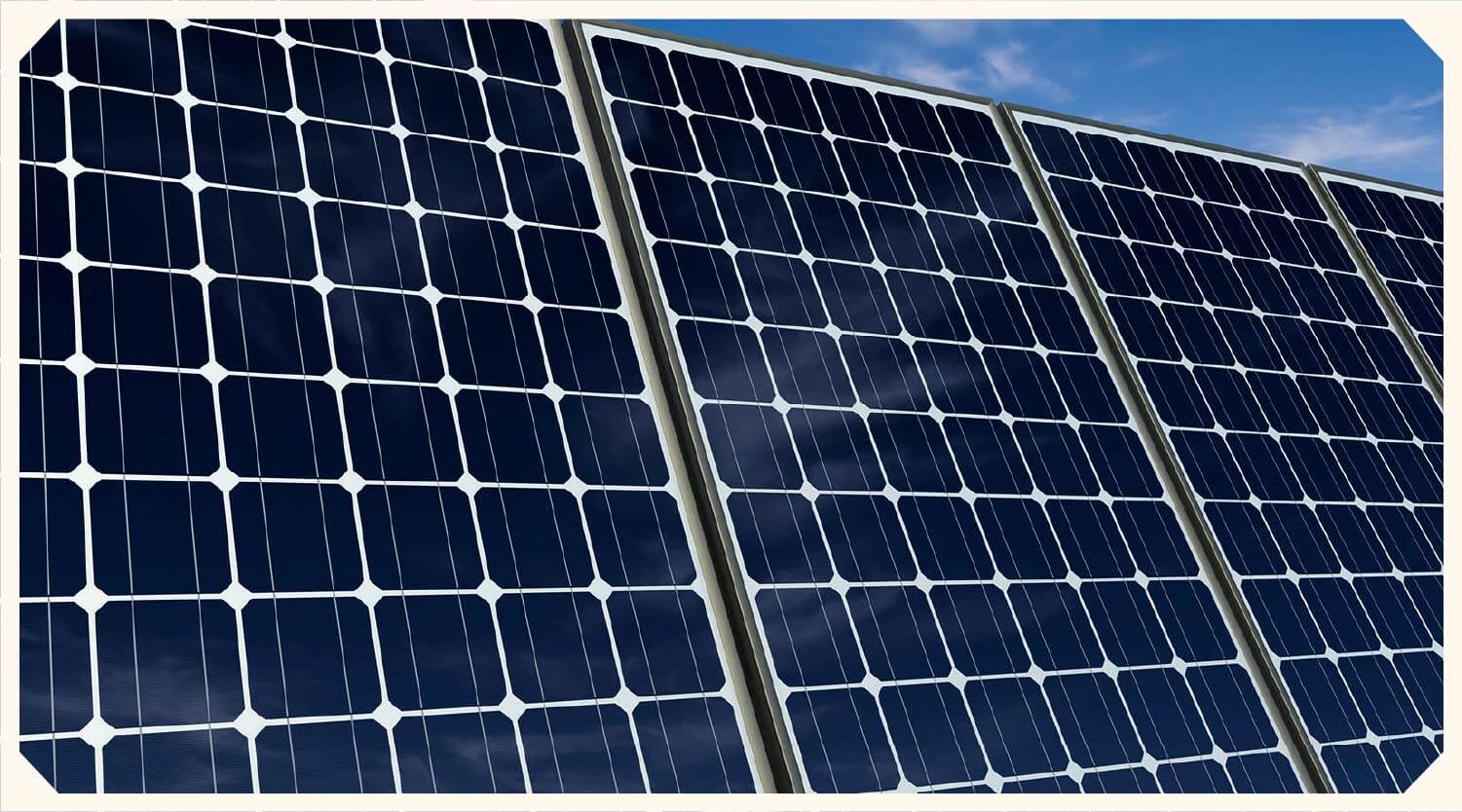
Monocrystalline silicon has a uniform crystal structure, appearing deep black with a consistent surface color.
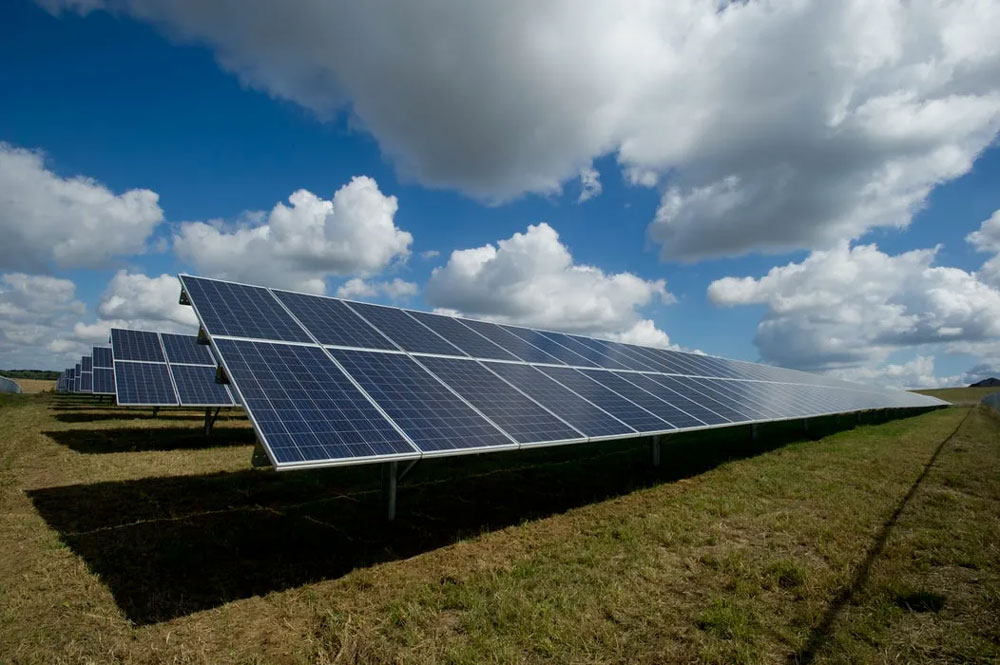
Polycrystalline silicon consists of multiple grains with different orientations, appearing blue with visible irregular grain patterns on the surface.
Differences in manufacturing processes
Monocrystalline silicon manufacturing uses the Czochralski method.
High-purity silicon raw material is heated to a molten state in a quartz crucible, and then a monocrystalline silicon seed crystal is slowly pulled upward to form a cylindrical ingot.
This method requires precise control of temperature gradient and pulling speed to ensure complete crystal structure growth.
Since the ingot is cylindrical, cutting it into square wafers generates material waste, which is one reason for the higher cost of monocrystalline silicon.
Polycrystalline silicon manufacturing uses the ingot casting process.
Molten silicon is poured into a square mold and solidified through controlled cooling conditions.
This method has a shorter production cycle and lower energy consumption, but the resulting crystal structure contains a large number of grain boundaries.
The irregular atomic arrangement at the grain boundaries hinders the movement of photogenerated electrons.
From an energy consumption perspective, the total energy consumption for producing monocrystalline wafers is about 60-70 kWh/kg, while for polycrystalline wafers it is about 40-50 kWh/kg.
Comparison of electrical performance parameters
Under Standard Test Conditions (irradiance 1000W/m², temperature 25°C), the performance differences of commercial solar modules are evident:
· Conversion Efficiency: The champion laboratory efficiency for monocrystalline silicon modules reaches 26.7%, with commercial product efficiency generally between 22-24%. The champion laboratory efficiency for polycrystalline silicon modules is 24.3%, with commercial product efficiency mostly in the 18-20% range.
· Temperature Coefficient: The power temperature coefficient for monocrystalline silicon is approximately -0.35%/°C, while for polycrystalline silicon it is about -0.40%/°C. At an operating temperature of 50°C, the output power degradation of monocrystalline modules is 2-3% lower than that of polycrystalline modules.
· Low-Light Performance: Monocrystalline silicon performs better than polycrystalline silicon under low-light conditions, potentially extending the daily effective power generation time by 15-20 minutes in the early morning and evening.
Long-term reliability performance
The service life of solar modules is typically required to be over 25 years, so long-term performance degradation is a key indicator.
l Initial Light-Induced Degradation: Polycrystalline modules may experience a 1-2% power degradation in the first month of use, while the initial degradation of monocrystalline is controlled within 1%.
l Annual Degradation Rate: High-quality monocrystalline modules can control the annual degradation rate below 0.5%, while polycrystalline modules are typically around 0.7-0.8%.
l Potential Induced Degradation: Monocrystalline modules are more sensitive to PID effects, but by using anti-PID cells and encapsulation materials, the anti-PID performance of modern monocrystalline modules has been greatly improved.
Evolution of cost structure
In 2018, monocrystalline modules were 15-20% more expensive than polycrystalline modules of the same power. By 2023, this gap had narrowed to 5-8%.
This change is mainly due to three aspects:
1. The popularization of diamond wire cutting technology has reduced the cost of monocrystalline wafers by 40%.
2. Continuous Czochralski technology has increased the charge capacity of monocrystalline furnaces from 100kg to over 300kg.
3. The industrialization of high-efficiency technologies such as PERC and TOPCon has further amplified the efficiency advantage of monocrystalline silicon.
Currently, in the manufacturing cost per watt of modules, monocrystalline silicon is $0.02-$0.03 higher than polycrystalline silicon.
Application Scenario Analysis
Installation considerations for residential roofs
Typical single-family homes in North America have available roof areas between 40-60 square meters, often segmented by obstacles like chimneys and skylights.
In such space-constrained environments, maximizing power generation per unit area is crucial.
Monocrystalline Silicon Solution:
l Using 360W high-efficiency modules, each with an area of about 1.8 m².
l 20 modules can be installed on a 50 m² net area, with a system capacity of 7.2 kW.
l Annual energy generation is about 9,000-11,000 kWh, which can cover over 80% of the electricity demand of a US household.
Polycrystalline Silicon Solution:
l Using 300W standard modules, each with the same area.
l Only a 5.0 kW system capacity can be installed in the same area.
l Annual energy generation is about 1500 kWh less than the monocrystalline system.
In states like California that implement net metering, the monocrystalline system can generate an additional $300-$400 in electricity revenue annually, recouping the initial investment price difference in 5-7 years.
For households with electric vehicle charging needs, the additional energy generation can support a daily driving range of 50 kilometers.
Energy solutions for commercial buildings
Large supermarkets and factory roofs have large areas and little shading, but their load-bearing capacity is often limited. Here, a balance between system weight and generation efficiency is needed.
Flat-roof commercial buildings:
l The installation angle is usually less than 5, and the spacing between modules must meet anti-shading requirements.
l Monocrystalline modules, with their higher conversion efficiency, can accommodate larger capacity in a given area.
l A 10,000 m² roof can install a 1.1 MW monocrystalline system or a 0.9 MW polycrystalline system.
Energy efficiency simulation data:
l A case study of a warehouse roof in Chicago shows that the annual energy generation of a monocrystalline system is 18% higher than that of a polycrystalline system with the same investment.
l In the commercial sector with high electricity prices, this means an additional annual saving of $15,000-$20,000 in electricity costs.
Site selection strategy for large ground-mounted power stations
In agricultural areas of the US Midwest, annual land rent per acre is $500-$1,000, while in coastal areas it can exceed $5,000.
Impact analysis of land cost:
l When land cost is below $3,000 per acre, the polycrystalline silicon solution may still be economical.
l Monocrystalline power plants can save 15% of land area, offering a significant advantage on scarce plots near high-voltage transmission lines.
Actual case comparison:
l A 100 MW power plant in Texas using monocrystalline technology saved 30 hectares of land compared to the originally designed polycrystalline solution.
l The saved land cost was enough to offset the module price difference, and later O&M costs were reduced by 8%.
Adaptability performance in special environments
The requirements for modules in the high-temperature environment of Arizona are completely different from those in the cold climate of Minnesota.
Performance in high-temperature regions:
l Monocrystalline module temperature coefficient: -0.35%/°C, Polycrystalline: -0.40%/°C.
l At an ambient temperature of 45°C, the power generation advantage of the monocrystalline system expands to 5-8%.
Considerations for cold climates:
l The performance advantage of monocrystalline silicon under low-light conditions increases winter power generation by 10-15%.
l This is particularly important for northern regions with high energy consumption during the heating season.
Mobile and off-grid application scenarios
Mobile applications such as RVs and boats have strict weight and size limitations.
The load-bearing capacity of a standard RV roof is about 50 kg, with a usable area not exceeding 5 square meters.
Data comparison for mobile scenarios:
l A 5 m² roof can install a 1.1 kW monocrystalline system or a 0.9 kW polycrystalline system.
l The 200W power generation difference can produce an additional 0.8-1.2 kWh of electricity per day.
l This is enough to provide continuous power for a 12V RV refrigerator or charge a laptop 5-8 times.
Reducing cell capacity by 1 kWh can save $300-$500 in system costs.
Appearance
Monocrystalline silicon modules are pure black with a uniform surface and low reflectivity (typically below 5%), allowing them to blend seamlessly into dark roofs.
Polycrystalline silicon modules appear deep blue with distinctive ice-flower-like speckles, have slightly higher reflectivity, and present a more industrial esthetic.
Color and Texture
The physics behind the color difference
The pure black appearance of monocrystalline silicon stems from its highly ordered crystal structure. In the Czochralski process, silicon atoms are controlled to form a continuous lattice with a single crystal orientation.
This arrangement results in a very regular energy band structure for the semiconductor material, leading to high and consistent photon absorption efficiency.
When light hits the surface, most of the visible light spectrum is effectively absorbed to excite electrons, with very little reflected, and the reflected portion is relatively uniform across wavelengths, thus perceived by the human eye as deep black.
Its reflectivity in the visible light range can typically be as low as below 4%.
The manufacturing process of polycrystalline silicon determines that its interior contains a large number of grains. The atomic arrangement within each grain is regular, but the orientation between different grains is random.
This structure creates numerous grain boundaries. When light passes through these grain boundaries, scattering occurs, causing some light to be reflected back.
This scattering affects short-wavelength light (blue, violet) differently than long-wavelength light, resulting in non-uniform reflection across the spectrum, thus presenting varying shades of blue.
Its average reflectivity is typically 1-2 percentage points higher than that of monocrystalline silicon.
Texture formation from manufacturing steps
The "ice flower" texture of polycrystalline silicon is not intentionally designed but a natural result of the casting process.
1. Directional Solidification: In the casting of polycrystalline silicon ingots, molten silicon begins to cool and solidify from the bottom of the crucible upward. Crystals start growing from numerous nucleation points, competing with each other, eventually forming random grains typically ranging in size from millimeters to centimeters.
2. Acid Texturing: After the wafers are cut, they undergo a "texturing" process to create microscopic textures that reduce reflection. Due to the anisotropic nature of polycrystalline silicon, isotropic etching with an acidic solution is typically used, forming pits of varying sizes and distributions.
The uniform texture of monocrystalline silicon benefits from its controlled growth and subsequent processing.
1. Crystal Orientation Control: The entire ingot maintains a consistent (100) crystal orientation.
2. Alkaline Texturing: Monocrystalline silicon wafers use anisotropic alkaline solutions for texturing, which can etch uniformly sized, neatly arranged pyramid structures. These microscopic pyramids are typically 1-5 micrometers in size and effectively trap light inside the cell. The uniform microscopic structure results in macroscopic color uniformity.
Quantitative parameters and measurement
l Reflectivity: Measured using an integrating sphere spectroreflectometer. The reflectivity of textured monocrystalline silicon can be optimized to below 3%, while that of polycrystalline silicon is typically between 5%-8%. Lower reflectivity means more light is absorbed by the cell, favoring current generation.
l Color Coordinates: In the CIE Lab color space, the measured values on the surface of a monocrystalline silicon module cluster near the origin of the blackbody radiation curve, indicating low color saturation and low lightness. Measurements of polycrystalline silicon show a clear shift towards blue (negative b-value) and higher lightness (L* value).
Appearance consistency and module grading
For installers and end-users, appearance consistency is a practical consideration. Due to their highly uniform color and texture, monocrystalline silicon modules maintain good visual consistency even across different production batches.
When installed over a large area, the entire array looks like a single unit.
Polycrystalline silicon modules, however, may have visible batch differences. Grain size and distribution may vary slightly between different ingots, leading to subtle variations in color shade.
In extreme cases, color differences might be observed between polycrystalline silicon modules from different batches in the same power plant.
Beyond Black and Blue:
l PERC Cells: Passivated Emitter and Rear Cell technology requires covering the entire rear side with a dielectric film and metal electrodes, making the back of monocrystalline PERC cells uniformly black as well, whereas the rear electrode pattern of traditional cells is visible.
l HJT Cells: Using amorphous silicon thin films, their intrinsic layer is brownish, giving the cells a unique dark brown or black-brown appearance.
l IBC Cells: All electrodes are moved to the back, leaving the front completely free of metal gridline shading, presenting an extremely uniform pure black, considered the pinnacle of esthetics.
Reflective Properties
How the surface interacts with light
When light reaches the surface of a solar cell, reflection, absorption, and scattering occur. The strength of reflection depends on surface roughness and flatness.
l Monocrystalline Silicon Surface: After anisotropic alkaline texturing, the monocrystalline silicon surface forms a regular texture composed of "pyramid" structures about 1-3 micrometers high.
l Polycrystalline Silicon Surface: Due to the random crystal orientation of the grains, anisotropic alkaline texturing cannot be used. It typically uses acidic solutions for isotropic etching, forming unevenly sized and distributed pits and pore structures.
Methods and indicators for measuring reflectivity
In laboratories and industrial production, reflectivity is accurately measured using a spectral reflectometer equipped with an integrating sphere. This device collects reflected light from all directions, thus obtaining the total reflectivity. Two main indicators are used for evaluation:
l Weighted Average Reflectivity: This is not a simple arithmetic average. It needs to consider the spectral distribution of sunlight (usually using the AM1.5G standard spectrum). The instrument measures the spectral reflection curve of the solar cell across the visible and near-infrared spectrum (e.g., 300-1,200 nm), then weights this curve with the AM1.5G spectrum to calculate an average value that more closely matches actual operating conditions.
l Spectral Reflection Curve: This graph provides richer information than a single number. It shows the reflection situation of the cell at different wavelengths. The ideal curve maintains extremely low reflectivity across all wavelengths where silicon is sensitive to light (approximately 350-1180 nm).
Practical impact of reflective properties on performance
Lower reflectivity directly translates to higher "short-circuit current" because more photons are successfully captured.
For a standard monocrystalline silicon cell, optimizing its reflectivity from 8% to 3% means that approximately 5% of the photons that were previously reflected can now be used for power generation, directly increasing the cell's current output.
Furthermore, reflective properties are related to the angle of incidence. When sunlight is not perpendicular but strikes at a large angle, the reflectivity of any surface increases.
The monocrystalline silicon surface with its micro-pyramid structure experiences a relatively slow increase in reflectivity at larger angles of incidence.
It has a better ability to capture oblique light in the early morning, evening, and during winter in high-latitude regions compared to smooth surfaces or surfaces with irregular structures.
Role of the Anti-Reflection Coating
Both monocrystalline and polycrystalline silicon cells deposit a silicon nitride anti-reflection coating on the textured surface.
This thin film uses the principle of light interference to further reduce reflectivity.
Its working principle is: by precisely controlling the thickness of the film (typically a quarter wavelength for the center wavelength of visible light), the light reflected from the top surface of the film and the light reflected from the film-silicon interface undergo destructive interference, canceling each other out.
The color of this coating (usually blue or dark blue) is itself a result of the interference effect.
Its optimal thickness needs to be co-designed with the surface morphology after texturing to achieve the lowest overall reflectivity.
For polycrystalline silicon, this coating also greatly helps reduce its originally higher reflectivity.
Reflection from a module perspective
When encapsulated into a module, the glass and encapsulation material (EVA or POE) also affect the overall reflective properties.
Modern photovoltaic glass undergoes anti-reflective treatment, with its own anti-reflection coating that can reduce reflection from the glass surface from about 4% to below 2%.
The refractive index of the encapsulation material between the glass and the cell needs to match both to ensure light enters the cell efficiently.
Therefore, module manufacturers optimize the glass, film, and cell as an integrated optical system, aiming to minimize the overall reflection loss of the module.
Ultimately, the overall reflectivity of a high-performance monocrystalline silicon module can be controlled below 1.5%, while that of a polycrystalline silicon module will be slightly higher.
Cell Shape
Crystal growth method determines the basic shape
The initial shape of the solar cell is determined by the manufacturing method of the silicon ingot.
· Monocrystalline Silicon's Cylindrical Ingot: When growing monocrystals using the Czochralski method, the silicon melt is pulled upward while rotating around a central axis guided by a seed crystal, naturally forming a cylindrical ingot.
· Polycrystalline Silicon's Square Cast Ingot: Polycrystalline silicon uses the directional solidification method, cooling molten silicon in a square quartz crucible.
The pseudo-square design is a compromise solution
To balance the material utilization of monocrystalline silicon and the effective power-generating area of the cell, the industry adopted the classic "pseudo-square" design. This process can be explained with specific data:
· From Cylinder to Brick: First, the irregular outer part of the cylindrical ingot is cut off to obtain a "square brick" with a roughly square cross-section. The silicon material loss in this step is typically around 15%-20%.
· Cutting Wafers: Wafers are cut from this square brick using a diamond wire. The four corners of the final wafer naturally exhibit rounded corners corresponding to the original cylindrical contour. This shape, compared to cutting directly into a full square, can increase the overall material utilization of monocrystalline silicon from less than 50% to over 80%.
A traditional M2 specification (156.75mm) pseudo-square monocrystalline cell typically has an area about 1.5% to 2% smaller than a square polycrystalline cell of the same size.
Impact of cell shape on module manufacturing
The shape of the cell directly affects the efficiency of module encapsulation and the final appearance of the module.
l Layout Efficiency: When stringing cells into a module, square cells can be arranged closely, with almost no gap between them. After laying out pseudo-square cells, tiny diamond-shaped gaps are left between the rows and columns of the cell strings.
l Visual Identity: These tiny diamond-shaped gaps form a unique, uniformly distributed white grid pattern (from the reflection of the underlying EVA film and backsheet), becoming the most recognizable visual feature of traditional monocrystalline modules. The white grid lines between cells in modules composed of square polycrystalline cells are straight.
Full-square monocrystalline becomes the mainstream trend
In recent years, with technological progress and the pursuit of higher module power, "full-square monocrystalline" has become absolutely mainstream. This is achieved primarily in two ways:
1. Increasing the initial ingot diameter: By improving Czochralski technology, it is now possible to grow large-diameter cylindrical ingots exceeding 210mm. When trimming this into a large square brick, the area proportion of the rounded corners becomes relatively smaller, making the cut wafers very close to square.
2. Diamond wire cutting technology: The popularization of this technology has made it possible to cut thinner wafers, reducing kerf loss. This makes the material loss acceptable even when cutting off the rounded corners to obtain fully square wafers.
Full-square monocrystalline cells eliminate the area loss caused by rounded corners, increasing the power-generating area of a single cell by about 2%, directly boosting module power.
At the same time, it gives monocrystalline modules the same neat grid line appearance as polycrystalline modules, blurring the boundary for distinguishing technology based on shape appearance.
Relationship between shape and new module technologies
The evolution of cell shape also interacts with innovations in module technology. For example:
l Half-cell module technology: Both square and full-square monocrystalline cells are laser-cut along the main bus bars into two halves. The shape of the half-cells changes the current path, reducing internal electrical losses, but the shape itself remains square or rectangular.
l Shingled module technology: Cells are cut into many smaller pieces, which are then overlapped and bonded like shingles, completely eliminating the gaps between cells and maximizing the utilization of the module area.