Why Is Investing in Solar Energy Worth It | Lower Bills, Energy Savings, Long-Term Value
Installing photovoltaic panels to convert light energy into electrical energy, can reduce electricity bills by over 50%.
System lifespan exceeds 25 years, about 8 years return cost, annual average investment return rate reaches 10%.
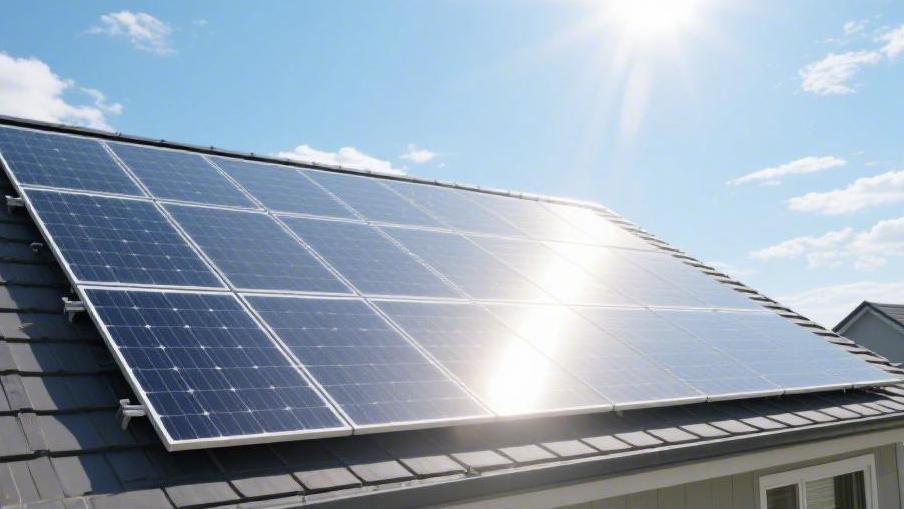
Lower Bills
Save big money
Installing a set of specification 8 kilowatt (kW) direct current (DC) solar system, in an average sunshine duration of 4.5 hours region, can produce electricity about 36 kilowatt-hours (kWh) daily. According to the US family average monthly consumption of 899 kilowatt-hours (kWh), this set of system in no shadow block, inverter efficiency 97% standard work condition, monthly can produce about 1,080 kilowatt-hours alternating current, completely cover 100% of the family's basic load. In Massachusetts or California etc. electricity price high reach per kilowatt-hour 0.28 to 0.45 dollars regions, if the original monthly bill is 350 dollars, after installing the system, the "energy consumption fee" part in the bill usually will directly return to zero, only remaining about 15 to 20 dollars fixed grid access fee (Customer Charge).
This kind of saving is not linearly maintained, but along with utility electricity price every year about 2.5% to 4% inflation rate and year by year increase. According to US Energy Information Administration (EIA) historical data, past 10 years all-US average retail electricity price increased about 27%. A set of expected lifespan 25 years system, its 20th year saved per unit electricity value, will be about 1.8 times the 1st year installation. In 25 years' full life cycle, a set of 8 kW system cumulative can save about 65,000 dollars in electricity bill expenditure, while its initial installation cost (after deducting 30% federal tax credit) is usually only 16,000 to 19,000 dollars, internal rate of return (IRR) often can break through 15%.
Calculate detailed account
Electricity bill saving efficiency highly relies on the "Net Metering" policy's specific parameters. In states supporting 1:1 equivalent deduction, like Florida, the solar system in noon 12:00 to 14:00 output peak power (assume 6.5 kW) if exceeds family at that time 1.5 kW load, extra 5 kW power will at per unit electricity about 0.15 dollars price send back to the grid, and at night at the same price equivalent deduction. Grid becomes a 100% efficiency virtual cell.
However, in implementing "Net Billing 2.0 or 3.0" regions (like California), sell back to grid price might only be retail price's 25% around (about per kilowatt-hour 0.05 to 0.08 dollars). Under this kind of rule, adding a capacity of 13.5 kilowatt-hours (kWh), depth of discharge (DoD) 100% lithium cell set (like Tesla Powerwall 3) becomes extremely important. Through storing daytime extra 40% power, in the evening 16:00 to 21:00 peak electricity price period (Time-of-Use Rate), the family can avoid the per unit electricity 0.50 dollars high amount peak time rate. This "self-generation self-consumption" mode can lift the whole system comprehensive electricity bill saving rate from pure photovoltaic 60% to above 95%.
Look at lifespan
Mainstream monocrystalline silicon (Monocrystalline) modules' degradation rate currently controlled within 0.5% annually. In installation after 10th year, system power generation ability still maintains at initial rated power of 95.4%; even reaching 25th year, output power is still not lower than 85%. Matching string inverter (String Inverter) lifespan usually 12 to 15 years, replacement cost about 2,000 to 3,000 dollars; while microinverters (Microinverters) possess modules with a 25-year warranty.
From a hardware specification look, above 400 W modules usually adopt half-piece (Half-cut) technology, can in partial shadow (like tree shade covering 10% area) situation, through bypass diode reduce current loss, ensure overall power generation amount not to appear cliff-style drop. If the roof orientation is due south and the tilt angle is between 25 and 35 degrees, the system's photon efficiency is highest, and per kilowatt installed capacity annually can produce about 1,400 to 1,600 kilowatt-hours of electricity. This kind of long-term, high-density energy output, resisted future energy market fluctuations, and brought financial risks.
Get subsidies
For a set total price of 25,000 dollars, the owner, when declaring next year's personal income tax, can directly obtain a 7,500-dollar tax credit (Tax Credit), rather than a pre-tax deduction (Deduction). If you owe the government 8,000 dollars in taxes, use this sum as credit after only needing to pay 500 dollars. Besides, some states (like New York State) also provide an extra 25% (highest 5,000 dollars) state-level tax credit.
If you choose installment payment (Solar Loan), the current annual percentage rate (APR) is usually between 6.5% and 8.5%, and the loan term is mostly 10 to 20 years. For an originally monthly pay 200-dollar electricity bill family, if the loan monthly installment is 160 dollars, and the system covered 90% of the electricity amount, then this family from the first month starting achieved 40 dollars net cash flow growth. In a system running around 8th year, cumulative saved electricity bills will completely cover the initial net investment cost, entering so-called "free electricity use" stage. In the remaining 17 years of my lifespan, this is equivalent to obtaining an extremely high annual return rate on a steady financial asset, and this asset's output (electricity) is tax-free.
Energy Savings
Enough or not enough to use
A set of standard configuration residential solar system, usually chooses single-block power between 400 watts (W) and 450 watts (W) monocrystalline silicon modules. Take a total installed capacity of 10 kilowatt (kW) system as an example. This needs installing about 25 blocks, each size about 1.75 meters × 1.13 meters, solar panels, total occupied roof area about 50 square meters. In all-US average daily 4.5 hours peak sun hours (Peak Sun Hours), this system's theoretical daily average power generation is 45 kilowatt-hours (kWh). Considering the inverter from direct current (DC) to alternating current (AC) process, about 3% to 5% loss, and cable transmission 1% voltage drop, the family's actual usable daily electricity amount is about 42.5 kilowatt-hours (kWh).
Key data reference: A typical family of four, if possessing two 1.5-horsepower central air conditioners, one large capacity electric water heater as well as basic lighting and home appliances, its summer daily electricity consumption often between 30 to 40 kilowatt-hours (kWh). 10kW system when light is sufficient, coverage rate can reach above 110%, extra electricity amount then flows through bidirectional meter toward grid.
This kind of energy saving depth also reflects on seasonal fluctuation hedging. In winter, because the sun's altitude angle is relatively low, sunshine duration might shorten to daily 2.5 hours. At this time, the 10 kW system output drops to 25 kilowatt-hours (kWh). To balance this kind of seasonal difference, professional design schemes usually suggest installing 20% redundancy capacity higher than the basic load. Through this way, summer multi-generated electricity amount can be stored in regions implementing Net Metering policy as "electricity bill credits", offsetting winter's about 15% to 25% energy gap.
Can store electricity
Energy saving upper limit not only depends on power generation, more depends on control power over electrical energy, especially through lithium iron phosphate (LiFePO4) cells achieved energy moving. Mainstream home energy storage batteries like 13.5 kilowatt-hour (kWh) specification storage units, their depth of discharge (DoD) usually can reach 100%, and charge-discharge round-trip efficiency (Round-trip Efficiency) maintains at 90% around. When solar panels in noon 12:00 produce 5 kW peak power, while the family load is only 1.5 kW, the extra 3.5 kW power will be charged into the cell, rather than sold at a low price to the grid.
In implementing TOU regions, the afternoon 16:00 to 21:00 electricity price might be 3 times that of early morning. Through energy storage system, a family can, in this high-price period, completely separate from the grid running. If a family evening peak load is 2.5 kW, continuous running for 5 hours consumes 12.5 kilowatt-hours (kWh), exactly within a single block 13.5 kWh cell coverage range. This kind of precise energy scheduling every year can extra reduce about 800 to 1,200 dollars expenditure, making the whole set system energy self-sufficiency rate (Self-sufficiency Rate) from pure photovoltaic mode 35% soar to above 85%. For families possessing electric vehicles (EV), one 7.2 kW Level 2 Charger (Level 2 Charger) every charge 1 hour needs consume about 7.2 units of electricity, if all come from own green electricity, per mile driving cost will drop from public grid supply about 0.06 dollars to close to 0 dollars marginal cost.
Can withstand consumption
Energy saving long-term nature decided by hardware physical degradation rate. Top brand N-type monocrystalline modules in the first year degradation rate lower than 1%, subsequently 24 years, annual degradation rate stable at 0.4% around. In a set of systems running for 25 years, its power generation efficiency can still maintain at initial nominal power of 89% above. From environmental contribution quantification data, every saved 1,000 kilowatt-hours (kWh) of coal electricity is equivalent to reducing about 0.7 tons of carbon dioxide emissions. A year power generation 15,000 kilowatt-hours (kWh) system, in 25 years life cycle cumulative emission reduction exceeds 260 tons.
Hardware specification details: Modern modules mostly adopt multi-busbar (MBB) technology, can effectively reduce fine grid lines' shadow area and shorten current transmission path, reduce internal resistance loss by about 2% to 3%. Meanwhile, possessing IP68 protection grade microinverters can work in extreme environments inside from -40°C to 65°C, its mean time between failures (MTBF) is usually set at above 1 million hours, ensuring energy saving processes will not be interrupted because of frequent hardware failure.
Can calculate accurate numbers
Roof azimuth (Azimuth) and tilt (Tilt) to energy saving influence possess clear mathematical correlation. In the Northern Hemisphere, due south (180 degrees) is regarded as the golden orientation, if the roof tilt is set at 30 degrees, photovoltaic modules capture photon kinetic energy and reach maximum value. If because of house structure limits, modules must be installed on east-facing or west-facing roofs, power generation efficiency will usually drop 15% to 20%. Under this kind of situation, increasing the number of modules by about 15% can compensate for this part loss, ensuring annual total output still maintains at above 12,000 kilowatt-hours (kWh) level.
In addition, shading analysis is a key step in ensuring goal achievement. Using professional software to simulate surrounding trees or buildings in one year 12 months inside shadow trajectory, if shadow coverage exceeds module area 10%, output might drop 30% above. To deal with this problem, half-piece cell (Half-cut cells) technology divides the module into up and down two independent circuit parts. When the bottom suffers shading, the upper half part can still maintain 100% output. This kind of technical level redundancy design makes family in complex environment under energy saving prediction accuracy (Accuracy) can control in plus or minus 5% error range inside. Combining a smart monitoring gateway, the owner can real-time view every minute power curve (Power Curve), accurately grasp every unit of green electricity flow and value.
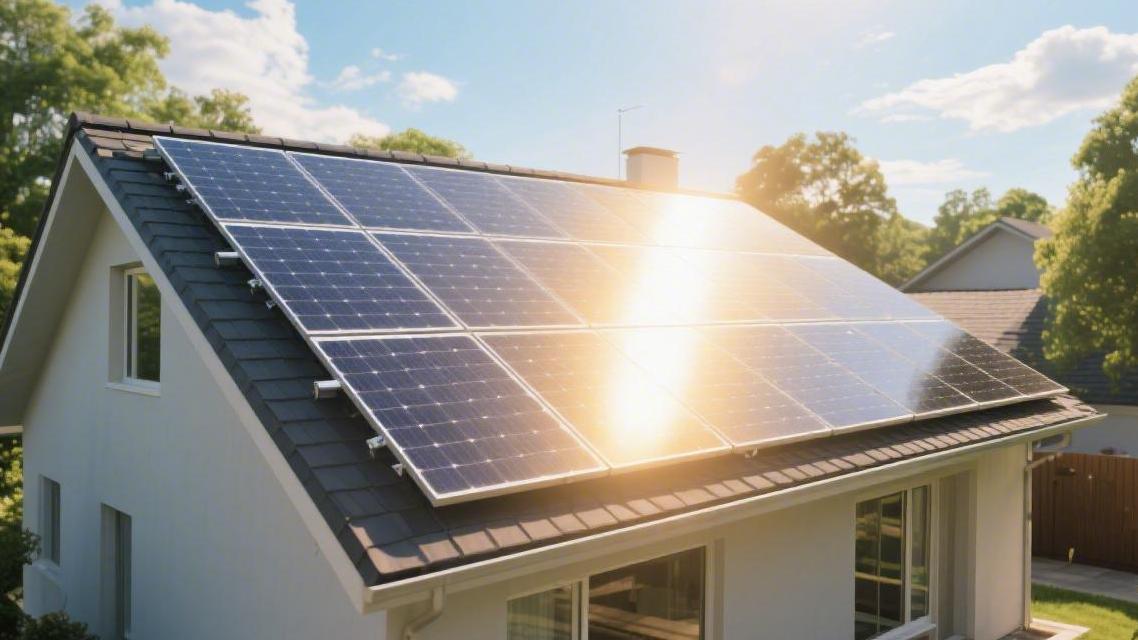
Long-Term Value
House more valuable
According to Zillow, toward all-US tens of thousands of house sales data tracking, installed solar system residences in resale time premium rate average reach 4.1%. Take a set market price of 500,000 dollars for an independent house as an example. This kind of green asset can directly add about 20,500 dollars to the assessment value of the house property. This kind of value growth is not fake labeling. The US National Renewable Energy Laboratory (NREL) established a clear calculation model: for every reduced 1 dollar annualized electricity bill expenditure, its market valuation will increase 20 dollars. If a 8 kilowatt (kW) system can save 1,500 dollars on electricity bills every year, then in an appraiser's eyes, this is equivalent to adding 30,000 dollars to the house's net value.
This kind of premium in different regions shows differentiation, but the trend is highly consistent. In New York State, solar houses selling speed is usually faster than non-solar houses by 20%. More importantly, most states (like California, Florida, New Jersey) all have property tax exemption policies. Your house because of installing value 25,000 dollars solar equipment and appreciated 25,000 dollars, but you don't need this increased 25,000 dollars to pay every year about 1.2% property tax, this in 25 years holding cycle inside again in disguised way saved about 7,500 dollars in tax expenditure.
Value dimension | Traditional residence (No Solar) | Solar residence (With Solar) | 25-year cumulative difference (Delta) |
Asset valuation | $500,000 | $520,500 (+4.1%) | +$20,500 |
Annual electricity expenditure | $2,100 (Year increase 3%) | $180 (Fixed grid fee) | +$48,000 (Saving) |
Property tax expenditure | Baseline tax amount | Baseline tax amount (Appreciated part exempt) | $0 (Extra saving) |
Maintenance cost | $0 | $1,500 (Cleaning/Inspection) | -$1,500 |
net revenue | $0 | Higher about $67,000 | Total return rate about 280% |
Revenue more steady
From a pure financial investment angle, the internal rate of return (IRR) of installing solar usually between 12% to 18%, far higher than the S&P 500 index's past 30 years about 10.2% average annualized return rate. Solar system initial investment through federal investment tax credit (ITC) can immediately recover 30% of the cost. If you invest 20,000 dollars, second year tax reporting time, then you can take back 6,000 dollars cash credit, actual risk exposure is only 14,000 dollars. In the following seven years, through monthly saved electricity bills, this 14,000 dollars will completely return the cost.
Entering 8th year to 25th year "pure revenue period", every unit electricity system produces is net profit. Because electricity is a life necessity, this kind of revenue volatility is extremely low, not subject to stock market turmoil or interest rate adjustment influence. If you put every year's saved 1,500 dollars electricity bill into a financial account with an annual return rate of 5%, 25 years after compound interest, the total amount will exceed 70,000 dollars.
Resist price increase
According to US Bureau of Labor Statistics data, the past ten years' retail electricity price compound annual growth rate (CAGR) has been between 2.5% and 4%, while in years of energy crisis, some regions' electricity prices increased once, breaking through 15%. The solar system essentially is for your future 25-year electricity use requirement performed "price locking". No matter how utility companies upward adjust per unit electricity unit price, your own house produced electricity cost from installation completion that moment starting then fixed at per kilowatt-hour (kWh) at about 0.06 to 0.08 dollars level (based on 25 years total power generation conversion).
This kind of certainty in retirement planning is particularly important. For fixed income retired personnel, a monthly fluctuating electricity bill (summer might soar to 400 dollars) is a financial hidden danger. Through a PV system, a family can lock in this part of expenditure at an extremely low fixed level. Even if the system in the 20th year appeared 0.5% annual power degradation, an initial power 10kW system still can output above 8.2kW electricity, enough to cover the majority of family basic load, thereby avoiding energy market price fluctuations toward life quality interference.
Hardware lifespan
Modern monocrystalline silicon modules' physical lifespan usually exceeds 30 years, although the standard power guarantee period is 25 years, but laboratory tests show that high-quality modules in the 30th year output efficiency can still maintain at the initial state of 80% around. The system's long-term value possesses extremely strong extensibility. The system core wear part is the inverter. Currently, the first-line brand string inverter design lifespan is 12 to 15 years, replacement cost per watt 0.15 to 0.25 dollars. If, in the initial installation stage, you choose microinverters (Microinverters), then you can obtain a 25-year warranty on panels, further reducing the full life cycle maintenance cost.
Hardware degradation and value model: Assume a set system starting power is 100%.
l Year 1: Output 98% (First year induction degradation)
l Year 10: Output 94.4% (Every year degradation about 0.4%)
l Year 25: Output 88.4% (Still higher than industry standard 85%)
l This kind of extremely slow physical depreciation speed makes the solar system become the house all equipment inside depreciation rate lowest assets one.
Environmentally friendly asset
In some specific markets (like Maryland or New Jersey), residential solar systems produce electricity that can generate solar renewable energy credits (SRECs). Every producer 1,000 units of electricity can obtain one credit. These credits can be sold to utility companies needing to fulfill green electricity obligations. According to market price, this can bring extra several hundred to thousand dollars cash income for the owner every year. Even in no SREC market regions, reduced carbon footprint (per system annually about emission reduction 8-10 tons carbon dioxide) is also a house property in future carbon neutral policy background, an important bargaining chip inside maintaining competitiveness.