Which Solar Technologies Are Best for Urban Buildings | Space Efficiency, Building Integration
For urban buildings, N-type high-efficiency monocrystalline modules—such as TOPCon or HJT—should be the first choice for improving space efficiency. Installing N-type monocrystalline panels on rooftops with conversion efficiency above 24% can significantly boost output per unit area.
For building-integrated photovoltaics (BIPV), CdTe BIPV panels with 14%–18% efficiency can replace conventional façade materials, achieving power generation with zero additional land use.
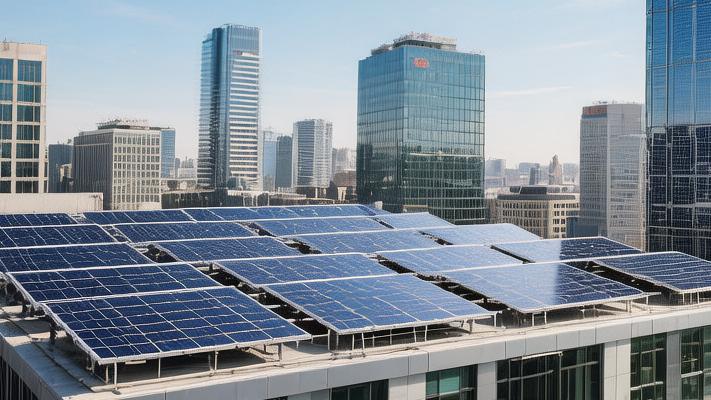
Space Efficiency
The standard rooftop area of a 50-story commercial office tower typically tops out at 2,500 square meters, but exhaust systems, elevator shafts, and façade maintenance tracks can consume as much as 65% of that physical space.
To maximize generation within the remaining 875 square meters of usable area, the system must reach a power density of 220 W/m² in order to achieve a total installed capacity of 190 kW.
A standard 550 W monocrystalline solar panel measures 2,278 mm by 1,134 mm, with a projected area of 2.58 square meters and a baseline conversion efficiency of 21.3%.
Once the 0.5-meter-wide perimeter safety and maintenance access path required by fire regulations is factored in, the actual number of installable panels must be reduced by another 12.4%.
Engineers often reduce the optimal tilt angle from 30 degrees to 15 degrees. This sacrifices 4.2% of peak solar capture, but allows 28% more modules to fit within the same geometric boundary.
During the summer high-temperature window from 11:00 to 14:00, operating temperatures can climb to 65°C, causing output voltage to decline at a negative temperature coefficient of 0.35% per °C.
If the setback distance between the edge modules and the parapet wall is reduced from 1.2 meters to 0.8 meters, wind pressure on the perimeter area increases by 18%. To withstand gusts of 32 m/s, the tightening torque of the aluminum alloy clamps must be increased from 15 N·m to 22 N·m.
Calculate Row Spacing
To prevent shadows cast by the front row at 15:00 from causing the output voltage of the rear row to drop sharply by 35%, row spacing must be modeled using a solar azimuth of 180 degrees and the winter solstice minimum solar altitude of 22.5 degrees.
For panels installed at a 20-degree tilt and a mounting height of 1.2 meters, maintaining 1.85 meters of rear clearance allows the system to sustain 99.2% irradiance capture during the most productive four-hour window from 10:00 to 14:00 each day.
When rooftop depth is limited to 45 meters, compressing row spacing from 1.85 meters to 1.1 meters results in a 14% shading rate during the winter months from November through February.
However, the additional 45 panels that can be installed under the tighter layout increase total system capacity enough to raise annual energy production in MWh by 11.5%.
Across a statistical sample of 150 high-rise PV projects, the variance in generation caused by this tighter-spacing strategy was only 3.2%.
When local commercial peak electricity rates exceed USD 0.18 per kWh, the 1.1-meter spacing scheme can still achieve an internal rate of return above 8.5%, while shortening the payback period by 7.3 months.
Elevated Racking
By building a 2.4-meter-high PV canopy with hot-dip galvanized steel, the three-dimensional rooftop volume originally occupied by 1.5-meter-high outdoor AC units can be fully reclaimed.
This steel support structure requires the roof to carry an additional load of 3.5 kN/m², increasing the initial budget for structural steel and lifting work by USD 45 per square meter.
The 2.4-meter clearance height increases rear-side airflow by 2.2 m/s, and forced convective cooling lowers cell operating temperature by 3.5°C.
That 3.5°C reduction improves the module temperature coefficient by 0.12%, adding an extra 185 kWh per month for a 100 kW array.
The canopy structure also allows 300 W microinverters to be mounted on crossbeams 1.2 meters above the high-temperature asphalt waterproofing layer, keeping them clear of 60°C ground-radiated heat.
As a result, the projected service life of the electrolytic capacitors increases from 12 years to 15.5 years, avoiding one major inverter overhaul costing USD 4,500 over a 25-year lifecycle.
Bifacial Generation
Bifacial modules, encapsulated front and back with 2 mm tempered glass, can capture large amounts of diffuse reflected light generated by the 15% to 25% albedo of light-colored TPO waterproof membranes.
A 540 W bifacial module installed above a white-coated roof with a reflectivity of 0.65 can gain an additional 65 W from the rear side, increasing total output per 2.58-square-meter module to 605 W.
Rear-side generation varies widely: under thick cloud cover, the gain may be only 8%, while at summer noon it can peak at 28%.
Raising the bifacial modules 0.8 meters above the roof increases rear-side diffuse light flux by 42%, reducing the median payback period of the system from 6.8 years to 5.9 years.
Assuming a linear degradation rate of 0.5% per year, a bifacial system on a 500-square-meter rooftop will generate 245,000 kWh more electricity over a 30-year lifecycle than a monofacial system.
This lowers the LCOE by USD 0.012 per kWh and increases the system's overall economic value added (EVA) by 18.5%.
Building Integration
A 200-meter-tall commercial skyscraper can have more than 30,000 square meters of vertical curtain wall area. By integrating BIPV into the façade, passive glazing systems costing USD 150 per square meter can be upgraded into all-weather power-generating surfaces.
Standard double-glazed Low-E glass typically has a U-value of 1.6 W/m²·K. When 3.2 mm crystalline silicon cells are laminated inside and sealed with PVB resin, thermal transmittance drops to 1.1 W/m²·K.
This reduces the standard deviation of summer air-conditioning load by 14.5%, while a 5,000-square-meter south-facing PV curtain wall operating at 15.2% conversion efficiency can generate a stable 680 MWh annually.
A vertically mounted 90-degree façade array can capture large amounts of low-angle sunlight in winter, keeping the annual monthly generation distribution within a normal dispersion band of 18%.
Compared with the 35% seasonal fluctuation typical of rooftop systems installed at a 30-degree tilt, vertical façades show much stronger resistance to cyclical interference in multi-month power generation.
Replace Conventional Cladding
Using frameless CdTe thin-film photovoltaic glass measuring 1,200 mm by 2,400 mm in place of conventional aluminum composite panels can reduce the base façade material budget by 45%.
At 8 mm thickness, CdTe modules weigh only 24.5 kg/m², which fits comfortably within the standard 30 kg/m² load-bearing safety threshold of curtain wall aluminum framing systems.
Compared with monocrystalline silicon modules, thin-film solar panels have a much lower power temperature coefficient of only -0.21% per °C.
When façade surface temperatures climb to 75°C in July, thin-film modules limit output loss to 10.5%, avoiding the much steeper 18% drop seen in conventional silicon panels.
Over a 25-year service life, annual median performance loss remains controlled at 0.4%, allowing the system to retain 88% of its original rated power at the end of the cycle.
The two-part silicone structural adhesive used by installers requires 72 hours to fully cure under conditions of 25°C and 50% relative humidity, after which it provides stable wind pressure resistance of 4.2 kPa.
Optimize Daylighting
Atriums and high-level skylights are often required to maintain at least 20% light transmittance in order to preserve a baseline indoor illuminance of 450 lux, avoiding unnecessary daytime lighting costs.
Manufacturers use laser etching to precisely control the gap width between 156 mm × 156 mm monocrystalline cells, adjusting light transmittance from 0% to a designed 25%.
A 12 mm cell spacing reduces installed power density from 180 W/m² to 135 W/m², but cuts lighting energy consumption by 32 kWh per square meter per year.
The PVB interlayer between the two sheets of high-transparency glass blocks 99.8% of UV radiation below 380 nm, while also absorbing 65% of infrared heat.
Statistical sampling shows that across a batch of 500 translucent PV modules, the power-generation deviation stays within ±2.5%, demonstrating extremely high manufacturing precision.
Integrated Area | Material Type | Light Transmittance | Power per m² | Peak Surface Temperature | Cost Premium | Median Payback Period | Generation Variance |
South-facing façade | CdTe thin film | 0% | 125 W | 72°C | USD 65/m² | 7.4 years | 14% |
Skylight dome | Double-glass monocrystalline | 25% | 135 W | 68°C | USD 110/m² | 8.2 years | 22% |
Sun-shading louver | Crystalline silicon laminate | 5% | 185 W | 65°C | USD 85/m² | 6.5 years | 28% |
Balcony balustrade | Flexible CIGS | 10% | 110 W | 62°C | USD 95/m² | 9.1 years | 19% |
Add Shading Canopies
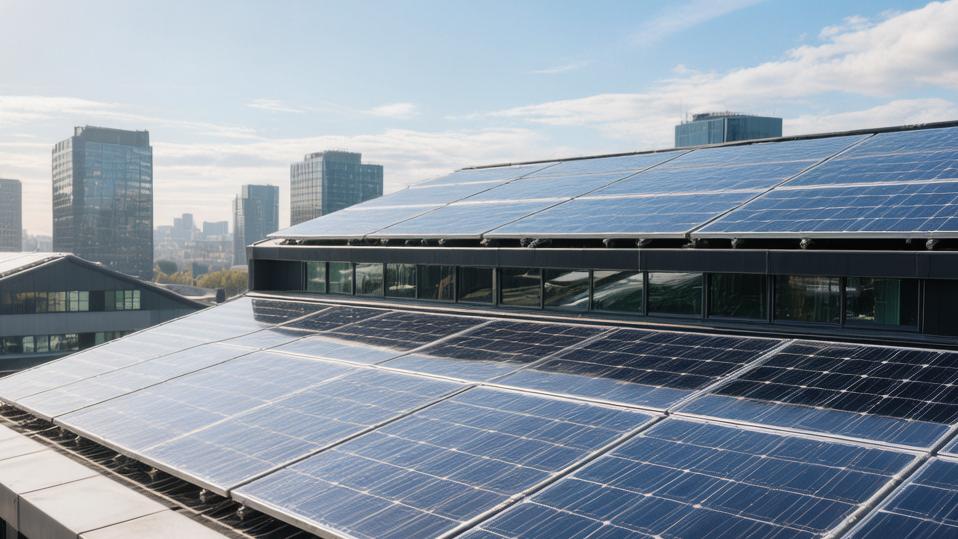
Extending 1.5-meter-wide photovoltaic louvers horizontally above south-facing window frames allows them to intercept harsh summer midday sunlight at an elevation angle of 72 degrees.
These BIPV shading canopies block 85% of direct solar heat gain, reducing the surface temperature in interior zones near the windows by 4.5°C.
Made from 8 mm tempered glass combined with a 1.52 mm PVB laminated layer, the photovoltaic louvers can withstand snow loads of 2.5 kN/m².
A 200-square-meter shading array, installed at a 30-degree tilt, provides a total installed capacity of 35 kW. Its intraday generation curve shows a Pearson correlation coefficient of 0.88 with the building's central air-conditioning load profile.
When the chiller system draws its peak current of 1,200 A at 14:30, the photovoltaic louvers can simultaneously deliver a peak current of 45 A, helping offset part of the grid load.