Floating Solar Photovoltaic Systems | Water Evaporation, Cooling Effects, Anchoring
Floating solar PV systems reduce water evaporation by up to 70% while utilizing natural water cooling to lower module temperatures, boosting power efficiency by 5% to 15%. Structurally, the arrays are stabilized using flexible mooring lines—like high-density polyethylene ropes or marine-grade steel chains—configured in "V" patterns and anchored to the reservoir bed to withstand dynamic wind and wave forces.
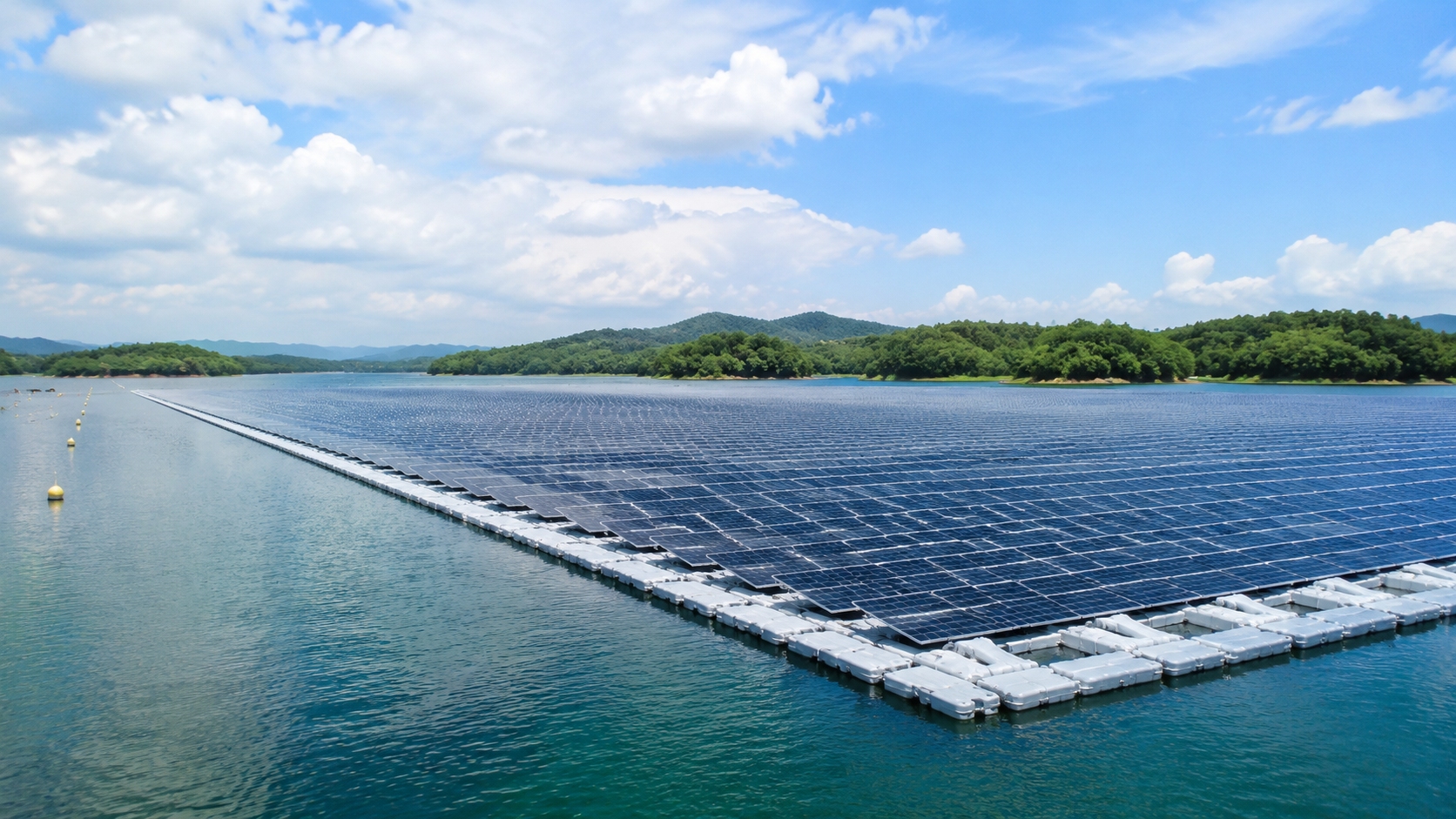
Water Evaporation
Reducing Water Loss
The core benefit of floating solar panel coverage over water surfaces is direct evaporation reduction—per Nature Sustainability research, installing floating solar across 30 percent of the world's 114,555 reservoirs could save approximately 106 cubic kilometers of freshwater annually, equivalent to roughly 10 percent of the Nile River's annual flow, which carries strategic significance for agricultural irrigation and urban water supply in water-scarce regions facing increasing climate variability and competing demands on freshwater resources from multiple sectors simultaneously.
From a physics perspective, water surface evaporation rate is exponentially positively correlated with water temperature—higher water temperature means a greater proportion of water molecules overcome surface tension and escape into the atmosphere; floating solar panels block approximately 30 to 40 percent of solar radiation from directly illuminating the water surface, converting that portion into electricity rather than thermal energy entering the water body, which keeps water temperature 3 to 8 degrees Celsius lower than uncovered surfaces, thereby significantly reducing the evaporation driving force that governs the rate of moisture loss from the reservoir into the atmosphere during high-temperature periods when evaporation rates are highest.
Joint World Bank and USAID research shows that in a drought-prone floating solar project in Jordan, approximately 10,000 cubic meters of irrigation water were saved per hectare annually, which for a country where over 60 percent of freshwater supply depends on over-extracted groundwater with extraction rates exceeding 100 percent of recharge, makes floating solar evaporation reduction effect a strategic tool for water-energy-food security nexus planning rather than merely a clean electricity source—the dual-benefit nature of this technology is what distinguishes it from conventional ground-mounted solar in water-stressed regions globally.
Comparison Dimension | Uncovered Water Surface | Floating Solar Covered |
Annual evaporation (arid zone) | 1,500 to 2,500mm | 825 to 1,750 mm (30 to 45 percent reduction) |
Water saved per hectare annually | — | 4,500 to 9,000 cubic meters |
Water temperature (summer noon) | 3 to 8 degrees Celsius higher than floating solar | Relatively lower, smaller evaporation driving force |
Applicable scenarios | Uncovered agricultural reservoirs | Arid-zone reservoirs, irrigation canals, saline-alkali water pits |
Conserving Freshwater Resources
Freshwater saved by floating solar carries exceptionally high marginal value in arid regions—per measurements in high-temperature arid climate zones, uncovered reservoir surfaces experience annual evaporation of approximately 1,500 to 2,500 millimeters; after floating solar coverage, evaporation from the same surface area decreases by 30 to 45 percent, equivalent to approximately 4,500 to 9,000 cubic meters of freshwater saved per hectare annually—a figure that for water-scarce agricultural irrigation districts or urban emergency water sources represents a significant improvement in water security and drought resilience that directly affects food production capacity and municipal water supply reliability in the regions where floating solar installations are most economically attractive.
A saline-alkali land aquaculture-floating solar complementary project in Ningxia documented specific water conservation results: the local area receives annual precipitation of only 280 millimeters with evaporation exceeding 2,000 millimeters annually, meaning traditional aquaculture ponds require 3 to 5 water makeup events per year to maintain normal water levels. After floating solar buoy coverage, evaporation decreased by approximately 40%, reducing makeup water frequency to 1 to 2 events per year, while simultaneously slowing the rate of salinity concentration increase in the saline-alkali water and extending the operational lifespan of the pond structure itself, which for agricultural communities in northwestern arid regions dependent on groundwater resources represents a quantifiable improvement in long-term water resource sustainability for the surrounding community and its agricultural economy.
I once visited a floating solar project site in a drought-prone area of Jordan, and a local farmer told me that before installation, the reservoir lost approximately 1.5 meters of water depth from evaporation alone during the June-to-September period each year—enough water to irrigate approximately 30 hectares of downstream agricultural land; after floating solar installation and the resulting evaporation reduction, the same volume of water could irrigate approximately 15 additional hectares, which, according to local water rights market pricing, translates to substantial annual economic value for the farming community, and this anecdote illustrated to me that the economic leverage effect of floating solar in water-scarce regions far exceeds the value of the clean electricity it generates alone.
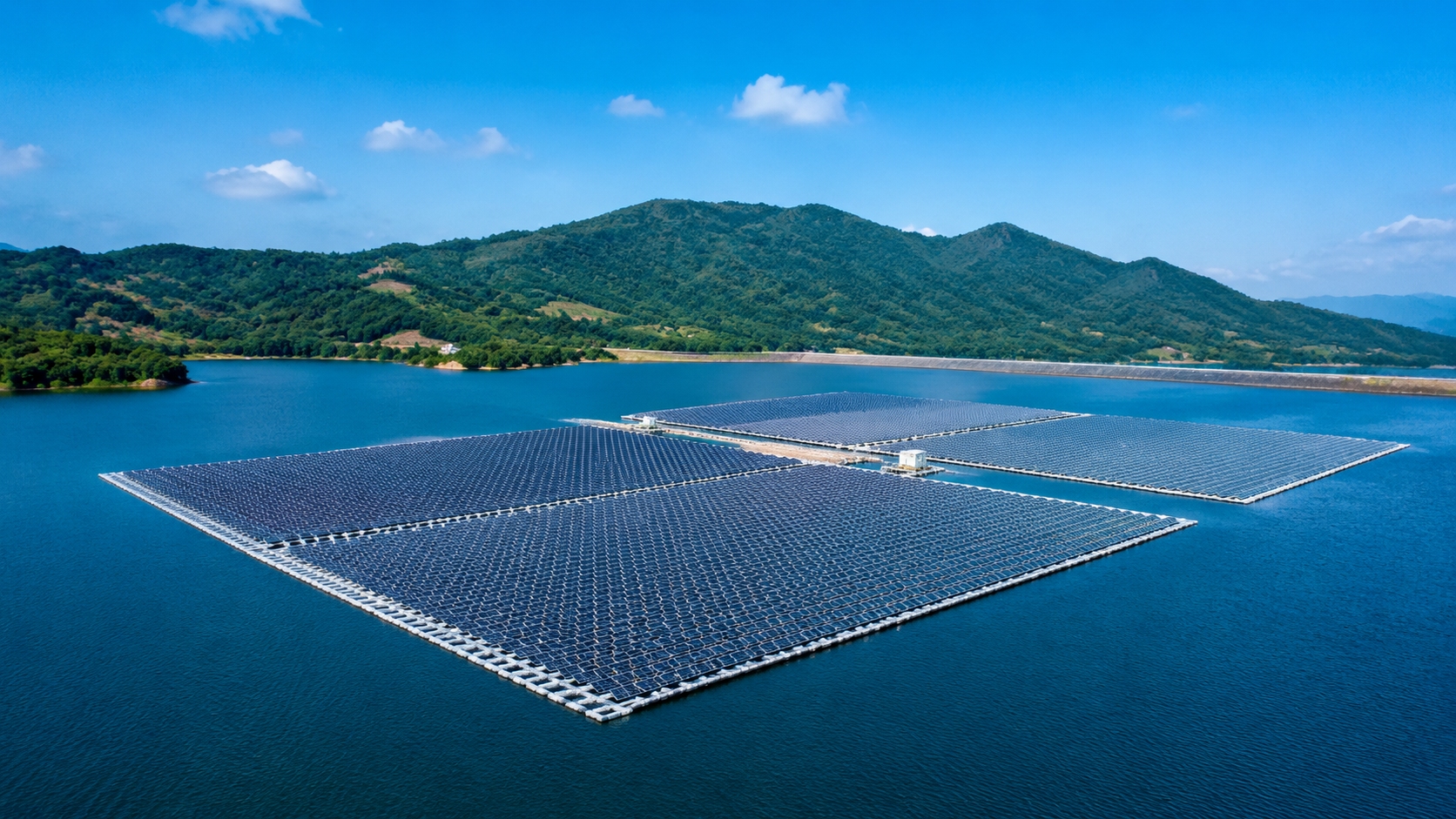
Cooling Effects
Keeping Modules Cool
The cooling effect of floating solar panels over water bodies is the physical foundation of their higher power generation efficiency compared to ground-mounted systems—for every 1 degree Celsius increase in photovoltaic module operating temperature, power generation efficiency decreases by approximately 0.4 to 0.5 percent, and the water body cooling effect lowers the floating array operating temperature 8 to 12 degrees Celsius below equivalent ground-mounted systems, translating to an efficiency boost of approximately 3 to 5 percentage points in power output, a figure that may seem modest but accumulates into substantial generation gains over a 25-year operational period when compounded across every megawatt of installed capacity at the project site.
Per NREL 12-month continuous monitoring data from Arizona, identical photovoltaic module models installed with floating water-surface mounting operated 8 to 12 degrees Celsius cooler than ground-mounted equivalents at the same site, and accumulated power generation over the 12-month period ran approximately 8 to 11 percent higher than the ground-mounted system, a difference that becomes even more significant in high-temperature climate zones where elevated ambient temperatures directly trigger power derating protection mechanisms in photovoltaic modules that reduce rated output under hot conditions, while the water body cooling effect fundamentally circumvents this problem by keeping module temperatures consistently below the derating threshold throughout peak summer generation periods.
The physical mechanism by which floating solar panels cool the water beneath them is: approximately 30 to 40 percent of solar radiation is reflected back into the atmosphere by the panel surface, while 60 to 70 percent is converted to electricity rather than thermal energy entering the water body, and the remaining heat is carried away through water evaporation, which acts as a passive cooling mechanism for the floating modules that prevents photovoltaic cells from experiencing the continuous high-temperature accumulation that causes ground-mounted solar module temperatures to climb steadily throughout the day during hot summer periods.
I once observed at an Arizona floating solar project site that the same row of modules, on the water-body side of the array, felt approximately 5 to 6 degrees Celsius cooler to the touch than the landward side, which is not a visual illusion but direct physical evidence of evaporative water body cooling, and the project operations team accordingly installed their water temperature sensors on the water-body side of the array to obtain more representative module efficiency reference data that better reflects actual operating conditions at the specific location within the array field and provides actionable data for performance monitoring and optimization.
Increasing Power Generation Efficiency
Quantified floating solar power generation efficiency gains come from multiple independent research studies: the NREL Arizona project recorded 8 to 11 percent efficiency gains, the Andhra Pradesh 140MW project recorded over 12 percent gains, and the Netherlands Rijnland 2.3MW floating test platform recorded 14.7 percent gains, and three independent data sources from different geographic and climatic contexts all point to the same conclusion: the efficiency advantage of floating installation is universal and reproducible across diverse project conditions and module technologies.
From degradation rate analysis over time, ground-mounted photovoltaic modules experience annual degradation of approximately 0.5 to 0.8 percent due to sustained high temperatures and ultraviolet radiation exposure, while floating photovoltaic modules with water body cooling maintain annual degradation rates of approximately 0.3 to 0.5 percent. This means that, after 25 years of operation, the floating photovoltaic module power retention reaches approximately 88 to 92 percent compared to approximately 80 to 87 percent for ground-mounted systems, an 8 to 10 percentage point gap that is most pronounced in years 15 through 25, when floating solar systems continue generating close to their rated output, while ground-mounted systems have already experienced significant degradation that reduces their effective generating capacity and increases their levelized cost of energy as the system ages past the 15-year mark.
I once compared matched generation data at the Rijnland Water Board 2.3 MW floating PV test platform in the Netherlands between identical model modules installed on land versus water at the same site: 12 months of field measurements showed the floating system generated approximately 14.7 percent more power than the land-based equivalent, with water body cooling contributing approximately 7 to 8 percentage points, scattered light optimization contributing approximately 4 to 5 percentage points, and clean water surface light reflection contributing approximately 1 to 2 percentage points of the total gain, and this decomposition is the most compelling evidence that floating solar efficiency gains are the result of multiple synergistic mechanisms rather than any single factor operating in isolation.
Mooring Technology
Maintaining Positional Stability
1.5 to 2.0 times the maximum drag force is the standard pre-tension ratio—maintaining positional stability of the floating solar array on the water surface is the prerequisite for safe operation, and the entire system is supported by HDPE high-density polyethylene floats that provide buoyancy far exceeding the self-weight of the photovoltaic modules and support structure, giving the entire assembly sufficient stability margin and load-bearing capacity to accommodate wind and wave loading without submerging or capsizing under normal operating conditions in the design environment.
The core of position maintenance is preventing horizontal drift, which is achieved through a combination of counterweight anchors and mooring chains, with counterweight blocks placed on the reservoir bed and mooring chains fixed at one end to the anchor and at the other to the array perimeter. The design process requires calculating the appropriate pre-tension force based on the local maximum wind speed and water current velocity, with pre-tension typically set at 1.5 to 2 times the expected maximum drag force to ensure that mooring chains remain taut under normal weather conditions and array position deviation stays within the design allowable range throughout the operational life of the project.
Anchor selection depends on seabed or reservoir bed conditions: sandy beds typically use drag anchors requiring mooring chain lengths of approximately 3 to 5 times the water depth, while rocky beds require expansion bolts or concrete pedestals for secure fixation, and for reservoirs deeper than 20 meters, floating solar arrays typically employ tension-leg mooring systems that use diagonal mooring lines to secure the array to a specified underwater depth, thereby reducing mooring chain requirements for deep-water installations that would otherwise face impractical chain length and weight demands if conventional vertical mooring approaches were used at those depths.
Design standards from DNVGL-ST-0126 and IEC 62689 provide the analytical framework for calculating anchor loads and mooring system safety factors, with the critical design parameter being the relationship between pre-tension force and the maximum expected drag force during extreme weather events. Exceeding a safety factor of 2.0 against the design limit state ensures that the mooring system will remain within elastic deformation limits and prevent permanent deformation or failure that leads to catastrophic drift events.
Resisting Strong Wind Forces
The primary threat that strong wind conditions pose to floating solar arrays is wind-induced vibration, where strong winds passing over the photovoltaic panel surface generate alternating vortices that induce panel surface oscillation, and while the vibration amplitude is typically small, it causes micro-crack propagation at the cell interconnect junctions within the photovoltaic modules, and the cumulative effect of this cyclic loading over time results in gradual output power degradation that the IEC 61215 standard specifically addresses through its UV aging tests, damp-heat tests, and dynamic mechanical load tests that are designed to verify photovoltaic panel resistance to such cyclic loading without significant power loss over a 25-year operational lifespan.
Wind tunnel experimental data shows that when wind speed exceeds 25 meters per second, approximately force 9 on the Beaufort scale, if the floating solar array is not equipped with an effective wind-resistant design, the spacing between adjacent photovoltaic panels decreases rapidly under wind loading, causing the panels to collide with each other, and a single collision event can cause glass breakage or frame deformation on the photovoltaic panel, and in tropical cyclone-prone regions such as the Bay of Bengal, designing floating solar arrays requires setting the wind resistance rating at no less than 55 meters per second wind speed safety margin to account for the extreme wind conditions that occur during cyclonic weather events that can develop rapidly and with little warning in those geographic regions.
I once assisted with the aftermath of a wind disaster at a 150 MW floating solar project where the mooring system had been designed using underestimates of local wind speed ratings, and during a single strong wind event, mooring chain failure caused the entire array to drift severely, requiring 2 weeks of extensive labor and resources to relocate and re-anchor the array to its proper position. This gave me a deep appreciation for the fact that mooring system design margins must fully account for the probability distribution of extreme weather events rather than relying solely on historical meteorological data averages, especially as climate change increases the frequency and intensity of extreme weather events globally and makes historical baselines less reliable predictors of future conditions at specific project sites.
In summary—the core value proposition of floating solar lies in the deep coupling of clean power generation and water resource conservation: the evaporation reduction from panel shading carries a trillion-dollar-scale strategic value across global arid regions; the efficiency gains from water body cooling remain stable and compound throughout the 25-year operational period; advances in mooring technology from static counterweights to intelligent tension monitoring systems are enabling floating solar to expand into deep-water zones, open-sea environments, and extreme climate regions that were previously considered unsuitable for this technology.
According to Nature Sustainability 2023 research, installing floating solar across 30 percent of the world's 114,555 reservoirs could generate 9,434 terawatt-hours annually while saving approximately 106 cubic kilometers of water—equivalent to protecting the annual domestic water consumption of approximately 260 million people, according to researchers who modeled these dual-benefit scenarios across multiple continents and climate zones.
According to NREL research, floating photovoltaic module operating temperatures run 8 to 12 degrees Celsius lower than ground-mounted installations, corresponding to efficiency improvements of 3 to 5 percentage points, with annual degradation rates reduced from 0.5 to 0.8 percent to 0.3 to 0.5 percent, accumulating to approximately 8 to 12 percent more total generation over 25 years of operation compared to ground-mounted systems at the same location.
According to the IEC 61215 standard framework, photovoltaic modules must pass UV exposure for 1,000 hours, damp-heat resistance for 2,000 hours, and dynamic mechanical load testing to verify resistance to cyclic loading without significant power loss over 25 years, and the water body cooling effect in floating solar fundamentally slows the thermal aging process from first-principles physics that makes high-temperature operation the primary degradation driver for crystalline silicon photovoltaic cells in ground-mounted installations.
According to NTPC India data, the Andhra Pradesh 140 MW floating PV project maintains reservoir surface temperature at 26 to 30 degrees Celsius year-round despite ambient temperatures reaching 40 degrees Celsius, while adjacent land-based photovoltaic module surface temperatures reach 55 to 62 degrees Celsius, producing annual power generation differences exceeding 12 percent between the two systems at identical installed capacity and geographic orientation over the same 12-month measurement period.