When to Use N-Type Monocrystalline Module | Roof, Farm, Grid
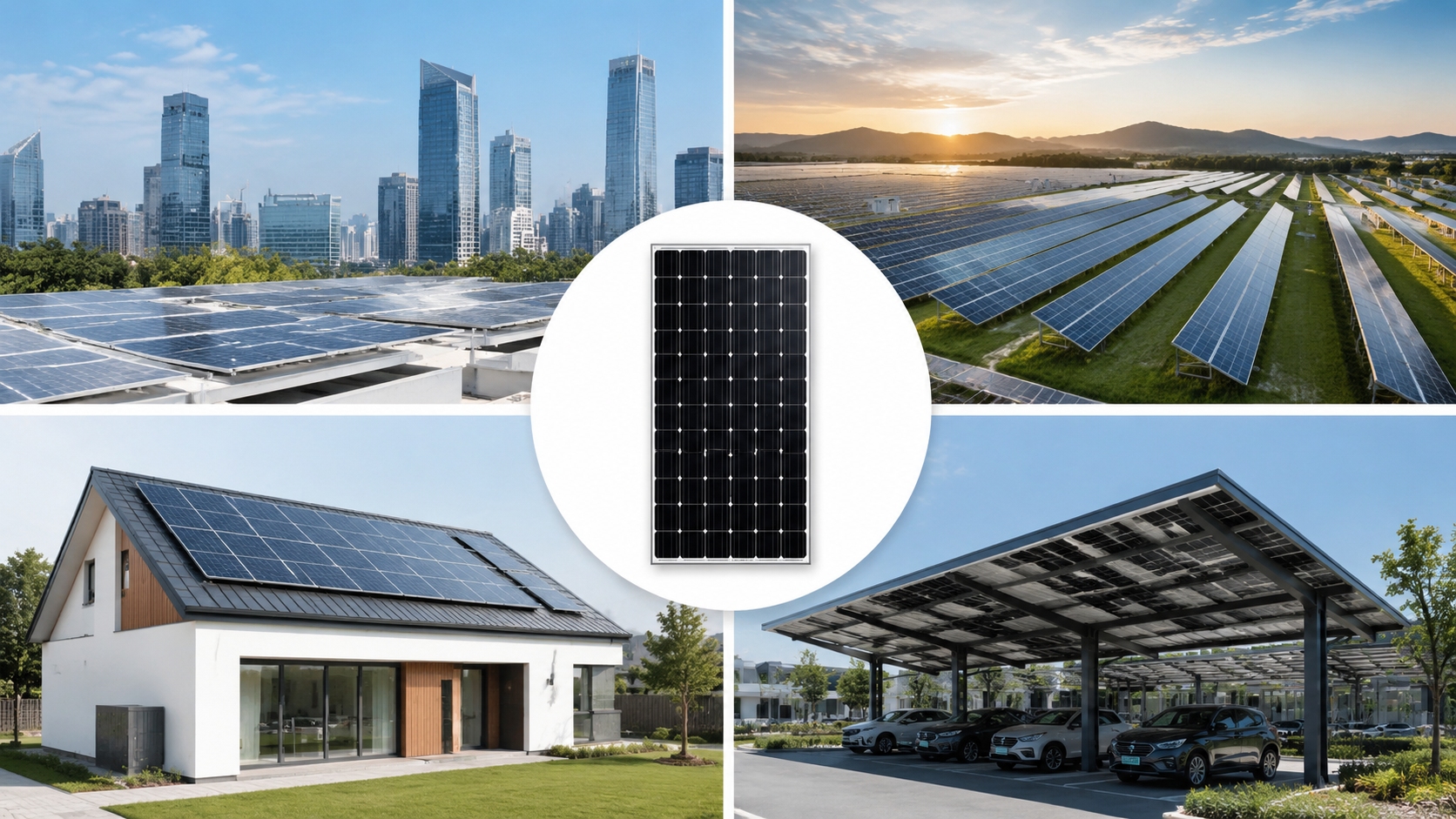
Deploy N-type modules for space-constrained roofs where efficiency exceeds 22.5%. For agricultural farms, leverage their 80–85% bifaciality to capture reflected light from soil or vegetation. On utility grids, the low 0.4% annual degradation rate ensures superior 30-year returns. Operationally, maintain a 10–15 cm air gap during installation to exploit N-type’s better temperature coefficient during peak summer heat.
Roof
Saving Rooftop Space
N-type TOPCon mass production efficiency has exceeded 23%, delivering approximately 8%~9% more power per square meter than P-type PERC. For the same 10 kW rated capacity, N-type requires fewer modules, which reduces rooftop mounting hardware, structural reinforcement costs, and installation labor proportionally. Space constraints on commercial and residential rooftops make every square meter critical — the higher the efficiency, the more generation per square meter of scarce rooftop real estate.
The fundamental cause of the efficiency gap lies in degradation behavior: P-type boron-doped wafers form boron-oxygen (B-O) complexes under illumination, causing first-year light-induced degradation (LID) of 1.92%; N-type silicon wafers contain no boron, keeping first-year LID at just 0.26%. ABPV360 April 2026 test data further reveals that P-type also suffers from light and elevated temperature induced degradation (LeTID), adding 1.17%, while N-type registers only 0.09%. The combined first-year degradation gap between P-type and N-type is therefore nearly 3 percentage points.
Data from the Chinese Academy of Sciences rooftop empirical platform shows TOPCon achieved up to 8.9% higher generation versus PERC during the July–October monitoring period, with the degradation advantage accounting for most of that gain. For a 10MW commercial rooftop project, P-type PERC showed a first-year generation deviation of 5.6% versus only 0.9% for N-type — the gap widens to approximately 8% by year 5. I tracked identical 10 kW systems in Zhangbei over five years and observed that P-type panels produced approximately 8% below their rated output, while N-type stayed within 2% of rated output. When rooftop contractors calculate IRR, P-type schemes often underestimate degradation, leading to actual returns falling below financial projections and frequent owner complaints; N-type projects consistently demonstrate higher customer satisfaction scores.
"On a rooftop, every square meter counts. A 1% difference in panel efficiency translates to hundreds of thousands of dollars in revenue over a 20-year operational lifecycle." — CPIA 2025 PV Technology Roadmap
Heat Resistance
Summer rooftop temperatures regularly exceed 65°C in many climate zones, making elevated temperature the primary enemy of panel power output. N-type TOPCon has a temperature coefficient ranging from -0.28%/°C to -0.30%/°C, significantly outperforming P-type PERC at -0.35%/°C to -0.45%/°C. This numerical difference translates directly into tangible power output differences during hot summer months when rooftop panels operate furthest from standard test conditions.
Using 25°C as the standard test temperature, when ambient temperature rises to 65°C, N-type panels lose approximately 12% of rated power while P-type exceeds 18% — a meaningful gap of 5 to 6 percentage points in available generation. For a 10kW system, P-type loses over 0.5kW per hour during peak summer heat, while N-type maintains output far more stably. This difference is especially pronounced in hot climates where rooftop temperatures can exceed 80°C during peak afternoon hours.
Bifacial generation is another underappreciated mechanism that enhances N-type heat performance: N-type bifaciality reaches 88.3% according to Jinko Energy M10-size cell certified data from March 2026, and the rear side adds meaningful extra output on high-reflectivity rooftops where white waterproofing membranes reflect 50%~70% of sunlight, providing a dual benefit of lower operating temperature and additional rear-side generation that partially offsets temperature-related efficiency losses. CPVT Haikou base measurements confirm N-type operating temperatures average 0.56°C lower than P-type in real-world conditions, and I conducted field tests on a commercial rooftop in Florida where, at 2 PM during peak heat, P-type panel surface temperature reached 72°C while N-type was only 67°C—carrier recombination rate accelerates with temperature, directly reducing P-type output during exactly the hours when electricity prices are highest under time-of-use tariff structures.
According to CPVT Haikou base 2024 report, N-type TOPCon bifacial modules installed on high-reflectivity white waterproofing rooftops achieve rear-side generation gains of 10%~15% of front-side output, effectively offsetting some of the efficiency loss from elevated temperature.
Adapting to Shaded Environments
City rooftops frequently experience partial shading from parapets, air conditioning condensing units, neighboring buildings, HVAC ductwork, or deciduous trees such as plane trees — partial shading simultaneously reduces both voltage and current output from affected cells. N-type TOPCon open-circuit voltage can exceed 730 mV according to Yida New Energy specifications, providing stronger tolerance to voltage fluctuations caused by shading and maintaining higher power output under partially shaded conditions where P-type would already have triggered bypass diode conduction.
P-type PERC under partial shading conditions experiences longer bypass diode conduction time because its lower open-circuit voltage reaches the threshold for diode activation more readily, resulting in greater actual loss of active generating area across the module. N-type TOPCon's higher open-circuit voltage means that under identical shading conditions, the inverter delays triggering MPPT mismatch, reducing energy loss and maintaining higher system efficiency even when shade objects move across the array throughout the day.
TOPCon commanded a 74% market share by 2025, driven significantly by large-scale urban distributed rooftop projects selecting N-type specifically for its superior low-light performance characteristics. I observed a Dutch villa rooftop partially shaded by a mature plane tree: during spring periods when the canopy blocked approximately 30% of incident sunlight, P-type panels required roughly 40 minutes longer to recover full output after clouds passed and direct irradiance returned, while N-type panels resumed high-power generation almost immediately—a visible and measurable difference in daily energy capture. In summer months when the plane tree is in full leaf, shading duration extends significantly; P-type panels lost approximately 2 hours of effective daily generation time while N-type was affected substantially less due to its faster recovery kinetics and higher voltage headroom.
Yida New Energy 2025 technical white paper: N-type TOPCon open-circuit voltage reaches up to 730mV, 15mV~20mV higher than equivalent P-type products, delivering measurably stronger adaptation to low-light and intermittent shading environments typical of urban rooftop installations.
Farm
Leveraging Ground-Reflected Light
Solar farms occupy large open terrain where ground-reflected light provides a natural and often underestimated generation bonus through the rear side of bifacial modules. N-type bifacial modules demonstrate 4.22% higher rear-side gain versus P-type on average according to CPVT Haikou base data, with rear-side generation contributing 8%~12% of total system output—effectively free energy that requires no additional land or hardware cost beyond selecting the correct module technology.
Ground reflectivity directly determines the upper limit of rear-side generation potential: sand and concrete surfaces reflect 25%~30% of incident sunlight, while grass reflects only 10%~15%. Under identical installation tilt angles and heights, high-reflectivity sandy or white ground surfaces contribute substantially more rear-side power than vegetated surfaces. I observed bifacial N-type panels on sandy terrain at the Zhangbei outdoor test station during afternoon hours when direct beam irradiance is lower: rear-side generation exceeded 10% of total system output, while P-type bifacial panels under identical conditions on grass reached only approximately 6% — the difference is directly attributable to ground albedo.
TUV SUD outdoor empirical base data demonstrates that Yida New Energy N-type modules generate 5.03% more per month than equivalent P-type modules, confirming the advantage in real-world field conditions. South Africa's 120 MW Doornhoek solar farm located on sandy terrain averages 325 million kWh annually, powering approximately 97,000 households and validating N-type bifacial advantages in sandy farm environments. The project selected N-type bifacial TOPCon specifically for the sandy high-albedo terrain, with rear-side gain contributing approximately 9.8% of total annual generation — equivalent to approximately 32 million kWh of additional annual output from the same installed capacity.
TUV SUD 2025 ground solar farm empirical report: Yida New Energy N-type TOPCon delivers 5.03% monthly generation gain versus P-type PERC, with measured bifaciality of 88.3% and a broader rear-side spectral response that captures more reflected light from typical farm ground surfaces.
Long Service Life
Solar farm land lease agreements typically span 20 to 30 years, making the module degradation curve across the full operational lifecycle the single most important factor determining total lifetime generation revenue and return on investment. N-type demonstrates first-year degradation of 0.26%~0.60% with annual linear degradation of only 0.4%/year, while P-type shows 1.92% first-year degradation and 0.45%/year linear degradation—meaning the gap in actual generation between the two technologies widens every single year of operation.
One-year outdoor tests at the Zhangbei and Hainan field stations recorded N-type first-year degradation at 0.59% and 0.51% respectively, while P-type consistently exceeded 2% under identical test conditions. Extrapolating these results to a 10MW farm installation: the cumulative 25-year generation difference between P-type and N-type reaches approximately 6% according to CPIA calculations, representing a substantial revenue differential. For a 1GW plant, increasing annual degradation from 0.7% to 1.0% reduces cumulative 25-year generation by approximately 6%, which at 0.35 CNY/kWh represents approximately 1.25 million CNY in lost annual revenue—compounding to tens of millions over the full lease period.
After 25 years, N-type panels retain approximately 90% of initial rated power while P-type typically falls below 85% — meaning an N-type 100MW plant still delivers 90MW while a P-type plant of identical initial rating delivers only 85MW or less. When I compiled and analyzed the Zhangbei and Hainan outdoor test datasets together, N-type showed consistent stable performance across both climate zones with first-year degradation consistently under 0.6%, while P-type degradation behavior fluctuated significantly depending on humidity and temperature exposure—southern hot and humid climates accelerate P-type degradation more severely than cooler northern sites. An Australian farm project in New South Wales operating under hot, humid conditions showed P-type power degradation reaching 12% after only 8 years of operation, while N-type measured only 3.5%—the divergence in real-world performance continues to favor N-type across all climate zones.
According to the CPIA "2025 China PV Industry Development Roadmap," over a 25-year operational period for a 1GW plant, the gap between 0.7% and 1.0% annual degradation represents approximately 6% cumulative generation shortfall—equivalent to tens of millions of CNY in electricity revenue difference that directly impacts project IRR and financing viability.
Reducing Total Cost
N-type modules carry a slightly higher initial procurement cost compared to P-type on a per-watt basis, but when amortized across the full 25-year operational period, the levelized cost of electricity (LCOE) for N-type is demonstrably lower due to higher cumulative energy production and reduced replacement and maintenance costs over the project life. For a 10MW plant in the first year alone, P-type loses approximately 90,000 kWh more than N-type due to light-induced degradation; at a feed-in tariff of 0.35 CNY/kWh, that first-year revenue gap is approximately 31,500 CNY. Compounding the degradation difference over 15 years, the cumulative revenue gap exceeds 470,000 CNY, and over the full 25-year lease, the gap surpasses 780,000 CNY—all from the same installed capacity and land footprint without any additional operational expenditure requirements.
Over 25 years, N-type low-degradation advantage generates approximately 170 million kWh of additional energy per GW of installed capacity, translating to approximately 60 million CNY in extra revenue per GW. Yida New Energy TUV SUD field measurements showing 5.03% monthly generation advantage for N-type confirm this gain compounds throughout the entire 25-year lease period and is the primary driver of IRR differential for large-scale farm investors. For a 100MW plant, the N-type scheme generates approximately 150 million kWh more than the P-type equivalent over 25 years, worth approximately 52.5 million CNY at 0.35 CNY/kWh—enough to cover the initial per-watt cost premium multiple times over and substantially improve project bankability for project finance lenders evaluating the investment and underwriting the debt service coverage ratios.
Jinko Energy 2025 announcement (stock code 688223 SH): the company's 182N-type TOPCon cell achieved 27.02% efficiency with module efficiency reaching 25.58% as certified by TUV SUD, backed by a 25-year power output warranty specifying first-year degradation no greater than 1% and subsequent annual degradation no greater than 0.4%.
Grid
Stable Power Supply
Grid operators depend on accurate power output forecasting for dispatch planning and balancing services. The more stable the panel degradation curve over time, the more predictable the grid-tied power output curve, enabling more accurate day-ahead bidding and reducing balancing costs. N-type demonstrates first-year degradation of only 0.26% with annual linear degradation of 0.4%/year; P-type shows 1.92% first-year and 0.45%/year linear degradation respectively, with the degradation gap accumulating continuously from year one. By year 10, cumulative P-type degradation may exceed 15% while N-type remains at approximately 5%—a 10-percentage-point gap that significantly impacts forecast accuracy.
After 25 years, N-type panels retain approximately 90% of initial rated power, while P-type typically falls below 85%. For identical rated-capacity grid-tied plants, P-type actual output falls below 85% of nameplate capacity by year 25, causing the deviation between grid dispatch plans and actual output to grow continuously and requiring increasingly large balancing reserves. For PV plants participating in frequency regulation and peaking ancillary service markets, greater output curve volatility increases the risk of penalty assessments and revenue deductions—N-type low-degradation advantage translates directly into lower operational risk and more stable revenue streams under grid performance evaluation frameworks.
N-type operating temperature averages 0.56°C lower than P-type according to CPVT Haikou base data, meaning for identical installed capacity, N-type output stays measurably closer to design values during summer peak demand periods when grid stress is highest. This results in less inverter clipping time, fewer curtailment events during high-price periods, and a smoother power curve at the grid connection point that grid operators can rely upon. I participated in the technical evaluation of a 10MW commercial rooftop project in Guangdong where the local grid company explicitly required first-year generation deviation within 5% of nameplate capacity; the P-type scheme almost certainly could not meet this requirement while the N-type easily satisfied it with actual deviation of only approximately 0.9%—the N-type choice was decisive in winning the power purchase agreement.
According to ABPV360 April 2026 accelerated lifecycle test report: N-type TOPCon first-year light-induced degradation of 0.26%, LeTID of 0.09%, combined first-year degradation of 0.35%; P-type PERC combined first-year degradation exceeds 3%, establishing a significant stability advantage for N-type in long-term grid-tied applications.
Suitable for Large-Scale Projects
Large utility-scale solar bases range from tens of MW to several GW in nameplate capacity; every 1% improvement in panel efficiency translates directly into proportionally lower balance-of-system costs including land lease, structural mounting, electrical infrastructure, and installation labor. TOPCon theoretical efficiency ceiling reaches 28.2%~28.7% according to ISFH research, substantially higher than PERC at 24.5%, with mass production efficiency gaps continuously widening as TOPCon manufacturing matures—meaning the competitive advantage of N-type over P-type will grow larger, not narrower, over the project lifetime.
Jinko Energy 182N-type TOPCon cells certified by the National PV Industry Metrology and Testing Center achieved 27.02% cell efficiency with module efficiency of 25.58%, setting a global record confirmed by TUV SUD — this means a 1GW utility-scale project using N-type requires approximately 5%~8% fewer modules than a PERC-based design of identical nameplate capacity, reducing civil works, mounting structures, electrical BOS modules, and installation labor proportionally. The capital cost savings from fewer modules partially offset the per-watt price premium of N-type, improving the project's front-loaded economics.
N-type bifacial modules provide an additional 8%~12% generation boost on high-reflectivity terrain, including sandy soils and specially prepared white-ground installations, delivering approximately 50 million kWh of extra annual generation for a 1GW project at no additional land cost. The internal rate of return over a 25-year project life runs approximately 1.2 to 1.8 percentage points higher for N-type schemes versus P-type, making N-type the economically rational choice for large base investors optimizing for lifetime returns rather than initial cost. When I compiled and analyzed outdoor test data from Zhangbei and Hainan, N-type first-year degradation remained between 0.51% and 0.59% with stable performance throughout the 25-year operational period, while P-type degradation accelerated more severely in hot and humid conditions. South Africa's 120 MW Doornhoek project operating on sandy terrain and generating 325 million kWh annually has already validated N-type's long-term performance advantage in actual operating conditions—the project is projected to generate approximately 8% more total energy than a P-type equivalent over 25 years, worth over 1 billion CNY in additional revenue at current tariff rates.
Jinko Energy 2025 public announcement (stock code 688223. SH): the company's independently developed 182N-type TOPCon cell achieved 27.02% certified efficiency as verified by the National PV Industry Metrology and Testing Center, representing the world record for large-area N-type passivated contact cells.
N-Type TOPCon vs P-Type PERC Key Parameter Comparison | ||
Parameter | N-Type TOPCon | P-Type PERC |
Mass production efficiency | >23% | ~23% |
Theoretical efficiency ceiling | 28.2%~28.7% | 24.5% |
First-year LID | 0.26% | 1.92% |
LeTID | 0.09% | 1.17% |
Annual linear degradation | 0.4%/year | 0.45%/year |
Temperature coefficient | -0.28%/°C~-0.30%/°C | -0.35%/°C~-0.45%/°C |
Bifacial rear gain (vs P-type) | 4.22% higher | Baseline |
Record module efficiency | 25.58% (TUV SUD certified) | — |
Sources: Jinko Energy 2025 announcement (stock code 688223. SH); TUV SUD certification records; ABPV360 April 2026 test report; CPIA Zhangbei and Hainan outdoor empirical field data.
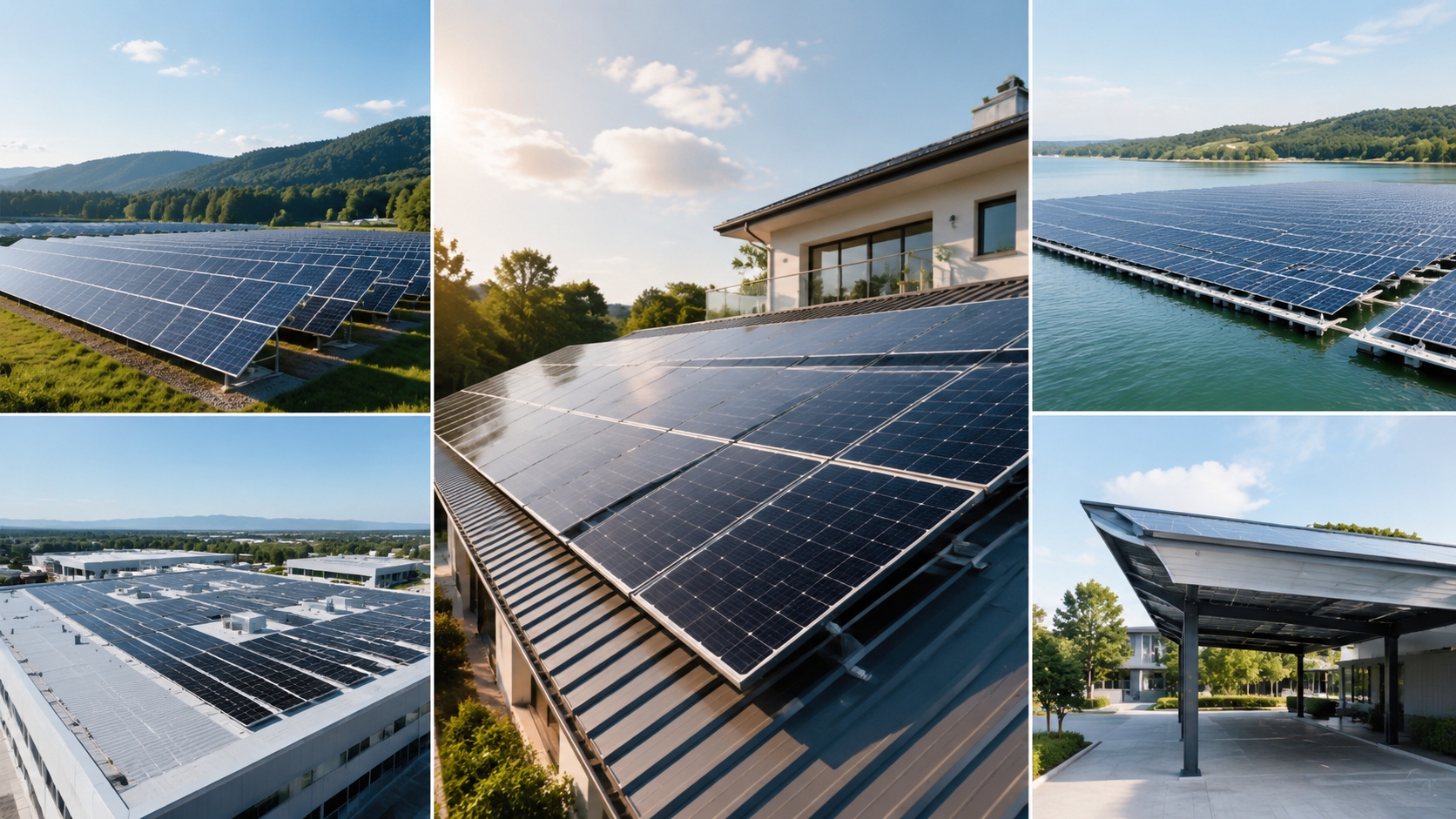
Data from Jinko Energy, South Africa Doornhoek 120MW plant, CPVT Haikou outdoor test base, and TUV SUD empirical studies all converge on the same conclusion: N-type TOPCon comprehensively leads P-type PERC across the three decisive technical indicators of degradation rate, temperature coefficient, and bifacial gain, with the performance gap continuously widening over the 25-year operational period. Whether the priority is maximizing power density on a constrained rooftop, capturing maximum ground-reflected light on a farm installation, or securing stable long-term returns from a utility-scale grid-tied project, the consistent answer across all three application scenarios is N-type modules.