How to Clean Lightweight Portable Solar Modules | Tools, Steps, Care
To maximize output (increasing efficiency by up to 25%), clean modules during early morning or evening to prevent thermal shock. Use a soft microfiber cloth with distilled water or a 1% mild soap solution. Gently wipe in circular motions, avoiding abrasive brushes, then dry with a lint-free towel to prevent hard-water spots and maintain the module's protective coating.
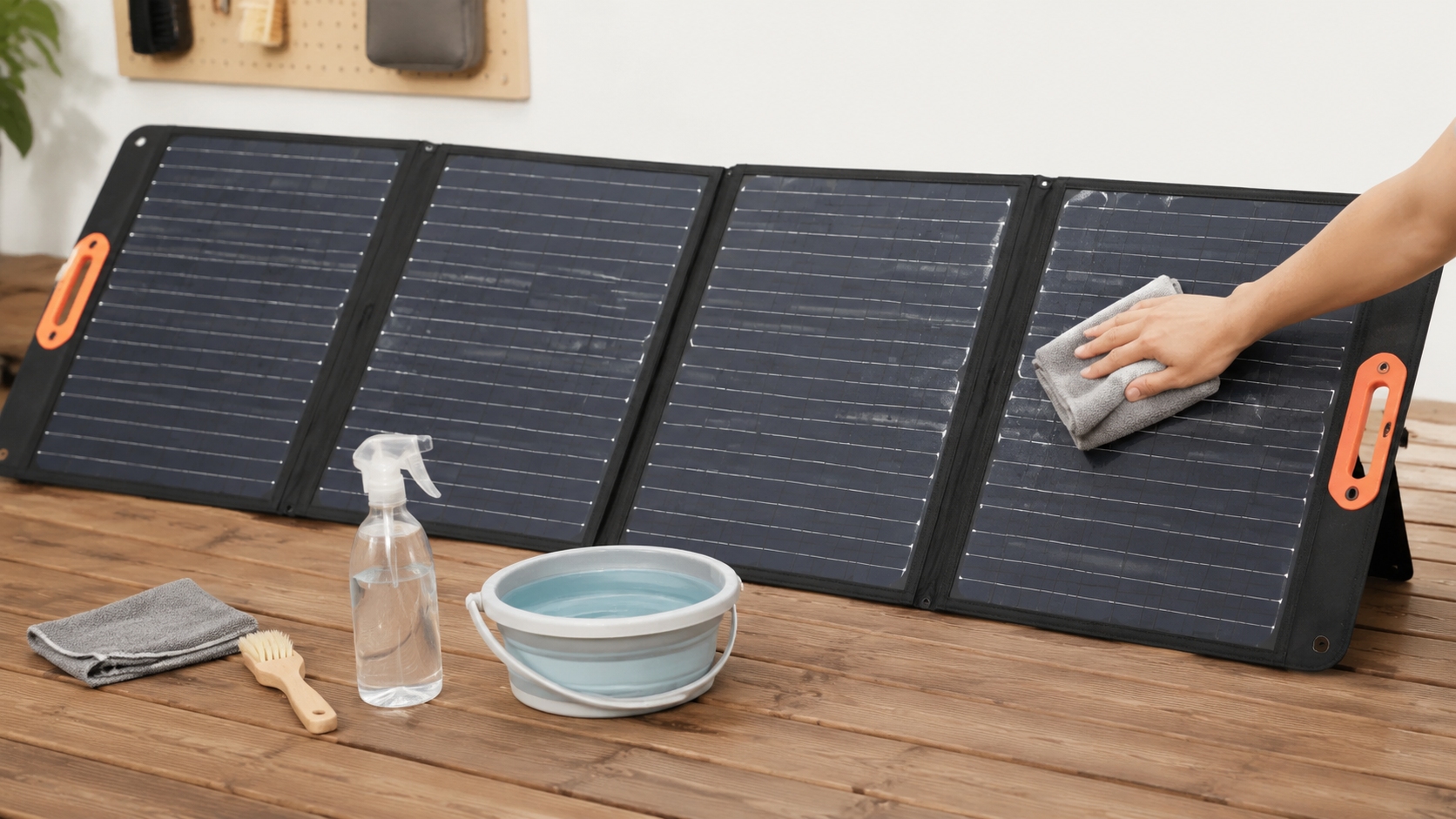
Tools
Soft Microfiber Cloth
TÜV Rheinland testing shows that microfiber cloths capture 97% of particles larger than 2μm, while ordinary cotton cloths capture only about 60%. Microfiber filaments measure just 0.06-0.08 dtex, with wedge-shaped cross-sections that physically entrap dust particles rather than pushing them across the surface, significantly reducing the risk of micro-scratches during friction. Before cleaning, fold the cloth into 4-8 layers, switching to a clean layer each time a layer becomes soiled—this prevents captured particles from circulating inside the cloth and causing secondary abrasion. Choose a non-woven microfiber cloth with a grammage of 80-120 g/m², which offers sufficient fiber density without shedding lint, and can be washed and reused over 200 times.
Test softness with the back of your hand before use—the texture should feel silk-like rather than rough. Wash in water below 40°C by hand, avoiding fabric softener (which forms a hydrophobic film on fibers, reducing particle-capture ability). Air-dry flat in shade to prevent fiber deformation. Replace with a new cloth every 3 months, as aged microfiber loses significant particle-capture efficiency.
Also pay attention to the fiber weaving method—needle-punched non-woven fabric is approximately 15% more effective at trapping particles than woven cloth. Dark-colored clothes are preferable outdoors, as light-colored ones easily show stains, making it harder to judge cleanliness. Store the cleaning cloth separately from rough gear in your backpack to prevent accidental fiber wear or oil contamination.
Pure Distilled Water
Tap water contains calcium, magnesium, and other minerals—hard water areas can have TDS (total dissolved solids) of 100-300 mg/L, leaving white mineral deposits upon drying. NREL research shows that tap water residue can reduce local light transmittance by 3%-5%, equivalent to a daily power loss of approximately 0.3-0.5 W per 100 W panel. Portable solar panels are often used in the wild where tap water is unavailable, so prepare in advance by carrying distilled or purified water in a sealed LDPE water bag with a capacity of 1 L or more, weighing only about 1 kg—minimal additional load.
Use a portable TDS meter before a trip to quickly check water quality—sources with TDS >50 mg/L are not recommended for direct use. If distilled water is truly unavailable, rainwater filtered through a fiber cloth can serve as an emergency substitute, but wipe dry immediately with a dry cloth; do not leave it sitting overnight as this promotes microbial growth. Market prices for portable distilled water are approximately $2-5 USD per liter; plan to carry 200-300 ml per cleaning session.
When obtaining water is difficult in the field, a car inverter (12V DC to 110/220V AC) can power a small portable distiller, producing approximately 500 ml of distilled water per hour—suitable for sustained cleaning during multi-day outdoor operations. If using mineral water as an emergency substitute, choose low-TDS products (<50 mg/L), but only in emergencies—mineral water still contains more dissolved solids than distilled water and may leave trace deposits on the panel surface after drying.
Soft-Bristle Brush
Select a soft-bristle brush made of nylon filaments with a diameter of 0.1-0.15 mm—well below the Mohs hardness of 7 for solar glass, causing no surface scratching. Bristle length should be 20-40 mm; too short creates excessive rigidity and concentrated pressure, while too long causes bristles to spread and fail to effectively transfer cleaning force. For dried loose sand and grit on the surface, sweep gently with the brush before wiping—this prevents particles from being dragged across the cloth surface and creating micro-scratches. After brushing, use the cloth to wipe in a single direction to remove residual fine dust, preventing retained particles from causing wear during the next cleaning.
When selecting a brush, press the bristles gently with your thumb—it should glide across glass without scratching, and the bristles should fully conform to the surface. Rinse bristles with clean water after use, then air-dry to prevent bristle deformation. Replace with a new brush every six months; aged bristles lose elasticity and cleaning efficiency drops significantly. A foldable telescopic-handle brush is especially suitable for outdoor use, collapsing to approximately 15 cm in length and weighing only about 80 g.
An electric toothbrush on its gentle vibration mode can also serve as a temporary substitute for a soft-bristle brush—move the brush head slowly across the panel surface, the vibration frequency of 6,000-12,000 pulses per minute can dislodge loose particles without applying pressure, though you will still need to wipe away the released particles with a cloth afterward. This method is for emergencies only and should not replace the soft-bristle brush for regular maintenance. Replace a brush immediately if bristles become split or frayed.
Steps
Remove Surface Dust
Before cleaning, be sure to disconnect the system from power to avoid microcurrents or electric shock from touching live connectors. Dust is the most common contaminant on solar panels—NREL research indicates dust accumulation can reduce photovoltaic transmittance by 5%-25%, with approximately 3-15 g of dust accumulating per square meter per week, and up to 30g/m²/week in arid desert-edge regions. Use a dry soft-bristle brush at a 30-degree angle close to the glass surface, sweeping rapidly in one direction (e.g., left to right) without pressing—the electrostatic-adhered particles will naturally be intercepted by the brush fibers. Never use hard plastic scrapers or credit card edges to scrape the panel surface.
Laboratory testing shows that visible scratches left by credit card edges can reduce peak panel power output by approximately 8%, and these scratches are irreversible. According to REI outdoor forum users, a hiker who used pre-moistened wipes containing abrasive particles to clean a foldable solar panel found fine scratches on the panel surface after just one month, with peak power output dropping by approximately 8%.
After brushing, tilt the panel 15-20 degrees and give it a few gentle shakes, letting loose particles fall away under gravity. If there are spider webs or leaf debris on the surface, remove them carefully with tweezers first, then brush—preventing heavier debris from being pushed into frame gaps during wiping. Clean in the early morning or evening, avoiding panel cleaning under direct scorching sun—cleaning agents evaporate quickly on hot panels, leaving water spots instead.
Gently Wipe the Surface
Moisten the microfiber cloth with distilled water until it no longer drips (approximately 2-3 times its own weight in water), then fold and grip it in your palm. Apply pressure no greater than 2 N (approximately 200 g of force), wiping gently in circular motions to maximize protection of the anti-reflective coating. Wipe an area of approximately 20 cm × 20 cm at a time, checking cloth cleanliness after every 2-3 wipes and switching to a clean section when the cloth becomes dirty. For the junction between the edge frame and glass surface, use the narrow tip of the cloth to carefully clean—this area has the most stubborn deposits, but a small area, so excessive force is unnecessary and may damage the sealing adhesive.
Stubborn tree sap (such as pine resin) can be removed by placing a cloth moistened with 1-2 drops of medicinal alcohol on the spot for 30 seconds before wiping—alcohol dissolves most organic contaminants and evaporates without residue. Use 75% concentration medicinal alcohol; higher concentrations evaporate too quickly to dissolve the contaminant. After using alcohol, wipe again with a damp cloth to prevent alcohol residue from blocking the light path.
Coverage should span the entire glass surface—recommended approach is along a diagonal from the top-left to bottom-right, with each wipe stroke overlapping adjacent strokes by approximately 3 cm to ensure no gaps. Never wipe back and forth in a single horizontal or vertical direction—this rolls particles into clumps and creates arc-shaped scratches on the glass. If the cloth becomes particularly dirty during wiping, replace it immediately with a clean cloth—wiping with a dirty cloth is equivalent to rubbing glass with abrasive, multiplying scratch risk.
Air Dry Naturally
Use a second dry microfiber cloth to gently absorb residual water droplets using a pressing motion rather than back-and-forth wiping—this prevents water droplets from being spread into water spots. Air dry naturally—never use a hairdryer. Direct hot air on the panel accelerates aging of the sealing adhesive at the glass-frame junction, increasing moisture infiltration risk. NREL research indicates that high temperatures accelerate aging of the EPDM sealing gasket at the panel edge, and long-term repeated thermal exposure compromises seal integrity, causing waterproof rating to gradually decline from IP67.
Tilt the panel at a 15-30 degree angle during air drying to accelerate natural moisture runoff. Check the glass surface for residual water spots or fiber marks; dab locally with a cloth tip if needed. Allow the panel to rest for at least 30 minutes after the entire cleaning process, ensuring connectors are completely dry before storing. If storage or transport is urgent, use a compressed air canister (the kind used for camera cleaning) to blow away residual water droplets, keeping the nozzle at least 15 cm from the glass and using moderate pressure—excessive pressure will blow water droplets into frame seams.
Compressed air canisters contain inert gas (such as nitrogen), which has no adverse effects on photovoltaic modules. If no canister is available, tilt the panel and gently tap the frame edges, allowing excess water droplets to slide off under gravity. During air drying, avoid direct sunlight on the panel—water droplets may create hot spots through the light-focusing effect, damaging local cells. Complete the entire air-drying process in a cool, ventilated area.
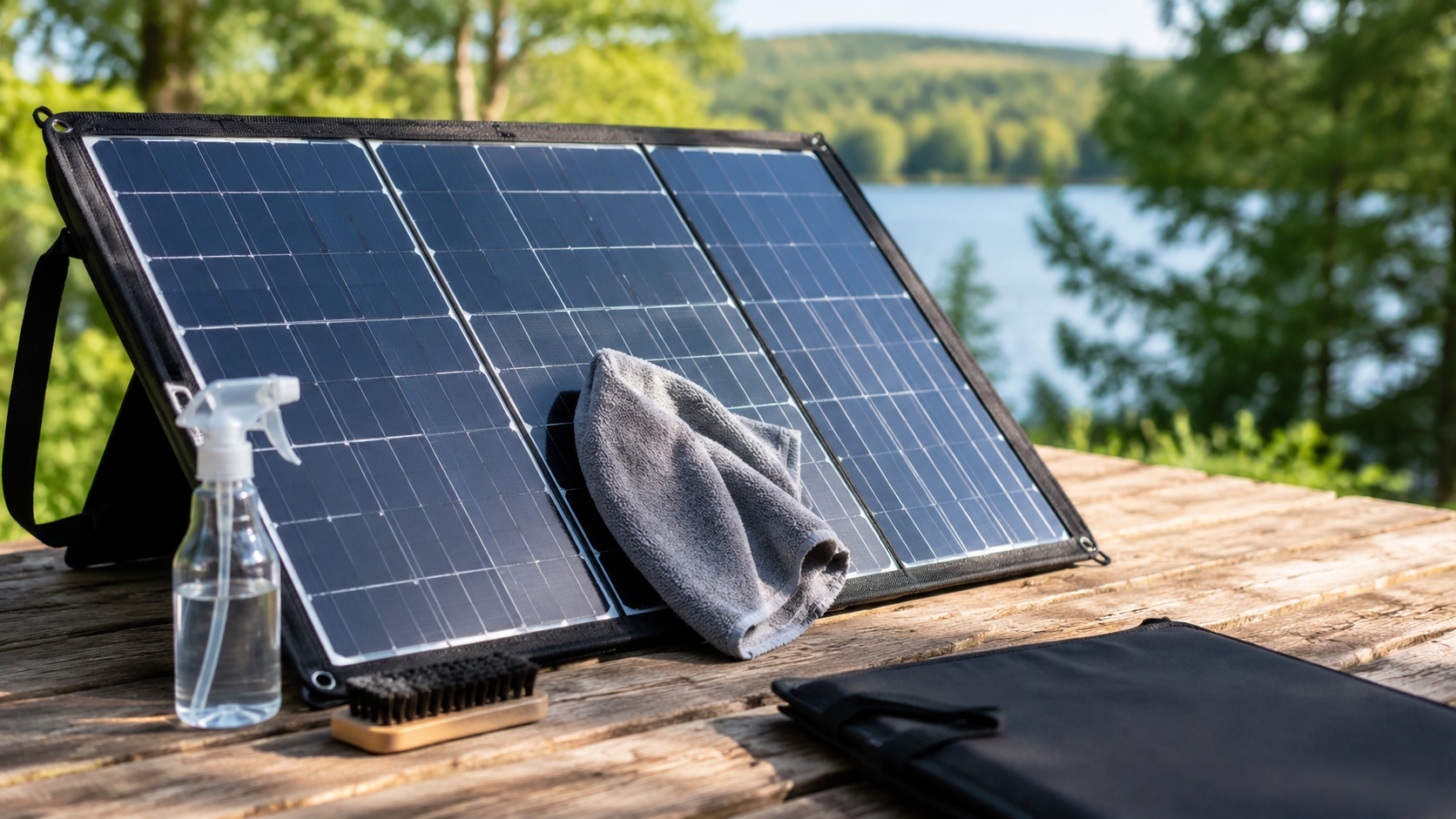
Care
Avoid Harsh Soaps
Strong alkaline cleaning agents with pH >10 corrode the anti-reflective coating (ARC layer) on the solar glass surface, causing permanent transmittance reductions of 0.5%-2%—an irreversible form of damage. Abrasive cleaning creams or scouring powders are equally prohibited—SiO2 abrasive particles, typically 1-10μm in diameter, leave micro-scratch clusters after friction that are invisible to the naked eye but reduce panel transmittance and accelerate future dust accumulation. Even neutral soaps (pH ≈ 7) leave a transparent film from dried residual surfactants that blocks part of the incident light path.
A California case shows that a surf fisherman who used tap water to clean a foldable panel in a salt spray environment—the inadequately rinsed chloride accelerated corrosion of the MC4 connector metal contacts, raising contact resistance to four times the normal level after three months. It is recommended to use only distilled water or a dedicated photovoltaic panel cleaner (pH 6.5-7.5), free from abrasives and bleaching agents, which can air dry naturally without rinsing.
Before using a dedicated photovoltaic cleaner, test it on a small, inconspicuous corner, observing for iridescent marks (signs of coating damage) before applying to the full panel. Water-based glass cleaners for car windshields can be used for emergencies, but avoid products containing ammonia—ammonia reacts with Si-OH groups on the glass surface, altering local refractive index.
Inspect Cables
Before and after each use, grip the MC4 connector between thumb and forefinger and gently wiggle it to check for looseness. MC4 connectors carry an IP67 waterproof rating, but long-term UV exposure increases rubber seal hardness by approximately 5 Shore A per year, potentially compromising sealing performance after 3-5 years. Inspect cable outer jackets for cracks, animal bite marks, or friction wear (commonly found at contact points with mounts and backpack straps)—these mechanical damages are often visible to the naked eye yet most easily overlooked.
A foldable panel user reported that during camping, backpack straps rubbing against the power cable for six months caused the outer jacket to crack, nearly leading to a short circuit and fire. Upon discovering cable damage, stop use immediately, wrap temporarily with waterproof tape, and replace as soon as possible—do not continue energizing to avoid arcing that could trigger a fire. When not in use for extended periods, protect connectors with dust covers to prevent sand from entering the sealing surface and affecting contact impedance.
It is recommended to apply a layer of dielectric grease to connector sealing rings before each rainy season, which delays rubber aging caused by UV and ozone. When plugging or unplugging MC4 connectors, grip the connector body itself rather than the cable—rough pulling is the main cause of internal copper wire breakage; breakage points generate local hot spots with thermal runaway risk. Before prolonged storage, wrap exposed connector areas with waterproof tape, then place in a waterproof storage bag.
Store in a cool place
Monocrystalline silicon panel maximum operating temperature is 85°C, and the maximum storage temperature is also 85°C. For portable units with built-in lithium batteries, the storage temperature recommendation is no higher than 45°C to delay electrolyte decomposition. High temperatures not only accelerate aging of the panel edge EPDM sealing gasket and reduce waterproof sealing, but also significantly increase lithium cell self-discharge rates. NREL research indicates that lithium batteries stored at 65°C experience annual capacity decay approximately three times greater than those stored at 25°C.
Portable panels are often stuffed into car trunks, where summer direct sunlight can push interior temperatures to 70-80°C—far exceeding safe storage thresholds. It is recommended to store panels in insulated soft cases or foam boxes, which provide both light-and-heat insulation and shock absorption during transport. Check cell charge every three months during long-term storage, maintaining charge between 40%-60% to significantly slow lithium-ion electrolyte decomposition.
Store panels in temperature-stable areas such as a bedroom closet or basement, with humidity controlled at 30%-60% RH to prevent connector metal oxidation. If planning to store unused for more than six months, fully disconnect the panel from the system, store the cell module separately in a dry environment at 15-25°C and 40-50% humidity, and seal it after charging to 50%—this represents the best practice for long-term lithium cell storage.
Sources: TÜV Rheinland Microfiber Cleaning Efficiency Test (2022), NREL Photovoltaic Module Soiling Loss Study (2023), IEC 61215 Ed.3 Photovoltaic Module Maintenance Handbook, REI Outdoor Forum User Case Reports
Portable Solar Panel Cleaning Tools Comparison | |||
Tool | Recommended Specification | Prohibited Items | Price Range (Reference) |
Microfiber Cloth | Grammage 80-120g/m², non-woven, lint-free | Abrasive cloths, hard cotton cloths | $5-15 |
Distilled Water | TDS <10 mg/L, capacity 1-2 L | Tap water, mineral water (contains minerals) | $2-5 |
Soft-Bristle Brush | Nylon filament diameter 0.1-0.15 mm, bristle length 20-40 mm | Hard brushes, metal brushes, plastic scrapers | $8-25 |