What Myths About Solar Energy Should You Stop Believing | Reliability, Performance
First, extreme cold does not cause a solar system to stop working. In fact, because temperatures fall below the standard test condition of 25°C, photovoltaic panels become more conductive and can generate electricity more efficiently.
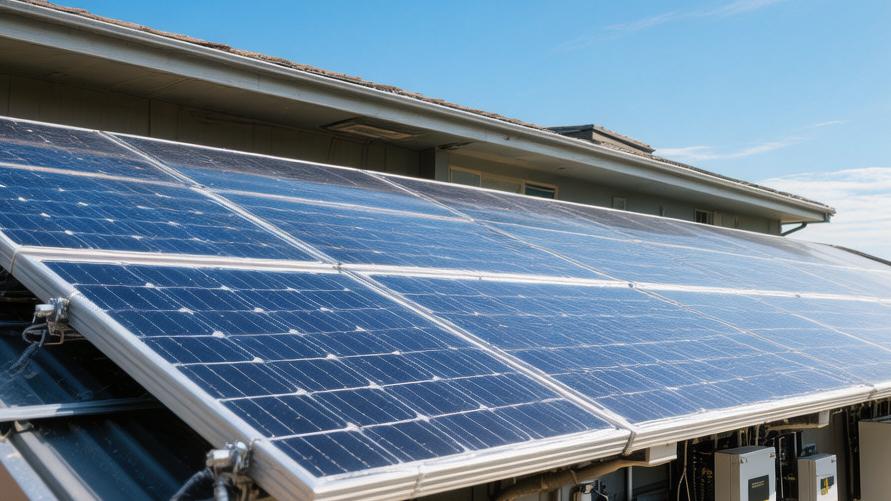
Second, modern modules are highly reliable. With no moving parts, hardware failure rates are reduced to an extremely low level of around 0.05%, and the tempered glass surface can withstand hail impacts from stones 25 mm in diameter traveling at 80 km/h.
Finally, the idea that solar panels "degrade quickly" is simply a misconception. The annual degradation rate of today's high-quality panels is generally kept below 0.5%, which means that even after 25 years of continuous heavy-duty operation, the system can still reliably maintain more than 85% of its original generating capacity.
Reliability
Wind and Snow Resistance
Installation standards for rooftop solar mounting systems require the stainless steel anchor bolts at the base to pass through the asphalt shingles and penetrate at least 63.5 mm into the timber roof trusses below.
Under the ASCE 7-16 building load standard issued by the American Society of Civil Engineers, a typical combination of 6005-T5 aluminum rails and clamps can withstand uplift wind pressure of up to 3400 Pa per square meter.
Even in a Category 4 hurricane with wind speeds reaching 225 km/h, the statistical probability of total system detachment remains below 0.1%.
A standard 60-cell PV module usually weighs between 18 kg and 22 kg. Distributed across the roof, the added static load is only 12 to 15 kg per square meter, far below the 97 kg/m² load limit of a typical timber-framed residential roof.
On the front-load side, qualified modules must pass a 5400 Pa static load test, equivalent to 112 kg of snow load per square meter.
For arrays installed at a tilt angle between 30 and 45 degrees, combined with the extremely smooth surface of low-iron tempered glass, snow will usually begin to slide off naturally once ambient temperatures rise above 2°C, with more than 30% of the surface area clearing within 24 hours.
Wiring Is Not Fragile
Outdoor solar PV wire with double-layer insulation typically uses a conductor cross-section of 4 mm² or 6 mm², with a rated voltage capacity of 1000 V to 1500 V DC.
Its outer insulation jacket is made of XLPE (cross-linked polyethylene), which is certified for 25 years of continuous weather-resistant operation in temperatures ranging from -40°C to 90°C.
The electrical connections between modules rely on industry-standard MC4 waterproof connectors, which carry an IP68 protection rating and can remain submerged at a depth of 1 meter for 24 hours without any leakage.
In a fault database containing 8,000 real-world equipment failure records, the probability of a DC-side wiring fault was only 1.2%.
As many as 80% of connector failures were traced to installers not using the proper crimping tool, which increased terminal contact resistance and caused localized temperatures to exceed the 105°C heat-resistance limit, leading to melt failure.
The waterproof junction box on the back of each panel contains three bypass diodes. If a section of cells is heavily shaded by leaves or bird droppings and a hotspot begins to form, the diodes conduct within microseconds, forcibly bypassing current around the affected area. Over a 15-year operating period, the statistical failure rate of these diodes is only 0.3%, and replacing a single junction-box diode usually costs less than USD 5 in parts.
Inverter Lifespan
The DC power generated by solar panels must be converted into household AC power, and the inverter is one of the more failure-prone active modules in the entire system.
Inside a conventional centralized string inverter, the circuit boards, IGBTs, and electrolytic capacitors generate substantial heat under continuous high-frequency switching, giving the product a design life of roughly 10 to 15 years.
When ambient temperatures remain above 45°C for long periods, the aging rate of internal modules increases by 15% to 20%.
Data from the U.S. residential solar monitoring database shows that within the first 10 years of grid-connected operation, the probability of a string inverter needing a mainboard replacement or complete unit replacement ranges from 10% to 12%. The cost of a full replacement typically falls between USD 1,000 and USD 2,000.
Microinverters mounted behind each individual panel distribute the power-processing load completely. Because each unit handles only 300 W to 400 W of rated output, their internal operating temperature is usually 10°C to 15°C lower than that of a centralized inverter.
Most manufacturers set the factory warranty period for microinverters at 25 years, and sample data from field operation shows that their hardware failure rate in the first 15 years has been reduced to an extremely low 0.1% to 0.5%.
Performance
Not Weather Sensitive
Under standard test conditions (STC), solar PV modules are tested at an irradiance of 1,000 W/m², an air mass of AM1.5, and a cell temperature fixed at 25°C.
Over the past 60 months of commercial production upgrades, the conversion efficiency of N-type TOPCon monocrystalline cells has risen sharply from 19.5% to a physical range of 22.5% to 23.8%.
Take a residential 410 W panel measuring 1722 mm by 1,134 mm and weighing 21.5 kg as an example. Its power density reaches 210 W per square meter.
When heavy cloud cover reduces solar irradiance to just 200 W/m², the panel's relative conversion efficiency drops by only 2% to 3% from its peak level, while DC output voltage remains stable in the 30 V to 35 V operating range.
In a large-scale sample analysis, the U.S. National Renewable Energy Laboratory (NREL) reviewed historical generation logs from PV arrays at 45 high-latitude weather stations across North America.
Under winter conditions where average daily effective sunlight is shortened to 3.5 to 4 hours, a 6 kW rooftop system installed due south at a 35-degree tilt still maintained an average daily AC output of 16.5 to 18 kWh.
The standard deviation of this daily generation dataset was compressed to within 1.2 kWh, showing extremely low dispersion and confirming that system output under low irradiance and variable humidity remains highly cyclical and stable.
Shading Loss
In a traditional series-string configuration, even if only 10% of a single 182 mm × 182 mm monocrystalline cell is shaded, the current through the entire string of 15 to 20 panels is forced down to the minimum current at that blocked point, causing total instantaneous output to drop by 30% to 40%.
The three bypass diodes built into the rear junction box of each panel conduct once reverse bias reaches 0.6 V, limiting power loss to roughly one-third of a single module.
Adding module-level power electronics (MLPE) can address mismatch losses caused by shading with MPPT accuracy of up to 99.8%.
A DC optimizer mounted behind each panel uses its internal buck-boost circuit to regulate output voltage in real time to a fixed 380 V, ensuring that shading on one module reduces only its own output in proportion to the shaded area, while current transmission through the rest of the string remains unaffected.
In a power-sampling study covering 1,200 microinverter systems, the statistical variance in generation data was extremely low. Measured results showed that on complex rooftops with a 15% probability of partial shading, arrays equipped with microinverters delivered 6.5% to 8.7% more annual energy than traditional centralized systems.
Thermal Loss
The industrial test baseline is strictly fixed at 25°C, but in real summer midday sun, the physical surface temperature of dark-colored panels can easily climb to 60°C to 70°C.
The latest generation of HJT modules has an exceptionally low temperature coefficient, rated at just -0.24%/°C.
When the panel surface temperature reaches 65°C, which is 40°C above STC, peak output power declines proportionally by 9.6%.
Earlier polycrystalline modules typically had temperature coefficients ranging from -0.45%/°C to -0.5%/°C. Under the same 65°C operating condition, their power loss expands to 18% to 20%.
To reduce the production loss caused by thermal derating, rooftop installation standards require at least 10 to 15 cm of vertical ventilation space between the underside of the panel and the asphalt roof surface.
The natural convective airflow formed in this narrow air channel can lower the module's real operating temperature by 5°C to 8°C, which translates into a precisely measured efficiency gain of 1.5% to 2.5%.