How to Choose Lightweight Portable Solar Module | Cell, Power, Type
Select N-type monocrystalline cells for 23%+ efficiency. For portability, choose 100W–200W folding panels weighing under 4 kg. Opt for ETFE lamination for superior UV resistance and a 10-year lifespan. Crucially, ensure the Open Circuit Voltage (Voc) is 10–20% lower than your power station's maximum input rating to prevent surge damage during peak sunlight hours.
Cell
Monocrystalline vs Polycrystalline
Monocrystalline cells are manufactured from a single silicon crystal using the Czochralski process, resulting in a characteristic uniform deep-black appearance. This continuous crystal structure provides electrons with an unobstructed path for current flow, enabling peak conversion efficiency under ideal conditions. Polycrystalline cells are produced by casting multiple smaller silicon crystals together, creating visible boundaries between grain structures that scatter electron movement and reduce overall efficiency. Their blue-gray surface with visible crystal boundaries is the visual hallmark distinguishing them from monocrystalline products.
Polycrystalline panels exhibit better low-light stability because diffuse light — the scattered sunlight that dominates on overcast days — interacts more uniformly with multi-crystal surfaces. Monocrystalline efficiency drops more sharply when light is not direct sunlight, while polycrystalline maintains a smoother power curve under shifting cloud cover. This explains why polycrystalline has traditionally dominated in northern European markets where diffuse light prevails for much of the year.
Monocrystalline panels cost 20-30% more than polycrystalline but generate 15-20% more power per square meter. For long-term fixed installations maximizing power output per square foot of mounting space, choose monocrystalline. For fixed campsites or rooftop installations where space is less constrained, polycrystalline offers better value for money over the panel lifespan. — Tongwei Group Technical Whitepaper, 2023
My first solar panel purchase went for polycrystalline to save money, and after three days of trekking, I realized a 5000mAh power bank took two full days to charge. Switching to a monocrystalline 100W foldable panel cut charging time in half. Polycrystalline\'s low-light advantage is nearly useless on high-altitude treks—with low sun angles in the morning and evening plus tree shadows, only monocrystalline\'s high direct-sun efficiency can compensate for the partial shading.
· Monocrystalline: 18-22% efficiency, higher cost, ideal for fixed campsites and rooftops with direct sun exposure
· Polycrystalline: 15-17% efficiency, lower cost, better low-light stability, suited for lightweight trekking in shaded environments
Conversion Efficiency
Conversion efficiency is defined as the percentage of incident solar irradiance (measured in watts per square meter under standard test conditions) that gets converted to usable electrical power. Higher efficiency numbers directly translate to more power generation from the same panel footprint—critical when mounting space is limited on a backpack, roof rack, or boat deck.
Laboratory STC (Standard Test Conditions) rated values must be significantly discounted to estimate real outdoor performance. STC uses 1000 W/m² irradiance at 25°C cell temperature — conditions that rarely occur in the real world. Tongwei field tests across multiple Chinese provinces during summer show outdoor conditions reaching only 75-85% of laboratory values, because real sun angle changes throughout the day and panel temperature rise (efficiency drops approximately 0.4% per 1°C above 25°C ambient) both substantially pull down output from the STC baseline.
The temperature coefficient is the key parameter affecting actual power output in field conditions. Monocrystalline temperature coefficient is approximately -0.35% per °C, meaning every 1°C above the 25°C standard condition reduces output by 0.35%. Summer noon panel surface temperatures can reach 60-70°C on dark-colored surfaces exposed to full sun — a 35-45°C temperature rise above STC conditions — resulting in approximately 12-15% power loss compared to rated output. — NREL Research Report
Field testing a 100W monocrystalline panel at Qinghai Lake last August revealed a dramatic gap between rated and real-world output. Noon output was only 72 W—the panel was scorching hot to the touch, well above 60°C. Retesting at 4 pm after the panel cooled through convective airflow, output recovered to 91 W. The 19 W gap between these two measurements—over 23% of rated capacity—represents the real cost of the temperature coefficient in real-world summer conditions.
· Lab efficiency is not real efficiency; outdoor tests typically reach only 70-80% of rated STC values
· Summer heat is a power output killer — always check temperature coefficient when evaluating panels
· Monocrystalline panels slightly outperform polycrystalline in high-temperature environments due to lower temperature coefficients in quality products
Durability Testing
Outdoor use means panels must withstand vibration from vehicle transport, impact from wind-blown debris, thermal cycling from day-night temperature swings, and prolonged UV exposure. Durability directly determines whether a panel lasts 3 years or 25 years, making certification and material quality the most important factors after basic electrical specifications.
The most direct standard for judging durability is third-party certification from recognized testing bodies. Panels passing IEC 61215 Ed. 3 must pass a 25 mm hail impact test at 23 m/s impact velocity (approximately 83 km/h) and a 2400 Pa uniform static load test simulating severe wind pressure. ETFE (ethylene-tetrafluoroethylene fluoroplastic) coating offers over 95% light transmittance and 10 times better UV radiation resistance than PET (polyethylene terephthalate), making it the clearly superior material for outdoor foldable panels despite its higher cost.
ETFE coating has a self-cleaning property unique among solar panel encapsulants — its extremely low surface energy means water droplets bead up and roll off under gravity, taking dust and pollen particles with them. In sandy environments like the Gobi Desert or the Australian outback, this self-cleaning action maintains transmittance over weeks rather than days. PET-coated panels without this property can lose 30% power generation within 3 days of sand dust accumulation, requiring manual cleaning with water that may not be readily available in the backcountry. — NauticExpo Product Engineering Handbook
During a Meili Snow Mountain trek in Yunnan province, I dropped and cracked a cheap polycrystalline panel on granite, and power output at the crack location dropped 40% that same day due to cell fragmentation and open-circuit failure. Since then, I always verify ETFE coating and IP (Ingress Protection) waterproof rating before purchasing — the difference between IP67 (submersible to 1m depth) and IP65 (water jet resistant only) in heavy monsoon rain is literally "keep charging safely" versus "rush to pack everything away before the downpour."
· Essential certification: IEC 61215 hail test (25 mm at 23 m/s), 2400 Pa wind pressure test for all-weather reliability
· Preferred material: ETFE coating (95%+ transmittance, UV-resistant for 20+ years, IP67 waterproof rating)
· Avoid: panels with only polymer film protection—scratches from sand or branches cannot be repaired and cause immediate efficiency loss
Power
Wattage Requirements
Wattage (W) represents the panel\'s maximum power generation capacity under standard test conditions (1000 W/m² irradiance, 25°C, AM 1.5 spectrum) — the first and most critical step in purchasing is performing an accurate energy audit of your actual power consumption and matching it to available sunlight hours at your destination.
Match your panel wattage to realistic daily generation and consumption: a 30W panel generates approximately 15-20Wh on sunny summer days (accounting for real-world efficiency of 75%), enough to fully charge a smartphone 2-3 times; a 100W panel produces approximately 50-60Wh daily, covering phones, headlamps, GPS units, and camera batteries for weekend camping; 200W+ systems with cell storage can support refrigerators, drones, and laptops for extended backcountry expeditions; 500W+ systems can sustain a complete off-grid RV lifestyle with induction cooktops and residential fridges.
Power density — watts generated per kilogram of panel weight — is the critical metric for portable applications. A 100W foldable panel weighs approximately 2 kg, yielding power density around 5 W/kg; same-power rigid panels weigh approximately 8-10 kg with power density reaching 15-20 W/kg. Lower power density means worse portability but lower cost per watt of generating capacity for stationary applications. The sweet spot for backpacking is 5-7W/kg; for RV and boat use, where weight matters less, 15-20W/kg rigid panels offer better long-term economics. — Amazon Outdoor Power 2024 User Review Dataset
Systematic gear planning prevents under- or over-buying: phone plus headlamp plus camera plus drone, choose 100W foldable with 20Ah power bank; adding a 50L compressor fridge, choose 200W or higher with 100Ah lithium cell bank; full-time RV living with induction cooking and rooftop AC, choose 500W rigid panels with MPPT controller, generating 2-3kWh daily in summer sun — costing less than gasoline generator fuel over a 3-year period.
· 30W: phone charging, headlamp, GPS, suitable for lightweight single-day trekking with minimal power needs
· 100W: phone plus camera plus GPS plus small fan, weekend camping with moderate electronics load
· 200W: compressor refrigerator, drone batteries, laptop, long-term field research or videography operations
· 500W+: fixed campsite, RV, sailboat with residential appliances, long-term off-grid living
Output Options
All solar panels output unregulated direct current (DC), which must be properly converted and regulated through charge controllers before connecting to batteries, and through adapters or protocols before charging consumer devices. The output interface types directly determine compatibility with your existing gear—mismatched interfaces create conversion losses and potentially dangerous voltage mismatches.
Current mainstream configuration for portable solar is USB-C Power Delivery at 45-65W combined with DC 18V/5A barrel connector, with newer products adding Qi2 magnetic wireless charging at 15W. USB-C PD has been the universal charging standard for consumer electronics since Google mandated it in Android smartphones in 2016 and Apple adopted it in iPhones from 2020 onward — a single cable now charges laptops, tablets, cameras, drones, and phones from the same port.
EU legislation effective 2024 requires all portable electronic devices sold in Europe to support USB-C charging, including smartphones, tablets, e-readers, keyboards, cameras, and headphones. This regulatory mandate will push nearly all device manufacturers to USB-C by 2026, making USB-C PD output a requirement rather than a luxury for any solar panel purchased in 2024 and beyond. Buying solar equipment with only DC barrel outputs or proprietary magnetic connectors creates future compatibility risk as these legacy interfaces disappear from consumer devices. — EU Radio Equipment Directive 2022 Revision
My previous solar setup only had DC 18V output, requiring a bulky step-down adapter for MacBook Pro charging with approximately 15-20% conversion loss as heat. Switching to the Jackery 100 Plus with direct PD 65W USB-C output eliminated the adapter entirely—every climb felt lighter without the adapter\'s 200 g, and direct charging no longer generated dangerous heat buildup in the converter housing during extended use. Adapter conversion loss is not merely inefficiency; it is also a fire safety concern in enclosed backpacks.
· Essential interface: USB-C Power Delivery at 45W+ for modern laptop and tablet fast charging compatibility
· Bonus interface: DC 18V/5A barrel for compatibility with traditional power banks and 12V lead-acid cell systems
· Emerging standard: Qi2 magnetic wireless at 15W will become ubiquitous in 2025-2026 for cable-free phone charging
· Never buy: panels with only DC barrel output and no USB-C PD protocol—they cannot charge modern devices efficiently
Charging Speed
Wattage ratings on solar panel spec sheets are measured under Standard Test Conditions that rarely exist in real outdoor environments. Understanding the gap between rated watts and real-world charging performance prevents disappointment and helps size systems correctly for actual use cases.
Field measurements across multiple locations reveal that panel output varies dramatically with weather and time of day: on overcast days with predominantly diffuse light, output typically drops to 30-40% of rated wattage; during midday sun with panels kept cool through airflow, output reaches 75-85% of rated values; in early morning or late afternoon when the sun angle is low, output is only 50-60% even with clear skies due to the cosine effect of oblique irradiance. NREL data confirms that lithium-ion batteries stop accepting charge above 35°C cell temperature and charging current is halved below 5°C—both common conditions in outdoor environments.
MPPT (Maximum Power Point Tracking) charge controllers outperform simple PWM (Pulse Width Modulation) controllers by capturing 15-20% more energy in low-temperature and low-irradiance conditions. MPPT controllers use a DC-DC converter to continuously adjust the panel\'s operating voltage and current to the optimum maximum power point on the I-V curve, whereas PWM controllers simply connect the panel directly to the cell at whatever voltage the cell presents. In cold morning conditions where panels can actually exceed their STC voltage, MPPT\'s voltage conversion recovers substantially more usable energy than PWM\'s direct connection approach. — NREL Off-Grid Solar Design Guide
On a Four Sisters Mountain expedition at approximately 4,000m elevation, I tested a 100W foldable panel at 5°C ambient temperature at 7 am, paired with a Powerfilm LightSaver 2.0 lithium iron phosphate power bank. Measured charging current was approximately 2.1A at 18V (approximately 38W) — roughly 40% below the panel\'s 25°C rated output of approximately 5.5A. After placing the panel in direct sun inside my tent during a rest stop to warm it above 15°C before resuming, subsequent charging testing showed approximately 20% recovery in output, confirming that panel temperature management can meaningfully improve real-world energy harvest in cold environments.
· Sunny midday: 75-85% of rated wattage—a 100W panel produces approximately 75-85W
· Cloudy diffuse: 30-40% of rated — a 100W panel produces approximately 30-40W
· MPPT controllers capture 15-20% more energy than PWM, especially in morning and winter conditions
· Low temperature (below 5°C) reduces charging speed by over 40% — pre-warming panels improves harvest
Types
Foldable Panels
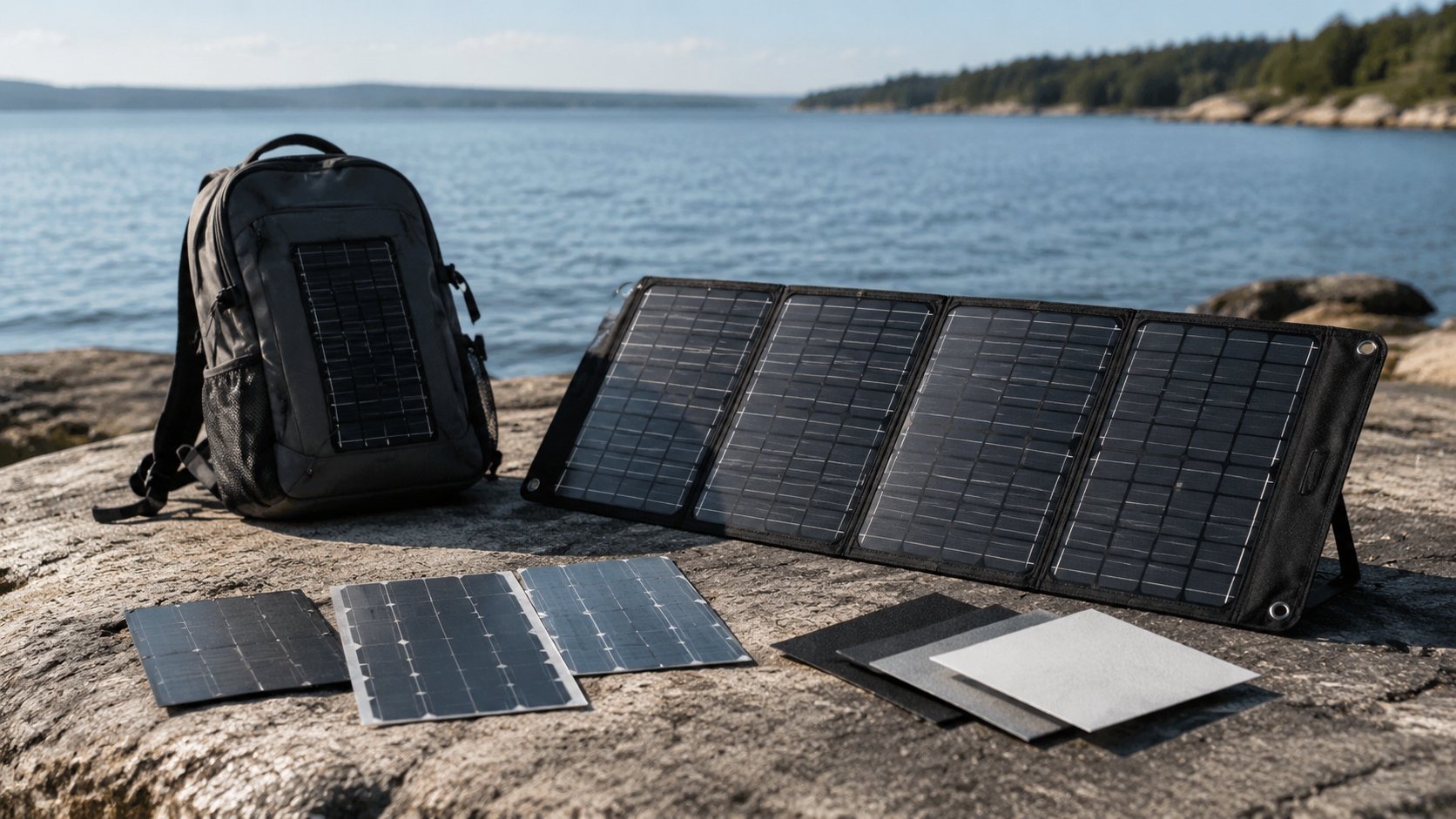
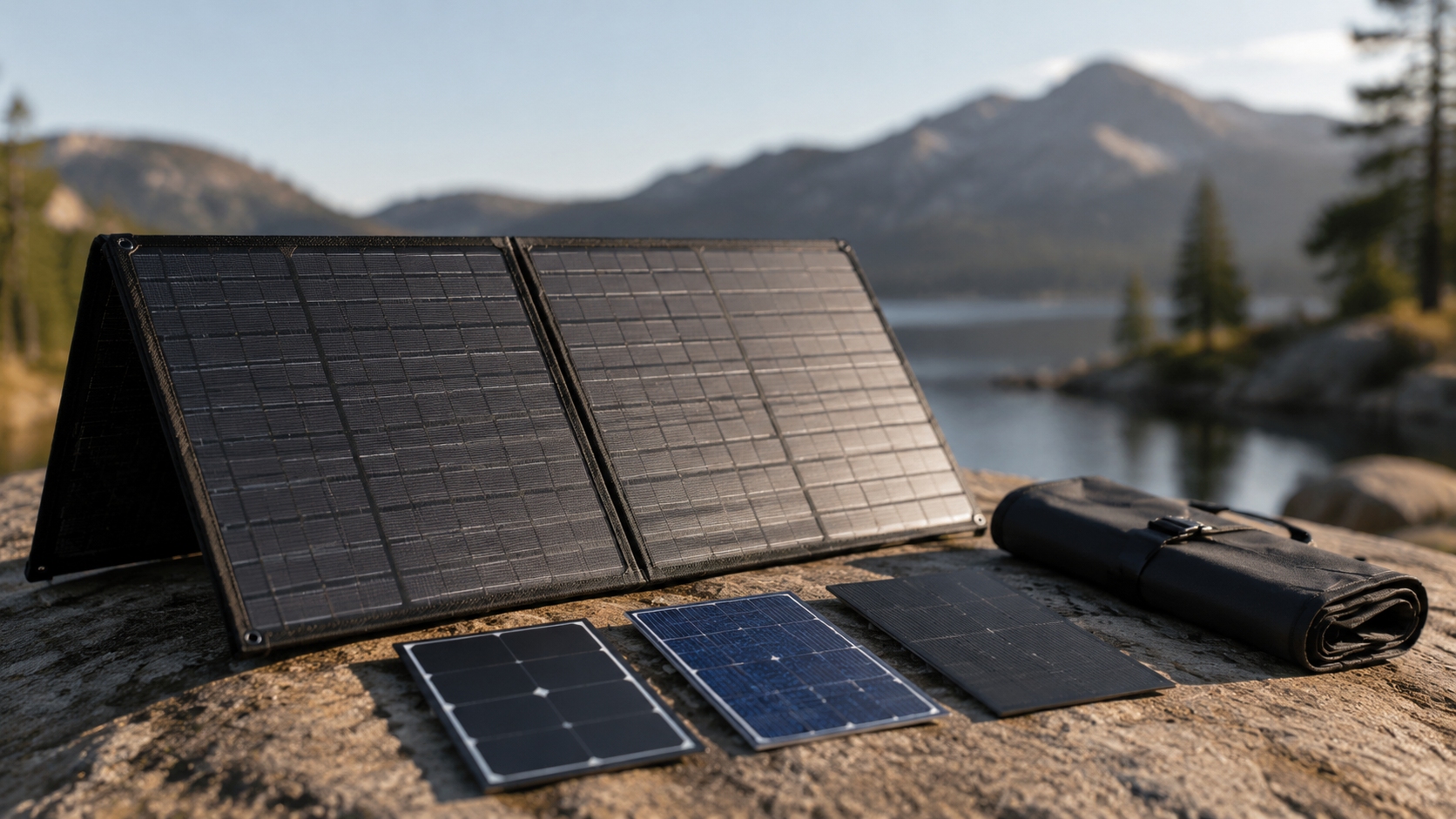
Foldable solar panels have become the dominant portable solar solution for outdoor recreation and emergency power, consisting of 2-4 individual panel sections connected by weather-resistant hinges. The folding mechanism reduces the footprint to approximately one-quarter of the fully expanded size, enabling storage in backpacks, vehicle compartments, or carry bags that would be impossible with rigid panels.
The practical specifications of foldable panels center on weight, folded dimensions, and weather resistance. Taking a popular 200W foldable panel as a concrete example: unfolded area is approximately 1.8 m² (roughly the size of a single mattress), folding down to approximately 60 cm by 80 cm (comparable to a large book) that fits in a backpack side pocket. A 100W foldable panel typically weighs approximately 2 kg, scaling to approximately 4 kg for 200W models. Power density of approximately 5W/kg is the practical ceiling for current ETFE-encapsulated foldable technology using crystalline silicon cells.
ETFE-coated foldable panels represent the current optimal balance of outdoor durability and portability in the portable solar market. Compared to PET coating, which degrades significantly after 3-5 years of UV exposure (becoming brittle and yellowing, losing 15-20% transmittance), ETFE coating maintains optical clarity and mechanical properties for over 10 years with virtually no degradation. ETFE\'s non-stick surface also provides self-cleaning in rain, critical for maintaining output in dusty environments without manual cleaning. Look for an IP67 waterproof rating when purchasing — this certifies the panel can be left in monsoon rain without damage. — REI Outdoor Gear Review Report, 2024
On the Everest Base Camp trek, I carried the Jackery SolarSaga 100 — folded, it was smaller than a travel magazine and comfortable on one shoulder using just its built-in handle. The ETFE surface shrugged off three days of monsoon drizzle without any visible water ingress. When crossing the Khumbu Ice Fall moraine at approximately 5,000m elevation, Jackery maintained stable output at minus 10°C with 40 km/h wind gusts—far more reliable than a companion\'s competing brand panel that began showing intermittent connection warnings at minus 5°C.
· Advantages: compact folding, lightweight portability, ETFE coating durability, IP67 all-weather waterproof rating
· Disadvantages: 5W/kg power density, lower generation efficiency than rigid monocrystalline panels
· Best applications: backpack trekking, RV travel, weekend camping, emergency preparedness kits
· Purchase standards: ETFE coating (not PET), IP67 waterproof, USB-C PD output, IEC 61215 certification
Rigid Panels
Rigid solar panels represent the traditional, proven technology for fixed solar installations, using aluminum alloy or steel frames to secure crystalline silicon cells beneath tempered glass. The rigid glass-encapsulated construction achieves the highest conversion efficiency of any commercially available solar technology — premium monocrystalline rigid panels reach 22-25% efficiency, meaning they convert nearly one-quarter of incident sunlight into electricity in ideal conditions.
The weight and mounting requirements of rigid panels are substantial trade-offs against their efficiency advantages. A 500W rigid panel weighs approximately 25-30 kg and requires purpose-built mounting frames—typically aluminum extrusions with stainless steel hardware—adding another 5-10 kg to the system. However, in sunny locations with favorable mounting angles, initial cost is only 50-70% of equivalent-wattage foldable panels, while generating 15-20% more annual energy. Over a 25-year panel lifespan, this combination of lower upfront cost and higher annual output produces dramatically lower levelized cost of electricity (LCOE).
Rigid panels have 40-60% lower levelized cost of electricity (LCOE) than foldable panels in fixed installation scenarios. The higher initial efficiency of monocrystalline cells means more energy harvested per square meter of roof or ground space, and the 25-year warranted lifespan of quality rigid panels (compared to 10-15 years for foldable panels) reduces replacement frequency. For users with fixed parking spots or seasonal campsites who prioritize long-term economics over portability, rigid panels paired with MPPT charge controllers remain the most cost-effective off-grid power solution available. — BloombergNEF 2024 Solar Outlook Report
A retired couple on a self-drive expedition across the Australian outback installed 4 pieces of 130W rigid monocrystalline panels (520W total) on their camper van\'s roof, paired with a 600Ah lithium iron phosphate cell bank and a 40A MPPT controller. Over three months of unpowered travel through the Kimberley region and Simpson Desert—where grid power is completely unavailable—they maintained full residential power for cooking, refrigeration, lighting, and satellite internet. System modification cost approximately 28,000 RMB (approximately $3,850 USD at 2024 exchange rates), averaging approximately 7 yuan ($0.95 USD) per day for electricity over their 3-month trip—far less than equivalent gasoline generator fuel costs would have been.
· Advantages: highest efficiency 22-25%, 25-year warranted lifespan, lowest cost per watt over system lifetime
· Disadvantages: not foldable, requires dedicated mounting brackets, heavy at 25-30 kg per 500 W unit
· Best applications: fixed campsites, RV stationary seasonal parking, rooftop installations, boat decks with permanent mounting
· Purchase standards: monocrystalline cells, maximum system voltage 100V or higher for MPPT controller compatibility, tempered glass encapsulation
Flexible Panels
Flexible solar panels use thin-film amorphous silicon or CIGS (copper-indium-gallium-selenide) cell technology rather than crystalline silicon wafers, enabling the distinctive bendable form factor that sets them apart from all other panel types. The maximum practical bending angle is approximately 30 degrees from flat before cell cracking becomes a significant reliability concern, and thickness of 2-3 mm makes them approximately 70-80% lighter than equivalent rigid glass panels.
The weight advantage of flexible panels is substantial for certain applications. A 100W flexible panel weighing approximately 1.5 kg can be adhered directly to curved surfaces—RV roofs, sailboat decks, camper van roofs—using adhesive strips or straps without any mounting hardware. Compared to a same-wattage foldable panel at approximately 2 kg, the flexible panel saves 500 g while eliminating the need to fold and store a separate rigid structure. For vehicle-based applications where the panel stays mounted permanently, this weight saving and zero mounting complexity are compelling advantages.
Flexible panel bending efficiency loss is a well-documented and unavoidable physical phenomenon. As the panel bends, incident light uniformity across the cell surface deteriorates, creating localized areas of lower irradiance that reduce the overall operating voltage of the cell string. SunPower\'s engineering data shows that at 25-degree bending angles, power output decreases approximately 8% compared to flat installation. Beyond 25 degrees, micro-crack formation in the thin-film cells accelerates dramatically due to tensile stress concentration at crystal grain boundaries, with failure rates rising steeply after repeated thermal cycling. — SunPower Flexible Panel Technical Whitepaper
When mounting a flexible panel on a rooftop cargo rack for a Gobi Desert crossing, I noticed visible hairline cracks appearing in the lower-left corner on day 4 of the journey—likely caused by the combination of thermal expansion stress and road vibration. Power output dropped 15% that same day, and because flexible panels cannot be repaired (unlike rigid panels where individual cells can be bypassed), the entire panel had to be replaced. The lesson: flexible panels perform best on perfectly flat surfaces with minimal thermal cycling, and should never be used on surfaces with compound curves exceeding the manufacturer\'s stated maximum bend radius.
· Advantages: ultra-thin 2-3mm profile, bendable for curved surfaces, 50-70% lighter than rigid, no mounting hardware needed
· Disadvantages: efficiency loss from bending, vulnerability to thermal-vibration cracking, 10-15 year lifespan vs 25 years for rigid
· Best applications: permanently mounted on flat vehicle rooftops, sailboat decks, camping trailer roofs without roof-rail mounting points
· Purchase standards: SunPower or First Solar cells, maximum bending angle below 25 degrees, IEC 61215 certification, IP65 minimum waterproof rating
Type | Efficiency | Power Density | Weight (100W) | Lifespan | Waterproof | Best Use Cases |
Foldable | 15-20% | ~5 W/kg | ~2 kg | 10-15 years | IP67 | Backpack trekking, RV travel |
Rigid | 22-25% | 15-20W/kg | ~8-10 kg | 25 years | IP65 | Fixed camps, RV stationary |
Flexible | 10-15% | ~10 W/kg | ~1.5 kg | 10-15 years | IP65-IP67 | Rooftop, Boat tops |
Backpack trekking: choose foldable ETFE plus IP67 for all-weather charging in the mountains; RV camping: choose rigid monocrystalline plus MPPT controller for maximum daily harvest at fixed sites; rooftop stationary: choose SunPower flexible panels for low-profile aerodynamic mounting. Select wattage based on real needs—30W for ultralight single-day trips, 100W for weekend camping with phones and cameras, 200W+ for extended field operations with refrigerators or drones.