How Does Solar Aquaculture Affect the Environment | Land Use, Water Systems, Carbon Reduction
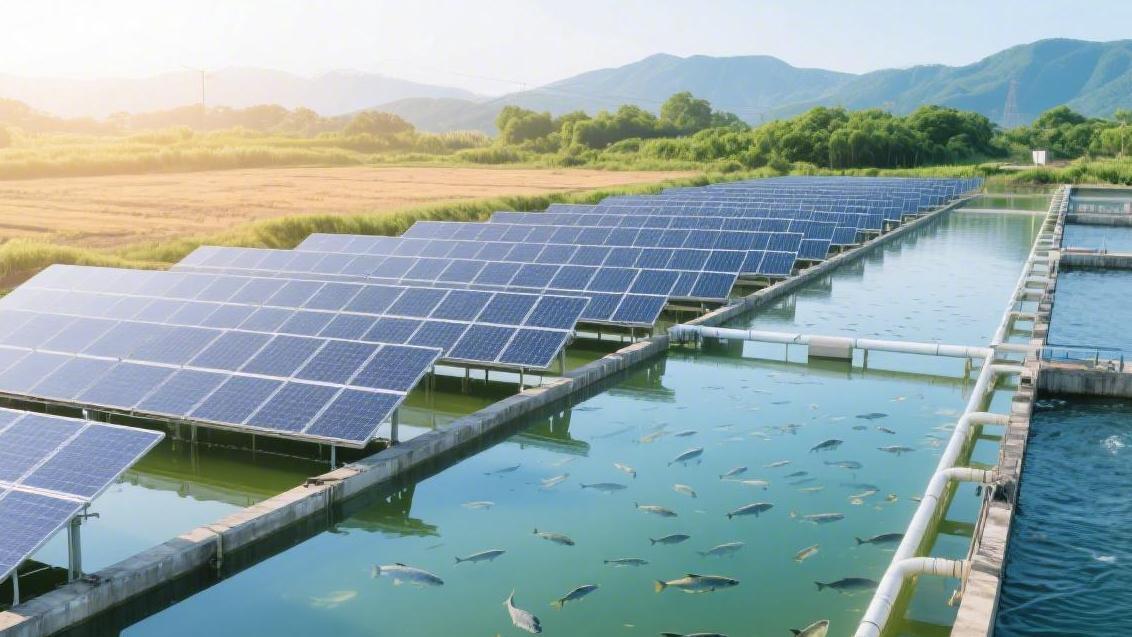
Fishery-solar complementarity realizes "one land two uses" by erecting photovoltaic panels above the water surface.
This mode can reduce water temperature and decrease water evaporation by more than 30%, photovoltaic panel shading can inhibit algae excessive breeding, through precise control of feeding amount and water quality monitoring, besides producing per mu clean electricity, it can also reduce carbon dioxide emissions by tens of tons, effectively taking into account high-efficiency land utilization and water ecological system protection.
Land Use
How to occupy land
Traditional ground photovoltaic power stations usually need one megawatt (MW) to occupy about 15,000 to 20,000 square meters of flat land, while water-based photovoltaic systems through bracket elevation, take the same piece of horizontal projection area's output efficiency lifted 1.6 times to 2.2 times. Photovoltaic bracket's steel pipe pile diameter is usually between 400 mm and 600 mm, vertically driven into the water bottom mud layer's depth is generally 8 meters to 12 meters, to cope with water flow flushing and wind load. Per mu water surface arranged pile positions quantity is about 24 to 36, physical land occupation area only occupies below 0.5% of water pool total area. This means that underwater aquaculture reserved over 99% of physical space.
Take one 50-hectare lake for example, install 40 MW photovoltaic modules, its bracket span is usually set at 6 meters to 10 meters, ensuring that catching boats and automatic feeding machines have enough operation radius. Within 25 years of operation cycle, land's rent expenditure by single agricultural use transforms into "photovoltaic lease + fishery contract" composite mode, per square meter comprehensive output value from pure aquaculture 1.8 yuan lifts to 4.5 yuan.
l Space parameters: Photovoltaic module lowest point distance from highest water level needs to maintain 2.5 meters to 4 meters, ensure air circulation and reduce module dust accumulation, bracket tilt angle controlled at 12 degrees to 28 degrees.
l Shading rate: Array shading rate is usually designed between 35% to 50%, to guarantee water bodies can receive 200W to 400W effective photosynthetic radiation per square meter.
l Density data: Per hectare installation density can reach 1.1 MW, using monocrystalline silicon 585 W + bifacial modules, its back side gain in water surface reflection environment can provide 5% to 12% extra power generation amount.
l Structural lifespan: Bracket uses C5 class anti-corrosion grade hot-dip galvanized steel, coating thickness not lower than 85 micrometers, ensures in a 90% humidity environment for 30 years does not happen structural failure.
l Marginal cost: Compared to land-based power stations, water-based construction costs increase 12% to 18%, mainly originating from water-based piling machinery rental fee and complex cable laying technology.
Whether it's cost-effective
In actual measurement, a 1MW project every year can generate 1.3 million to 1.6 million degrees of green electricity, according to a 0.4 yuan to 0.6 yuan per degree electricity price calculation, single megawatt annual income is between 520,000 yuan to 960,000 yuan. At the same time, water surface below aquaculture annual revenue maintains at per mu 3,000 yuan to 6500 yuan. This double revenue structure makes the project's internal rate of return (IRR) stable at 8.5% above. If the count in land consolidation cost's saving, project's construction budget can save about 5% field leveling fee, because the water surface itself possesses extremely high flatness.
Due to photovoltaic panels toward water surface physical shading, water vapor evaporation amount every year reduces 150 mm to 280 mm, in a 1000-mu project, every year can reduce about 150,000 cubic meters of fresh water loss. This kind of invisible protection toward water resources in arid regions is equivalent to saving about 800 yuan per hectare water supplement cost. Simultaneously, the photovoltaic module's cleaning maintenance frequency is set at per quarter 1 time, every time cleaning consumes water only is per square meter 0.5 liters, and cleaning after water directly flows back to the pond will not cause extra land pollution or resource waste.
l Asset residual value: After 25 years, photovoltaic modules still possess not less than 80% of nominal power, aluminum alloy frames and bracket steel's recovery value occupies about 3.5% of the initial investment.
l Maintenance budget: Annual O&M fee is usually set at per watt 0.03 yuan to 0.05 yuan, and contains drone infrared inspection and inverter room's constant temperature control power consumption.
l Land tax: In some regions, due to being identified as composite type agricultural land, can enjoy urban land use tax reduction, reduction range usually is between 50% to 100%.
l Growth rate: Under 25% shading rate, shade-tolerant fish species growth speed lifts 6%, because reduced strong ultraviolet radiation toward fish epidermis stress damage.
l Load intensity: Bracket system needs to bear the highest 35 meters/second wind speed pressure and per square meter 50 kilograms snow load, ensure asset safety in extreme climate.
Water Systems
Become cooler
According to actual measurement, when photovoltaic panel coverage rate reaches 45% to 55%, water surface solar short-wave radiation receiving amount will from per square meter 1,000W reduce to 400W to 550W. This energy input change directly changed the water body's heat balance. In summer, the air temperature exceeds 36℃ high temperature season, the no shading fish pond's surface water temperature usually soars to 33.5℃ even higher, while the photovoltaic panel below 1 meter place water temperature usually maintains at 28.2℃ to 29.8℃. This 2℃ to 4℃ temperature difference possesses extremely high production value, because most fresh water fish species when water temperature exceeds 32℃ will appear high temperature stress, feeding rate drops 15% to 25%.
Due to photovoltaic modules blocking about 60% of direct light and wind force, water surface convective heat transfer coefficient reduced 12% to 18%, this leads to water vapor evaporation rate significantly slowed down. Data shows, per hectare protected water area, every year can reduce 1500 to 2200 cubic meters of fresh water evaporation. In one operation cycle for a 25-year project, this water-saving effect can effectively alleviate arid season water supplement pump 5% to 8% electricity consumption. Meanwhile, photovoltaic panels at night will reflect one part of the water body toward the atmosphere, emitting long-wave radiation, making the water temperature at dawn time compared to open water areas high out 0.5℃ to 1.2℃. This day-night temperature difference narrowing, will take water body vertical convection frequency from every day 2 times to about 1.2 times, thereby reducing bottom silt inside hydrogen sulfide etc. harmful substances upward diffusion risk.
l Photothermal parameters: Shaded area water body specific heat capacity although does not change, but due to radiation absorption reduction, unit volume heating rate slowed down 0.35℃/hour.
l Evaporation loss: Evaporation amount reduction brought salinity fluctuation range from original ±3‰ narrowed to ±1.2‰, stabilized osmotic pressure.
l Cooling output: Every reduce 1℃ high temperature water temperature, fish feed conversion rate (FCR) average optimized 0.08, per output 1000 kilograms of fish can save about 80 kilograms of feed.
l Equipment load: Water surface temperature rise being controlled makes circulation pump's operation frequency can be from 50 Hz down-regulated to 42 Hz, saving about 15% matching electricity consumption.
Not enough gas
Photosynthetically active radiation (PAR) in photovoltaic panels below will drop 40% above, this makes the water inside dissolved oxygen (DO) daytime peak value from 12 mg/L drop to 7.5 mg/L about. In order to maintain fish survival, the water system needs 5 mg/L above the safe oxygen concentration. This water system must be equipped with higher power density automated oxygenation equipment. The mainstream solution is according to per mu 0.8 kW to 1.2 kW standard configuration impeller type or microporous jet aerator, compared to traditional aquaculture, its daytime opening frequency needs to increase 20% to 35%.
This dissolved oxygen structure change makes the water body inside the oxygen compensation depth from water below 2.5 meters shrink to 1.6 meters. On rainy days or light intensity lower than 200 W/square meter, extreme weather under, water inside dissolved oxygen's falling rate will compared to ordinary ponds fast 15%. Therefore, the system usually integrates a dissolved oxygen sensor, which every 10 minutes collects one time data, when the reading is lower than 4.5 mg/L, the time automatically triggers an increase in the aerator frequency. Although increased electricity costs, but due to water temperature lower, oxygen in water inside saturated solubility instead lifted about 5.8%, this physical characteristic compensation in certain degree offset photosynthesis weakening brought risk.
l Dissolved oxygen density: Saturated dissolved oxygen value along with temperature every drop 1℃ improves about 0.2 mg/L, photovoltaic area's dissolved oxygen stability compared to open area high out 12%.
l Algae statistics: Cyanobacteria and green algae biomass density respectively drop 30% and 18%, effectively inhibiting summer easy to appear "water bloom" phenomenon.
l Operation budget: Forced oxygenation brought electricity fee expenditure increase, average distributed per kilogram fish meat on cost is about 0.15 yuan to 0.22 yuan.
l Equipment response: Frequency conversion oxygenation system in 30 seconds from standby to full load work, single time startup surge current controlled at rated value's 1.5 times within.
l Gas diffusion: Water body surface air exchange rate constant k drops to 0.12 m/d, need through mechanical stirring water take bottom oxygen-deficient water body forced upward lift.
Water becomes clear
Due to light intensity limited, phytoplankton toward ammonia nitrogen (NH3-N) and nitrate absorption speed slowed down about 15%, but at 28℃ about constant water temperature under, nitrifying bacteria biological activity instead compared to 33℃ high temperature environment high out 20%. Monitoring shows, photovoltaic aquaculture system's ammonia nitrogen concentration usually maintains at 0.2 mg/L to 0.5 mg/L between, far lower than the 0.8 mg/L warning line. This microbial community structure adjustment makes water body self-purification capacity's fluctuation range decreased 35%, and avoids biological filtration system collapse due to high temperature.
Water inside total suspended solids (TSS) in photovoltaic areas also manifested different physical characteristics. Due to the panel below, wind waves are smaller, water body turbulence intensity reduced 25%, this promoted the diameter greater than 20 micrometers organic debris settling speed accelerated 12%. Although this will lead to bottom silt accumulation speed every year increasing by about 1.5 centimeters, but due to bottom water temperature lower, bottom silt inside organic matter fermentation gas production rate dropped 22%.
Water body pH value fluctuation range from 7.2-9.0 narrowed to 7.5-8.3, reduced acid-alkali change toward fish gills caused osmotic damage.
Through this toward water system's precise regulation, photovoltaic modules not only are power generation units, but have become one giant physical regulator. It through controlling radiation flux and heat exchange, takes originally violently fluctuating natural environment transformed into one parameter relatively constant semi-artificial controlled ecological system. Although this needs to input more automated monitoring equipment and electricity support, the output fish specifications uniformity lifted 15%, mortality rate from traditional 10% above reduced to 5%.
Carbon Reduction
Dirty work reduced
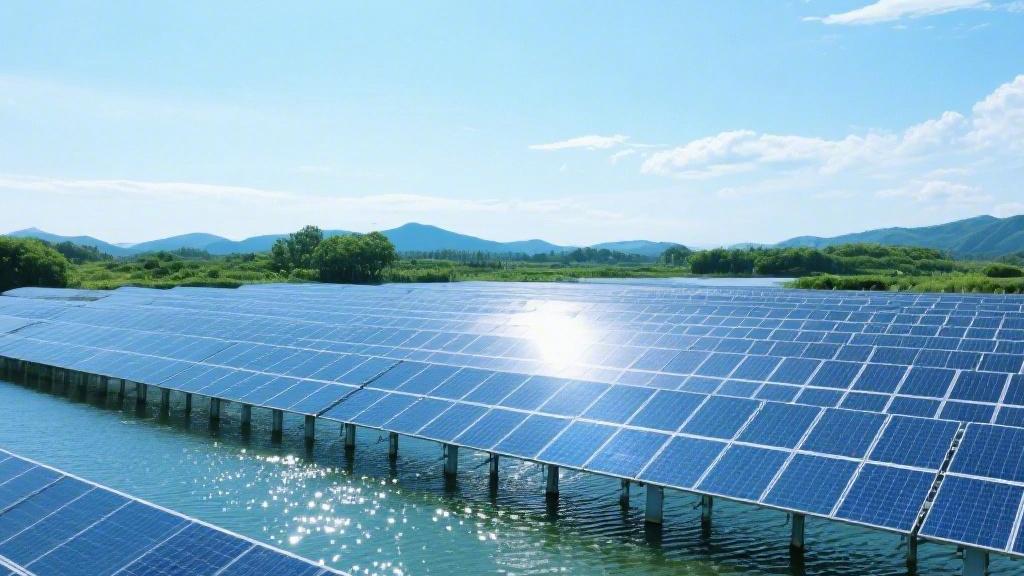
Currently, the global power industry's average carbon dioxide emission intensity is about 0.45 to 0.7 kilograms per degree of electricity, but in regions relying on coal-fired power generation, this value usually reaches 0.95 kilograms. Take one installed capacity of 30 megawatts (MW) medium-sized fishery-solar complementarity project for example, its output every year can be about 42 million degrees of green electricity. According to the 0.95 kilograms emission replacement rate calculation, this project directly reduces carbon dioxide emissions by about 39,900 tons every year. In 25 years, the full life cycle within, this figure will cumulative reach 997,500 tons, equivalent to planting 55 million adult trees.
Besides carbon dioxide, thermal power cogeneration also will produce a giant amount of sulfur dioxide and nitrogen oxides. Per ten thousand degrees electricity emission reduction contribution usually contains about 0.3 tons sulfur dioxide and 0.15 tons nitrogen oxides. For the 30MW project, every year can reduce 1260 tons of sulfur dioxide and 630 tons of nitrogen oxides emissions, greatly reducing acid rain formation probability and atmospheric fine particulate matter (PM2.5) concentration. Simultaneously, this mode of electricity can save 0.32 to 0.35 kilograms of standard coal consumption. The annual saved coal total amount is about 13,400 tons, reduced coal mining, transportation process inside generated secondary pollution and energy consumption.
Indicator type | Per megawatt (MW) annual output/contribution | 25-year life cycle cumulative | Remarks |
Power generation | 1.4 million - 1.6 million degrees | 35 million - 40 million degrees | Depends on light resources |
CO2 reduction | 1330 - 1520 tons | 33,000 - 38,000 tons | According to 0.95 kg/kWh count |
Standard coal saving | 448 - 512 tons | 11,000 - 13,000 tons | According to 0.32 kg/kWh count |
Forest equivalent | 73,000 - 83,000 trees | 1.8 million - 2.1 million trees | Per tree annually absorbs 20 kg |
Underwater hold breath
Fish pond bottom silt is an invisible source of greenhouse gas emissions, especially methane and nitrous oxide. Due to photovoltaic panel shading 35% to 50% solar radiation, the bottom water temperature in the high temperature season can reduce 2.5℃ to 4.1℃. This temperature falling directly inhibited bottom silt inside anaerobic microbial metabolism rate. Monitoring data shows that water temperature every drop 1℃, organic matter decomposition generates methane rate will drop about 8% to 12%. In 1000 mu aquaculture water area inside, through photovoltaic temperature control, every year can reduce about 150 tons of methane emissions. Considering methane's global warming potential (GWP) is 28 times that of carbon dioxide, this link carbon reduction contribution is extremely significant.
Although photosynthesis weakening led to oxygen production amount in daytime peak value dropped to 1.5 mg/L, but through automated oxygenation pump's high-frequency scheduling, water body bottom dissolved oxygen usually maintains at 3.5 mg/L above. This artificial intervention prevented bottom silt entering a deep anaerobic state, thereby cutting off a large amount of nitrous oxide generation path. Nitrous oxide's greenhouse effect is carbon dioxide's 265 times to 298 times, through maintaining an aerobic environment, per hectare water surface every year can extra reduce equivalent to 45 tons carbon dioxide equivalent greenhouse gas emissions.
Due to algae outbreak frequency reduced 25% above, dead algae settling on pond bottom becoming "carbon source" speed also accordingly slowed down. The water body inside total organic carbon (TOC) concentration from traditional aquaculture drops from 25 mg/L to 18 mg/L. This carbon element in the water body inside stabilized existence, actually played a certain degree of biological carbon sequestration role, and avoided organic carbon rapid degradation into gas escaping to the atmosphere.
Gas type | Uncovered pond emission intensity | After photovoltaic coverage emission intensity | Reduction range |
Methane | 1.2g/㎡/day | 0.95g/㎡/day | 20.8% |
Nitrous oxide | 0.08mg/㎡/day | 0.06mg/㎡/day | 25.0% |
Carbon dioxide | 450g/㎡/day | 380g/㎡/day | 15.6% |
Green electricity pay bill
Manufacture one set of 550W monocrystalline silicon photovoltaic modules, brackets, and cables needed total energy, approximately equivalent to its operation 1.3 years to 1.7 years generated electricity. In the remaining 23.3 years of operation, the system will output every degree of electricity, all of which is pure zero emission net gain. Compared to traditional coal power or natural gas power stations, its full life cycle carbon footprint always grows linearly with fuel consumption. Photovoltaic panel's aluminum alloy frame and stainless steel bracket after 25 years possess over 90% recovery rate, this part recycled material carbon footprint is only 5% to 10% of the original ore production.
According to the current carbon quota per ton, the price range fluctuation of 65 yuan to 120 yuan, one 30MW project every year generates a carbon reduction indicator value of about 2.6 million yuan to 4.8 million yuan. This sum of income can offset project about 15% of annual operation and maintenance fee. If counting in Green Electricity Certificate (GEC) sales, per megawatt-hour revenue can increase by 20 yuan to 50 yuan, further shortening the investment return cycle. Currently, such projects' internal rate of return (IRR) after counting in carbon revenue, usually can be from 8.2% to 9.4%.
For example, using conversion efficiency 22.5% above N-type TOPCon modules, although initial cost lifted about 5%, but in the same land area, annual power generation amount can lift 3% to 5%, corresponding carbon reduction contribution also synchronously increases. This high efficiency energy conversion mode, on per hectare land, realizes carbon intensity reduction, is pure forest carbon sink project's 15 times to 20 times.