800W vs. 400W Solar Modules | Which Is Better for Residential Use
400W-class modules are the preferred choice for residential use, as their standard specification of approximately 1.7㎡ allows for more flexible optimization of rooftop space utilization, and photoelectric conversion efficiency generally exceeds 21%.
Compared to 800W large-scale modules, which exceed 35 kg and carry extremely high wind resistance risks, 400W modules are perfectly compatible with mainstream residential micro-inverters.
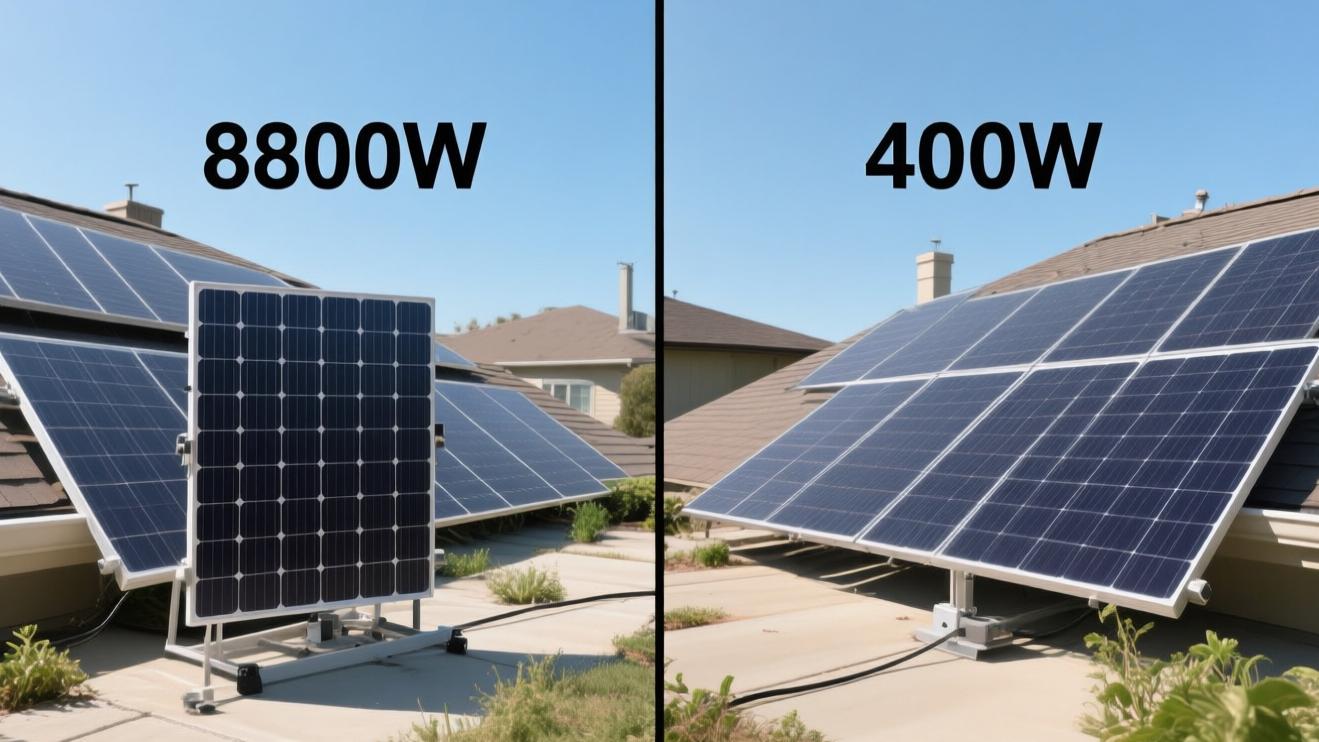
Roof Space
On a typical 200-square-meter residential roof, 182mm specification 400W modules can utilize approximately 15% more edge space than 800W modules due to their dimensional advantages.
800W modules reach lengths of 2.38 meters; when attempting to avoid skylights, chimneys, or vents, their large size often leads to gaps in the layout.
Statistical data shows that on complex roofs, the total installed capacity of 400W systems is typically 10% to 15% higher than that of 800W systems.
Dimensions & Physical Data
There are significant physical differences between 400W modules (using 182mm cells) and 800W modules (using 210mm cells).
The standard length of a 400W module is 1722 mm, with a width of 1,134 mm and a thickness usually maintained at 30 mm.
In contrast, 800W modules jump to a length of 2,384 mm and a width of 1,303 mm, with frame thickness generally increased to 35 mm for structural integrity.
This change in size results in a dramatic increase in the light-receiving area of a single module from 1.95 m² to 3.11 m², an increase of approximately 59.5%.
Because the area of a single panel exceeds 3 m², 800W modules face severe wind interference during handling on residential roofs, making them impossible for a single person to control.
Physical Parameter Comparison | 400W Class (182mm Cells) | 800W Class (210mm Cells) |
Length Specification | 1722 mm | 2,384 mm |
Width Specification | 1,134 mm | 1,303 mm |
Frame Thickness | 30 mm | 35 mm |
Single Panel Area | 1.95 m² | 3.11 m² |
Glass Configuration | 3.2mm Single / 2.0mm Dual | 2.0mm + 2.0mm Dual Glass |
Module Weight | 20.5 kg - 21.5 kg | 38.0 kg - 39.5 kg |
Mounting Hole Spacing | 400mm / 1,100mm | 400mm / 1400mm |
The weight of a 400W module is approximately 21 kg, which complies with single-person manual handling limits defined by labor protection laws in most countries.
The weight of an 800W module is nearly 40 kg, which not only requires two installers to work in coordination but also exerts immense localized pressure on roof purlins and tiles.
In a standard 600 mm-spaced residential roof joist structure, the weight of a 400 W module is distributed over 1.95 m², generating a static load of approximately 11 kg/m².
Even with a larger area, the 800W module's unit area static load increases to over 12.5 kg/m².
Because the force at single fixing points is more concentrated, older wooden roof structures are prone to physical deformation or cracking.
When a 400W module encounters a wind load of 2400 Pa, it generates a total thrust of approximately 4680 Newtons.
The 800W module, due to its area, generates a staggering 7464 Newtons of total thrust under the same 2400 Pa wind pressure.
This difference in force requires 800W modules to use higher-strength 6063-T6 aluminum alloy frames, with a torsional resistance coefficient more than 30% higher than that of 400W modules.
In actual installations, residential roof hooks and rail systems are typically designed for modules 1.7 to 2 meters in length.
The 2.38-meter length of the 800W module results in an excessive lever arm, causing mounting fasteners to endure more severe metal fatigue under high winds.
A standard 40ft high-cube container can hold 36 pallets of 400W modules, with 36 panels per pallet, totaling 1296 panels.
However, because the 800W module's length exceeds 2.3 meters, it must use vertical side-loading packaging, allowing only 31 panels per pallet, with a pallet height of 1.3 meters.
This requires forklifts with longer tines at the unloading site; otherwise, pallets are highly prone to tipping during movement.
On narrow residential streets, trucks carrying 800W modules often struggle to turn, and the space required for unloading is double that of 400W modules.
800W modules typically use 132 or more cells with half-cut technology. Their open-circuit voltage (Voc) remains between 40V and 50V, but the short-circuit current (Isc) can soar above 20A.
In comparison, the current for 400W modules is usually around 13A. This high-current physical characteristic leads to higher heat accumulation in the junction box on the back of the module.
To prevent hot-spot effects, the 800W module's junction box requires larger physical heat dissipation space and thicker cables of 4 mm² or higher.
In high-temperature summer environments, the physical thermal expansion coefficient of large-area modules causes silicon wafers in the center to endure greater mechanical stress, leading to a much higher probability of micro-cracks compared to small-sized modules.
400W modules usually feature two sets of symmetrical holes with 1,100mm spacing, compatible with over 95% of roof hook positions on the market.
Mounting hole spacing for 800W modules is typically stretched to 1400mm or more, forcing installers to drill extra holes in the roof to align with joists, increasing the physical risk of roof leaks.
Physical stability analysis shows that modules with a long side exceeding 2.3 meters will exhibit over 15 mm more central downward deflection under heavy snow compared to 1.7-meter modules.
Obstacle Avoidance Capability
With a compact size of 1722 mm by 1,134 mm, 400 W modules demonstrate high physical inclusivity when dealing with vent pipes, skylights, and chimneys.
In contrast, the 2.38-meter length and 1.3-meter width of 800W modules create a 3.11 m² footprint that is highly prone to layout interference on complex roofs.
On typical North American or European single-family residential roofs, the spacing between vents and exhaust pipes is often between 1.5 and 2 meters.
This means a 2.38-meter long 800W module cannot be placed between two obstacles without rerouting the plumbing.
400W modules can utilize their 1.72-meter short side to flexibly fit into these narrow gaps, reducing the idle rate of rooftop space.
· Utilization of Gaps Around Skylights: Standard skylights usually occupy 1.2m x 1.5m. In the limited area from the bottom of the skylight to the eaves, 400W modules can be arranged vertically, whereas 800W modules would often exceed the roof edge and must be omitted.
· Physical Avoidance of Chimney Shadows: The length of a chimney shadow changes with the season and time. Using small modules allows for more precise array edges. When 400W modules are placed horizontally, the panel height is only 1.13m, allowing extra space above or below the chimney while avoiding shadows.
· Layout Redundancy for Vent Pipes: Residential roofs are filled with ~100mm diameter plastic vent pipes. When multiple pipes are scattered, the large physical entity of an 800W module cannot be placed if it touches even one pipe. Data shows that on roofs with more than 3 obstacles per 50 m², 400W modules offer 18% higher installation density.
Many regional building codes require modules to maintain a safety corridor of 300 mm to 450 mm from the ridge and edges for firefighter access.
On a 6-meter wide slope, five 1.13-meter wide 400W modules can be placed side-by-side, totaling 5.65 meters, meeting setback requirements.
However, four 1.3-meter wide 800W modules total 5.2 meters, while five reach 6.5 meters, exceeding physical boundaries.
This 0.8-meter loss in width directly results in a system power drop of approximately 1600 W.
In the vertical direction, the 2.38-meter height of 800W modules makes it difficult to lay two rows while maintaining ridge safety corridors on short-slope roofs, whereas 1.72-meter 400W modules easily achieve dual-row layouts.
800W modules use multi-busbar and half-cut technology with three bypass diodes.
However, due to the massive single-panel power, if a chimney shadow covers just one edge of the long side, approximately 260 W to 300 W of power vanishes as the diodes activate.
The same shadow area on a 400W module would only affect about 130W. For series-connected systems, a single point of shading on a large module causes a significant drop in the entire string's current.
Small modules allow designers to fine-tune positions to coordinates with the lowest shading probability, ensuring higher annual yield in high-pollution or high-obstacle environments.
· Edge Filling on Sloped Roofs: Triangular or trapezoidal sloped roofs narrow sharply at the edges. 400W modules can use staggered layouts to maximize filling the triangular areas near gutters. 800W modules leave large unusable triangular voids.
· Flexibility of Mounting Rails: Avoiding obstacles involves not just the modules but the rails beneath. 800W modules require large spans; if an obstacle blocks the rail path, the entire row is obstructed. 400W modules use short-span rails that are easier to route around protrusions.
· Capacity Allocation on Multi-orientation Roofs: On complex roofs with South, East, and West faces, 400W modules can be scattered. 800W modules are difficult to arrange at scale on smaller East/West slopes, failing to utilize multi-angle generation advantages.
When fine-tuning to avoid obstacles, a 21 kg 400 W module can be easily slid 50 mm on the rails to align with visual centers or avoid rear hook obstacles.
A 39 kg, 2.38-meter 800 W module is extremely difficult to move; if the initial positioning conflicts with a vent, the workload to readjust is triple that of small modules.
In a limited 100 m² usable space, there are usually over 10 layout options for 400 W modules, while options for 800 W modules are often reduced to only 2 or 3 due to size constraints.
Structural & Wind Safety
The weight of a 400W module stays around 21 kg.
When installed on standard wooden or light-steel roofs, the static pressure is evenly dispersed over 1.95 m².
Conversely, 800W modules jump to 38.5 kg–40 kg.
While the area increases to 3.1 m², the shift in center of gravity and the intensity of single-point stress change significantly.
In common 600 mm or 24-inch rafter structures, a 400 W module spans 3 rafters, with each rafter bearing ~7 kg.
800W modules span more rafters, but due to high central deflection, snow loads up to 30 cm can push the pressure at the center beyond residential design limits.
800W modules weigh nearly 40 kg per panel.
This exceeds the localized load-bearing design of many residential roofs.
Large modules are more prone to physical deformation under snow loads.
Physics dictates that the lift force generated by wind is proportional to the module area.
At a standard 2400 Pa wind pressure, a 400 W module faces ~4680 N of upward force, while an 800 W module faces 7464 N.
Each hook and bolt must bear 60% more pull-out force.
In high-wind areas like Florida or coastal Europe, a 2.38-meter module acts like a giant sail, creating physical moments far exceeding those of 1.72-meter modules.
Safety Assessment Parameter | 400W Class Module | 800W Class Module |
Static Weight per Panel | 21.0 kg | 39.2 kg |
Load per Unit Area | 10.7 kg/m² | 12.6 kg/m² |
Total Lift at 2400 Pa | 4680 N | 7464 N |
Edge Moment Arm Length | 0.86 m | 1.19 m |
Frame Torsional Strength Req. | Standard | Enhanced (6063-T6) |
Recommended Hook Spacing | 1200mm - 1400mm | 800mm - 1,000mm |
Due to excessive length, the physical vibration amplitude of 800W modules under alternating wind loads is typically double that of 400W modules, leading to internal micro-cracks.
To counter this, 800W frames are thickened to 35mm-40mm, further increasing total weight.
Giant modules create massive lever moments in the wind.
Pull-out pressure on hooks increases sharply with area.
Long-term vibration leads to physical fatigue of mounting modules.
Stability analysis shows that 400W modules under 5400 Pa snow load exhibit center deflection within 15 mm.
800W modules can exceed 35 mm. This bending can press against junction boxes or rails, causing physical wear to the back glass.
Large glass panels also have a 22% higher probability of shattering during hailstorms due to higher physical tension.
Physical Deformation & Resistance | 400W Spec Performance | 800W Spec Performance |
Max Deflection (5400 Pa) | 12 mm - 15 mm | 30 mm - 40 mm |
Glass Impact Resistance | Standard | Higher Edge Fragility |
Frame Tear Load | Stable at 2400 Pa | Requires Reinforcement Beams |
Installation CG Height | ~0.85 m | ~1.20 m |
Installation Fall Impulse | ~205 N·s | ~385 N·s |
Building codes often strictly limit pull-out forces on wooden frames. With 400W modules, pressure can be dispersed by adding clamps to keep force within 500N.
800W modules force lower density of fixing points due to their sheer size, often pushing force per hook over 850N, accelerating the aging of roof waterproof layers and creating leak risks.
Wind Load
In extreme environments with wind speeds of 130 mph (58 m/s), a single 800 W module bears an upward suction of over 2500 N, compared to ~1600 N for 400 W modules.
800W modules require a 30% higher density of roof hooks and thicker, shorter-span rails to prevent deformation.
Area & Physical Thrust
Common 400W modules are ~1722mm long and 1,134mm wide (1.95 m²). 800W modules reach ~2,384mm long and 1,303mm wide (over 3.1 m²).
This 55% increase in size generates a disproportionate increase in thrust.
At 110 mph, wind load on 400 W is ~1800 N, while 800 W exceeds 2850 N.
Technical Comparison | 400 W Residential Std. | 800W Industrial Large | Difference % |
Typical Length | 1722 mm | 2,384 mm | +38% |
Typical Width | 1,134 mm | 1,303 mm | +15% |
Total Wind Area | 1.95 m² | 3.11 m² | +59% |
Single Panel Weight | 21.5 kg | 38.4 kg | +78% |
Thrust at 115 mph Wind | ~1920 N | ~3050 N | +58% |
800W modules create highly concentrated stress on rafters. In ASCE 7-16 codes, roof corners have higher wind pressure coefficients.
800W modules often span multiple zones, leading to uneven thrust across a single panel, causing delamination.
If the overhang exceeds 10 cm, vibration frequencies can approach the structural resonance of the building.
Wind Speed (mph) | 400W Pressure (psf) | 800W Pressure (psf) | 800W Total Load (lbs) |
80 mph | 16.4 | 16.4 | 548 |
100 mph | 25.6 | 25.6 | 856 |
120 mph | 36.8 | 36.8 | 1230 |
140 mph | 50.1 | 50.1 | 1675 |
At 140 mph, the load on an 800 W module is 1675 lbs (760 kg)—like parking a small car on a few square meters of roof. 400 W modules disperse this load across more hooks.
A 5 kW system needs ~13,400 W modules (30 hooks), whereas 800 W needs ~7 modules, but hook density must increase to handle local pressure.
Rack Fixation Solutions
400W modules easily span common 16-inch or 24-inch rafter spacing. 800W modules significantly increase static pressure on single rafters.
For 800 W, pull-out force can exceed 3000 N, requiring deeper bolt embedment to prevent wood fiber loosening.
Heavy-duty rails (2.5 mm+ thickness) are mandatory for 800W modules to avoid visible sagging.
Support density must increase from 1.5 to over 2.2 points per m², increasing physical costs and waterproofing penetrations.
· Bolt Specs: 800W modules require M10+ stainless fasteners with torque at 16-18 Nm.
· Overhang Limits: 400W allows 300mm; 800W must be limited to 150mm.
· Clamp Length: 800W clamps should increase from 40mm to 60mm+.
· Anchor Density: In asphalt shingles, 400W uses 1.2m spacing; 800W needs 0.6m-0.8m.
· Expansion Gaps: 800W requires at least 20mm expansion joints between panels.
Roof Structure Pressure
A 400W module exerts ~11.2 kg/m² static pressure. 800W modules, with larger 210mm wafers and dual-glass, reach ~38.5 kg-40 kg, raising unit area load to over 12.4 kg/m².
Total system weight including reinforced rails is ~20% higher, consuming building safety margins.
Structure Pressure Indicator | 400W Residential | 800W Industrial | Pressure Increase |
Single Weight | 21.5 kg - 22.5 kg | 38.0 kg - 41.5 kg | ~78% |
System Load per m² | 13.5 kg/m² | 16.2 kg/m² | ~20% |
Anchor Pull-out Force | ~1600 N | ~2900 N | ~81% |
Rafter Deflection | 2.5 mm | 4.8 mm | ~92% |
Suggested Hook Spacing | 1200mm - 1400mm | 600mm - 800mm | +50% Density |
In ASCE 7-22 standards, if system weight exceeds 5% of design limits, expensive reinforcement is required. 800W modules often hit this red line.
At 120 mph, upward suction can exceed 2800 N per bolt, potentially stripping wood rafters or shattering shingles.
In cold areas, 800 W modules collect more snow—up to 500 kg per panel at 30 cm depth.
System Compatibility and Efficiency
800W modules (210mm wafers) have currents of 18A-20A, while 400W modules are 11A-13A.
Most residential MPPT inputs are limited to 15A, resulting in a 20% clipping loss for 800W modules.
While 800W can reduce BOS by 12%, the 35 kg weight increases structure requirements by 50%.
Electrical Matching & Inverter Performance
800W modules jump to 18.5A - 20.5A (Imp), exceeding the 12.5A-15A limits of most residential string inverters produced before 2023.
Electrical Parameter Comparison | 400W Std (M10 54-cell) | 800W High Power (G12 132-cell) |
Max Power Current (Imp) | 13.04 A | 20.15 A |
Short Circuit Current (Isc) | 13.85 A | 21.40 A |
Max Power Voltage (Vmp) | 30.70 V | 39.75 V |
Open Circuit Voltage (Voc) | 37.10 V | 48.20 V |
Fill Factor | ~78.5% | ~81.2% |
MPPT Compatibility Rate | 98.5% (Mainstream) | 25% (New models only) |
In a 600V residential DC limit, 400W strings allow 12-14 panels, while 800W strings are limited to under 9.
High-current operation (20A) in 800W modules creates 2.3x more heat than 400W (13A) in the same cables, accelerating aging of inverter capacitors (Arrhenius model). 800W systems require 6mm²-10mm² cables.
Inverter Matching Data | 400W Module | 800W Module |
MPPT Peak Efficiency | 98.2% - 98.5% | 97.4% - 97.8% (Heat affected) |
Full Load Internal Temp | 45 - 55 °C | 60 - 75 °C |
DC Line Loss (4mm²) | ~0.5% (100m string) | ~1.2% (100m string) |
Current Clipping Loss (15A limit) | 0% | 18% - 22% (Noon peak) |
800W modules require 30A+ fuses (IEC 60364-7-712). High currents increase fire risks if MC4 connectors are not perfectly crimped.
Space Utilization & System Costs
On complex roofs, 400W modules offer 15% more effective capacity as 800W modules (2.3m+) often violate setback rules. For a 10 kW system:
· 400W: 25 panels, 50 connectors, 84 m rails.
· 800W: 13 panels, 26 connectors, 58 m rails (12% lower metal cost).
Labor costs for 800W systems increase by 20% as 38.5 kg exceeds single-person lifting limits, requiring two workers or specialized lifts.
Shipping 800W modules is 15% cheaper per watt in bulk, but residential delivery is harder due to 2.4m pallet lengths.
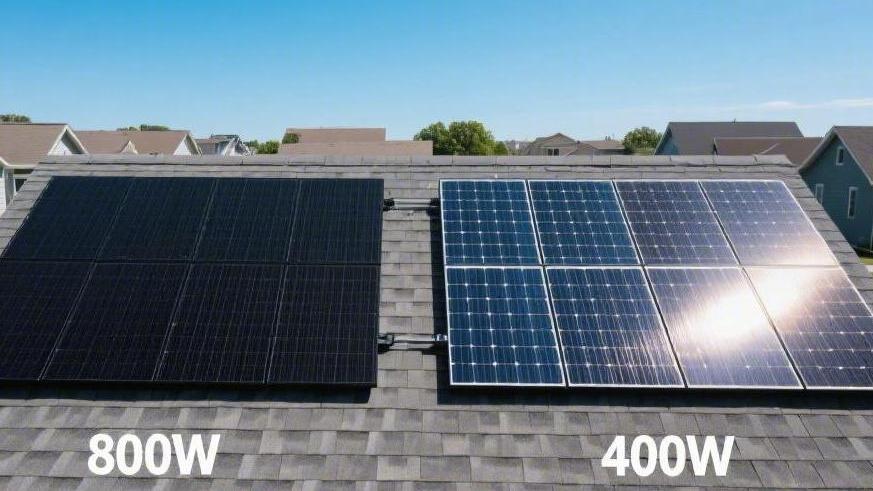
Structural Load & Environment Resistance
800W modules exert 25% more unit pressure. Under 30 cm snow, deflection reaches 15 mm + for 800 W, leading to higher micro-crack rates (0.8% vs 0.1%).
Structural/Environmental Parameters | 400W Residential | 800W Ultra High Power |
Single Weight | 21.8 kg | 39.2 kg |
Surface Area | 1.95 m² | 3.11 m² |
Lift at 140 km/h Wind | ~1600 N | ~2550 N |
Thermal Expansion (ΔT=50℃) | ~1.8 mm | ~2.6 mm |
Hail Impact Resistance | 25 mm @ 23 m/s | 35 mm @ 27 m/s (Requires thick glass) |
Thermal expansion for 2.4m modules exceeds 4mm between seasons, requiring larger expansion joints to prevent PID (Potential Induced Degradation).
800W modules are better for low-slope roofs; for steep slopes (45°), 400W modules are safer and distribute stress better.