How Much Power Does a 100-Watt Solar Panel Produce
A 100W solar panel outputs 100W under STC, but actual daily yield is ~0.4-0.5kWh (4-5 peak sun hours). Use MPPT controllers to boost efficiency; angle/weather affect output.
Solar Panel Basics
The panel's efficiency, typically between 18% and 22% for modern monocrystalline types, dictates how much sunlight it can convert. Its physical size, usually around 1.6 meters long by 1 meter wide (≈41" x 26") for a standard 100W panel, determines how much sun it can capture. The core technology inside, like monocrystalline or polycrystalline silicon cells, also influences performance and cost. Understanding these foundational specifications is the first step to accurately predicting how much real-world energy a 100W panel will generate for your home, RV, or boat.
A 100-watt rating is defined under Standard Test Conditions (STC), a universal benchmark. STC specifies a panel temperature of 25°C (77°F), solar irradiance of 1000 watts per square meter, and a specific light spectrum. In this perfect lab environment, the panel will produce exactly 100 watts. Its key electrical specifications are defined at this point: the Open Circuit Voltage (Voc) is often around 21-22 volts, and the Maximum Power Voltage (Vmp) is about 18 volts. The panel's efficiency is calculated by seeing what percentage of the sunlight hitting it gets converted to electricity. For a standard 1.6 square meter panel to output 100W, an efficiency of roughly 15.6% is required. Most modern panels do better, with efficiencies commonly between 19% and 22%.
Monocrystalline silicon cells, made from a single crystal structure, are the most efficient, commonly reaching 20-23%. They are typically darker in color, often black. Polycrystalline cells, with a fragmented crystal structure, are slightly less efficient, usually in the 15-18% range, and have a distinctive blue, speckled appearance. The number of cells matters too. A standard 100W residential panel typically has 36 cells connected in series. Each cell usually produces about 0.5 to 0.6 volts under load. Stringing 36 of them together is what creates the useful system voltage of around 18 volts (36 cells x 0.5V = 18V).
What 100W Means
These conditions are fixed at a panel temperature of 25°C (77°F) and a solar irradiance of 1000 watts per square meter. Think of it like a car's horsepower rating measured on a perfect, flat track. In reality, you'll almost never drive under those conditions. Therefore, the 100W figure is a crucial reference point for comparing panels, but it is not what you will get on your roof at 2 PM on a hot summer day. Your actual, usable output will typically be 70% to 85% of that rated value due to real-world environmental factors and system losses.
So, what can 100 watts of instantaneous power actually do? It's enough to run several small, essential devices simultaneously. For example, it could power five 20-watt LED light bulbs at full brightness. It could run a 45-watt laptop charger and a 25-watt table fan with power to spare. A key measurement for solar users is daily energy, measured in watt-hours. To find this, you multiply the panel's effective output by the number of peak sun hours at your location.
First, you must de-rate the panel's label power. On a day with good sun but typical operating temperatures around 35°C (95°F), the panel's output drops due to its temperature coefficient, typically around -0.3% to -0.4% per degree Celsius above 25°C. This 10°C increase alone causes a 3-4% reduction. Further losses of about 2-5% occur in the wiring and connections. If you're using an inverter to produce household AC power, you lose another 5-10% in conversion. A realistic, effective output for calculating daily yield is often closer to 85 watts.
Assume your location receives an average of 4.5 peak sun hours. Your daily energy harvest is calculated as: 85 watts x 4.5 hours = 382.5 watt-hours, or about 0.38 kilowatt-hours (kWh). Over a 30-day month, that's roughly 11.5 kWh of energy. To put that in perspective, the average U.S. household uses about 900 kWh per month. The energy from one 100W panel would therefore offset approximately 1.3% of that total usage. Its real value is in powering specific, low-wattage loads or charging batteries for off-grid applications. For instance, that 0.38 kWh is enough to charge a standard 50-watt hour smartphone about seven times, or run a modern, efficient 12-watt DC refrigerator for nearly 32 hours.
Daily Power Output
In a region with 4.5 peak sun hours, a perfectly installed panel might aim for 450 Wh daily. However, real-world factors like temperature, angle, and equipment losses consistently reduce that figure. Understanding the calculation and the typical 15-30% total loss between the panel and your cell or appliance is critical for accurate system sizing and setting realistic expectations for performance.
Phoenix, Arizona, may average 5.5 peak sun hours, while Seattle, Washington, might average 3.5. This 57% difference in solar resource is the single biggest factor in your daily yield.
The system efficiency factor is where theoretical yield meets reality. A series of losses occur between sunlight hitting the panel and usable power coming out of your system. To get a realistic estimate, you must account for these in sequence. A typical calculation for a well-installed, grid-tied system in a warm climate might look like this, starting with the theoretical daily yield:
1. Temperature Loss: Panel output decreases as they heat up. The temperature coefficient, typically -0.3% to -0.5% per °C above 25°C, is a major factor. On a day where the panel operates at 45°C (113°F), that's a 20°C rise, leading to a 6-10% power reduction.
2. Dirt and Degradation: Dust, pollen, and bird droppings can cause 3-5% losses unless cleaned regularly. Additionally, panels degrade annually; a 0.5% yearly loss is standard, meaning a panel in its 10 th year will produce about 5% less than when new.
3. DC Wiring Losses: Resistance in the cables between the panel and inverter consumes 1-3% of the power.
4. Inverter Conversion Loss: Converting DC to AC power is typically 92-97% efficient, representing a 3-8% loss.
The initial ideal energy is 100W x 4.2h = 420 Wh. Now apply real-world losses: a -7% temperature loss, a -4% soiling loss, a -2% wiring loss, and a -5% inverter loss. Multiplying these efficiencies (0.93 x 0.96 x 0.98 x 0.95) gives a combined system efficiency of about 83%. Therefore, the realistic AC output is 420 Wh x 0.83 = approximately 349 Wh, or 0.349 kWh, per day.
Over a month, that's about 10.5 kWh. This 71 Wh difference between the ideal 420 Wh and actual 349 Wh is a 17% reduction, which is a very common outcome. This energy can run a 10-watt LED light bulb for nearly 35 hours, charge a 15,000 mAh (55.5 Wh) power bank about 6 times, or keep a modern, efficient 8-cubic foot DC refrigerator running for about 18 hours per day.
Sunlight and Weather
On a perfectly clear summer day, irradiance at the Earth's surface can reach 800-1,000 W/m², but this is not constant. It changes with the time of day, the season, and atmospheric interference. Weather events like clouds, rain, and even haze act as a variable filter, reducing irradiance to as low as 100-300 W/m² on heavily overcast days. This directly translates to a proportional drop in panel power, meaning a 100W panel might only produce 10 to 30 watts under thick clouds.
At a 60-degree sun angle (common on a winter morning), irradiance can be less than 50% of its noon peak. This creates a predictable daily power curve, where a panel's output might rise from 0 watts at sunrise to a brief peak of 85-90 watts around noon on a clear day, before falling back to zero at sunset.
A thin, high-altitude cirrus cloud layer might only reduce irradiance by 10-20%, while a dense, low cumulus cloud can block 80% or more of the sun's direct energy.
The power temperature coefficient, typically -0.3% to -0.4% per degree Celsius, means a panel operating at 45°C (113°F) on a hot, sunny day will produce roughly 6-8% less power than it would at the standard test temperature of 25°C (77°F).
For example, a location might average 6.0 peak sun hours in July but only 2.5 in December, a 140% seasonal difference.
Time of Day / Condition | Approx. Solar Irradiance (W/m²) | Estimated 100W Panel Output (Watts) | Notes |
Clear Sky - Noon (Summer) | 900 - 1000 | 80 - 90 W | High sun angle, high irradiance. Output is below rating due to temperature-related efficiency loss. |
Clear Sky - 9 AM or 3 PM | 600 - 750 | 55 - 70 W | Lower sun angle increases atmospheric scattering. |
Overcast, Heavy Clouds | 100 - 300 | 10 - 30 W | Primarily diffuse light. Output is low but not zero. |
Partly Cloudy (Sun Behind Cloud) | 200 - 500 | 20 - 50 W | Rapid fluctuations in output as clouds move. |
Rainy / Stormy Day | 100 - 200 | 10 - 20 W | Thick cloud cover and precipitation severely limit light. |
The National Renewable Energy Laboratory (NREL) provides 30-year averages of solar irradiance for most locations. A well-sized solar system is designed to meet annual needs, knowing that production will follow a predictable cycle, with summer months often producing 60-80% of the system's total annual output in many climates, while winter may contribute only a small fraction.
Measuring Electricity
Without measurement, you're only guessing. For example, a voltage reading might show 18.5 volts, suggesting the panel is active, but a simultaneous current measurement could reveal it's only producing 2.5 amps, resulting in a real-time power output of just 46.25 watts.
The fundamental measurements are Voltage (V), the electrical pressure, and Current (Amps or A), the flow rate of electrical charge. Multiplying these two values gives you instantaneous Power (Watts). A panel operating at its Maximum Power Point (MPP) might show 18.6 volts and 5.38 amps, which equals ~100 watts. However, power fluctuates constantly. Therefore, the most important metric for energy production is Energy, measured in Watt-hours (Wh), which is power averaged over time. For instance, if your panel averages 60 watts over a 5-hour period, it has generated 300 watt-hours of energy. The primary tools for this job are:
l A Digital Multimeter (DMM): A basic model with a 1-2% accuracy rating, costing 20−50, can measure DC voltage at the panel's terminals (e.g., 21.5 Voc open-circuit) and DC current in a circuit (e.g., 4.8 A under load).
l A DC Power Meter (Watt Meter): Installed in-line between the panel and charge controller, it continuously measures voltage and current, calculates real-time power, and, critically, integrates this over time to display total watt-hours produced
l A Smart Charge Controller or Inverter Display: Most modern charge controllers (MPPT or PWM types) and inverters have a built-in digital display that shows key metrics like daily yield in kWh, historical totals, and sometimes maximum power points. The accuracy of these can vary, with better MPPT controllers typically having a ±2% measurement tolerance on current.
For example, if your panel's DC watt-meter shows 420 Wh harvested in a day, but your inverter's display or a dedicated AC energy monitor shows only 365 Wh was delivered to your appliances, you can calculate the system's round-trip efficiency for that day: (365 Wh / 420 Wh) * 100 = 87%. A persistent efficiency below ~85% could indicate issues like undersized wiring, a failing inverter, or a significant voltage drop in the circuits.
Example Uses
A 100W panel, connected through a charge controller, can directly power a 12V, 5-watt security camera system, a 12V, 2-amp fan drawing about 24 watts, and a 10-watt LED light strip simultaneously during sunny hours, using roughly 40 watts of its potential 80-90 watt peak output.
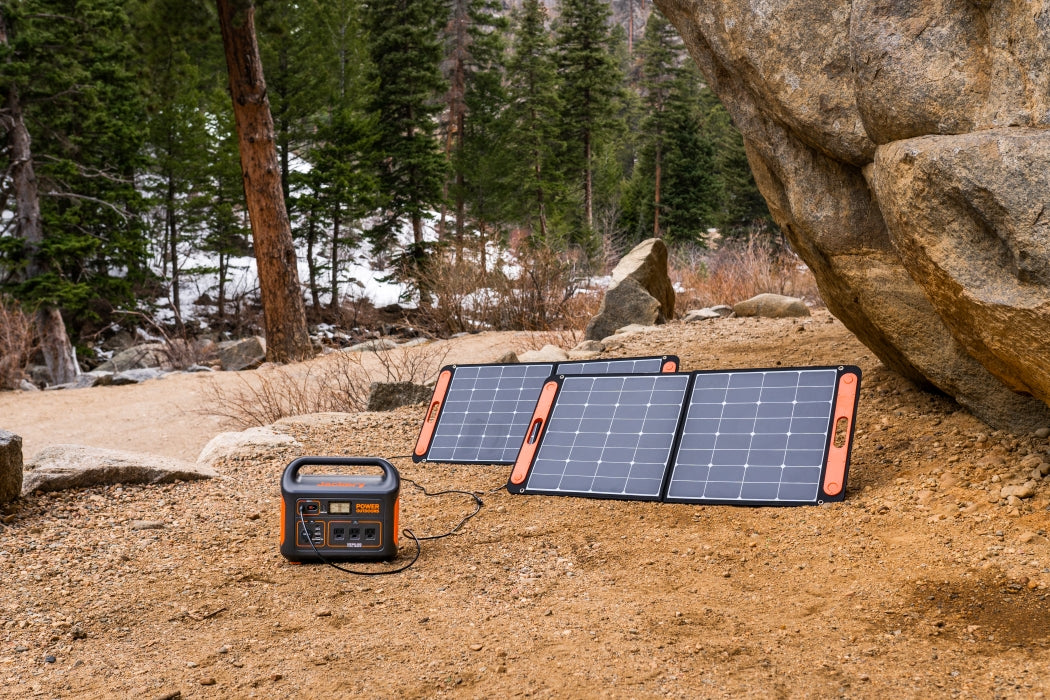
A standard USB-C charger might draw 18-30 watts. The panel can directly charge a modern 15-watt smartphone from 0% to 100% in about 2 to 3 hours of good sun, and over a full day, it can accumulate enough energy in a power bank to charge that phone 5 to 7 times. A common application is pairing the panel with a portable power station. You would connect the panel to the station's 12-30V DC input, which typically accepts a charging current of up to 10 amps.
On a 5 peak sun hour day, a 100W panel can deliver approximately 400-450 watt-hours of energy into the station, replenishing a 300Wh unit from 20% to 100% in about 4-5 hours. This makes it an excellent companion for weekend camping, providing enough energy to recharge a 60Wh laptop twice, run a 15-watt CPAP machine for 15-20 hours, and keep several LED lanterns and a small fan running.
A key rule is to match your energy consumption to your production. If your 100W panel system produces 0.4 kWh daily, your connected devices should consume less than that on average. For a 12-watt compressor fridge running 24/7, which uses about 288 watt-hours per day, the panel can comfortably cover its needs with about 70% of its daily yield, leaving reserve for other small loads.
If these are used for 5 hours each evening, the total daily consumption is 240 watt-hours (6 bulbs * 8W * 5h), which is well within the panel's typical production range. The system would require a 12V, 50Ah deep-cycle cell (providing 600Wh of capacity, of which 300Wh or 50% is the recommended usable portion to prolong cell life) and a 10-amp charge controller. It can easily offset the ~24 watt-hour daily drain of a 12V, 2-amp cellular router or a 5-watt GPS tracker, ensuring continuous operation even during 2-3 days of poor weather when paired with a modest 20Ah cell buffer.
A 100W panel can run a 12V, 0.8-amp car fan or a 12V, 3-amp RV roof vent fan for several hours during the day to manage heat buildup. The fan, drawing about 10-36 watts, would operate at near-peak speed during high solar output, directly correlating cooling power with solar intensity.