How to Extend the Lifespan of Solar Panels | Maintenance Guide
The key to extending the life of solar panels lies in scientific periodic maintenance. While mainstream modules have a design life of up to 25-30 years, efficiency naturally decays by about 0.5% annually.
It is recommended that you clean with fresh water every six months to remove accumulated dust and bird droppings, which can effectively improve power generation efficiency by 5%-15%.
In addition, surrounding obstructions must be cleared promptly to prevent the "hot spot effect" caused by local shadows, which leads to overheating of cells and avoids permanent structural damage.
Coupled with a routine replacement of the inverter every 10-15 years, it can be ensured that the system still maintains more than 80% of the initial power after 25 years, maximizing the return on investment.
Surface Cleaning
When the cumulative rainfall recorded by a weather station is below 50 mm for 30 consecutive days, the daily output power of the PV array will decay by 0.2% to 0.5%.
During the 45-day pollen dispersal period in spring, a sticky particulate attachment layer with a thickness of 0.5 mm will pull down the open-circuit voltage of the entire string by more than 12 V.
Timing the cleaning between 6:00 AM and 8:00 AM, or between 18:00 PM and 20:00 PM after sunset, ensures that the ambient temperature is in the range of 15°C to 25°C.
At this time, the surface temperature of the 3.2 mm thick front tempered glass will drop below 40°C.
The temperature difference between the sprayed water and the glass surface must be strictly controlled within 20°C.
An instantaneous thermal shock with a temperature difference exceeding 25°C will cause a 30% probability of micro-cracks up to 50 microns long in the glass.
This tiny crack, invisible to the naked eye, will consume 15 W to 25 W of the rated power of a single panel through thermal expansion and contraction over the following six months.
In sandy weather with wind speeds exceeding 8 m/s, the concentration of suspended particulate matter often reaches above 500 μg/m³. Strong winds will dry the cleaning water within 2 minutes, leaving mud spots with a distribution density of 300 per cm², hindering the penetration of infrared photons with a wavelength of 600 nm.
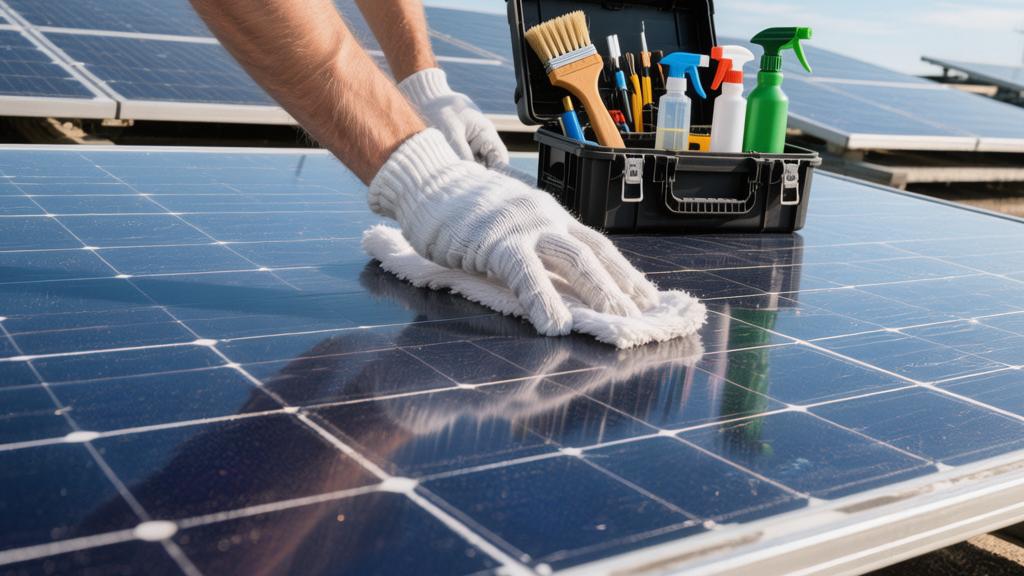
When to Clean
· When meteorological data shows cumulative rainfall of less than 50 mm for 30 consecutive days, the decay rate of daily power generation will climb to 0.5%.
· Performing operations in the early morning or evening when the ambient temperature is between 15°C and 25°C ensures the surface temperature of the 3.2 mm tempered glass remains below 40°C.
· Limiting the temperature difference between the rinsing water and the panel to within 20°C can 100% avoid physical micro-cracks of 50 microns in the glass.
· Avoid weather with wind speeds of 8 m/s or more to prevent water from evaporating within 2 minutes and leaving 300 mud spots per cm².
Untreated municipal tap water contains calcium and magnesium ions at concentrations of 150 ppm to 300 ppm.
After rinsing every 1.9 square meters of standard modules with 2 liters of such water, the water evaporates within 30 minutes, crystallizing into a white calcium carbonate scale about 0.1 mm thick.
The scale layer has a reflectivity of up to 18% for the usable spectrum of 400 to 1,100 nm, which will wipe out 8% of the system's theoretical power generation within a year.
The pH parameter of the water quality should be locked in the absolutely neutral range of pH 6.5 to 7.5.
When exposed to acidic water bodies with a pH below 6.0 or alkaline solvents higher than 8.0 for more than 3 minutes, the anti-reflective coating, which is only 10 to 15 microns thick, will undergo irreversible chemical degradation.
Damage to the coating will cause the light transmittance to drop from the factory setting of 95.5% to below 88%.
Purchasing a small reverse osmosis water machine with a flow rate of 50 gallons per hour to reduce the output conductivity to below 5 μS/cm costs only 0.05 USD per gallon of pure water.
A single cleaning of 25 panels with a total area of about 48 square meters consumes a total volume of pure water between 38 and 50 liters, with water costs of less than 1 USD.
What Water to Use
· Using reverse osmosis water with a Total Dissolved Solids concentration below 150 ppm can prevent the generation of 0.1 mm thick calcium carbonate crystals on the glass surface.
· Maintaining the water pH between 6.5 and 7.5 protects the 10 to 15 micron thick anti-reflective coating and maintains 95.5% light transmittance.
· Deionized water with a conductivity below 5 μS/cm costs about 0.05 USD/gallon; cleaning 48 square meters of panels only requires 50 liters.
· Avoid using hard water whose residue causes 18% light reflection, which can recover 8% of the theoretical power loss of the entire system annually.
The physical parameters of the brush bristles must be limited to soft polyurethane or nylon materials with a diameter of 0.1 mm to 0.15 mm.
Hard bristles with a diameter exceeding 0.2 mm will leave scratches deeper than 5 microns on the glass surface when 2 kg of downward pressure is applied, causing a diffuse reflection effect and losing 2.5% of photon capture.
The pump pressure limit of the water supply equipment should be capped at 35 bar (approx. 500 psi).
If the water pressure surges past the critical value of 40 bar, the impact force will cut into the gap between the aluminum alloy frame and the glass at a 45-degree angle, tearing the polyurethane sealant which is only 5 mm thick.
Moisture will penetrate the backsheet through the damage within the next 30 days, and the insulation resistance will plummet from the standard 400 MΩ to 10 MΩ, triggering a ground leakage fault.
The distance of the handheld nozzle should be maintained between 30 cm and 50 cm from the panel. The water spray angle should maintain a fan-shaped cross-section of 15 to 20 degrees.
The squeegee for final drainage should have a width of 40 cm. The rubber strip should be made of natural rubber with a hardness parameter of 50 Shore A, pushed at a speed of 0.8 m/s, taking away 99.5% of free water droplets with each contact.
Choosing the Right Tools
· Choose nylon brushes with a bristle diameter of 0.1 mm to 0.15 mm; 2 kg of thrust will not produce 5 micron glass scratches.
· Strictly control the water gun pump pressure below 35 bar to ensure the integrity of the 5 mm thick frame sealant and maintain 400 MΩ insulation resistance.
· Maintain the nozzle 30 to 50 cm from the panel with a 15 to 20 degree spray angle to maximize flushing efficiency.
· Equipped with a 40 cm wide rubber squeegee with a hardness of 50 Shore A, 99.5% of water droplets can be removed at a rate of 0.8 m/s.
The cleaning path should start from the highest point of the array with an inclination of 15 to 30 degrees, using gravitational acceleration to let the wastewater flow down at a speed of 0.5 m/s.
The horizontal overlap width of each stroke should be maintained at 5 cm to 8 cm, and the operation frequency is set to 2 back-and-forth strokes.
Bird droppings contain high concentrations of uric acid, with a pH usually hovering between 3.0 and 4.0.
For bird droppings clumps with a diameter exceeding 2 cm and a drying time of over 72 hours, spray 30 ml to 50 ml of deionized pure water and let it soak for 3 minutes.
After the solids soften, apply 500 g to 800 g of downward pressure to wipe them away.
If the local pressure exceeds 2000 Pa (equivalent to 2 kg of concentrated force), the probability of micro-fractures in the underlying monocrystalline silicon cells will jump to over 0.5%.
To remove stubborn grease with a thickness of 1 mm, a 10% volume ratio of isopropyl alcohol solvent needs to be added.
The retention time of chemical solvents on the panel surface is capped at 5 minutes.
Using an electric roller brush with a speed locked at 200 RPM and a contact area maintained at 0.5 square meters can increase efficiency from 15 panels per hour manually to 45 panels, saving 66% of exposure time.
Manual Wiping
· Start cleaning from the top of the 15 to 30 degree incline, maintaining a 5 cm to 8 cm overlap width with two cleaning cycles.
· For bird droppings over 2 cm in diameter with a pH of 3.0, soak with 50 ml of pure water for 3 minutes and apply 800 g of pressure to remove.
· The downward pressure during cleaning must be lower than 2000 Pa to suppress the probability of micro-fractures in monocrystalline silicon cells below 0.5%.
· An electric roller brush at 200 RPM covering 0.5 m² can increase the cleaning rate from 15 to 45 panels per hour.
A 10 kW residential standalone PV system physically consists of 25 to 30 modules with a rated power of 400 W.
Hiring a professional cleaning team with high-altitude certification involves hourly rates fluctuating between 25 USD and 40 USD.
A single comprehensive deep cleaning takes 2.5 to 3 hours, with the total bill including consumables depreciation falling between 100 USD and 150 USD.
A 10 kW system in an area with an average of four hours of daily sunshine has a theoretical annual power generation of 14,600 kWh.
If the local net metering electricity price is anchored at 0.15 USD/kWh, and the photoelectric conversion rate recovers by 10% after cleaning, an additional 1,460 kWh of electricity will be released over the next 12 months.
The absolute monetary gain from the electricity conversion is 219 USD.
After deducting the 150 USD cleaning budget, the book's net profit reaches 69 USD, and the return on investment for a single maintenance session soars to 146%.
In heavy industrial/mining areas where dust deposition exceeds 50 tons per km² per year, the cleaning frequency needs to be increased to once every 90 days, or 4 times a year.
The total annual cleaning budget will rise to 600 USD.
The cumulative power generation loss recovered by four cleanings is as high as 4,380 kWh, equivalent to 657 USD in revenue. After offsetting the total cost of 600 USD, it still maintains a redundant cash flow of 57 USD.
Visual Inspection
The best optical window for performing visual inspection is set at 10:00 AM or 14:00 PM, when the sunlight forms an angle of 40 to 50 degrees with the panel surface.
The refraction of light allows tiny defects on the 3.2 mm thick front tempered glass to appear.
The inspection line of sight should be maintained within a range of 0.5 m to 0.8 m from the panel to capture dendritic micro-cracks longer than 10 mm and 50 microns wide.
Cracks caused by hail impact or thermal expansion and contraction will oxidize the underlying silver busbars within 30 days of water penetration, causing the power output of a single 400 W module to drop by 15 W to 25 W.
Observe along the grid lines; if brown snail trails with a width of 2 mm to 3 mm are found, it indicates that the encapsulant ethylene vinyl acetate (EVA) has begun to release acetic acid at a concentration of 5%.
The chemical reaction will cause the light transmittance of the coating to crash from the initial 98% to below 85%.
For every 0.1 square meter of yellowed or browned area, the system's daily short-circuit current will shrink by 0.3 A.
According to the International Electrotechnical Commission IEC 61215 test standard, when the diameter of delamination bubbles on the glass surface exceeds 5 mm, or the bubble area exceeds 1% of the single panel area approx. 0.019 m², the module will have a 90% probability of the insulation resistance falling below the 400 MΩ red line during the "Double 85" test (85°C and 85% relative humidity).
Check Glass Surface
The anodized aluminum alloy frame with a thickness between 35 mm and 40 mm must bear the 22 kg weight of the module itself and wind/snow loads up to 2400 Pa.
Check the joints of the four corners of the metal frame; the normal physical gap must be less than 0.5 mm.
Once the gap expands to more than 2 mm due to force, a single 30 mm rainfall will cause 10 ml of water to remain in the silicone sealing groove, triggering electrochemical corrosion.
Fixed brackets are usually made of 2.5 mm thick hot-dip galvanized steel, and the standard zinc layer thickness should reach 65 microns.
If the surface rust area exceeds 2% of the total surface area, or the diameter of a single rust spot exceeds 15 mm, it means the zinc layer loss rate has exceeded the limit.
Exposed to coastal environments with a salt spray concentration of 5% every month, unrepaired corrosion points will corrode into the internal steel at a rate of 0.1 mm per year, reducing the bracket's wind resistance limit from 35 m/s to 20 m/s.
Construction torque specifications require that all M8 stainless steel pressure block bolts fixing the frame must use a torque wrench to apply a tightening torque of 14 N·m to 18 N·m. A torque below 10 N·m will produce micro-vibrations at a frequency of 50 Hz when the wind speed reaches 15 m/s, causing glass wear; stress exceeding 20 N·m will crush the tempered glass at the frame edge within 48 hours.
Check Metal Brackets
The DC cables connecting the modules use double-insulated tinned copper wire with a cross-sectional area of 4 mm².
After 5000 hours of continuous UV irradiation, the hardness of the cross-linked polyethylene insulation sheath will increase from Shore A80 to above A95.
Observe the suspended cable sections; the sag must be controlled within 5 cm.
The bending radius of the cable at turns must never be less than 4 times the outer diameter of the cable (approx. 24 mm).
Forcing a bend angle lower than 90 degrees will cause 15% to 20% of the internal 0.3 mm diameter copper strands to break, causing the local resistance to soar from 0.005 Ω to 0.5 Ω.
When current passes through a high-resistance area, the surface temperature will rapidly climb from a normal 45°C to 85°C.
After standard MC4 connectors are mated, there should be no visible gap in the external locking nut.
If the rubber O-ring is found to be extruded by more than 0.5 mm, or the plastic shell shows 2 mm long white stress marks, the factory-rated IP68 waterproof and dustproof rating will be downgraded to IP54.
In the early morning, when relative humidity reaches 90%, the downgraded connector will condense 0.2 ml of trace dew inside, shortening the creepage distance between positive and negative poles by 30%, triggering a leakage current as high as 50 mA, which in turn triggers the leakage protector in the inverter to cut off the output of the entire string with a total load of 5,000 W within 300 ms.
Inspect Cable Connectors
Flip your view to the back of the module, where the 0.3 mm thick polyvinyl fluoride composite backsheet bears the task of isolating 1000 V DC high voltage.
Under full-load operation at an ambient temperature of 40°C, the normal surface temperature distribution of the backsheet should be between 55°C and 65°C.
Inspect the 1.9 m² backsheet surface for scorched yellow or carbonized spots with a diameter exceeding 10 mm.
Areas with scorch marks indicate that the solar cells on the front have experienced a hot spot effect, with local temperatures exceeding 130°C, burning through the internal insulation layer, which is only 0.1 mm thick.
The junction box installed at the top of the panel is filled with thermally conductive silicone to a depth of 15 mm.
Visually, if the silicone shows cracks wider than 1 mm or a volume shrinkage rate of 5%, the three bypass diodes inside will face a risk of heat accumulation.
Inverter Check
Check Machine Location
According to the Arrhenius Equation, for every 10°C increase in the operating ambient temperature, the physical life of the capacitor will be directly shortened by 50%.
The design life of a standard string inverter at 25°C is usually 12 to 15 years, but if installed in a poorly ventilated attic where the ambient temperature is long-term at 45°C, the failure probability of its electronic modules will increase by 300% after 5 years of operation.
The vertical distance between the top of the machine and obstacles should be maintained between 300 mm and 500 mm, and a clearance of no less than 200 mm should be left on both sides for air circulation.
If multiple inverters are installed side by side, the spacing should be increased to more than 400 mm to prevent the heat accumulation effect caused by the hot air above 50°C discharged from adjacent machines.
The protection level of the shell is usually IP65 or IP66, which means it can withstand a water jet with a flow rate of 100 liters per minute, but long-term UV irradiation will accelerate the aging of the sealing strips, reducing its waterproof performance by 20% within 8 to 10 years.
Fan Dust Cleaning
For inverters with built-in active cooling fans, the speed is usually set between 3000 RPM and 5000 RPM.
When the dust thickness on the surface of the heat sink fins reaches 1 mm, the heat exchange efficiency of the aluminum alloy radiator will drop by more than 15%.
This leads to an increase in the junction temperature of the power transistor (IGBT) by 5°C to 10°C.
When the junction temperature breaks the critical point of 85°C, the inverter will trigger a power-limiting protection mechanism, forcing the maximum output power to decrease by 20% to 30% to prevent hardware damage.
Every 180 days, it is necessary to use dry compressed air with a pressure of less than 2 bar to clean the air inlet filter.
It is strictly forbidden to use a damp cloth with humidity exceeding 60% to wipe the ventilation holes to prevent tiny water droplets from infiltrating the circuit board and causing creepage faults under a high power state of over 200 W.
If the monitoring software shows that the fan operating current exceeds the rated value by 15% (usually above 0.5 A), it indicates that the bearing friction has increased due to excessive dust, and the fan should be replaced immediately.
The cost of replacing a single fan is about 50 to 100 USD, but it can effectively avoid the burning of a motherboard worth 2000 USD due to overheating.
Tighten Connectors
The DC-side MC4 connectors should have a contact resistance of less than 0.5 mΩ under full load current (usually 10 to 15 A).
Due to seasonal thermal expansion and contraction, micro-displacements occur at the bolt connections, causing contact resistance to rise by 5% to 10% within 2 years.
Every 12 months, a calibrated torque wrench must be used to apply a standard torque of 2.5 to 4.5 N·m to the AC output terminals.
If an oxide layer appears at the connection, it will cause the contact point to generate high temperatures above 100°C, which will show as a clear red spot under a thermal imager.
This thermal loss not only wastes 0.1% of the power generation every hour but may also trigger a DC arc fault.
Inspection Item | Normal Parameter Range | Abnormal Warning Value | Maintenance Cycle |
DC Input Voltage | 200V - 1000V (depending on string) | Deviation > 5% of same group | Every six months |
Insulation Resistance | > 400 MΩ | < 1 MΩ | Annually |
AC Voltage Fluctuation | Rated Voltage ± 10% | Exceeding 15% auto-disconnect | Real-time monitoring |
Terminal Temperature | < 65℃ | > 85℃ (risk of melting) | Quarterly |
Total Harmonic Distortion | < 3% | > 5% (affects appliances) | Annual testing |
Firmware Upgrade
Modern inverters use Maximum Power Point Tracking (MPPT) algorithms to lock in the peak power of the plant, with tracking efficiency usually above 99.5%.
Firmware update patches released by manufacturers every 6 to 12 months usually include optimizations for low-light algorithms on rainy days.
By upgrading the firmware, the startup efficiency during low irradiance periods like morning and evening can be improved by 0.5% to 1.2%.
For a 10 kW system, a 1% efficiency improvement means an extra 150 kWh of power generated annually.
Calculated at an electricity price of 0.15 USD/kWh, this simple software maintenance operation can directly recover 22.5 USD in revenue loss annually.
Before executing a firmware upgrade, it must be confirmed that the DC input voltage is higher than the 250V startup threshold and that the WiFi signal strength is better than -70 dBm to prevent the bus communication protocol from crashing due to data transmission interruption.