What Affects Solar Panel Efficiency | Light, Temperature, Angle
Solar panel efficiency by light intensity, temperature and angle influence. Light intensity higher, power generation larger; temperature rise time efficiency decreases, usually every rise 1℃ efficiency decreases about 0.5%; optimal angle is installation place latitude angle. Summer can appropriately adjust to increase absorption light amount.
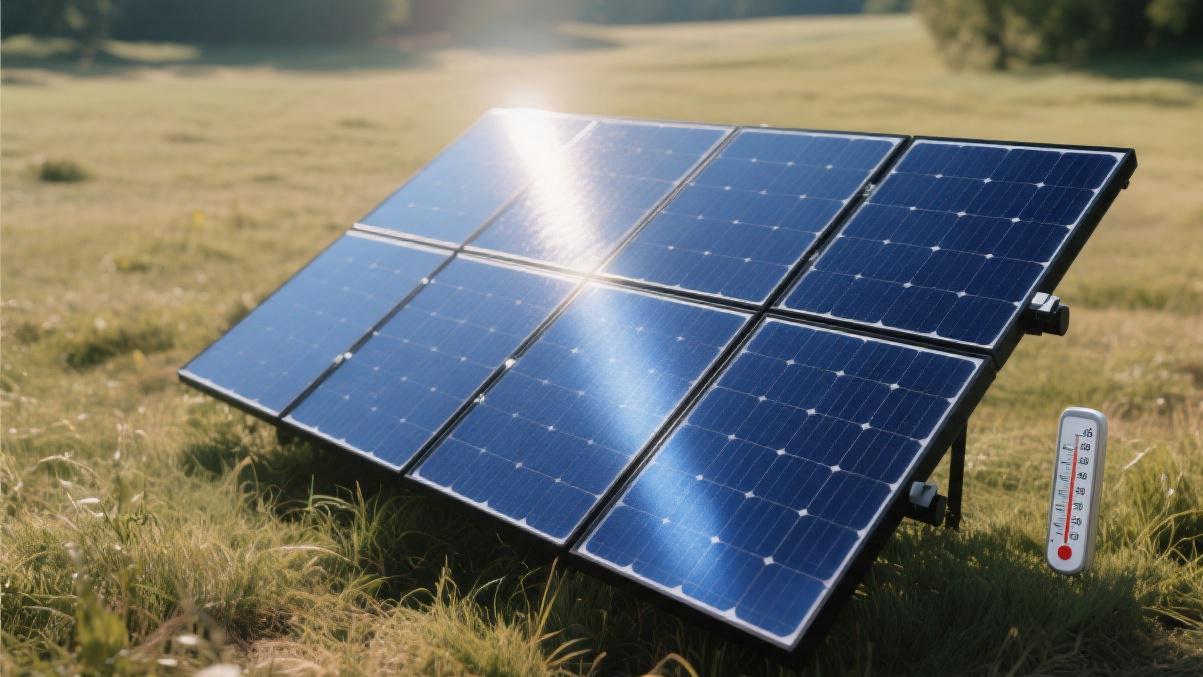
Light
Light must be enough
Monocrystalline silicon cell to light induction mainly relies on photons hitting the silicon lattice to produce electron-hole pairs. When irradiance from 1000 watts decreases to 600 watts, module's short circuit current (Isc) will almost linearly synchronously decrease 40%. In a low irradiance environment, cell internal parallel resistance loss will become prominent, leading to fill factor (FF) from typical 0.80 to below 0.75.
In order to maintain stable output, the inverter must frequently search for the maximum power point (MPPT), and at this time, if the voltage is lower than the start value (usually around 200 volts), even if the panel surface has light, the whole system will stop working because the power cannot overcome the inverter's self-consumption electricity.
Irradiance intensity ($W/m^$2) | Typical output efficiency (%) | 2 square meter module power (W) | Current change ratio |
1000 (Standard) | 22.5% | 450 | 100% (Base) |
800 (Sunny day) | 22.1% | 354 | Decrease 21.2% |
600 (Cloudy) | 21.4% | 256 | Decrease 43.1% |
400 (Overcast) | 19.8% | 158 | Decrease 64.8% |
200 (Extremely weak light) | 16.5% | 66 | Decrease 85.3% |
Pick light to eat
Sunlight contains ultraviolet, visible light to infrared different wavebands, wavelength range distributed between 300 nanometers and 2500 nanometers, but silicon-based cells can only utilize one part of them. Monocrystalline silicon's band gap width is approximately 1.12 electron volts (eV), only wavelengths shorter than 1100 nanometers photons have enough energy to excite current.
Wavelength at 300 to 400 nanometers ultraviolet light due to energy too high, most of it will transform into heat energy, making the module temperature rise; while exceeding 1100 nanometers infrared light will then directly penetrate the cell, not produce any charge. Currently, high efficiency N-type cells through optimizing anti-reflection coating (ARC) refractive index (usually set at 2.0 around), can put 400 to 1000 nanometers waveband light reflectivity decrease to 2% below, thereby making external quantum efficiency (EQE) in specific waveband reach 90% above.
Spectral waveband (nm) | Energy characteristics | Silicon cell conversion rate performance | Common loss factors |
300 - 400 (UV) | Energy extremely high | Extremely low (below 10%) | Convert to heat energy, accelerate EVA aging |
400 - 700 (Visible) | Energy moderate | Extremely high (85% - 95%) | Surface grid line shading loss |
700 - 1100 (Near infrared) | Energy matched | Medium (50% - 80%) | Bottom reflection insufficient caused loss |
> 1100 (Far infrared) | Energy too low | Close to 0% | Directly penetrate or convert to invalid heat energy |
Don't block light
Even if one piece of fallen leaf blocks a module inside one piece cell's 30% area, it will also trigger a serious short circuit current bottleneck. Photovoltaic module internal usually by 60 or 72 pieces cells series connected, according to wooden bucket effect, current's size is limited by whole string inside performance worst that piece cell. When a local shadow is produced, that place's resistance will instantly soar, forcing current through the bypass diode (Bypass Diode) to perform flow guidance.
Once a diode conducts, that sub-string (usually 20 pieces of cells) output voltage will directly return to zero. If a set of 10 kilowatt system has one piece panel by tree shade blocked 10% area, through voltage drop and inverter MPPT efficiency fluctuation calculation, the whole string's power generation loss often will reach 25% to 30%, far exceeding the shading area proportion.
Shading proportion (Single module) | Bypass diode action | Power loss percentage | System voltage change (V) |
0% (No shading) | No action | 0% | 41.5 (Rated) |
5% (Single cell full shade) | Conduct 1 group | About 33.3% | Decrease about 13.8 V |
15% (Horizontal shading) | Conduct 2 groups | About 66.6% | Decrease about 27.6 V |
3% (Scattered shading) | Intermittent conduct | 15% - 40% | Violent fluctuation, affect stability |
Borrow some reflection
Backside power generation gain mainly depends on ground's albedo (Albedo). If you install modules on ground covered with white gravel (reflectivity about 0.6), the backside can provide 15% to 25% electricity output. Taking power 550 watt bifacial module as an example, in grass environment (reflectivity 0.2), its actual comprehensive output can reach 580 watts above.
In order to maximize utilize these reflections, installation height needs to be from close to ground lift to away from ground 1.5 meters around, this can increase scattered light entering back side cell's geometric space, making every watt investment cost in not increasing panel quantity situation decrease about 10% single watt shared cost.
Ground type | Albedo (Albedo) | Back side generation gain (%) | 25 years cumulative extra electricity (kWh) |
Asphalt pavement | 0.12 - 0.15 | 3% - 5% | About 1,200 |
Green grass | 0.20 - 0.25 | 6% - 9% | About 2,500 |
Dry sand | 0.35 - 0.40 | 12% - 15% | About 4,800 |
White coating/Gravel | 0.60 - 0.80 | 20% - 30% | About 8,500 |
Weather good or bad
Air quality (Air Mass) to light reaching ground energy density has a direct correction effect. The standard test uses AM 1.5, namely sunlight passing through the atmosphere layer path length is vertical irradiation time's 1.5 times. When air humidity exceeds 80%, the atmosphere inside will absorb specific waveband infrared radiation, leading to a decrease in panel surface irradiance of about 50 watts per cubic meter.
In addition, air inside PM 2.5 particles will light produce Rayleigh scattering, making direct light become scattered light. Although monocrystalline silicon modules can absorb part of scattered light, due to the incident angle being messy, they cannot be cell surface light trapping structure effectively captured, this will lead to photoelectric conversion efficiency on heavy haze days decreasing by about 15% to 20%, directly lengthening the system's payback period.
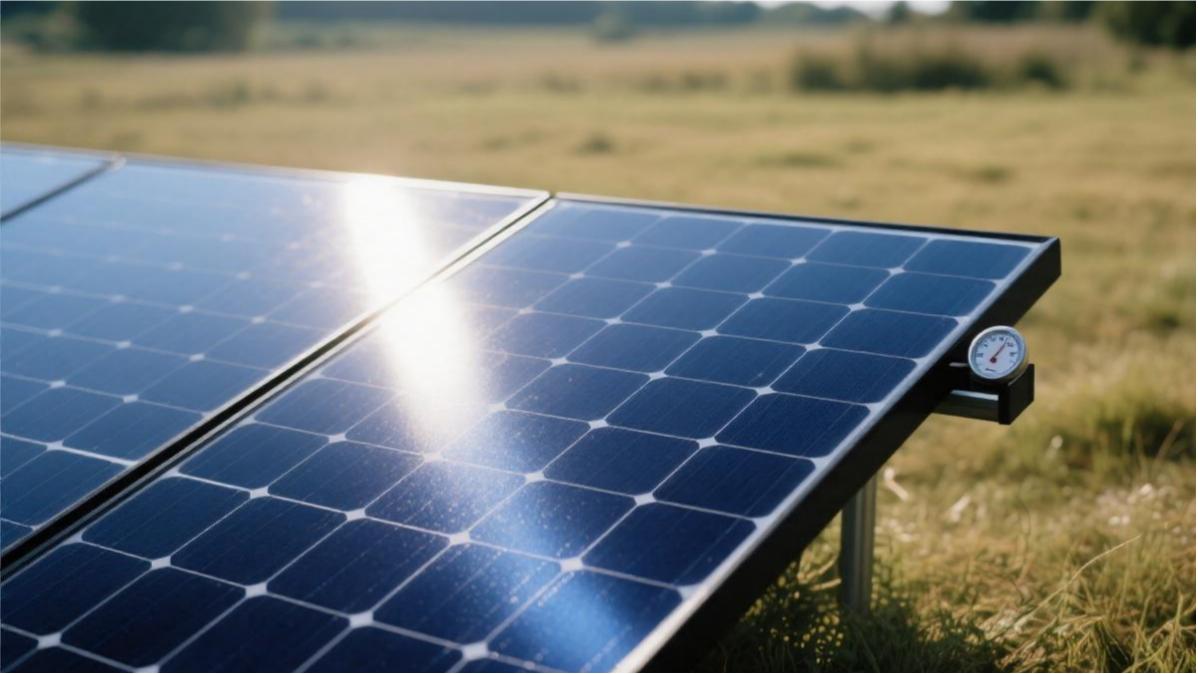
Temperature
Afraid of sun heat
Photovoltaic module in receiving solar radiation time, only about 20% to 22% of energy can be converted to electricity, the remaining 80% will transform into heat energy accumulated on the cell cell. Although the module needs sunlight to work, too high a temperature will lead to semiconductor internal carrier recombination speed accelerating, thereby decreasing voltage output.
Monocrystalline silicon module's standard test environment (STC) is set at 25 degrees Celsius, but in actual summer operation, when the environment temperature reaches 35 degrees Celsius and the wind speed is lower than every second 1 meter, the deep blue cell board surface will absorb a large amount of infrared, leading to the internal cell's actual work temperature (NOCT) easily soaring to 65 degrees Celsius or even 75 degrees Celsius. This kind of internal temperature and standard environment temperature difference of 40 degrees Celsius above situation will directly lead to module output power appearing large-scale slide. If no heat dissipation intervention is performed, the whole set system's daily generation gain will be by heat loss swallowed 10% to 15%.
· Photoelectric energy conversion ratio: 20% convert to electricity, 80% convert to heat
· Standard test base temperature: 25 degrees Celsius
· Summer roof extreme temperature: 65 degrees Celsius to 75 degrees Celsius
· Temperature caused power loss: usually 10% to 15% fluctuation
· Effective radiation absorption upper limit: usually at every square meter 1000 watts when heat accumulation is fastest
Calculate detailed account
Evaluating temperature influence most professional parameter is power temperature coefficient, mainstream monocrystalline silicon PERC module's this value is usually at every degree Celsius negative 0.35% to negative 0.39% between. From 25 degrees Celsius, start calculating, temperature every rise 1 degree, one piece rated power 500 watt panel will lose about 1.8 watt to 1.95 watt power.
If the panel reaches 70 degrees Celsius at noon, at this time, the relative temperature is higher by 45 degrees, power loss will reach 16% above, originally, a 500-watt panel's actual output might only remain 420 watts. For an 8 kilowatt peak output system, this due to temperature rise caused instantaneous power shrinkage might be as high as 3200 watts, equivalent to white-white wasted 6 pieces to 7 pieces panel's floor area and equipment cost, if according to year calculation, in a light sufficient but hot region, this will lead to a total return rate decrease of about 3% to 5%.
Cell real-time temperature | 500W module actual output | Compared to base loss power | 20kW system instantaneous loss |
25 Celsius (Base) | 500 Watts | 0 Watts | 0 Watts |
45 Celsius (Regular) | 465 Watts | 35 Watts | 1400 Watts |
55 Celsius (Partial hot) | 447.5 Watts | 52.5 Watts | 2100 Watts |
65 Celsius (Extremely hot) | 430 Watts | 70 Watts | 2800 Watts |
75 Celsius (Extreme) | 412.5 Watts | 87.5 Watts | 3500 Watts |
Look at material
Different technology route cell cell to heat sensitivity difference very large, currently market high-end N-type TOPCon cell and HJT heterojunction cell in high temperature resistance aspect possess significant data advantage. P-type PERC cell's temperature coefficient is generally at negative 0.37% around, while N-type TOPCon can be optimized to negative 0.29%, HJT can even reach negative 0.24% to negative 0.26%.
Although N-type module single watt price might be more expensive than P-type by about 0.02 dollars to 0.03 dollars, in an operation environment exceeding 40 degrees Celsius, N-type module can contribute more than 3% to 4% generation every hour. By a 25-year power station operation cycle calculation, this kind of low temperature coefficient brought extra generation amount cumulative can improve system internal rate of return (IRR) by about 1.2%, enough to offset the initial procurement time's premium.
· P-type PERC temperature coefficient: about negative 0.37% per degree Celsius
· N-type TOPCon temperature coefficient: about negative 0.29% per degree Celsius
· HJT heterojunction temperature coefficient: about negative 0.24% per degree Celsius
· N-type module premium range: per watt about 0.02 to 0.03 dollars
· High temperature environment generation gain: N-type than P-type high 3% to 4%
· 25 years IRR improvement magnitude: about 1.2 percentage points
Hardware injury
When the ambient temperature rises from 25 degrees Celsius to 50 degrees Celsius, copper core cable's resistivity will increase by about 10%. This will lead to line loss (I square R loss) rise, thereby making the delivered to inverter end voltage further drop. Inverter internal power semiconductor devices such as IGBTs are extremely sensitive. Most commercial inverters in environments exceeding 45 degrees Celsius will start active derating protection (Derating), force limit output power at rated value's 70% to 80% operation to prevent overheating and burn-out.
If the installation environment ventilation is poor, the inverter's internal capacitor's life will shorten by half every time the temperature rises 10 degrees, and the originally designed 15-year use life might be in short order 8 years inside appear failure.
· Cable resistivity increase: every rise of 25 degrees increases 10%
· Inverter derating critical point: environment temperature 45 degrees Celsius
· Inverter limit electricity proportion: usually force limit at 70% to 80% output
· Capacitor life attenuation law: temperature every rise 10 degrees, life halves
· Expected maintenance cycle shortening: from 15 years to 8 years around
· System overall DC line loss: under high temperature might extra increase 0.5% to 1%
Leave gap
If for beauty take close-to-ground flat laying, backsheet temperature will than have 10 cm gap installation method higher 15 degrees Celsius above. According to fluid dynamics simulation, when the bracket is away from the ground, the height reaches 0.5 meters to 1 meter, and the module arrangement leaves a 2 cm gap around the board-to-board gap, the chimney effect can effectively drive air convection, making the module work temperature decrease 5 to 8 degrees Celsius. This kind of simple space layout optimization, in not needing adding any active cooling equipment situation, can let a 100 kilowatt power station every year generate about 2500 degrees to 3500 degrees electricity, according to average electricity price calculation, this is equivalent to every year extra increase hundreds of dollars in net profit.
· Recommended minimum ventilation gap: 10 cm above
· Temperature difference comparison: close-to-ground installation than suspended installation high about 15 degrees Celsius
· Recommended board-to-board thermal expansion contraction gap: 2 cm
· Natural cooling temperature drop effect: about 5 to 8 degrees Celsius
· 100 kW system annual extra generation: 2500 degrees to 3500 degrees
· Structure optimization cost input: almost zero, only need bracket height adjustment
Age fast
In a long as 20 years to 25 years use cycle, frequently situated at 70 degrees Celsius high temperature under modules, its EVA film is easy to happen delamination, yellowing, leading to light transmittance every year extra decrease 0.2%. In addition, high temperature will also induce a kind of called light and elevated temperature induced degradation (LeTID) phenomenon, making cell internal recombination centers increase, leading to module attenuation rate exceeding expectation in the first 3 to 5 years of operation, total power might extra lose 2% to 4%.
If system design time not considered hot spot effect, local temperature will be too high, even permanently melting internal interconnection strips, leading to the whole piece 400 watt to 600 watt panel completely scrapped, replacing one piece panel's labor and logistics cost often is panel itself value's 1.5 times.
· EVA film light transmittance loss: every year extra increase 0.2% attenuation
· LeTID typical power loss: operation early stage extra lose 2% to 4%
· Module design operation years: 25 years
· Hot spot local extreme temperature: might exceed 100 degrees Celsius
· Panel scrap replacement cost: approximately single panel price's 150%
· 25 years after comprehensive efficiency expectation: maintain at initial value's 80% to 85%
Angle
Find the right slope
When light vertically enters a panel, namely the incident angle is 0 degrees, the panel every square meter receives energy at a maximum value, namely 1000 watts under standard conditions. If the panel is horizontal and flat laid in the North Latitude 35 degrees region, due to the change in the sun's height angle, light often enters at a slant angle, which will lead to cosine loss.
Through calculation, we can find that, when the incident deviation angle reaches 30 degrees, the panel captured effective irradiance will decrease by about 13.4%; if the deviation angle expands to 45 degrees, the energy receiving efficiency will plunge 30%. In order to save this part loss, installation time usually must refer to local latitude to set tilt angle. For example, in the latitude 30 degrees region, tilt panel 30 degrees install, compared to 0 degrees flat laying, the whole year total generation amount can usually improve 15% to 20% around.
Experimental data shows: in a fixed power station, control tilt error within plus or minus 5 degrees, every year generation revenue fluctuation will not exceed 1%. But if for pursuing beauty and decreasing the tilt angle from optimal 35 degrees to 10 degrees, a 5 kilowatt family system every year will generate about 850 degrees electricity, according to a 25-year life calculation, cumulative economic loss will exceed 10,000 yuan.
Don't face the wrong side
In the Northern Hemisphere, true south (azimuth 180 degrees) is publicly recognized as the optimal choice, because this can guarantee panel from morning 10 o'clock to afternoon 3 o'clock this energy highest time segment inside, always situated at high power output state. If due to roof structure limitations, forced to turn southeast or southwest direction, deviate from true south 30 degrees around, whole year total generation amount will shrink 5% to 8%. Even more extreme situation is that the panel has to face east or west, due to only being able to utilize half day direct light, overall generation efficiency will be discounted 20% to 25%.
For commercial power stations, this kind of orientation mistake will lengthen the payback period from originally 6 years to 8 years above. In the design stage, must use a compass or professional measurement tool to locate true south direction, rather than refer to magnetic south direction, because the existing magnetic declination might lead to a 3 to 5 degree positioning bias, thereby producing about 1% hidden power loss.
Azimuth setting | Annual generation relative ratio | 10 kW system daily average generation (kWh) | Payback period influence |
True South (180 degrees) | 100% (Base) | 40.0 | Base cycle |
Southeast/Southwest | 92% - 95% | 37.2 | Extend 0.5 years |
True East/True West | 75% - 80% | 31.0 | Extend 1.8 years |
True North (Mistake) | 40% - 50% | 18.0 | Cannot recover costs |
Follow the sun
Single-axis tracking bracket can drive panel left-right rotate, ensure panel in morning and evening can also receive sunlight at a smaller incident angle. This kind of technology's mechanical cost although will let every watt initial investment increase about 0.15 yuan to 0.25 yuan, but it can bring 25% to 30% generation amount improvement. In light resources sufficient regions, single-axis system's levelized cost of energy (LCOE) is usually lower than fixed type by around 10%.
If upgraded to dual-axis tracking, although it can achieve all-weather 90-degree vertical irradiation, generation amount can be extra about 40%, but due to mechanical structure complexity and high maintenance frequency, it is usually only suitable for solar thermal power or high concentration photovoltaic systems. For ordinary distributed projects, choosing single-axis tracking can usually be done in 5 to 7 years through extra electricity cover bracket's premium expenditure.
Tracking system performance comparison: single-axis tracking system can let module in afternoon 4 o'clock output power maintain at noon peak value's 80% above, while fixed bracket at this time power usually already drop to peak value's 40% below. Tracking system every day can be more about 2.5 effective utilization hours.
Block light loss
In multiple rows arrangement power station, front row panel angle higher, produced shadow then longer. If for saving land area and shortening row spacing, back row panel bottom edge on winter solstice this day very likely by front row shadow block. This kind of local shading is very scary, even if only the bottom 5% area enters the shadow, due to the cell's series characteristics, the whole string module current will all be limited to the shading place's low current level, leading to power loss jump-style reaching 50% or higher.
Usually required row spacing is panel height's 2.5 times to 3 times, to ensure no shading between 9 o'clock in the morning and 3 o'clock in the afternoon. In addition, panel installation tilt if not lower than 15 degrees, surface dust and snow accumulation under rain wash more easily, natural slide down, this kind of "self-cleaning effect" can every year decrease about 3% maintenance cost and maintain 5% around generation efficiency.
Shading ratio | Bypass diode state | Instantaneous power decrease | Long term influence |
0% (Full light) | Close | 0% | Normal operation |
3% (Bottom shading) | Trigger | 33% | Produce local hot spot |
10% (Single row shading) | Trigger | 66% | Shorten cell life |
20% (Multi-point shading) | All start | 90%+ | System might shutdown |
Four seasons all compatible
Due to Earth's revolution, the sun's operation track in summer and winter has huge differences. The summer solstice and winter solstice sun height angle difference value can reach 47 degrees around. The fixed angle bracket essentially is a whole year average value compromise solution, usually set at latitude minus 5 to 10 degrees to emphasize summer generation, or latitude plus 5 to 10 degrees to emphasize winter generation. If adopt adjustable bracket, manually in every year spring and autumn two seasons, adjust once angle, generation amount can extra increase 4% to 6%.
In design bracket stress, also must consider angle increase brought by wind load pressure. When the panel tilts from 15 degrees to 45 degrees, the leeward side produces instantaneous suction, which increases one time above, this requires ballast block or ground pile depth increase 30% above, to prevent extreme weather under 30 meters per second wind speed exceed bracket collapse.
· Summer Solstice optimal angle: Local latitude -15 degrees
· Winter Solstice optimal angle: Local latitude + 15 degrees
· Manual adjustment gain: every year about 4.5% electricity growth
· Wind load change: tilt every increase 10 degrees, wind resistance coefficient about rise 15%
· Bracket ballast standard: 35 degrees tilt usually requires every square meter load-bearing not lower than 60 kg