How Does Wet Weather Affect Solar Panels | Rain Impact, Light Absorption, Performance Changes
Rainy days will reduce light intensity, power generation amount usually drops 20%–50%, but rainwater can clean panels to increase efficiency.
Can through increasing tilt angle 10–15 and configuring energy storage batteries, reduce rainy weather's influence on power supply.
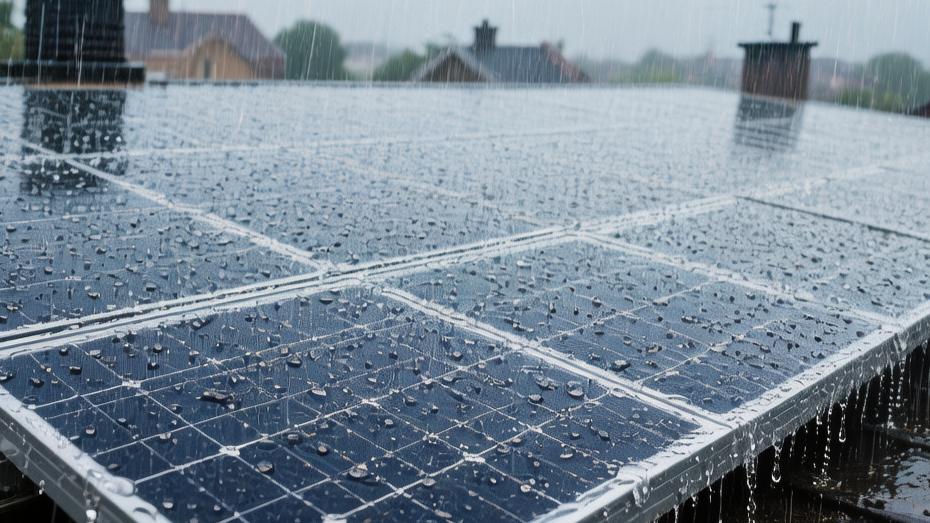
Rain Impact
Sudden temperature drop
When summer light reaches 800 watts per square meter, silicon wafer working temperature usually climbs to 65℃ to 75℃ high temperature interval. One 20℃ sudden rain shower falls, panel surface temperature will in short 5 minutes inside plummet 30℃ to 40℃.
· 3.2mm thick tempered glass and internal 0.2mm thick silicon cell piece's thermal expansion coefficients exist 8% to 12% numerical difference.
· Every second produces 0.1℃'s intense temperature drop, forcing the EVA encapsulant film layer to bear about 15 Pascals' shear stress.
· After experiencing 500 times above rapid-cold rapid-heat cycles, module internal interconnect ribbon's solder joint desoldering probability increases to 3.5% around.
· After 0.5 mm ribbon displacement occurs, the whole 400 watt panel's series internal resistance jumps 200 milliohms, accompanying a long-term output power drop of 4% to 7%.
Surface water film
When rainfall amount exceeds 5 mm per hour, the solar panel glass surface forms one layer thickness of 0.1 mm to 0.3 mm between the flowing water layer. Light rays crossing air contact water film time, refractive index from 1.0 changes to 1.33, about 4% of visible light is reflected back to atmosphere.
· Photovoltaic glass brings anti-reflection coating at dry state, under which light transmittance maintains at 93.5% to 94.5% standard level.
· Water film coverage makes wavelength at 400 nanometers to 800 nanometers interval's high-energy photon penetration rate forcefully fall to below 88%.
· Installation tilt angle lower than 10 degrees' flat roof system water accumulation layer thickness reaches 2 mm time, photoelectric conversion efficiency additionally loses 1.5 percentage points.
· Encountering continuous three days' overcast and rainy weather, water film refraction effect lets one 5kW system's daily average power generation reduce 0.3 to 0.5 degrees electricity.
Impact micro-cracks
Large raindrops with diameters reaching 3 mm to 5 mm at 6 to 8 meters per second terminal speed smash towards the panel surface. Every square meter's glass every minute bears about 300 times kinetic energy exceeding 0.05 Joules' physical impact.
· Tempered glass resists diameter 25mm hail at 23 meters per second speed's impact, continuous low-frequency vibration lets original naked eye invisible 5 micron level micro-cracks continue to expand.
· After long reaching 10 years, total 8000 hours' rainwater impact, cell piece internal micro-crack length extends 2 mm to 4 mm.
· Width's physical fracture blocks the partial electron transmission path, nominal current 10 amperes' cell piece loses 0.2 amperes to 0.5 amperes' output.
· Using a drone carrying a thermal imager to conduct 50-meter high altitude inspection, micro-crack area expanded due to rainwater impact's temperature compared to surrounding high out 5℃ to 8℃.
Gas penetration and leakage
The environment's relative humidity during the rainfall period rapidly climbs to 85% to 95% high humidity state, water vapor molecule diameter maintains at 0.28 nanometers. Backplate material's water vapor transmission rate higher than 2 grams per square meter per day, moisture in 72 hours penetrates into module internal.
· System applying as high as 1000 volts direct current voltage, free water molecules accelerate sodium ions migrate toward the surface, inducing exceeding 3% degradation rate.
· At 85℃ temperature and 85% humidity's double 85 test environment under continuous 1000 hours, panel's output power occurs within 5% degradation.
· Aluminum alloy frame's silicone sealing strip appears 0.5mm gap, rainwater penetration lets local insulation resistance from rated 50 megohms fall through to below 2 megohms.
· Continuous leakage fault lets single module's monthly power generation return to normal condition under's 20 US dollars shrink to 15 US dollars around.
· Rainfall intensity reaches 20 mm per hour, drainage holes are by diameter exceeding 2 mm leaves or silt blocked, panel bottom frame forms water accumulation trough. One piece length 2.2 m, width 1.1 m's 182 size large module, frame water accumulation 1 cm deep additionally increases about 2.5 kg dead load.
· Continuous downward gravity lets the 30mm aluminum frame produce 0.5mm to 1mm center deflection deformation.
· Roof installs 100 blocks of the same specification modules, array overall additionally bears 250 kg load-bearing pressure.
· Long-term staying at non-uniform stress state under, bolt torque at installation pressure blocks from standard 15 Nm loosens to around 10 Nm.
· Every year, spending 500 US dollars on maintenance budget, hire professional personnel, use torque wrench to re-tighten 400 nuts, and the rainstorm weather's mechanical damage rate reduces 80% above.
Bottom silt belt
Drizzle cannot take away silt, will in every hour 1 mm weak precipitation inside form concentration exceeding 20% mud paste. The lower edge of the panel about 3 cm to 5 cm area easily accumulates thickness reaching 2 mm silt belt.
· Bottom shading lets a 156mm square single cell piece produce a hot spot effect, local temperature soars to 90℃ above.
· Only covering the bottom row cell piece area's 10%, the whole panel's bypass diode automatically starts, cutting off that string's 33.3% power output.
· Originally, every hour, the producing 350 watts electrical energy module, in short time, is pulled low to 230 watts working level.
· Every year, invest about 300 US dollars to purchase specialized silt drainage clips stuck at the frame, water accumulation emptying speed increases 3 times, retrieving about 4% electricity loss.
Light Absorption
Clouds too thick
Rainy weather often accompanies troposphere middle thickness reaching 500 m to 2500 m cumulonimbus or stratocumulus clouds, atmosphere's optical thickness indicator from sunny days' 0.2 climbs to 10 to 50 interval. Thick water drop cloud layer through Mie scattering changes sunlight penetrating atmosphere reaching ground's total radiation amount, standard test condition under every square meter 1000 watts solar irradiance is weakened to every square meter 50 watts to 150 watts.
Monocrystalline silicon photovoltaic module's open circuit voltage towards light intensity's sensitivity presents a logarithmic relationship change, radiation amount drops 90% time, voltage value only from nominal's 38.5 volts slightly drops to around 35 volts, maintaining above inverter 200 volts' starting threshold. Short circuit current and reaching surface's photon flux density form a positive proportion linear relationship. Every second, a penetrating cloud layer hits one 2 square meter area panel's photon quantity from 10 to the 21st power plummets, working current from 10.5 amperes plummets to 0.8 amperes to 1.5 amperes.
When series array inside exists uneven thickness moving cloud layer, every 5 seconds produces 30% to 40% local shadow shading fluctuation, forcing Maximum Power Point Tracking system constantly re-calculate seek-optimization, every match delay loses about 1.5% to 2.5% instantaneous power generation.
Cloud Type | Avg Physical Thickness | Atmos Optical Thickness | Radiation reaching ground | Panel working current | Power drop range |
Clear cloudless | 0m | 0.1 to 0.3 | 950 to 1050 W/m² | 10.0 to 11.0 A | 0% |
Thin stratocumulus | 300 to 500 m | 5 to 15 | 400 to 600 W/m² | 4.5 to 6.5 A | 40% to 55% |
Thick cumulonimbus | 1500 to 2500m | 40 to 60 | 50 to 150 W/m² | 0.5 to 1.8 A | 85% to 95% |
Water vapor eats light
Atmosphere environment relative humidity reaching 90% to 100% during the precipitation period, air inside suspended water drops and high concentration gaseous water molecules in the specific near-infrared waveband produce strong absorption peaks. Liquid water at 940 nanometers and 1100 nanometers wavelength places significant physical absorption bands. Silicon-based solar cell's spectrum response range is between 300 nanometers and 1100 nanometers. The 900 nanometers to 1000 nanometers region belongs to the high-yield frequency band of photoelectric conversion. Thickness 50mm precipitation air mass pulls 940nm waveband's photon penetration rate low 25% to 35%, long wavelength photons that can deep enter P-type silicon layer excite electron-hole pairs are halfway consumed exhausted by water vapor.
Monocrystalline silicon module in this waveband's Internal Quantum Efficiency is as high as 85%, lacking effective photon input lets this specific spectrum interval's electrical energy yield rate occur 20% above's cliff-style drop. Humidity reaching 95% continuous rainy days, wavelength exceeding 800 nm infrared radiation flux attenuation rate is 1.5 times faster than visible light, panel overall light-heat conversion temperature compared to dry sunny day reduces 15℃ to 20℃. Every degree Celsius 0.35% power negative temperature coefficient at low temperature provides about 5% efficiency compensation, still cannot fill water vapor absorbing infrared photons caused's 15% base capacity deficit.
Solar spectrum waveband | Water vapor absorption characteristic | Silicon cell responsivity | Sunny day penetration | Rainy day penetration | Corr power loss rate |
300 to 500 nm | Weak absorption | 0.1 to 0.3 A/W | 85% to 90% | 40% to 50% | 5% to 8% |
500 to 800 nm | Extreme weak absorption | 0.4 to 0.6 A/W | 90% to 95% | 35% to 45% | 15% to 20% |
900 to 950 nm | Strong absorption band | 0.5 to 0.55 A/W | 80% to 85% | 15% to 25% | 25% to 30% |
1100 nm and above | Extreme strong absorption | Near 0 A/W | 70% to 75% | 5% to 10% | Below 1% |
Remaining blue-green light
Rainy day cloud layers and precipitation drops produce multiple space scattering, change light structure, reaching photovoltaic panel surface, direct light's proportion in total radiation amount plummets from clear weather's 85% to less than 5%, diffuse light proportion climbs to 95% to 100%. Wavelength between 400 nm and 500 nm shortwave blue light and green light penetrating liquid water and cloud layer's scattering attenuation is relatively small, rainy day panel received spectrum modules occur severe blue shift.
Silicon wafer towards 450 nm blue light's spectrum responsivity is only 0.25 A/W, not reaching half of towards 800 nm red light's 0.6 A/W, shortwave photons at silicon cell surface 0.1 micron to 0.5 micron shallow region are early absorbed, massive extra energy in heat energy form dissipates. Standard polycrystalline silicon module under AM1.5G spectrum's nominal efficiency is 18%, in diffuse light as main blue-shifted spectrum irradiation under, photon energy and material bandgap width matching degree reduces, actual photoelectric conversion efficiency down-reaches 12% to 14% interval.
Tilt angle set at 30 degrees roof array used for maximizing capture direct light, in all-diffuse rainy environment, azimuth angle advantage is smoothed out, different oriented panels received irradiance variance from sunny day's 300 W/m² shrinks to less than 15 W/m², every string's short circuit current deviation rate narrows to within 2%.
Weather State | Direct radiation ratio | Diffuse radiation ratio | Spectrum energy peak shift | Wafer matched conv efficiency | Array azimuth yield deviation |
Strong UV sunny day | 85% to 90% | 10% to 15% | 600 to 700 nm | 19% to 21% | 25% to 35% |
Cloudy to overcast | 40% to 50% | 50% to 60% | 500 to 550 nm | 15% to 17% | 10% to 15% |
Continuous mod rain | 2% to 5% | 95% to 98% | 450 to 480 nm | 12% to 14% | 1% to 3% |
Wet film becomes refractive
The solar glass surface when rainfall reaches 3 mm per hour forms a layer thickness of 0.05 mm to 0.2 mm flowing liquid film, destroying the original anti-reflection coating's optical matching structure. Silicon nitride anti-reflection layer physical thickness set at around 75 nm, refractive index at 2.0 around, between refractive index 1.0 air and refractive index 1.5 glass builds optical transition zone.
After rainwater coverage, the first layer's contact medium's refractive index becomes water's 1.33, light rays experience air to water, water to glass, glass to EVA film multiple interface refraction. Wavelength 600 nm light at a vertical angle incident on the air-water interface's reflectivity is about 2%, water to glass interface's reflectivity drops to around 0.3%. Interface reflectivity numerical values occur at the same time, water film's wave ripples break vertical incident angle condition, 30 to 60 degrees tilt incident light at liquid film surface producing total reflection probability increases by times, high incident angle light's transmittance from dry state's 92% slides to 86% to 88%.
Module in early rain first 15 minutes inside surface attached water drops present hemispherical distribution, convex lens effect focuses partial light at cell piece local, producing instantaneous 0.5 watt to 1 watt tiny power fluctuation, with rain amount increase water film joins together, overall transmittance light flux tends toward stable attenuation.
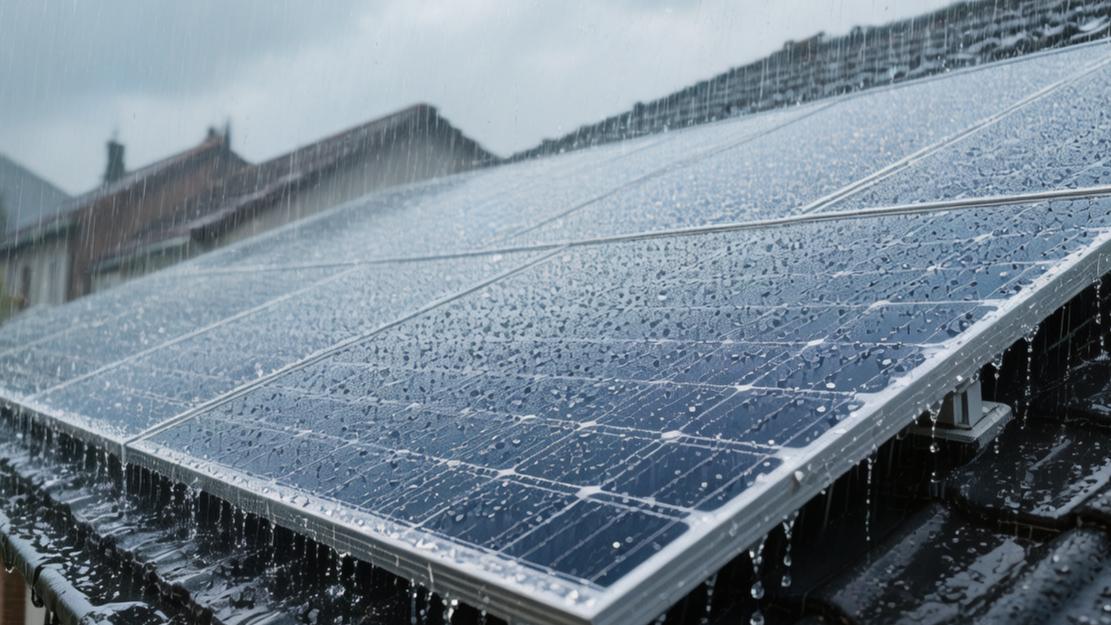
Performance Changes
Non-starting
One set standard 10kW household string-type solar system, usually by 25 blocks nominal power 400 watt monocrystalline silicon panels series-connected composed, nominal DC working voltage maintains between 850 volts to 950 volts. When rain leads to atmosphere transmittance lower than 15%, single panel's open circuit voltage from normal 41 volts slightly drops to 36 volts, but short circuit current will from 11.5 amperes plummet to below 0.5 amperes. This kind of extreme light attenuation leads to whole DC side input power insufficient at 200 watts, inverter internal DSP digital signal processor detects input power cannot cover its own about 50 watts to 80 watts standby loss as well as power grid synchronization required's lowest excitation current.
In order to prevent electrical energy reverse flow and hardware overload, the inverter will cut off the Insulated Gate Bipolar Transistor's chopping working state, leading to the whole array's actual output power becoming 0 watts. The system will every 300 to 600 seconds execute one time maximum power point scanning, until the environment irradiance rises to above 150 W/m², input voltage continuous 5 minutes stabilizes above 250 volts starting threshold, AC contactor will then re-close.
Single-phase string inverter in input power lower than rated power 1.5% rainfall period, internal conversion efficiency from 98.5% cliff-style falls to less than 40%, forcefully grid-connected produced alternating current's total harmonic distortion rate will climb to above 5%, unable to satisfy utility network required's power quality standard and forced enter sleep standby mode.
Voltage drops down
In a standard test environment, a 400-watt panel's maximum power point voltage is usually around 35 volts, corresponding maximum power point current is 11.4 amperes. Shaded by rainwater and thick clouds after, photons hitting the silicon wafer produced electron-hole pair quantity rapidly reduces, P-N junction's built-in electric field strength follows and weakens. The maximum power point voltage will shift left about 10% to 15%, dropping to the 30-volt to 32-volt interval, and the current curve then presents extreme flattening, with peak current pressed at 0.8 amperes to 1.2 amperes, extreme low level.
Maximum Power Point Tracking algorithm during seek-optimization process, will at every second 10 to 20 times frequency apply 0.5 volt to 1 volt disturbance voltage step length. Low irradiance under's characteristic curve becomes extreme flat and exists multiple local false peaks, seek-optimization algorithm easily falls into local optimal solution, leading to system extra losing 3% to 5% usable electrical energy. One block originally able to output 400 watt electrical energy module, actual working point is locked at 31 volts and 1 ampere intersection, single board real-time power generation power only remains 31 watts.
Solar array in continuous rain environment under's Fill Factor indicator from dry clear time's 0.78 deteriorates to around 0.65, series internal resistance due to surface water film's weak leakage effect increases about 50 milliohms to 100 milliohms, leading to module internal thermal loss ratio in weak power generation state still occupies above 12% of total converted energy.
Fast degradation
Environment relative humidity continuous 48 hours maintaining above 90%, will accelerate photovoltaic module material level's electrochemical degradation process. Monocrystalline silicon cell surface's silver paste grid lines width is usually only 40 microns to 60 microns, water vapor molecules penetrating backplate's fluorine film layer enter EVA film after, will with high molecular material occur hydrolysis reaction produce micro amount of free acetic acid.
PH value dropping to 5.0 to 5.5 micro-acidic environment will erode metal grid lines, causing series resistance monthly rise about 0.5 milliohms. As high as 1000 volts system to ground DC voltage and panel surface continuous water film together constitute one huge parallel plate capacitor. Leakage current from dry state under every square meter 1.5 mA plummets to 5 mA to 8 mA, accelerating sodium ions in glass migrate toward cell piece surface. Continuous Potential Induced Degradation effect lets panel's annual power degradation rate from standard 0.55% rise to around 0.8%. Passing the long-reaching 25-year meteorological cycle alternation, year-round rainy area's solar modules final output power will compared to nominal life line more degrade 3 to 4 percentage points, remaining quota from expected 84.5% slides to 80.5% critical value.
Module aluminum alloy frame and silicone sealing layer between's gap after experiencing 100 times above precipitation washing and thermal expansion cold contraction, interface adhesion drops about 15%, leading to water vapor penetration rate from daily every square meter 1.5 g increase to 2.5 g, internal metal contact points occur electrochemical corrosion probability increases near one fold.
Calculate earning less
Taking one set costs between 12000 US dollars and 15000 US dollars. For example, a 10 kW household roof system for solar radiation 5.5 kWh/m² on a standard sunny day, daily power generation stabilizes at around 45 degrees electricity. Meeting long-reaching one-week continuous rainy weather, the system can only produce 3 to 5 degrees of electricity, 7 days' cumulative power generation insufficient 30 degrees of electricity, compared to all sunny states, produced as high as 280 degrees of electricity capacity gap.
According to every degree of electricity, the 0.15 US dollars' retail electricity price calculate, a single week's economic loss reaches 42 US dollars. Assuming installation place every year has 45 days of precipitation, weather influence, annual total power generation expectation will from 14500 degrees electricity downward adjust to 13200 degrees electricity, annual economic return shrinks about 195 US dollars.
In a 25-year full life cycle financial calculation, this part due to rainwater caused cumulative power generation loss as high as 32500 degrees electricity, equivalent to an economic value of about 4875 US dollars. Originally calculated a 6.5-year investment recovery cycle, after deducting this part of meteorological loss, it will be pulled long 4 to 5 months, the Levelized Cost of Energy will also rise from 0.045 US dollars to 0.048 US dollars.
In the discount rate of 5% over a 25-year period, the Net Present Value calculation model inside, every year 10% to 12% precipitation power generation loss will let one 50kW medium commercial project's long-term internal rate of return from 14.5% fall back to 13.2%, cumulative cash flow return reduce about 12000 to 15000 US dollars.
Change to optimizers
The regular system uses centralized MPPT, one path will cause a barrel effect, just pulling low whole string 20 blocks panels' current output. After adding a unit price of 40 to 50 US dollars DC power optimizer, the equipment's internal buck-boost DC-DC conversion circuit can take a single panel produced 30 volts weak voltage, and independently boost to the inverter needed 400 volts stable bus voltage.
Even if certain few blocks panels because of above raindrop water accumulation or thick cloud shading lead to short circuit current drop to 1 ampere, the optimizer can also cut off its physical series connection restriction with normal panels, let other light conditions slightly better, and be able to output 3 amperes current's panels continue full load work. This kind of physical level decoupling architecture, with transmittance only 20% rainfall weather inside, can take photovoltaic array's overall electrical energy capture rate additionally increase 15% to 25%.
One 10 kW system needs an increase of about 1200 US dollars in initial hardware purchase budget, but in a rainy area, every year can retrieve about 450 to 600 degrees of electricity yield, investment added part's static recovery period is around 12 to 14 years.