What Are the Top Advantages of Portable Solar Panels | Mobility, Efficiency, Convenience
Three major advantages of portable solar panels: weight is only about 4 kg, fold and go, extremely high mobility;
Monocrystalline silicon conversion rate is as high as 24%, efficient energy gathering;
Just unfold it and aim at the sunlight, plug directly into an outdoor power supply to quickly store electricity, convenient and practical.
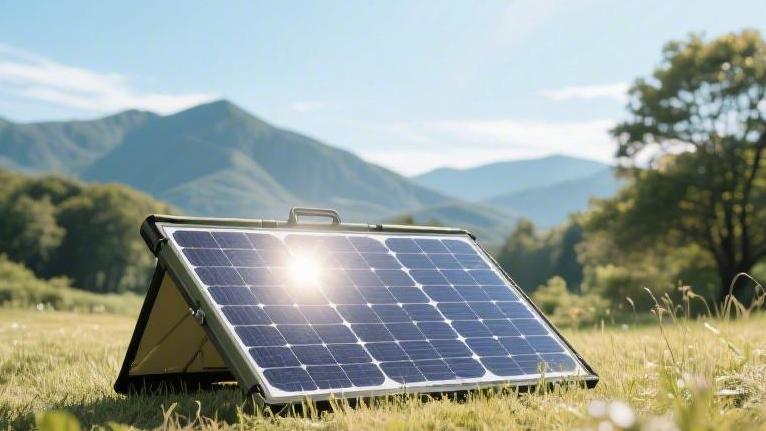
Mobility
Grab and Go
Conventional fixed monocrystalline silicon solar panels, because they have heavy tempered glass protective layers and aluminum alloy frames, usually weigh between 8.5 to 12 kilograms per square meter. In contrast, portable solar panels using ETFE (ethylene-tetrafluoroethylene copolymer) integrated packaging technology, due to removing the heavy glass structure, have a weight of only 2.8 to 3.5 kilograms for a 100-watt module. Its thrust-to-weight ratio (power-to-weight ratio) has increased from the fixed panel's 10 watts per kilogram to over 30 watts per kilogram, with an overall weight reduction magnitude as high as 65% to 75%.
For individual users, a weight of around 3 kilograms is equivalent to two thin and light laptop computers. During hiking or cross-country movement, this weight-reduction effect is very obvious. According to ergonomic tests, an adult carrying items within 5 kilograms in one hand and walking continuously for 15 minutes shows a heart rate fluctuation of only about 10%, whereas once it exceeds 10 kilograms, the sensation of muscle fatigue will grow exponentially at a rate of 15% per minute.
Really Thin
The thickness of traditional solar panels is generally between 30 mm and 40 mm, and they are not foldable, occupying an extremely large amount of space in narrow car interior spaces. Portable folding panels usually control their thickness within 40 mm in the storage state, while after unfolding, the thickness of a single power generation area is only 2 mm to 5 mm. This extreme thinness benefits from thin-film packaging technology, which presses multiple layers of composite materials together, providing extremely strong structural toughness while ensuring light transmittance reaches 95%.
In an ordinary five-seat sedan trunk (volume about 450 liters), a fixed solar panel will occupy about 20% of the effective space even if placed diagonally, while a folded portable panel can slide into seat gaps or storage bags like a laptop bag, reducing space occupancy to less than 2%.
Parameter Dimension | Traditional Fixed Panel | Portable Folding Panel | Increase/Decrease Ratio |
Weight per Watt | 80-100 g/W | 25-35 g/W | Weight reduced by about 70% |
Unfolded Thickness | 35 mm | 2.5 mm | Thinned by 92.8% |
Space Occupancy (100 W) | 0.05 cubic meters | 0.008 cubic meters | Saved 84% space |
Installation Time | 120-240 minutes | 0.5-1 minute | Speed increased 240 times |
Bend Resistance | 0 degrees (fragile) | 30-45 degrees (flexible) | Toughness greatly improved |
Stuff at Will
Mainstream 100-watt portable solar panels usually adopt two-fold or four-fold schemes. Taking the four-fold design as an example, the light-receiving area when unfolded is about 0.55 square meters to capture maximized solar irradiance; while the projection area after folding shrinks to around 0.13 square meters. This 4:1 expansion ratio allows power generation equipment to adapt to various complex transportation environments. In logistics transportation, a container of the same volume can load 3.5 times more quantity of portable equipment, greatly thinning the single-watt freight cost for cross-border or long-distance transportation.
In addition, panel edges are usually designed with reinforced hanging holes with diameters of 8 mm to 10 mm. In actual use, this design allows the panels to no longer be limited to flat-laying on the ground, but can instead utilize climbing ropes or carabiners to hang on the side of a camping car, the top of a tent, or even the back of a large-capacity backpack. In this dynamic moving state, because the panel can maintain an angle of 60 degrees to 90 degrees with the ground, it can still maintain about 40% to 60% power generation efficiency even during the walking process.
One Lift and Open
The deployment of a fixed system involves bracket assembly, screw tightening, lightning protection grounding, and waterproof sealing; the entire set of processes, even operated by professional personnel, needs to consume 2 to 4 hours. Portable panels adopt integrated magnetic suction handles or zipper closures; from taking it out to completely unfolding and entering the working state, the measured average time is only 22 seconds. Its self-contained elastic bracket supports 45-degree, 60-degree multiple gear adjustment; users can complete tilt angle optimization within 10 seconds according to geographical latitude and season, thereby obtaining about 25% more output power than horizontal placement.
These types of panels usually integrate MC4 or XT60 standard interfaces, support hot swapping, and instantaneous current carrying capacity can reach 20 amperes to 30 amperes. In extreme environments from minus 20 degrees Celsius to high temperatures of 60 degrees Celsius, the interface plug-and-unplug lifespan is generally above 3000 times. Users do not need to carry wire strippers, screwdrivers, or multimeters; as long as the connectors are aligned and pushed in, the circuit can be closed.
Withstanding Torture
The ETFE material on the surface of portable solar panels has a unique honeycomb structure, which not only can reduce light reflection loss by 3% to 5%, but also possesses extremely strong impact resistance. In drop tests, falling freely from a height of 1.5 meters onto hard ground, the functional damage rate of portable panels is lower than 2%, while traditional glass panels have a breakage rate of nearly 100% under the same conditions.
From the perspective of life-cycle cost, although the single-watt price of portable panels is about 15% to 25% higher than that of fixed panels, its durability and zero maintenance cost offset this gap. The self-cleaning property of ETFE material is extremely strong; rain flushing can take away more than 90% of dust, keeping photoelectric conversion efficiency stable at over 22% for the long term. For an outdoor player who uses it an average of 50 times per year, the depreciation cost of the portable panel is about 5 to 8 yuan per time, while the anytime, anywhere power guarantee it brings avoids risks of communication interruption or navigation failure caused by digital equipment power loss; this hidden return rate cannot be measured purely by money.
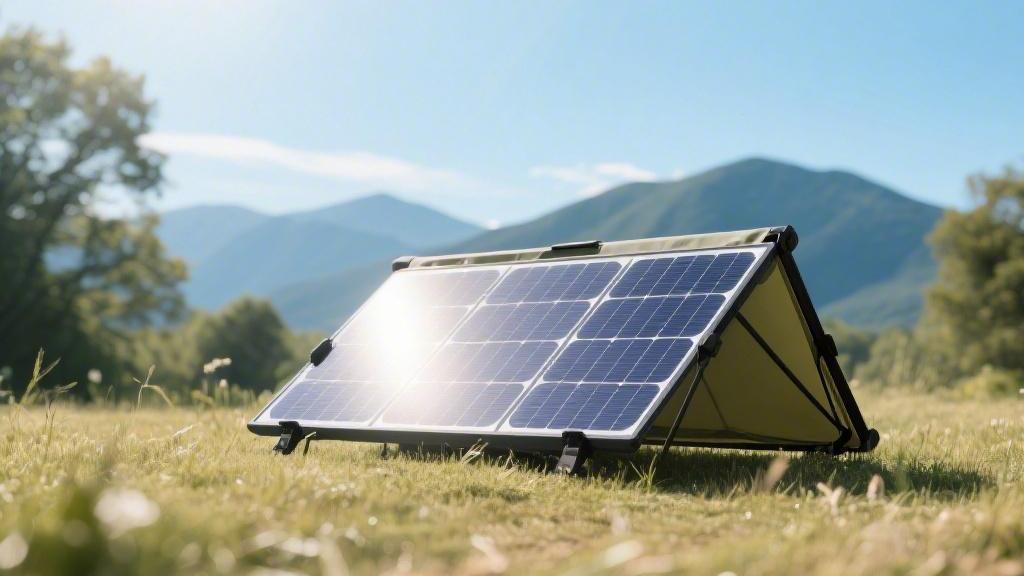
Efficiency
Light to Electricity Fast
Currently, mainstream portable panels on the market generally adopt N-type monocrystalline silicon wafers, with laboratory conversion efficiency already breaking through 24.5%, while the efficiency of mass-produced finished modules is stable between 22% and 23.8%.
In contrast, the efficiency of traditional fixed polycrystalline panels is only 15% to 17%; under the same 0.5 square meter light-receiving area, portable monocrystalline panels can produce about 35% more electricity. Taking a panel with a rated power of 100 watts as an example, under standard light intensity (STC) of 1,000 W/㎡, its output current can reach above 5.5 amperes, and the working voltage is maintained in the golden range of 18 volts to 20 volts, which exactly matches the best charging voltage input range of the vast majority of mobile power stations (Power Stations), reducing extra power loss of 3% to 5% caused by voltage conversion.
In actual outdoor testing, a 100-watt portable panel with a conversion efficiency of 23% can produce about 450 watt-hours (Wh) to 500 watt-hours of electricity within 5 hours of ample sunlight. If using a cheap panel with an efficiency of only 16%, only about 320 watt-hours of electricity can be produced in the same time; the difference between the two is as high as 130 watt-hours. This 130 watt-hour difference is enough to support a 15.6-inch laptop running for an extra 2 to 3 hours, or to fully charge a 4,500 mAh smartphone 4 times.
· Photoelectric Conversion Rate: 23.2% - 24% (Monocrystalline Silicon)
· Peak Power Deviation: ±3% (Actual output is close to the rated value)
· Current Density: about 38-40 mA/cm²
· System Gain: compared to polycrystalline silicon, it is improved by more than 30%
· Daily Average Electricity Production: 100W panel is about 0.45kWh - 0.55kWh
Works Even When Cloudy
Due to the adoption of PERC (Passivated Emitter and Rear Cell) or IBC (Interdigitated Back Contact) technology, high-specification portable solar panels have extended their spectrum absorption range from visible light to the near-infrared region (380 nm to 1100 nm). In the early morning or evening, when the light intensity drops to around 200 W/㎡, ordinary panels might stop working because they cannot reach the 12-volt starting voltage, but portable panels with high low-light sensitivity can still maintain an open-circuit voltage of 14 volts to 16 volts and generate a trickle current of 0.5 amperes to 1 ampere. Its effective power generation time can be extended by 1.5 to 2 hours per day compared to ordinary panels, and the overall electricity production contribution rate is improved by 12% to 18%.
Portable panels usually integrate two or more bypass diodes (Bypass Diodes) inside. When 10% of the panel area is blocked by leaves or tent corners, the diodes will automatically conduct, allowing the current to bypass the blocked part, thereby ensuring the remaining 90% area continues to work at full power. Without this design, even a small piece of shadow would cause the current output of the entire panel to drop by 50% or even completely to zero. Experimental data shows that portable panels with optimized circuit designs have an energy output 2.5 times higher than traditional series panels under partial shading conditions.
· Low-light Starting Threshold: light intensity as low as 150 W/㎡ can charge
· Work Duration Increment: daily average increase of 90-120 minutes
· Shading Loss Control: bypass design reduces current sudden drop by more than 70%
· Spectrum Absorption Width: covers the full band from 380 nm to 1100 nm
· Low-illuminance Current Maintenance: maintains 10%-15% of rated current
Heat Resistant and Durable
Solar panels being exposed to the sun, their surface temperature often soars to 60 degrees Celsius or even 70 degrees Celsius. Physical characteristics determine that the output power of silicon wafers will decrease as the temperature rises; the temperature coefficient of standard monocrystalline silicon is about -0.39%/℃. For every 1 degree Celsius the panel rises, the power will lose 0.39%. High-performance portable panels, by adopting ETFE packaging material and fabric backsheets with good heat dissipation performance, can control the working temperature near the 45 degrees Celsius Nominal Operating Cell Temperature (NOCT). In the summer with an ambient temperature of 35 degrees Celsius, its surface temperature is 5 to 8 degrees Celsius lower than ordinary PET packaging panels, thereby recovering about 2.5% to 3.1% of power output loss.
The light transmittance of ETFE film is as high as 95% or more, and its unique surface concave-convex structure can capture incident light from various angles, reducing reflection loss by about 3%. Long-term exposure to ultraviolet light will cause ordinary PET material to undergo more than 10% yellowing within 2 years, leading to a drop in light penetration, while ETFE material has a transmittance attenuation rate of less than 1% within a 5-8-year life cycle. This material stability ensures that the equipment can always maintain more than 95% of its factory-nominal efficiency during long-term use.
Performance Dimension | ETFE Packaged Portable Panel | Ordinary PET Packaged Panel | Efficiency Difference/Benefit |
Light Transmittance | 95% - 97% | 80% - 85% | Improved by more than 12% |
Temperature Coefficient | -0.35% / ℃ | -0.45% / ℃ | 5W more power in high temperature |
Reflection Loss | About 2% (Light-trapping structure) | About 5% (Specular reflection) | Reduced 3% energy loss |
Weathering Attenuation | <1% / Year | 5% - 10% / Year | Efficiency is 25% higher after 5 years |
Hot Spot Resistance | Extremely strong (Multi-busbar technology) | General (Easy to produce physical damage) | Reduced probability of circuit destruction |
Plug and Charge
Portable solar panels usually have a built-in high-efficiency controller or output directly to an MPPT charging port. The intervention of MPPT technology can perform real-time optimization and matching of voltage and current; compared to the traditional PWM charging method, its energy utilization rate is improved by 20% to 30%. In a 12-volt system, if the panel voltage is 18 volts and the current is 5 amperes, the PWM method can only utilize 12 volts × 5 amperes = 60 watts of power, while MPPT can transform it into 12 volts × 7.5 amperes = 90 watts of charging power.
Professional portable panels will be equipped with 12 AWG or 14 AWG specification pure copper tinned cables; the voltage drop of this thickness of wire within a 3-meter transmission length is controlled within 0.2 volts, and power loss is lower than 1%. However, some low-spec products on the market use 20 AWG thin wires, and the voltage drop can reach 0.8 volts, directly leading to more than 5% of energy being wasted on heat generation. By integrating high-power USB-C PD 65W fast-charging interfaces, portable panels can skip the converter to directly supplement power for electronic devices; this direct connection method avoids about 15% energy inversion loss in AC/DC conversion, making every watt of solar light converted enter the cell precisely.
Convenience
Plug and Use
Most 100-watt to 200-watt portable panels come with an integrated junction box, which has a built-in MPPT (Maximum Power Point Tracking) charging controller and supports multiple voltage output modes. The most commonly used interfaces include DC 7909, XT60, Anderson, and MC4; the plug-and-unplug lifespan of these industrial-grade interfaces is usually between 3,000 to 5,000 times. Even if an ordinary user does not understand electrical principles at all, it only takes less than 5 seconds to connect the panel with an outdoor energy storage power supply. In actual operation, this "plug and play" design saves about 95% of installation time compared to self-assembling a fixed system with air switches, combiner boxes, and brackets.
Modern high-power portable panels usually integrate a USB-C PD interface, supporting fast charging protocols up to 65 watts or even 100 watts. You no longer need to charge a heavy energy storage power supply first, and then have the power supply provide power to the computer. In cases of sufficient light, directly plugging a Type-C cable that supports 5-ampere current into the panel can charge a laptop with a 50 watt-hour cell life, taking about 1.2 hours to charge from 30% to 80%. This operation of saving the intermediate conversion step not only reduces the amount of equipment carried but also avoids about 15% to 20% of energy loss during the AC/DC inversion process, greatly improving the response speed of on-site power supplementation.
Under standard sunshine of 1,000 W/㎡, directly using the USB-C PD 65W interface of the portable panel to charge can save about 22% more original light energy than the "solar panel - energy storage power supply - laptop adapter" secondary conversion mode, because every DC-AC-DC conversion produces heat energy loss.
Adjustable Bracket at Will
In order to obtain the highest power generation efficiency in different latitudes and different seasons, the panel must be able to flexibly adjust its angle. Portable solar panels usually integrate two or four folding support frames on the back; these brackets use velcro or snap buttons for fixation and support quick switching between multiple tilt angles such as 45 degrees, 50 degrees, and 60 degrees. According to tests, in the north latitude 40 degrees region, adjusting the panel from a flat-laying state to a 45-degree angle vertically aligned with the noon sun can make the instantaneous output power leap from 60 watts to above 85 watts, an increase of 41.6%. This convenience in physical structure allows ordinary people to squeeze out 1.5 to 2 kilowatt-hours of energy more every day through simple manual adjustment, without increasing the panel area.
Because fixed panels have large weights (exceeding 10 kilograms per square meter), they must be installed on load-bearing walls or reinforced brackets, while portable panels are usually designed with 4 to 6 reinforced hanging holes around them, with a hole diameter of about 8 mm. You can use an ordinary D-shaped carabiner or a piece of 5 mm thick nylon rope to hang it on the luggage rack side of an off-road vehicle, on the wind rope at the top of a tent, or even on a roadside tree branch.
No Need to Specifically Scrub
The use environment of outdoor equipment is usually full of dust or rainwater; the ETFE (ethylene-tetrafluoroethylene copolymer) coating on the surface of portable panels provides great convenience in maintenance. This material not only has a light transmittance of up to 95% but also has hydrophobic properties similar to a lotus leaf, and its surface visibility retention capability is 3 times higher than that of ordinary PET material. In actual use, even if the panel is covered with a layer of floating dust about 0.5 mm thick, you only need to tilt the panel and gently splash about 500 milliliters of clear water, and more than 90% of the accumulated dust can automatically slide off with the water flow, without any professional cleaning agents or scraper tools.
Experimental data shows that in dry and dusty regions, ordinary panels without self-cleaning capability will have their power generation decrease by 15% to 30% after continuous use for a week due to dust shading. The anti-adhesion property of ETFE material extends the maintenance cycle from "daily maintenance" to "maintenance once every two weeks."
In addition, the weathering resistance of this material is extremely strong; under extreme temperature differences from minus 20 degrees Celsius to high temperatures of 85 degrees Celsius, the mechanical strength attenuation rate of the material is less than 1% per year. After you buy it, during a use cycle as long as 5 to 8 years, you almost don't need to invest any extra time or money in post-maintenance; the maintenance cost for a single use is almost close to zero.
Comparison of Relationship Between Maintenance Frequency and Output:
· Ordinary PET Panel: needs to be cleaned once every 2 days; if not cleaned, the output power attenuation rate on the 7th day is about 25.4%.
· ETFE Portable Panel: possesses self-cleaning characteristics, only needs simple rinsing every 14 days, and the output power attenuation rate is constantly controlled within 3.5% under the same conditions.
Can Charge Anything
Through the voltage regulation circuit inside the junction box, it can output multiple specifications of voltage ranging from 5V, 9V, 12V, 15V to 20V, automatically adapting to all digital products from Bluetooth headphones (about 2-watt power consumption) to large drone batteries (about 100-watt fast charging).
A typical 200-watt portable panel can simultaneously provide power to three devices with different protocols: one USB-A port outputs 5V/2.4A for a walkie-talkie, one USB-C port outputs PD 60W for a tablet computer, and one DC port outputs 18V/10A for an outdoor storage box.
You can save on carrying three to four wall-plug chargers of different specifications and just bring a set of solar panels and several standard charging cables. When encountering emergency situations, such as a vehicle cell losing power (12V lead-acid cell), some portable panels equipped with specialized alligator clip adapter wires can even perform trickle charging with a current of about 10 amperes; just by shining for about 2 to 3 hours, it can restore a cell that originally had a voltage of less than 11.5 volts to above 12.2 volts, which is enough to ignite.