How Do You Optimize Photovoltaic Performance on Water Bodies | 3 Techniques
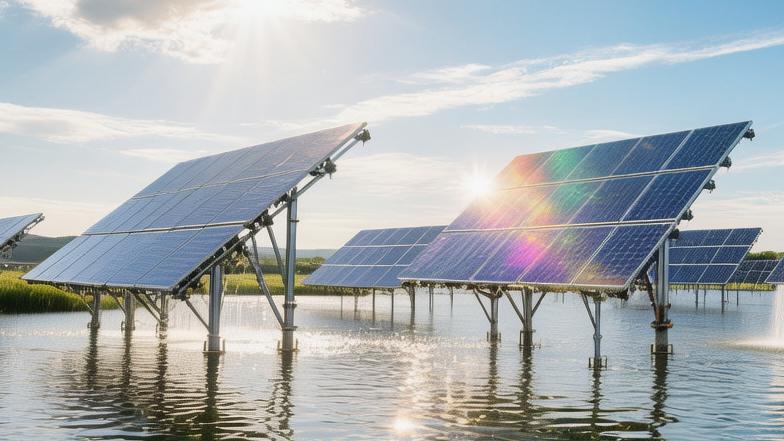
First is tilt and structural optimization, using a low-tilt design of 5°-15° to reduce surface wind load. Combined with the natural cooling effect of water, this can increase power generation by 5%-10% compared to land-based systems;
Second is intelligent tracking and anchoring systems, introducing floating solar trackers to further increase power generation gains by 15%-20% and ensure wave resistance;
Finally, corrosion-resistant materials and smart O&M, selecting High-Density Polyethylene (HDPE) to ensure a lifespan of over 25 years for the station, and utilizing drone inspections and automatic cleaning to quickly resolve shading losses caused by high humidity and bird droppings.
Anti-Reflective Coatings
Choosing the Thickness
The refractive index of ordinary photovoltaic glass fluctuates around 1.52, while the refractive index of air remains at 1.0 year-round.
When light enters the glass interface from the air, approximately 4% to 4.5% of solar radiation is reflected away.
By coating the glass surface with a layer of porous silica thin film, the refractive index of this film is precisely controlled between 1.25 and 1.30, which perfectly fills the refractive index gap between air and glass.
Visible light and near-infrared light wavelengths are concentrated in the 380 nm to 1100 nm region. To maximize the transmittance of specific wavebands, the physical thickness of the film must be strictly limited to the range of 120 nm to 150 nm.
When the film thickness reaches 130 nm and the microscopic porosity is controlled between 25% and 30%, the transmittance for light with a peak wavelength around 600 nm will climb to over 97.5%.
For a 210-size bifacial double-glass module with a surface area of 2.58 square meters, for every 1 percentage point increase in light transmittance, the output power of the module increases by 2.5 W to 3.2 W accordingly.
In high-reflection water environments, the proportion of diffuse scattered light reflected from the water surface to the total radiation received by the system reaches 8% to 12%. Modules with anti-reflective coatings on both sides can increase the light reception rate on the rear side by an additional 1.5%.
Converted for a conventional 50 MW floating power plant, the daily power generation can increase by approximately 4,200 kWh to 4500 kWh.
Blocking Water Vapor
The relative humidity of the water environment remains at 75% to 85% year-round. When the temperature difference between morning and evening reaches over 15°C, dense dew at the 3 μm to 5 μm level easily condenses on the glass surface.
The internal structure of ordinary porous films contains a large number of silanol groups. These hydrophilic groups aggressively absorb moisture from the air, causing the refractive index of the film to quickly climb from 1.28 to over 1.35 within 3 to 6 months, with transmittance dropping by 0.8% to 1.2% as a result.
By changing the microscopic surface morphology of the coating and using a fluorine-containing silane modified sol-gel method, the water droplet contact angle on the coating surface is increased from the original 30 to 40 degrees to between 110 and 115 degrees.
A hydrophobic state as high as 115 degrees allows water droplets attached to the panel to slide off quickly at a speed of 0.2 m/s to 0.4 m/s under the influence of gravity, simultaneously peeling off and carrying away more than 80% of floating dust particles on the surface.
After continuous baking for 1,000 hours in a test chamber with a temperature of 85°C and relative humidity of 85%, the transmittance attenuation of the hydrophobic anti-reflective film can be limited to within 0.2%.
The drastic reduction in water vapor permeability maintains the volume resistivity of the glass cover plate at above 10^12 Ω·cm, slowing down the speed of water vapor penetration through the internal encapsulant and reducing the probability of Potential Induced Degradation (PID) by 60% to 70%.
Withstanding Mechanical Brushing
Floating power plants need to be cleared of bird droppings every 15 to 20 days and rinsed with high-pressure water guns every 6 months to remove attached algae.
Standard mechanical cleaning equipment, such as rotating brushes made of nylon, applies a downward contact pressure of 200 Pa to 400 Pa when operating at a speed of 200 to 300 rpm.
The pencil hardness of traditional single-layer silica film is only 2H to 3H. After 20 to 30 mechanical brushings, the film thickness will wear down by 15 nm to 25 nm, resulting in a significant loss of the initial optical interference effect.
By incorporating titanium dioxide nanoparticles with a mass fraction of 1.5% to 2.5% into the original sol formula, or introducing organic-inorganic hybrid cross-linking technology, the hardness of the cured coating can be raised to the 5H to 6H standard level.
· In sand abrasion tests, using pure quartz sand with a diameter of 0.05 mm to 0.1 mm blown continuously for 2 hours at a wind speed of 14 m/s, the transmittance drop of the modified hardened film was controlled within 0.15%.
· Using a soft brush with a 2% concentration neutral cleaning solution and applying a 500 g load, after 5000 reciprocating abrasion tests in the same area, the absolute change in film reflectivity was less than 0.2%.
· For complex environments where the water is slightly acidic or alkaline, the solution pH is adjusted to the 5.5 to 8.5 range. After continuous immersion in 5% concentration sodium chloride brine for 480 hours, no visible peeling or bubbles appeared on the surface, and the coating adhesion remained firmly at the grade 0 test standard.
Cooling through Evaporation
Water Surface Heat Absorption
At room temperature, the complete conversion of 1 kg of liquid water into water vapor requires the absorption of approximately 2.26 MJ of latent heat.
When the ambient temperature reaches 30°C, the hourly evaporation per square meter of open water surface usually fluctuates between 0.8 liters and 1.2 liters.
During the light intensity peak from 12:00 to 14:00, the peak solar radiation approaches 1,000 W/m². With the specific heat capacity of a large water body fixed at 4200 J/(kg·°C), the temperature rise of the water surface itself is extremely slow, typically maintaining 22°C to 26°C.
During the process of evaporation and rising, water vapor lowers the local air temperature within a range of 0.5 m to 1.5 m above the water surface by 3.5°C to 5.8°C.
The peak power temperature coefficient of monocrystalline silicon cells is generally calibrated at -0.35%/°C. The backsheet temperature of conventional land-based modules under intense sun exposure can soar to 65°C to 70°C.
Thanks to the physical cold air mass brought by the water vapor below, the operating temperature of modules in the floating array is strongly suppressed to the range of 56°C to 60°C.
For every 7°C drop in backsheet temperature, the real-time output power of a single 540 W module can rise by 13.2 W to 15.5 W.
Calculated over an effective power generation period of 6 to 8 hours during the day, a single module can produce 0.09 kWh to 0.11 kWh of additional electricity per day.
Optimizing the Gap Height
Setting the lowest point of the module in the range of 0.5 m to 0.8 m above the historical average water level allows for the capture of natural breezes with flow rates of 1.8 m/s to 3.2 m/s above the water surface.
Wind speed combined with reasonable physical channels quickly dissipates the hot air that would otherwise remain stagnant on the back of the modules. The convective heat transfer coefficient significantly climbs from 12 W/(m²·K) in calm conditions to 28 W/(m²·K) to 35 W/(m²·K).
By increasing the spacing between rows within the array to 5.5 m to 6.2 m, wind penetration increases by 18% to 24%.
If the spacing is lower than 4 m, the rear array sits within the aerodynamic wake zone of the front row, causing the wind speed to plummet below 0.5 m/s, which results in the rear module backsheet temperature being 2.5°C to 3.8°C higher than the front row.
Lowest Point Height Above Water | Average Rear Wind Speed | Convective Heat Transfer Coefficient | Avg. Panel Cooling Magnitude | Power Generation Gain |
0.2 m | 0.8 m/s | 14 W/(m²·K) | 1.5°C | 0.52% |
0.5 m | 1.8 m/s | 26 W/(m²·K) | 4.2°C | 1.47% |
0.8 m | 3.2 m/s | 34 W/(m²·K) | 7.5°C | 2.62% |
1.2 m | 3.8 m/s | 38 W/(m²·K) | 8.1°C | 2.83% |
Monitoring Water Mist
The relative humidity index on the back of the panel will stay in the high operating range of 85% to 95% for long periods during the night and early morning.
Under the severe "Double 85" test conditions (90% relative humidity and 85°C ambient temperature), the probability of electrochemical corrosion occurring on the bypass diodes and metal terminals inside the junction box doubles.
The protection level must be mandatorily raised to IP68, and the thickness of the outer sheath of the Cross-Linked Polyethylene (XLPE) insulated cable should be increased from the conventional 1.5 mm to 2.2 mm to prevent water molecules from penetrating the silicone sealant layer at a rate of 0.02 μg/cm² per day.
From 7:00 to 9:00 AM, when the air temperature is lower than the dew point, a liquid water film 5 μm to 8 μm thick will adhere to the glass cover plate.
Sunlight striking the water film undergoes secondary refraction, causing the light transmittance to drop by 1.8% to 2.5% during the morning period.
As wind speeds reach 2 m/s after 9:00 AM, the surface water film is air-dried within 40 to 60 minutes, and the transmittance recovers to the calibrated value of 98.5%.
Tracking Systems
Rotate for More Power
The sun moves more than 120 degrees in azimuth from east to west every day. Conventional fixed mounts can only receive peak radiation during the two or three hours around noon.
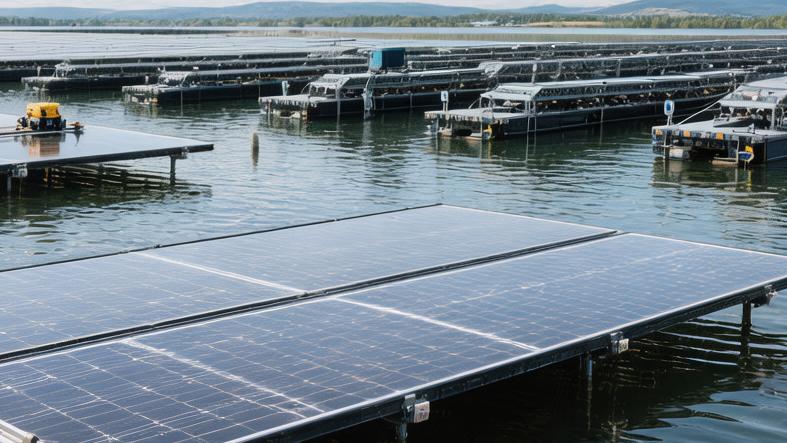
By introducing a horizontal single-axis tracking system to the floating power plant, the tilt of the photovoltaic array can rotate in real-time between -60 degrees and +60 degrees following the solar altitude angle.
During the periods from 8:00 to 10:00 AM and 14:00 to 16:00 PM, the angle between the incident light and the panel normal is forced to stay within 5 degrees.
The effective peak power generation time, originally 4.5 hours per day, is extended to 6.2 to 6.8 hours.
When the direct normal irradiance (DNI) remains between 800 W/m² and 950 W/m², the daily average power generation of a single 540 W module climbs from 2.4 kWh to 2.9 kWh.
For an entire 50 MW array in open waters between 20° and 40° North latitude, the total annual power generation will have a pure physical increment of 15% to 22%.
Real-time tracking algorithms compress the cosine loss rate in the morning and evening from 35% to below 4%, resulting in an additional 250 to 320 equivalent utilization hours per year.
Calculating the Rotation Axis
Unlike land, water does not have hard soil for pile driving. Tracking mounts as long as 100 m to 120 m rely entirely on the high-density polyethylene floating arrays below for support.
Huge torque needs to be distributed to rotation nodes set every 6 to 8 meters.
The output torque of the drive motor is typically set between 3500 Nm and 5000 Nm. Through a reducer, the mechanical transmission ratio is magnified to approximately 1:10000, allowing the entire array to rotate slowly at an angular velocity of 1.5 to 2.2 degrees per minute.
Astronomical algorithms combined with closed-loop feedback from tilt sensors lock the daily tracking accuracy within a 0.5-degree error range.
Once the on-site anemometer measures instantaneous wind speeds breaking the threshold of 18 m/s, the control system will forcibly flatten all panels to a 0-degree stow position for high-wind protection within 120 seconds, reducing the aerodynamic lift sustained by the array by 65% to 75%.
Anchoring Tension
Water levels have a seasonal drop of 3 to 5 meters per year, and winds and waves cause the array to drift horizontally by 0.2 m/s to 0.4 m/s.
Tracking modules are extremely sensitive to the yaw angle. Once the overall orientation deviation of the water array exceeds 2 degrees, 3% to 5% of the power generation gain from tracking is lost.
The mooring system needs to use a combination of high-molecular-weight polyethylene fiber ropes and elastic rubber shock absorbers.
The breaking strength standard for a single rope is set at 40 kN to 45 kN. In a reservoir environment with a water depth of 15 m to 25 m, it is anchored to bottom concrete blocks at an entry angle of 35 to 45 degrees.
When encountering surface swells with a wave height of 0.5 m and a period of 4 seconds, the elastic anchoring network can limit the overall pitch and roll amplitude of the array within 1.5 degrees, ensuring that the motor shaft does not seize or break due to localized torsional deformation.
The coordinate displacement tolerance for underwater anchoring points is only ±0.5 meters. Beyond this physical boundary, the hundred-meter-long single-axis transmission rod would withstand alternating stress exceeding its yield strength of 300 MPa.