How Can Photovoltaic Arrays Be Deployed on Lakes | 3 Innovations
First is the use of high-strength HDPE eco-friendly floating bodies and flexible intelligent anchoring systems, which not only provide strong load-bearing capacity but also perfectly adapt to extreme winds, waves, and water level fluctuations.
Second is the utilization of bifacial photovoltaic modules coupled with the cooling effect of natural water bodies to prevent overheating, thereby significantly increasing power generation efficiency by 10% to 15%.
Third is the "Water-Solar Complementary" ecosystem design, which generates high-efficiency electricity on the water surface while providing shelter for underwater organisms and reducing annual lake water evaporation by nearly 30%.
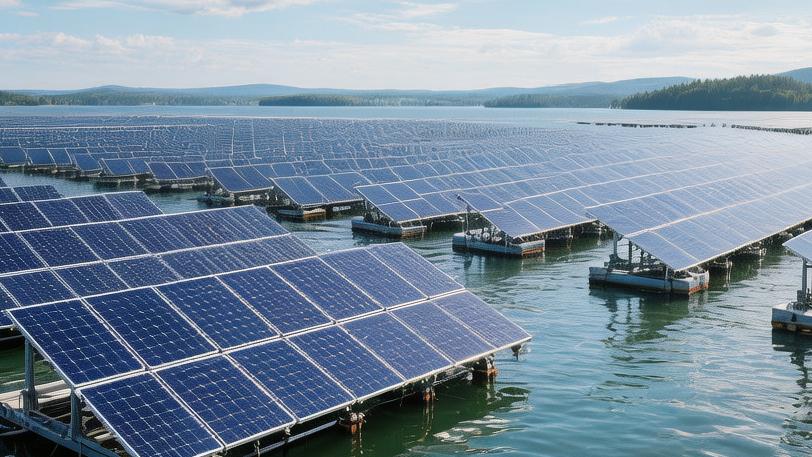
Floating Solar Panels
Choosing the Right Floats
High-density polyethylene (HDPE) blow-molded floats are the load-bearing foundation of the entire floating PV system.
The volume of standard commercially available single floats generally ranges between 0.4 cubic meters and 0.6 cubic meters, with the self-weight controlled between 7 kg and 10 kg.
Each square meter of the floating array provides a pure buoyancy reserve of 150 kg to 200 kg. After carrying a single 600-watt bifacial solar panel weighing a total of 22 kg, it retains at least 60% of surplus buoyancy.
Manufacturers mandatorily incorporate a 2.5% content of anti-UV carbon black additives and antioxidants during the polyethylene raw material production. This ensures the plastic maintains its physical strength for up to 25 years in equatorial regions where total UV radiation reaches 2000 kWh per square meter annually, with the material's tensile yield strength not falling below 22 MPa.
· The construction team assembles multiple floating modules with a 2:1 length-to-width ratio at the shore, with every 100 floats connected in series by 8 stainless steel dowel pins with a diameter of 12 mm.
· The periphery of the array is equipped with double-row high-strength wave-breaking floats with a width of 1.5 meters, capable of absorbing the kinetic energy of surface waves with heights between 0.8 meters and 1.2 meters.
· The anti-slip texture depth on the surface of the floating bodies is set at 3 mm, ensuring maintenance personnel can walk and work safely even in slippery conditions where the sole friction coefficient drops to 0.3.
Cooling Economics
The power generation of solar panels is significantly affected by surface temperature; the temperature coefficient of crystalline silicon modules is typically between -0.35%/°C and -0.45%/°C.
At summer noon, when ambient temperatures reach 35°C, the surface temperature of PV panels on land mounts can soar to 65°C or even 70°C, causing power generation to drop sharply by 10% to 14%.
The evaporating water vapor at the bottom of the floating array continuously carries away heat from the module backsheets, keeping the actual working temperature of floating solar panels stable within the 45°C to 50°C range.
Compared to ground power stations at the same latitude, the 15°C temperature difference brings an instantaneous power output gain of approximately 5.5% to 7.5%.
· A module with a rated power of 550 watts can output an additional 30 to 40 watts of peak power at noon daily due to the water cooling effect.
· A floating power plant with an installed capacity of 50 MW increases its annual power generation by as much as 4 million to 5.5 million kWh.
· In lakes with water depths exceeding 10 meters, the bottom water temperature remains at 15°C to 18°C year-round. This deep-water cold source suppresses daily average fluctuations of the surface water temperature to within 3°C.
How to Clean
Personnel use water pumps to extract fresh water from the lake beneath the power station. After filtering out algae and silt through a primary filter with a 50-micron pore size, the water is pressurized to 0.8 MPa and sprayed onto the glass panels.
Cleaning 1 MW of the array only requires 2 to 3 tons of water. The water flow naturally slides down along the 12-degree tilt of the modules and 100% flows back into the original water body, achieving zero water resource loss.
The track grip of the automated cleaning robot is set at 40 Newtons. At a travel speed of 0.5 meters/second, one robot can clean an area of 1,200 square meters of panels per hour.
· The average OPEX (operating expenditure) for performing high-pressure water washing four times a year is approximately 1,200 to 1,500 USD per MW.
· Floating environments lack surface dust, making the dust accumulation rate on module surfaces 40% to 60% lower than in land environments.
· The AR-coated glass with 98% light transmittance has its transmittance degradation strictly limited to within 0.5% after undergoing more than 100 nylon brush friction cycles.
Bird Dropping Worries
Open waters easily attract gulls, cormorants, and other water birds. Localized hot spot effects caused by bird excrement on PV panels can lead to serious power generation losses.
If 5% of a 2.5 square meter module area is covered by high-concentration acidic bird droppings, the series current of the module will drop by nearly 30%, and the power generation efficiency of the entire array will shrink by 8% to 12% within one week.
The maintenance team installs full-band ultrasonic bird repellers every 50 meters along the edge of the array, emitting sound waves between 15 kHz and 25 kHz with a sound pressure level reaching 110 dB.
· The bird repelling system randomly changes the emission frequency three times per hour to prevent birds' auditory nerves from developing habituation.
· Blunt-angled bird spikes with a length of 15 cm and a density of 10 spikes per square meter are installed at the highest points of the floats to physically block large water birds from landing.
· Panels corroded by excrement with a pH value between 3.5 and 4.5 require maintenance personnel to perform specialized wiping with a cleaning solution containing 0.5% non-ionic surfactant within 72 hours.
Integration with Aquaculture and Agriculture
Light Shielding Rate
The coverage area of floating PV arrays on a lake is usually strictly limited to below 70% of the total water surface area.
The remaining 30% light-transmitting gaps are the minimum requirement to maintain photosynthesis for underwater biological communities.
Engineers increase the spacing between two adjacent rows of solar panels to 2.5 to 3.5 meters to ensure that at least 400 W/m² of solar radiation penetrates 2 meters deep below the water surface between 10 AM and 2 PM daily.
Physical shading can reduce the average surface water temperature in summer by 3°C to 4°C, significantly inhibiting blue-green algae outbreaks and suppressing the reproduction speed of harmful algae by about 45%.
After the array installation, the underwater dissolved oxygen concentration can still remain stable between 5.5 mg/L and 7.8 mg/L year-round, provided reasonable aeration equipment is equipped.
The tilt angle of the panels is usually physically fixed at 12 to 18 degrees.
The low-slope design not only reduces surface wind loads by 15% but also allows early morning and late evening oblique sunlight to penetrate the water through longer refraction paths.
For aquaculture areas with water depths between 4 and 8 meters, a 30% light transmittance is just enough to maintain a photosynthetic carbon fixation rate of 1.2 mg Carbon per liter per day for phytoplankton.
After adjusting the light transmittance, underwater visibility often gradually improves from the original 0.8 meters to around 1.5 meters.
Aquaculture Accounting
The shadows cast by solar panels provide natural summer retreats for benthic fish and light-averse aquatic products.
In farm reservoirs in subtropical and equatorial regions, tilapia and catfish cages are usually suspended 1.5 to 2.5 meters directly beneath the floats.
Because the maximum summer water temperature is controlled within the optimal growth range of 28°C to 30°C, high-temperature stress responses in fish schools are reduced by 30%.
In the same water body, with a stocking density of 25 kg per cubic meter, the survival rate of fish fry has climbed significantly from the original 82% to 94%.
For every 1.3 kg to 1.4 kg of high-protein sinking feed invested, farmers can increase the net weight of underwater fish by 1 kg, saving about 15% in feed procurement costs compared to unshaded waters.
A 5-hectare composite floating PV and aquaculture project can produce 45 to 50 tons of commercial fish per hectare annually, with the average weight of a single fish at harvest maintained between 850 g and 1,200 g.
The aquaculture turnover period has been shortened from the standard 180 days to about 165 days, and the overall gross profit margin of the fishery can fluctuate upward by 8% to 11% annually.
Saving Pumping Costs
The electricity consumption of farmland irrigation systems around lakes accounts for more than 20% of total agricultural production expenditures.
The DC power generated by floating PV is continuously delivered to shore-side agricultural pumping stations through off-grid or grid-connected inverters with rated powers of 100 kW to 250 kW.
A high-power submersible pump with a head of 60 meters and an hourly flow rate of 350 cubic meters needs to operate at full load for 8 to 10 hours daily.
Using the peak power provided by the PV array during the day, farmers can fully cover the irrigation electricity load between 9 AM and 4 PM daily.
Calculated at an agricultural electricity unit price of 0.12 USD/kWh, the independent power supply system has slashed the energy cost per 1000 cubic meters of irrigation water from 18 USD to 3 USD.
The entire pumping irrigation cycle lasts 240 days a year; a 20-hectare farmland can save about 25,000 USD in electricity budget annually.
After 5 PM, surplus available power is fed back to the local low-voltage distribution grid at a unified purchase price of 0.05 USD/kWh, or stored in a 500 kWh lithium iron phosphate cell compartment for the greenhouse constant temperature system which consumes 15 kW per hour at night.
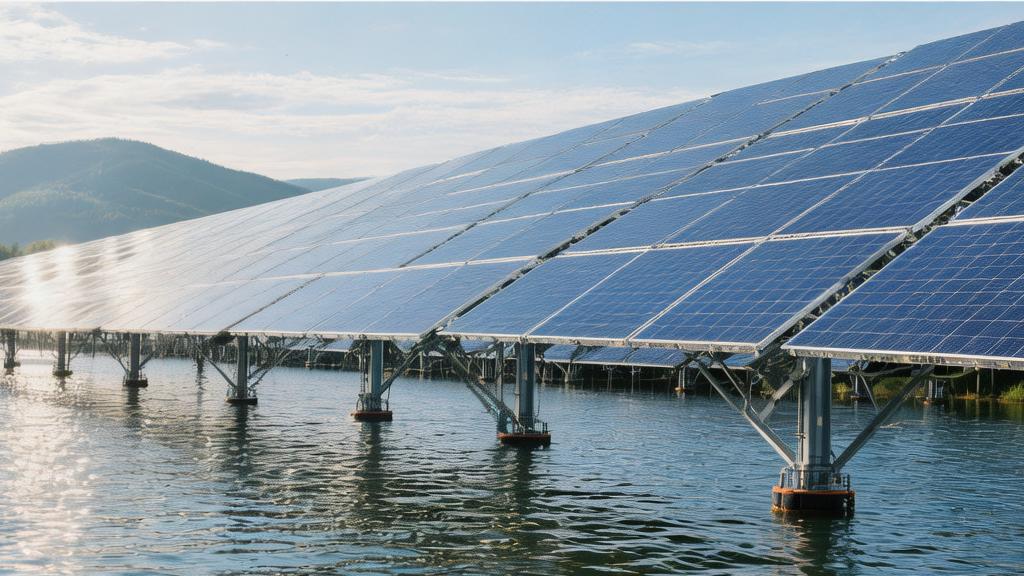
Advanced Tracking Systems
Rotating the Island
A 5000-square-meter floating PV array can be made into a rotatable floating island, ensuring the solar panels always face the sun's azimuth during the 10 hours from sunrise to sunset daily.
The water tracking system abandons common metal mechanical shafts used on land and treats the entire body of water below as a natural low-friction lubrication layer.
At the edge of a standard 1 MW circular floating array, engineering teams uniformly distribute 4 to 6 underwater thrusters or surface winch motors with a rated power of 2.2 kW.
At 6:30 AM daily, when light sensors detect ambient solar irradiance reaching 50 watts per square meter, the system sends a 24-volt low-voltage closure signal to the relay.
The motors slowly push the 150-ton plastic floating island to rotate eastward at an angular velocity of 0.2 to 0.3 degrees per minute.
The tracking algorithm controller has built-in astronomical position data for the next 30 years accurate to four decimal places, strictly limiting the azimuth error of single-axis horizontal tracking to within ±1.5 degrees. The total daily motor operation time is compressed to between 45 and 60 minutes.
Overcoming Resistance
Engineers have calculated that the hydrodynamic resistance of low-speed rotation on the water surface is only one-eighth of the rolling friction of an object of the same weight on land-based steel rails.
Pushing a circular floating body with a diameter of 80 meters to rotate at a linear speed of 0.05 meters/second requires a torque between 1200 N·m and 1500 N·m.
To counteract the water surface viscous resistance generated when the array rotates, the periphery of the floating island is equipped with flow deflectors with a cross-sectional area of 0.8 square meters.
When the water flow strikes the deflectors at a speed of 1.5 meters/second, 65% of the flow is smoothly guided to both sides of the array, suppressing the propulsion power consumption of the entire system to 0.4% to 0.6% of the total daily power generation.
For a tracking power station covering 2 hectares, the cumulative power consumption of the 3 internal driving motors usually does not exceed 180 kWh after 30 days of continuous operation.
The system is designed with a safety redundancy load of 300%. Even if one motor suffers a power failure, the remaining equipment can still output up to 8500 Newtons of thrust, maintaining the floating island's full 160-degree azimuth tracking at the set deflection rate daily.
Steel Cables
The physical medium for pulling the floating island's deflection is 18 mm diameter galvanized steel wire rope, encased in an anti-corrosion polyurethane sleeve with a thickness of 2.5 mm.
One end of the cable is anchored to a 3.5-ton concrete gravity block at the bottom of the lake bed, while the other end is wound around a servo winch at the edge of the floating body.
When the microcomputer issues an instruction to deflect 15 degrees to the west, the east-side winch smoothly releases the cable at a rate of 2 meters per minute, while the west-side winch simultaneously winds in an equal length of cable.
The tension meter values throughout the mechanical pulling process are monitored in real-time, with daily tension maintained in the 15 kN to 22 kN range.
If the tension reading increases sharply to 45 kN within 2 seconds, the system determines that it has encountered an underwater foreign object snagging, instantly cuts the 380-volt three-phase AC power, and triggers a brake stop.
After undergoing up to 12,000 extension and retraction friction cycles annually, the metal fatigue of the steel cable will only reach 40% of the breaking threshold in the 10th year. Maintenance personnel only need to inject 250 ml of industrial lubricant into the winch gearbox every 6 months.