Why Are Solar Cells Particularly Suitable for Developing Countries
Solar cells (photovoltaic technology), due to their decentralized nature, perfectly fit the current state of weak infrastructure in developing countries.
In regions such as Africa and Southeast Asia, approximately 600 million people still live without grid coverage, and solar energy can directly bypass costly and time-consuming grid construction to achieve "power leapfrogging" through distributed systems.
From an economic perspective, the cost of photovoltaic power generation has dropped by about 90% over the past decade, and the Levelized Cost of Energy (LCOE) in some regions is already lower than that of coal-fired power.
In addition, solar equipment is easy to maintain, has a lifespan of 20-25 years, and can combine local abundant sunshine resources (with annual radiation often exceeding 2000 kWh/m²) to provide cheap and reliable green power for rural medical clinics, remote education, and agricultural irrigation.
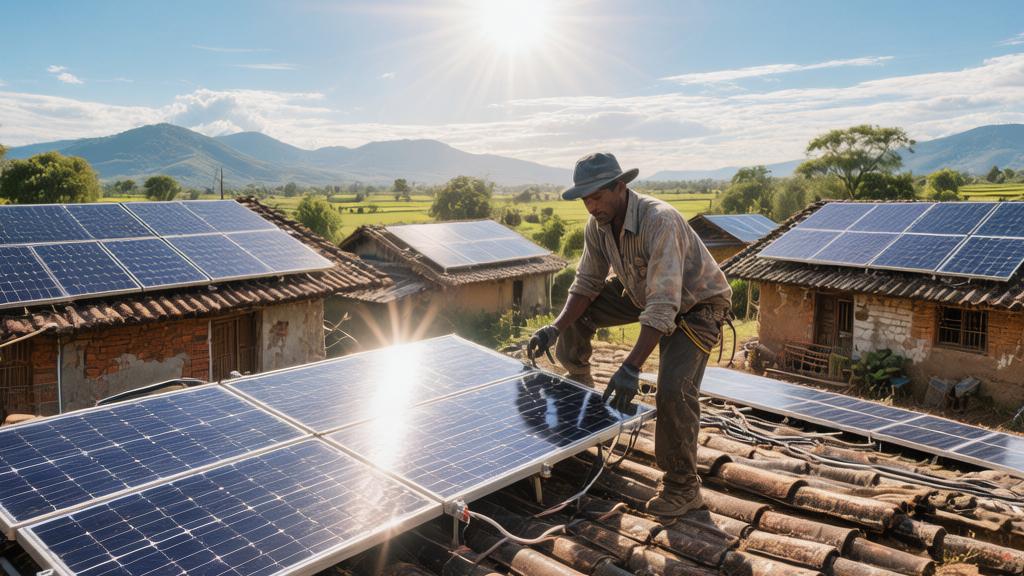
Overcoming Infrastructure Limitations
No Grid Required
Constructing every kilometer of 10 kV or 35 kV medium-voltage overhead transmission lines, including material costs for poles, wires, and insulators plus construction fees, typically costs between 12,000 and 25,000 USD.
If the terrain involves mountains or jungles, this budget will soar by over 40%.
For villages with a population density of less than 50 people per square kilometer, the static payback period for such infrastructure investment often exceeds 50 years, far surpassing the physical life of the power equipment.
A village-level microgrid with a power of 50 kW requires only about 350 square meters of land and, when equipped with a 200 kWh Lithium Iron Phosphate (LFP) cell storage system, can provide 1.5 kWh of basic electricity daily for 100 households.
This model cuts transmission losses from the 15% to 20% typical at the end of traditional grids to within 3%.
In these areas, the no-load losses of distribution transformers and the resistive heating of long-distance wires waste megawatts of energy annually, whereas solar systems—generating and consuming power on-site—have an energy utilization rate about 18% higher than long-distance supply.
Simple Wiring
Mainstream solar modules currently use standardized MC4 interfaces; these plug-and-play connectors typically have a contact resistance of less than 0.3 mΩ and an IP68 protection rating.
For local labor with limited educational levels, just four hours of technical training is enough to master series-parallel wiring rules, which shortens training time by 95% compared to training a power engineer capable of operating high-voltage transformers.
Regarding voltage levels, residential systems usually operate at safe DC voltages of 12V or 24V, significantly reducing the probability of electric shock accidents.
In contrast, traditional 220V AC grids, in the absence of professional maintenance, have a fire risk rate 4.5 times higher than solar systems due to aging lines.
From an equipment parameter perspective, the Maximum Power Point Tracking (MPPT) efficiency of modern inverters has stabilized at over 98%, allowing them to automatically adapt to a wide input voltage range from 120V to 1000V.
This means that even if voltage fluctuates by 30% due to cloud cover, the system can still maintain stable output.
For villages that only have dirt roads or no roads at all, thermal power equipment weighing several tons simply cannot be transported in.
However, solar panels—weighing only 20 to 25 kg each—can be carried to any corner by small farm vehicles or even by hand, solving the "deadly constraint" of the last 5 kilometers in infrastructure logistics.
Flexible Expansion
Traditional energy systems have a strong "scale threshold"—you cannot build just 1/10 of a coal power plant—but solar can start from as little as 100 watts.
An initial budget of only 200 USD can install a micro-system that satisfies 3 LED lights and 1 radio.
As local demand for agricultural irrigation or processing grows, simply adding grid-tied inverters and cell packs of the same specifications allows the system capacity to scale linearly from 1 kW to 10 kW within 24 hours, with almost zero downtime during expansion.
Taking Kenya's M-KOPA model as an example, users only need to pay about 0.5 USD daily via mobile payment (which is 30% cheaper than spending on kerosene) to gain ownership of the equipment within 1 to 2 years.
This hardware-based financial inclusion has provided power security to 250 million African people who were previously excluded from the modern financial system.
According to statistics, after gaining stable solar power, the average daily operating hours of local micro-businesses extended from 8 hours to 12 hours, and the growth rate of net household income generally falls between 4.8% and 7.2%.
Economic Feasibility
Prices Hit Rock Bottom
The global average transaction price for monocrystalline silicon PV modules has dropped from 3.80 USD per watt in 2010 to between 0.11 and 0.13 USD in early 2024, a cumulative drop of over 96%.
In the retail sector of African and Southeast Asian markets, the total procurement cost for a standard residential system—including a 400-watt monocrystalline panel, a 30A MPPT controller, and a 100Ah lead-acid cell—has been pushed down to below 280 USD.
This means that for a rural family with an average monthly income of around 150 USD, investing less than two months of total income provides 25 years of power autonomy.
Compared to five years ago, the installation budget for a system of the same power has decreased by 45%, while the conversion efficiency of photovoltaic cells has increased from 17% to currently over 22.5%.
This optimization in cost structure is directly reflected in the Levelized Cost of Energy (LCOE), with distributed solar currently costing about 0.04 to 0.06 USD per kWh.
· In 2024, PV module prices fell by 15% year-on-year, currently at a historical extreme range of 0.12 USD per watt.
· Each square meter of solar array in tropical regions produces annual electricity worth about 45 USD, while its hardware cost is only 60 USD.
· Every time global PV installed capacity doubles, its technical cost continues to drop by about 20% according to the learning curve rule.
· In the past 36 months, the price of matching energy storage batteries has also undergone a 30% reduction, with the cost per kWh of storage falling below 150 USD.
Cheaper Than Burning Oil
In areas without grid access, diesel generators are the only alternative, but their comprehensive cost per kWh is typically between 0.35 and 0.55 USD.
The transport premium for diesel in remote areas is often as high as 25%, with fuel prices staying between 1.1 and 1.4 USD per liter year-round, and the fuel conversion efficiency of generators at 50% load is only around 30%.
If a 5 kW diesel generator is replaced with a solar-plus-storage system of the same capacity, users can directly save about 1200 liters of diesel annually, equivalent to over 1500 USD in cash savings.
This zero-fuel-cost characteristic allows solar systems to offset 80% of their initial equipment premium starting from the 2nd year of operation.
Since solar does not require any consumables, its ability to hedge against inflation is more than 10 times higher than that of fossil fuels.
· The LCOE of diesel generators is 7 to 9 times that of solar systems, and the risk of fuel price fluctuations exceeds 15% annually.
· Over a 25-year lifecycle, the total fuel savings per kilowatt of solar installation can reach 28,000 liters of diesel.
· In areas with sufficient sunlight, the operating cost of solar water pumps is 65% lower than that of fuel pumps, reducing the expenditure for irrigating each hectare of land by 200 USD.
· Small commercial users replacing diesel engines with solar usually see their net profit margins increase by 4.2% to 6.8% due to reduced energy expenses.
Quick Payback
For small and micro enterprises in developing countries, the static payback period for solar investment has shortened to 3.2 to 4.5 years.
Taking a small village processing workshop as an example, installing a 10 kW PV system requires an investment of about 8500 USD and can generate 16,000 kWh annually.
At a local industrial and commercial electricity price of 0.15 USD per kWh, the annual revenue is approximately 2400 USD, with an internal rate of return (IRR) of over 18%.
This extremely high return on capital has attracted many micro-loan institutions, which provide 24-month installment plans so that the user's monthly repayment is exactly equal to what they previously paid for electricity or kerosene.
This financial logic of "paying off the loan with saved money" covers over 120 million off-grid people worldwide.
· Pay-as-you-go models like M-KOPA have lowered the initial entry barrier to 20 USD, with daily payments of only 0.45 USD.
· In the East African market, the payback period for solar street lights is only 14 months because they avoid the 500 USD per kilometer cost of laying underground cables.
· Barber shops or mobile charging stations with solar power commonly see a 25% to 35% increase in daily average revenue.
· The total interest expenditure for a 10-year loan to buy solar equipment usually accounts for 12% of the total investment, far lower than the 300% cumulative expenditure for fuel.
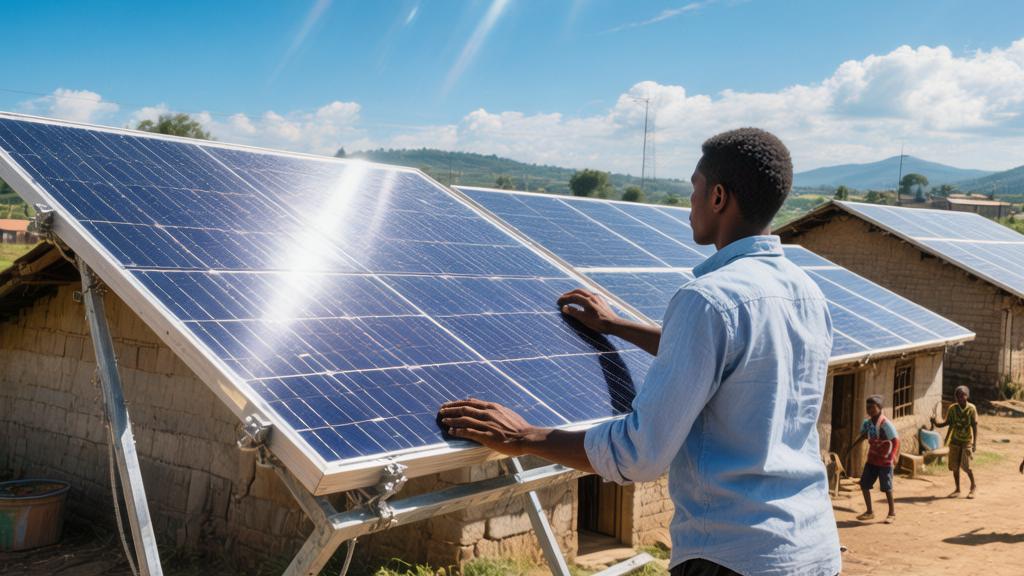
Scalability and Rapid Deployment
Blazing-fast Implementation
In remote villages lacking heavy machinery and grid-laying conditions, the installation speed of solar systems is about 500 times faster than traditional energy facilities.
Building a 100 MW coal or gas plant from site selection and environmental assessment to civil construction and commissioning usually takes 1,200 to 1,800 days, whereas a distributed solar project of the same scale only takes 120 to 150 days to grid-connect.
For a typical 5 kW residential system, two local villagers who have received 8 hours of basic training can complete everything from unboxing and wiring to bracket fixing in just 4 to 6 hours using simple manual tools.
This rapid deployment capability shortens the response cycle for energy supply from "years" to "hours," allowing areas that might not see grid extension for 50 years to obtain stable lighting within 24 hours.
Deployment Metrics | Traditional Thermal Power | Distributed Solar Systems | Improvement Factor/Difference |
Construction Cycle (5MW scale) | 730 - 1,095 days | 45 - 60 days | Shortened by approx. 15 times |
Single Point Installation Time | Requires months for transformer commissioning | 4 - 8 hours to complete wiring | Efficiency boost of 98% |
Professional Labor Required | 50-100 senior engineers | 2-3 junior technicians | Labor cost reduced by 85% |
Commissioning Pass Rate | Requires 72 hours of load-bearing operation | Plug in MC4 interface to power up | 0 second startup response |
Flexible Scaling
Solar systems possess a unique linear expansion logic; the installed capacity can be increased from 100 watts to 1 megawatt precisely according to the user's budget, with the price-per-watt fluctuation range controlled within 10%.
A user might initially only be able to afford a single 400-watt monocrystalline module for phone charging and 3 10-watt LED lights.
After their annual household income grows by 5.5%, they can seamlessly add a second module and parallel a 1000-watt micro-inverter. The entire expansion process requires no replacement of the existing distribution box and no new application for power installation.
This "building block" growth method ensures capital utilization rates exceed 95%, completely avoiding the risk of "large one-time investment with less than 20% utilization" commonly found in traditional power engineering.
Suppose a school adds 10 laptops with a rated power of 60 watts; the school only needs to add an extra 1.5 kW PV array and a 5 kWh energy storage cell pack on the roof.
The payback period for such incremental investment is usually stable at around 3.8 years, and it will not cause more than 3% harmonic interference to the original system's 230V AC output waveform.
Deliverable Anywhere
Since the physical specifications of a single solar panel are usually limited to 1.7 meters by 1.1 meters with a weight of only 19 to 23 kg, this size ensures they can enter 99% of global logistics endpoints.
A standard 40-foot container can hold approximately 700 to 800 PV modules, totaling about 350 kW, which is enough to meet the basic power needs of 500 remote households.
On 1.5-meter-wide mountain dirt roads where heavy trucks cannot pass, individual modules can be transported by small tricycles, livestock, or even by two adults on foot.
In contrast, industrial-grade diesel generators weighing over 1.5 tons each or distribution transformers weighing 5 tons can hardly be safely delivered to remote areas with slopes exceeding 15 degrees and road loads below 10 tons.
The compressive strength of solar panels is as high as 2400 Pascals, allowing them to withstand the intense vibrations of 200 kilometers of transport on bumpy roads while maintaining 0 hidden cracks in the internal cells.
This strong physical endurance and lightweight parameters allow energy infrastructure coverage to extend to plateaus above 4,000 meters in altitude or settlements hidden 50 kilometers deep in the jungle.