Can Damaged Portable Solar Modules Be Repaired Safely | Feasibility, Tools, Safety
Damaged portable solar modules can sometimes be repaired safely, but only for minor issues. Replace cracked MC4 connectors, broken cables, or loose junction-box seals using insulated tools, a multimeter, UV-resistant wire, and silicone sealant. First measure open-circuit voltage—many 100W modules output 18–22V. Do not repair shattered cells, burnt backsheets, or delaminated modules; replace them.
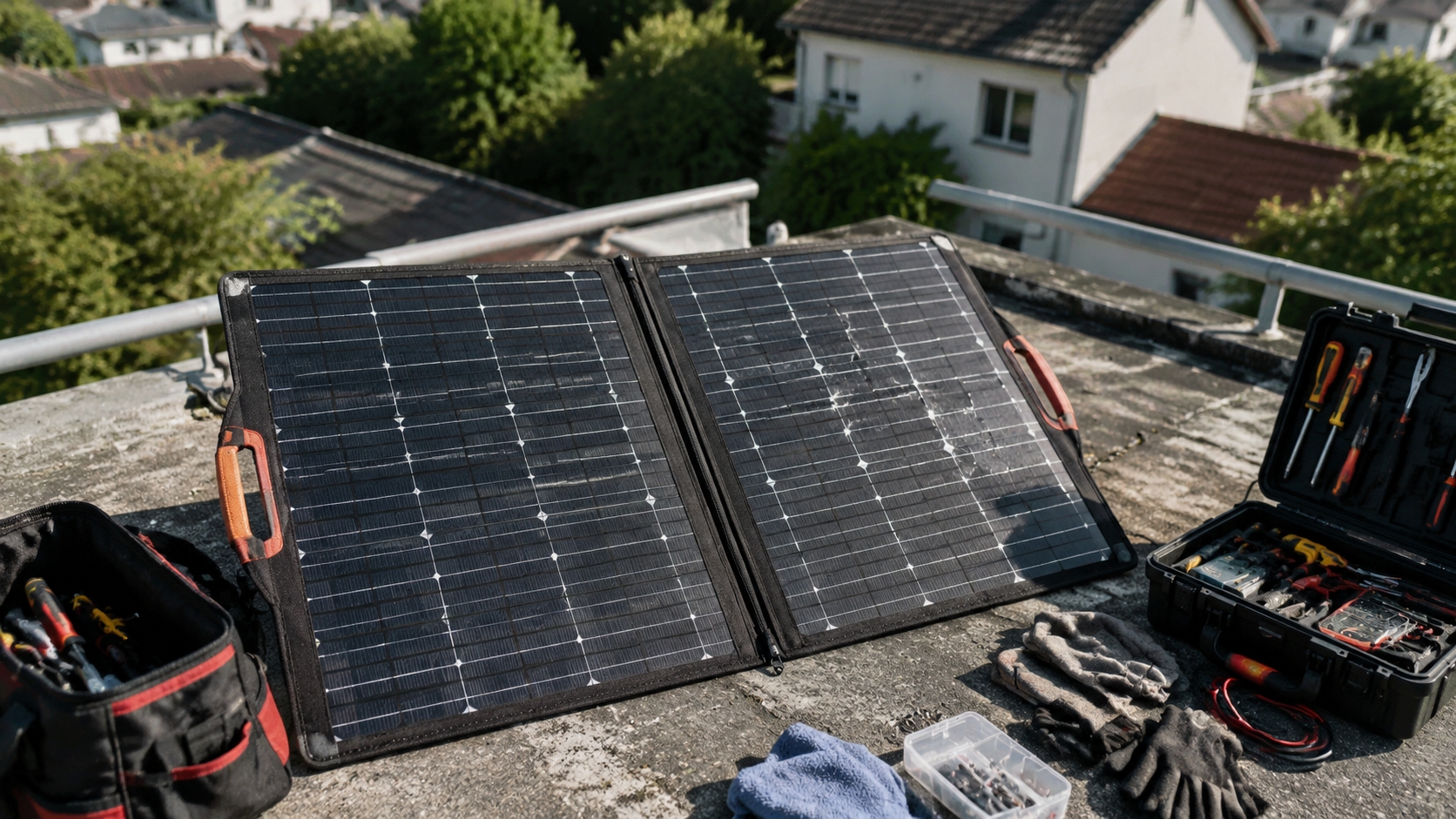
Feasibility
Damage Types
Portable solar modules sustain four primary damage categories during transport, handling, and installation. Accurate identification is the first step in assessing repair feasibility:
Damage Type | Typical Symptoms | Risk Level |
Physical Impact | Corner dents, glass cracks, back sheet scratches | Medium — High |
Hot Spot Effect | Localized overheating, cell darkening | High (thermal runaway risk) |
Junction Box Failure | Connector wear, solder joint separation, seal degradation | Medium |
PID phenomenon | Ion migration between glass and cells causing power loss | Medium (reversible or irreversible) |
During a distributed PV project in Xinjiang, I encountered TOPCon modules that had sustained transport impact — approximately 8% of the shipment showed minor back sheet dents on arrival. On-site infrared thermography confirmed that 2 of those modules had hot spots, with temperature differentials reaching 18°C above surrounding areas. Those two modules were immediately isolated and sent for factory inspection. This case illustrates: physical damage is not always visible to the naked eye, and infrared thermography is indispensable in damage assessment.
In portable use scenarios, physical impact and mechanical wear on junction box connectors are the most common issues. When evaluating damage type, prioritize checks on front glass integrity, back sheet for holes or bulges, and junction box sealant for cracking or aging.
Repair Limits
Assessing repair limits requires balancing damage severity, safety boundaries, and economic reasonableness. The following criteria have been established through field practice:
l Glass cracks exceeding 50mm or showing a web-like pattern → Seal integrity compromised, module replacement recommended;
l Cells displaying visible dark patterns or burn-through (diameter >5mm) → Area is permanently damaged; power recovery from repair will be limited;
l Frame severely deformed (angular deviation >5°) → Structural seal has failed; on-site repair is impractical;
l Back sheet puncture diameter >10mm → Moisture intrusion pathway established; repair is not advisable;
l Junction box body cracked or PIN terminals dislocated → Junction box replacement; economically justified;
l PID effect → Laboratory reverse-voltage treatment can recover up to 90% of rated power.
I was involved in repairing a 550W portable folding module for an outdoor expedition team: a 30mm glass crack was present, but the cell area was intact. The team applied PV-grade sealant and installed an additional transparent protective panel. The system has been operating normally for over 18 months since the repair. Conclusion: structural damage (glass/back sheet/frame) affects air and water tightness, making long-term reliability after repair uncertain; functional faults (junction box/PID) offer predictable post-repair performance and fall within reasonable repair scope.
When to Stop Repair
Repair processes have clear stopping points — recognizing them in time avoids wasted effort and accumulating safety risks. Stop immediately under any of these three conditions:
l Arc marks are found or more than 3 cells show burn-through — thermal runaway and fire risks are present;
l Upon seal removal, frame adhesive is found to be powdery or moldy — repaired seal longevity cannot be guaranteed;
l Repair work exceeds 60% of a new module's replacement value — economic justification no longer exists.
During an emergency repair, a client brought in a 550W portable folding module requesting frame deformation repair. Upon disassembly, a 15mm tear was found in the back sheet at the deformation site, with oxidized and darkened edges. No effective repair method was viable — the recommendation was outright replacement. Though the repair attempt failed, it prevented a potentially much more serious safety incident during the next use.
Practical rule: if repair procedures require professional welding equipment or a vacuum chamber, on-site conditions cannot guarantee repair quality, and the module should be sent back to the factory.
Tools
Essential Tools
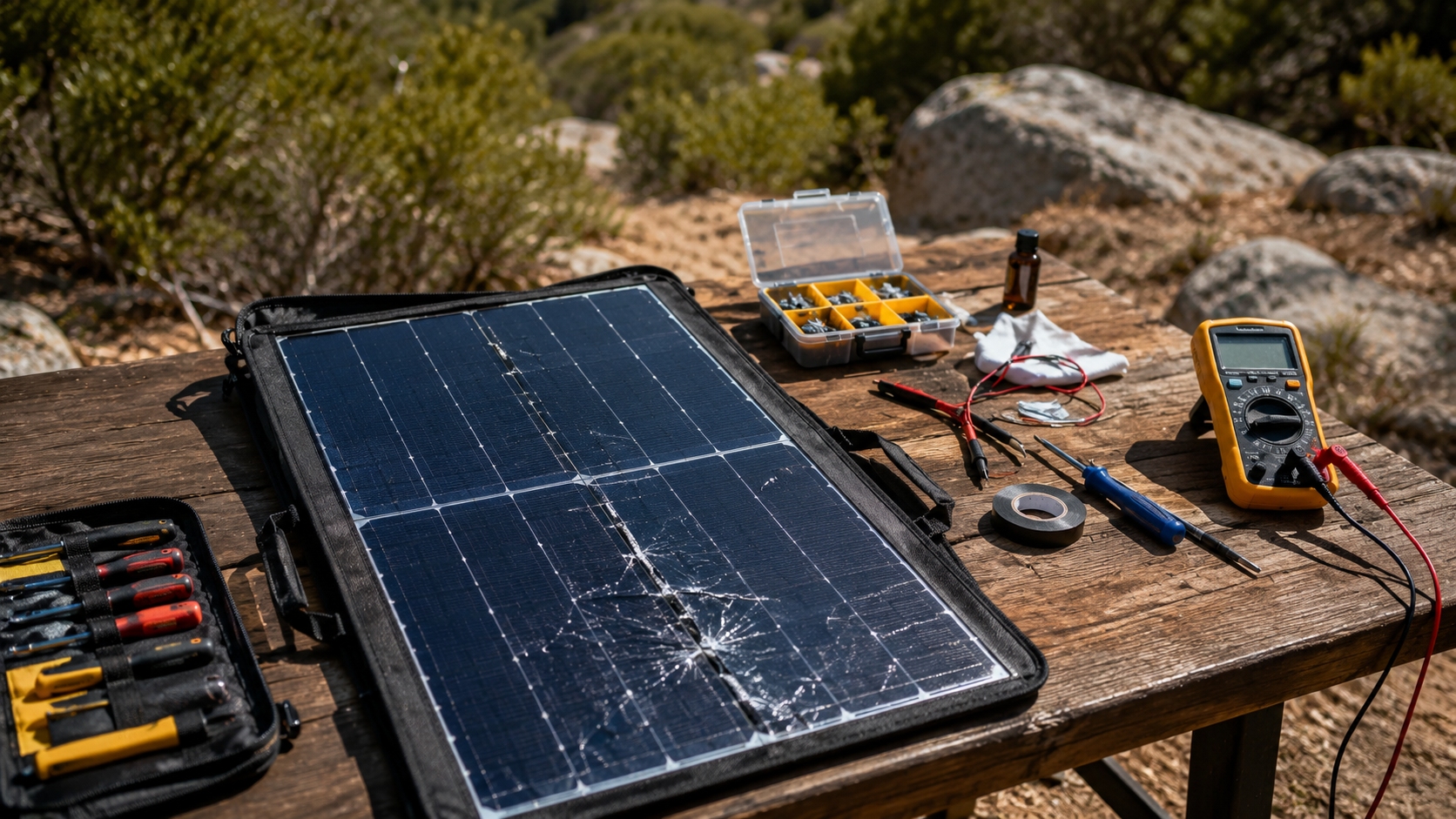
On-site repair of portable solar modules requires a complete set of basic tools. The following standard configuration has been validated across multiple projects:
l Insulated screwdriver set (1000V rated) — for removing junction box covers and connectors;
l Digital multimeter (accuracy ±0.5% or better) — for measuring open-circuit voltage (Voc) and short-circuit current (Isc);
l PV module-specific wrench (MC4 connector type) — ensures connector disassembly/reassembly without damaging the sealing structure;
l Butyl sealing tape and thermal conductive silicone — for temporary back sheet puncture treatment and hot spot thermal enhancement;
l Digital caliper and angle gauge — for measuring frame deformation and determining whether limits are exceeded;
l Infrared thermometer or thermal imaging camera — for detecting hot spots and solder joint temperature distribution.
During an emergency repair task in Northwest China, my toolkit lacked the MC4-specific wrench. I substituted regular needle-nose pliers, which damaged the sealing ring when prying the connector apart. This required an urgent resealant purchase and a 2-hour delay. The lesson: PV module repair demands dedicated tools. Improvised alternatives typically create larger problems downstream.
Protective Equipment
Portable solar module repair involves high-voltage DC systems, making protective equipment the first line of personal safety. The following is mandatory:
l Class 0 insulated gloves — mandatory when DC voltage exceeds 120V; add leather outer gloves for mechanical protection when needed;
l Safety goggles (ANSI Z87.1 or equivalent) — prevent eye injury from shattered cell fragments;
l Anti-slip work boots (ESD/anti-static type) — provide both electrostatic discharge protection and stable footing;
l Flame-resistant workwear (AR/FR rated) — prevent arc flash burns when handling suspected hot spot modules;
l Insulating work mat — provides additional electrical isolation when working in wet conditions or on metal structures.
A common misconception: many assume PV modules are not live on cloudy days or under weak light. In reality, even at 100W/m² irradiance, a standard 72-cell module's open-circuit voltage can still reach above 38V — well above the human body safety threshold (60V DC). During one overcast-day repair, a worker neglected insulated gloves and touched exposed junction box terminals, experiencing a distinct electric shock. Our team subsequently mandated insulated glove use at all times during module handling, regardless of light conditions.
Testing Equipment
After repair, dedicated testing validates module performance and safety. Here are the three most practical testing tools for portable scenarios:
l IV curve tracer — measures module output characteristics under Standard Test Conditions (STC: 1000W/m², 25°C); directly reads Pmax, Voc, and Isc and compares against nameplate values; deviations exceeding 5% warrant further investigation;
l Hipot tester (insulation withstand tester) — applies 500V DC to check insulation resistance; pass criterion is greater than 100MΩ, confirming no leakage risk after repair;
l EL (Electroluminescence) imager — captures infrared images when current is applied to the module; healthy cells appear bright white in EL images, while cracked or burned areas appear dark, making EL the most effective tool for detecting microcracks.
During a project in Shandong, a post-repair module showed normal IV curve results, but EL imaging revealed that pre-existing microcracks had expanded by approximately 15% after repair. Further investigation attributed this to stress concentration during sealant curing. This demonstrates: normal IV curves do not guarantee internal structural integrity, and EL inspection is irreplaceable in repair validation.
For portable applications, lightweight portable EL imagers and IV curve tracers are recommended, keeping total equipment weight under 5kg to maintain system portability.
Safety
Electric Shock Hazards
PV module electric shock hazards differ fundamentally from ordinary DC equipment in two critical ways: high-voltage series stacking and the persistence of live conditions under weak light. Safety protocols must address both factors specifically.
High-voltage series stacking: in portable solar systems, multiple modules are typically connected in series to increase system voltage. A single standard N-type bifacial module has an open-circuit voltage of approximately 41V–45V. Ten modules in series yield a system voltage of 410V–450V — far exceeding human safety limits. If any single module in the string has damaged connector insulation, the full string voltage can be applied across a person's body.
During an emergency rooftop PV inspection, a project used 15 TWMNF-66HD modules in series (system voltage approximately 600V). Two workers touched connectors at different positions in the string without individually isolating each module first. One worker had both hands on opposite polarity terminals, receiving an approximately 580V DC shock. Fortunately, the insulated gloves were not punctured and neither worker was injured. The post-incident review established a critical rule: in high-voltage series systems, every operation requires physical isolation of each module's positive and negative terminals (disconnect connectors and wrap exposed terminals with insulating tape). Never rely on the misconception that turning off the inverter makes it safe.
Shock rescue preparedness: the worksite must have insulated clamps, a first aid kit, and a clear emergency power shutdown procedure on hand. The first step in any electric shock rescue is always to cut power (disconnect connectors or open the fuse) — never touch the victim directly.
Module Handling
Individual portable solar modules typically weigh 25kg–35kg (N-type bifacial modules skew toward the upper range due to larger cell formats). Improper handling is a leading cause of physical damage and safety incidents. The following field-proven handling rules are essential:
l Two-person rule: modules exceeding 20kg require two-person carry; single-person handling is prohibited;
l Grip points: always hold the long edges of the aluminum frame; never touch glass edges or the back sheet with fingers;
l Tilt angle: during carry, the module's tilt from vertical must not exceed 15° to prevent self-bending or dropping;
l Temporary placement: always place soft material (EVA foam or blanket) underneath; when set face-down, the surface below must be flat with no hard objects;
l Stacking limit: loose modules should not be stacked higher than 6 layers, with a hard divider between each layer.
At a project site in Inner Mongolia, two workers were carrying a 575W bifacial module down stairs when one worker slipped. A corner of the module struck a metal corner guard on the handrail. The aluminum frame at the impact point showed a dent approximately 20mm deep. On-site infrared inspection confirmed the cell area was undamaged, and the frame was repaired and put back into service. This case illustrates: accidental impacts during handling do not always cause module damage, but standardized handling procedures are the only way to minimize incident probability.
Disposal Rules
When a module is confirmed unrepairable and requires disposal, photovoltaic module waste management regulations must be followed. Improper disposal not only violates laws but also wastes valuable materials including heavy metals (silver, cadmium, tellurium) and aluminum frames.
Applicable standards: PV modules fall under Waste Electrical and Electronic Equipment (WEEE) categories. Disposal should comply with the Solid Waste Pollution Prevention Law and the Regulations on the Collection and Treatment of Waste Electrical and Electronic Products. Module materials — aluminum frames (recovery rate >95%), glass (recovery rate >80%), and semiconductor materials (silver, silicon) — all have significant recycling value. Delivering to certified e-waste treatment facilities can even provide modest material recovery payment.
Cross-border transport restrictions: when portable solar systems require international transport, end-of-life modules qualify as restricted import waste. The UN Basel Convention imposes strict controls on cross-border movements of electronic waste containing hazardous substances. Confirmation of import permits and disposal qualifications in the destination country is required before shipment.
During an international project, I helped arrange disposal of over a dozen irreparable portable modules. The modules were sent to a certified domestic recycling facility, which processed them by material type — aluminum frames, high-transmittance glass, silver paste, and silicon wafers — and the final settlement not only covered disposal fees but generated a small surplus payment. This case demonstrates that compliant disposal is not only a legal requirement but also has genuine economic value.
Note: Key references: IEC 61215 (design qualification) + IEC 61730 (safety qualification). Three field essentials — insulated gloves, thermal camera, MC4 wrench — cover most emergency repair scenarios for portable solar modules.