How to Choose Solar Modules for Commercial Rooftops
Choose commercial rooftop solar modules by checking roof load, available area, and energy demand first. Prefer 550W–700W high-efficiency modules with 21%+ efficiency to maximize output. Confirm fire rating, wind load, PID resistance, and 25–30 year performance warranty.
Load Capacity
Roof Load Limits
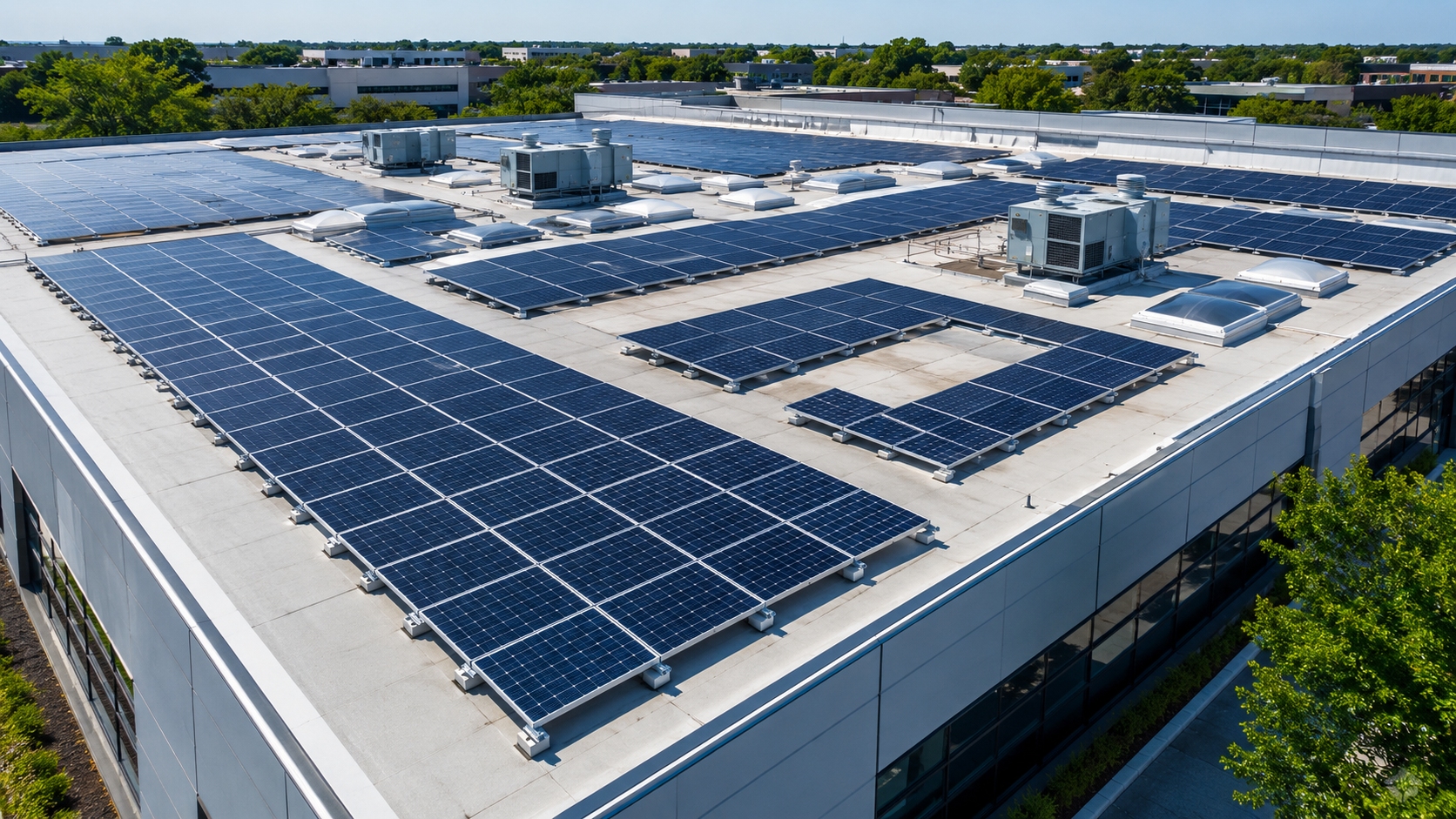
A commercial building roof structural design load consists of two parts: dead load and live load. Dead load includes the weight of the existing building structure, the waterproofing layer, and the insulation. Live load is the margin reserved for personnel activity or equipment installation per code requirements, typically 1.5–2.0 kN/m². China's GB 50009-2019 standard specifies that light steel roof live load is generally 0.5 kN/m² (non-accessible) or 2.0 kN/m² (accessible), while industrial factory color steel tile roofs typically only have 0.5 kN/m².
The additional dead load from a PV system depends on the mounting system and module weight: mainstream bifacial modules weigh approximately 28–32 kg/m², plus the aluminum alloy mounting weighing approximately 3–5 kg/m², totaling 31–37 kg/m², or 0.31–0.37 kN/m². For color steel tile roofs with only 0.5 kN/m² live load, adding PV leaves only 0.13-0.19 kN/m² remaining load margin.
During an inspection at a tire factory in Jiangsu, I found that the original design live load was 0.5 kN/m², and the owner planned to add PV. The design institute's calculation revealed that bracket fixed points were only arranged according to existing purlin spacing, resulting in a stress concentration factor of 2.3, causing deformation of parapet wall connectors. I required the design institute to issue a special load review report and adopted a purlin reinforcement scheme, reducing the stress concentration factor to 1.2. Color steel tile roof retrofits require structural review—never rely on the simple assumption that the load capacity is adequate.
Module Dimensions
Module dimensions directly affect rooftop plane utilization and mounting flexibility—a parameter easily overlooked yet with far-reaching impact on commercial rooftop selection. Current market mainstream module sizes show polarization: one end targets utility-scale power plants with large-format modules (length 2.4–2.2 m, width 1.3–1.1 m, weight 28–35 kg); the other end targets distributed scenarios with optimized standard-size modules (width 1.0–1.1 m, length 1.7–2.0 m, weight 20–25 kg). Large-format modules offer higher single-unit capacity (up to 700W+), but bending stiffness increases with the cube of size—at the same thickness, a 2.4 m module's bending deflection is approximately 2.8 times that of a 1.7 m module. For color steel tile roofs requiring maintenance foot traffic, overly long modules are more prone to microcracks under worker foot pressure—measured tread forces of 200–300 N can cause 3–5 mm local deflection in 2.4 m modules.
During a site survey at a color steel tile industrial park in Zhejiang, I discovered that projects using 2.2 m long modules showed a 4.7% module microcrack rate after two years (confirmed by EL testing), while adjacent plots using 1.8 m standard modules had only 0.8% microcrack rate over the same period.
The root cause: 2.2 m modules must span 4 purlin intervals (purlin spacing 1.5 m), and when workers step on the module center, approximately 70–80 kg of concentrated load causes microcracks in internal cells. Commercial rooftop maintenance passages should be no less than 600 mm wide, and module longitudinal orientation should be perpendicular to maintenance passages to reduce the probability of workers stepping on modules.
For curved roofs, module length also determines the ability to adapt to roof curvature: a 1.7 m module on a roof with a 5 m radius curvature has an angular deviation of approximately 9.7°; a 2.2 m module under the same curvature has a deviation of 12.5°, forcing bracket connectors to bend and posing structural safety hazards. When the roof curvature radius is less than 8 m, modules of 1.7 m or shorter are preferred.
Installation Compatibility
Commercial rooftop installation compatibility assessment must cover three dimensions: roof fixation method, electrical grid connection conditions, and maintenance accessibility. Roof fixation method is the core—profiled steel sheets require specialized clamps or through-fastened mounting.
Clamp schemes cause no damage to the roof waterproofing layer and are suitable for projects where the owner prohibits penetrating the waterproofing; through-fastened schemes require opening holes in the waterproofing layer and must be paired with high-quality waterproof sleeves and secondary waterproofing processes. I witnessed a case in Shandong where through-fastened installation resulted in large-area water leakage due to aging waterproof sleeves—repair expenses were three times the original installation investment.
Electrical grid connection conditions are equally critical: commercial rooftops typically require string voltage to match the inverter MPPT operating window (600–1000 V DC for 1000 V systems). In a commercial complex project I worked on (three roof orientations), because the inverter only had 2 MPPT channels, we ultimately chose to connect each roof face's strings separately before combining, adding approximately 20,000 yuan in combiner box costs; if we had selected a 6-MPPT inverter during the selection phase, combiner boxes could have been completely eliminated, making the total system investment actually lower.
Shading
Shading Patterns
Commercial rooftop shading sources are more complex than utility-scale plants, mainly divided into three categories: building self-shading (parapet walls, ventilation pipes, equipment platforms), surrounding building shading (high-rise buildings, trees), and module self-shading (insufficient array spacing).
Building self-shading is the trickiest—parapet walls, air conditioning units, and exhaust pipes create fixed shadow zones on the roof, with daily shadow trajectories varying with solar altitude angle, but shading positions are relatively fixed. Surrounding building shading has seasonal variation characteristics: in winter when the solar altitude angle is low (Beijing winter solstice noon altitude approximately 27°), building shadow projection distance is more than 2.5 times that in summer, and the same obstruction can cause 3-4 times more power generation loss in winter than in summer.
During acceptance inspection of a logistics warehouse project in Jiangsu, I found that the design-phase PVsyst simulation did not account for shading from the three-story office building north of the warehouse (building height 22 m, only 15 m from the warehouse). Result: from 9-11 AM in winter, the north roof string was constantly in the office building's shadow. This area's average annual generation hours were only 980 h, while the south roof with no shading reached 1260 h—a 22% gap. The correct approach is to shoot all-day shadow videos during the design phase (covering both summer and winter solstices) and build a 3D shading model combined with simulation software.
Bypass Diodes
Bypass diodes are key modules inside photovoltaic modules that protect cells from hot spot damage, and their configuration directly determines module safety and power generation performance under partial shading. Each bypass diode typically protects 20-24 cells. When a cell is shaded to the point where its reverse-bias voltage exceeds the diode forward voltage (approximately 0.4–0.5 V), the diode conducts, shorting that substring and allowing current to bypass the shaded cell, preventing local overheating.
There are two main bypass diode configuration types: the three-string type (3x20–24 cells) and the six-string type (6x10–12 cells). A three-string module loses 1/3 power when one substring is shaded, while a six-string module loses only 1/6 power, but six-string modules are approximately 5–8% more costly per unit contract value.
Bypass diode selection must also consider its thermal endurance: during hot spot testing, bypass diodes must conduct continuously for 1 hour under 100% shading conditions with junction temperature not exceeding 150°C.
In an actual project, I encountered a case where bypass diodes failed due to poor heat dissipation, causing package yellowing and cracking—the module was installed in a poorly ventilated roof depression, with summer module operating temperature reaching 78°C, exceeding the diode's normal operating upper limit temperature (typically 125°C). After 18 months of operation, batch-level diode failures occurred. For commercial rooftop selection, manufacturers should be required to provide bypass diode 1000-hour accelerated aging test reports at 85°C.
Additionally, the bypass diode configuration affects overall power generation efficiency under partial shading: six-string modules maintain approximately 75% power output at a 30% shading area; three-string modules under the same shading area can only maintain approximately 65% power. For commercial rooftops with frequent shading situations, the six-string configuration is the better choice.
Layout Spacing
Module layout spacing design is one of the key levers for maximizing commercial rooftop power generation. Insufficient spacing causes module self-shading, while excessive spacing wastes rooftop area. Module spacing calculation is based on the winter solstice noon shadow length formula: L = H * sin (90°- α) / tan(β), where H is module height, α is module tilt angle, and β is the winter solstice noon solar altitude angle.
Taking Beijing as an example (latitude approximately 40°N), winter solstice noon solar altitude angle is approximately 26.5°. With 15° module tilt and 0.1 m module height (nearly flat, minimal height difference), the minimum row spacing is approximately 0.15 m. However, actual projects must also consider maintenance passages (no less than 600 mm) and fire codes (modules with an area exceeding 2 m² require 400 mm maintenance passages).
In an industrial factory project in Zhejiang that I participated in designing (usable roof area 4,800 m², color steel tile bidirectional slope 3°), during the design phase, modules were laid flat on the south slope, with row spacing calculated at 0.2 m per the winter shadow formula. But after actual construction, it was discovered that morning and afternoon oblique shadows (when the solar altitude angle dropped below 5°) cast onto adjacent module rows, causing approximately 8% daily power generation loss from November to February each year. Later, adding 0.15 m light-blocking plates on the south side of each module row reduced this loss to within 3%, but added extra expenses.
The correct approach is to use PVsyst for annual hourly shading simulation (time step no more than 1 hour), focusing on shading coverage analysis during the low solar altitude period from November to February, and determining the optimal balance between row spacing and maintenance passages based on this.
Long-Term Reliability
Weather Resistance
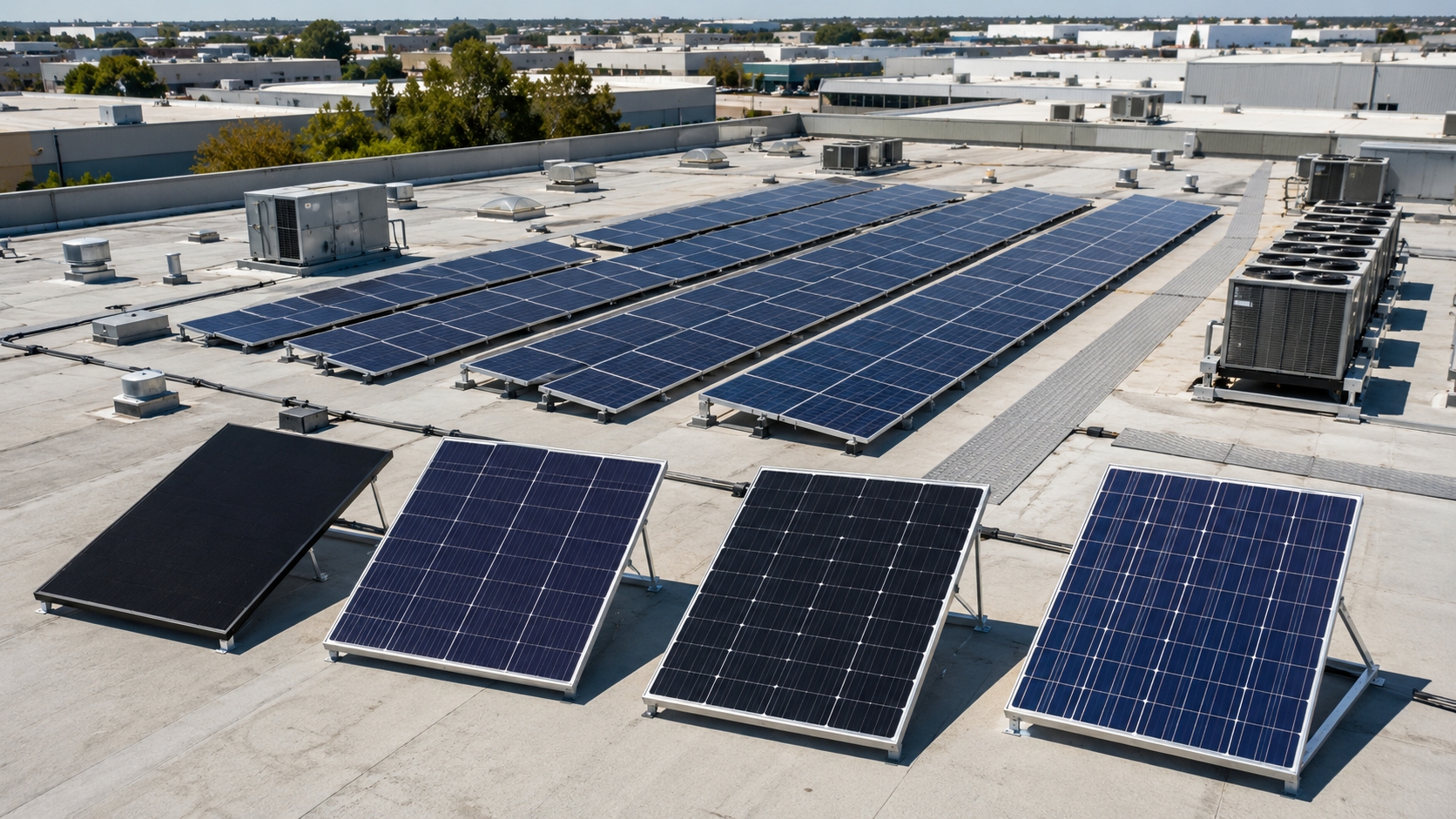
Commercial rooftop modules face more complex weather resistance challenges than utility-scale plants, mainly including four major factors: UV radiation, salt spray corrosion (coastal areas), temperature cycling, and moisture ingress. Coastal areas (less than 10 km from the coastline) face serious threats from salt spray environments to module frame sealing and backsheet materials: chloride ions penetrate the sealing layer and corrode metal grid lines, causing continuous module power degradation.
During acceptance inspection of a garment factory rooftop in Fujian (approximately 800 m from the coastline, annual average salt spray deposition rate approximately 150 mg/m²·d), I found that after 3 years of operation using standard EVA encapsulant modules, obvious salt crystallization appeared on the inner backsheet surface. EL images showed electrochemical corrosion channels forming in local cells, with power degradation more than double that of non-coastal projects (annual 0.72% vs 0.38%). Coastal projects must use salt spray-certified modules—IEC 61768 salt spray test (5% NaCl solution, 35°C, 1000 hours); power degradation must not exceed 5%.
Regarding temperature cycling, in regions with large day-night temperature differences, mismatched thermal expansion coefficients of internal module materials are a major cause of cell microcracks. Aluminum frames (expansion coefficient 23x10⁻⁶/°C) and silicon wafers (expansion coefficient 3x10⁻⁶/°C) generate relative displacement under temperature cycling.
Over thousands of daily cycles, this leads to fatigue fractures at cell silver grid line and bus bar connection points. My measured data: a project in Northwest China (day-night temperature difference reaching 25°C, more than 300 annual temperature cycles), after 5 years of operation, EL images showed a 6.3% microcrack rate, far higher than similar coastal projects. IEC 61215 thermal cycling test (-40°C to +85°C, 200 cycles) is the core standard for verifying module temperature cycling resistance—commercial rooftop projects should require manufacturers to provide this test report.
Power Degradation
Power degradation is the core indicator for evaluating module full-lifecycle power generation capability. Commercial rooftop projects typically require a 25-year power retention rate of no less than 80%, meaning annual degradation of no more than 0.8%. Degradation mechanisms are divided into three categories: Light-Induced Degradation (LID, occurring in the first 1000 hours after module commissioning), Potential-Induced Degradation (PID, related to system voltage and temperature), and Aging Degradation (increasing slowly over time, related to encapsulation materials and cell degradation).
N-type cell LID is nearly zero (less than 0.1%), with first-year degradation mainly from aging mechanisms; P-type PERC cell LID is approximately 0.5-1.2%, with partial recovery after annealing, but long-term operation still faces LeTID risk (magnitude 1-3%), which can cause an additional 0.5-1.0% irreversible degradation in high-temperature high-humidity environments.
Outdoor field-verified data from N-type TOPCon modules I participated in testing (Guangdong, annual average temperature 23°C, irradiance 1300 kWh/m²): first-year degradation 0.38%, stable at 0.30–0.35%/year for years 2–5, 5-year cumulative degradation 1.9%, power retention rate 98.1%. Compared with same-region P-type PERC modules with a 5-year cumulative degradation of 3.1%, the gap is approximately 1.2 percentage points, equivalent to approximately 300,000 kWh difference in 25-year cumulative power generation per megawatt.
The PID effect is particularly significant in high system voltage projects (module positive electrode-to-ground voltage exceeding 600V DC), and TOPCon modules' PID resistance is generally better than PERC, mainly because their N-type substrate has lower sensitivity to sodium ion migration, and encapsulation materials use low water vapor transmission rate POE instead of EVA.
During selection, require manufacturers to provide power degradation curve guarantees, specifying the first-year degradation upper limit and the 2-25 annual degradation upper limit, and include these in the module procurement contract's quality assurance terms, while noting PID test conditions (85°C/85% RH, 96 hours, damp heat test).
Warranty Terms
Module warranty terms are the final line of defense for protecting investors. Commercial rooftop projects must review warranty scope, exemption clauses, and compensation mechanisms article by article before signing procurement contracts. Industry-standard warranty systems are divided into two categories: Product Warranty (typically 10–15 years, covering physical damage from manufacturing defects) and Power Warranty (typically 25–30 years, guaranteeing module output power does not fall below a certain percentage of rated power). The two are legally independent—even if power degradation does not trigger the Power Warranty clause, product defects can still be claimed under the Product Warranty.
While assisting an investor in reviewing module procurement contracts, I discovered that a manufacturer's Power Warranty clause contained a clause calculating annual degradation using the arithmetic average—meaning if degradation is abnormally high in a certain year, the manufacturer can balance it with lower degradation in other years. This is an extremely unfavorable clause—the correct wording should specify that annual degradation is assessed year by year, without allowing cross-year balance. Ultimately, we required the manufacturer to revise the annual assessment without the arithmetic average exemption. Although the contract investment increased slightly, it protected long-term interests.
Key warranty review points: degradation measurement method (STC conditions vs. actual field conditions, with up to 5–10% difference between the two); compensation calculation method for degradation exceeding the standard (linear proration or tiered compensation); whether labor and logistics costs for module replacement are included in the warranty scope; and a third-party guarantee mechanism in case the manufacturer goes bankrupt or exits the market.
It is recommended that commercial rooftop projects explicitly state in contracts that the Power Warranty is backed by the manufacturer's standby letter of credit or a third-party insurance company, with a guarantee amount no less than 30% of the total contract investment.
Note: Balance structural capacity, irradiance, and maintenance access. Prioritize lightweight modules with adequate spacing; IEC 61215/61730 compliance is essential.