What Type of Roof is Best for Solar Panels
A standing seam metal roof facing south with a 30-degree tilt is ideal, as using clamps for non-penetrating installation can avoid water leakage.
If using asphalt shingles, it is necessary to confirm that they can bear a load of 15 kg per square meter, and industrial waterproof sealant must be injected into the hook drill holes for tight sealing.
Standing Seam Metal
Compared to asphalt shingle roofs that need to be renovated every 15 to 20 years, choosing a metal roof can save you the cost of dismantling and reassembling the photovoltaic system at least twice.
This removal and reinstallation fee averages between $2,500 and $4,000 each time in the United States.
This type of roof uses Galvalume steel sheets or aluminum-manganese-magnesium alloys with a thickness usually between 0.4 and 0.7 mm.
The surface is coated with PVDF fluorocarbon coating, which can resist ultraviolet radiation for more than 40 years without fading or chalking.
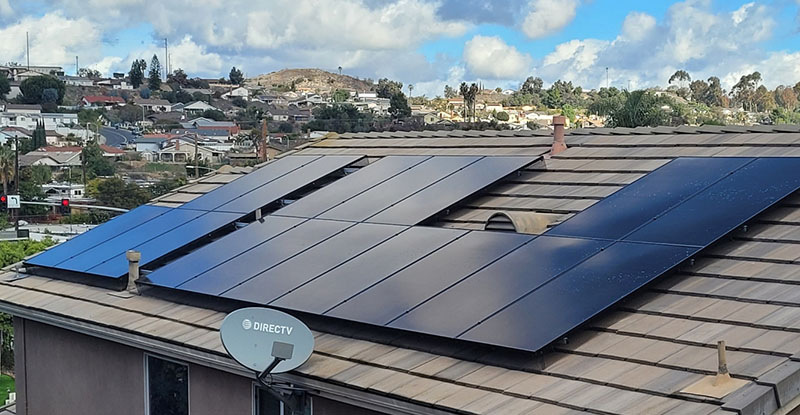
Zero Penetration
The biggest selling point of installing photovoltaics on a standing seam roof is that it absolutely does not damage the roof's waterproof layer.
The entire installation process truly achieves zero penetration points.
Installation uses a special aerospace-grade aluminum alloy clamp.
The inner width of this clamp is usually between 12 and 25 mm, just enough to grip the raised standing seam of the roof.
Workers only need to use a torque wrench to tighten 2 or 4 stainless steel set screws.
The torque is usually set at 16 to 20 Newton-meters.
The end of the set screw is rounded, so it will not pierce the coating on the metal surface, but only cause slight plastic deformation of the metal to form a physical "interlock."
Pull-out tests show that the tensile strength of a single clamp in the vertical direction can reach 800 to 1,200 kg.
For a standard 6 kW system, you will use about 40 to 50 of these clamps.
The total grip of the entire system can easily withstand Category 16 hurricanes with speeds of 200 km/h.
Excellent Heat Dissipation
The heat reflectivity of metal roofs is usually as high as 60% to 70%, while that of black asphalt shingles is only 5% to 10%.
At noon in summer, the surface temperature of a metal roof is 10 to 15 degrees Celsius lower than that of asphalt shingles.
Photovoltaic modules have a negative temperature coefficient characteristics; typically, for every 1 degree Celsius increase in temperature, the power generation power drops by 0.35% to 0.45%.
Photovoltaic systems installed on metal roofs can have an actual output power 4% to 6% higher than ordinary roofs in hot weather, generating 300 to 500 more kWh of electricity a year.
If you choose bifacial modules, the high reflectivity of the metal roof can increase the power generation gain on the back by 8% to 15%.
For a 10 kW system, this is equivalent to adding the power generation of a 400-watt panel for free.
Saving on Racking
The ribs of the standing seam roof are usually parallel, with spacing fixed at 300 mm, 400 mm, or 500 mm.
The cost of traditional rail solutions is about $0.15 per watt, while rail-less solutions only require clamps and mid/end clamps, reducing the cost to $0.08 to $0.10 per watt.
This can help owners save 30% to 40% on material costs.
More importantly, there are logistics costs. A set of traditional rails is 4 to 6 meters long, making transportation very troublesome.
All accessories for a rail-less system can be packed into a few small cardboard boxes 30 cm square, reducing the transport weight by 100 to 150 kg.
Installation speed is also improved. The average time for a skilled worker to install a panel on a metal roof is only 8 to 10 minutes, half of the 20 minutes required for a tiled roof. You can save hundreds of dollars in labor costs.
Resisting Thermal Expansion
The thermal expansion and contraction effect of metal materials is very obvious.
For a 10-meter-long steel roof panel, the length change can reach 3 to 4 mm under a day-night temperature difference of 30 degrees Celsius.
The fixing method for standing seam roofs uses concealed sliding clips, allowing the roof panel to expand and contract freely in the lengthwise direction.
The dedicated photovoltaic clamps are also independently clamped on the standing seams and do not transversely connect and lock two adjacent roof panels.
This design ensures that under extreme temperature differences, no destructive shear stress will be generated between the roof and the photovoltaic support.
In cold regions, the smooth surface of the metal roof, combined with an inclination angle of more than 30 degrees, allows snow accumulation exceeding 20 cm in thickness to slide off automatically under gravity.
This not only reduces the snow load of 20 to 50 kg per square meter on the roof but also allows the photovoltaic panels to quickly resume power generation after snow, avoiding the "hibernation period" of several weeks in winter.
Asphalt Composite Shingles
In the North American market, over 75% of residential roofs are covered with these asphalt composite shingles, commonly known as asphalt shingles.
This is not only because their installation cost is as low as $3 to $5 per square foot, but also because they are currently the most standardized installation medium in the photovoltaic industry.
For installers, asphalt shingles are a "comfort zone." All universal racking systems, such as IronRidge or Unirac, are designed primarily around this type of roof.
As long as your roof structure consists of standard wooden rafters with spacing of the common 16 inches or 24 inches, a skilled 3-person team can usually complete the installation of a 6 kW to 8 kW photovoltaic system in just 4 to 6 hours.
This high efficiency directly drives down labor costs, making photovoltaic installation quotes for asphalt shingle roofs typically $0.20 to $0.30 lower per watt than other roofs.
Drilling is Mandatory
When installing the mounting foot for photovoltaic racking, workers must drill through the shingles and waterproof felt until they penetrate into the wooden beams underneath.
A standard 20-panel system means you have to drill 40 to 60 holes in the roof.
To prevent water leakage, industry standards require the use of aluminum alloy flashing with rubber gaskets, typically 8 inches wide and 12 inches long.
This metal sheet is tucked under the upper layer of shingles to cover the drill hole position, forming a physical water-guiding structure.
Fixing bolts usually use 5/16-inch diameter stainless steel lag screws, and the length must reach 3 to 4 inches to ensure a penetration depth into the wooden beam of at least 2.5 inches.
This depth can provide a vertical pull-out force of about 2000 to 2500 pounds. Finding the beam is the most strenuous part for workers.
If they miss the beam (commonly known as a "shiner"), there will not only be no grip but also a hole that may leak water.
A responsible installer, if they drill into empty space, must fill the erroneous hole with high-quality roof sealant (such as Geocel 4500) and apply a "horseshoe-shaped" ring of sealant around the bolt in the correct hole position, with a thickness of at least 3 to 5 mm.
Granule Loss Happens Fast
The colored mineral granules covering the surface of asphalt shingles are not just for looks; they are the "sunscreen" for the shingles, used to block ultraviolet rays from decomposing the asphalt layer underneath.
In summer, the surface temperature of asphalt shingles can reach 60 to 70 degrees Celsius, making the softened shingles very fragile.
Photovoltaic installers wearing heavy safety shoes, plus carrying modules weighing 40 to 50 pounds each, walking repeatedly and twisting on the roof, can easily scuff off these granules.
Once the area of granule loss exceeds the size of a coin, the remaining life of this shingle will be shortened by more than 50%.
Especially in areas where stress is concentrated, such as ridges and valleys, if workers do not lay protective mats when installing rails, the shingles may even tear directly.
Although most damage can be repaired with asphalt cement, the repaired areas will usually fail again after 5 to 8 years.
Calculate the Timing
Although the cheapest "3-Tab" asphalt shingles have a design life of 20 years, under actual wind and sun exposure, they will start to become brittle and curl at the edges by the 12th to 15th year.
Current monocrystalline silicon photovoltaic panels generally have a power warranty period of 25 years and can actually be used for 30 years.
If your roof has been used for 10 years, even if it looks okay now, do not install photovoltaics directly.
Because you will definitely need to replace the roof within five years, and then you will have to pay an expensive "removal and reinstallation fee."
In the United States, the market price for this fee is $150 to $250 per panel.
For a system with 20 panels, taking them down and putting them back up will cost $3,000 to $5,000 in labor fees alone, not counting the cost of bracket accessories that may be damaged.
This wasted money is usually more than the electricity bill savings you make in these 5 years.
The industry's iron rule is: if the remaining life of the asphalt shingle roof is less than 10 years, you must re-roof first before installing photovoltaics.
Here is a detailed comparison of the compatibility between different asphalt shingle types and photovoltaics:
Shingle Type | Avg. Market Lifespan | Wind Resistance Rating | Load Bearing Capacity | Rec. Install Timing (Roof Age) | Notes |
3-Tab Shingles | 12 - 18 Years | 60 - 70 mph | Average | Only if < 5 years old | Thinner, easily cracked when stepped on during construction |
Architectural Shingles | 20 - 30 years | 110 - 130 mph | Excellent | If < 12 years old | Double thickness, more durable to foot traffic, best partner for PV |
Premium Shingles | 35 - 50 Years | > 130 mph | Superb | If < 20 years old | Strong surface texture, may require longer lag bolts |
Leave a gap for heat dissipation
If photovoltaic panels are covered on top without leaving enough air circulation gap, the temperature on the back of the panels will rise sharply.
Test data shows that when photovoltaic modules are installed close to the roof (gap less than 2 inches), the backplane temperature can be 30 to 40 degrees Celsius higher than the ambient temperature.
High temperatures lead to a voltage drop, directly causing a 10% to 15% loss of power generation.
Standard asphalt shingle installation plans require the rail height to keep the modules at least 4 to 6 inches (about 10 to 15 cm) away from the roof surface.
This height is just enough to form a "chimney effect," allowing cold air to enter from the bottom of the module and take away heat from the top.
This is not only for power generation efficiency but also to protect the roof. If heat accumulates and cannot dissipate, the shingles will age faster, and even cause the temperature inside the attic to rise, increasing the air conditioning load.
In addition, this gap is also for cable routing and installing optimizers or microinverters. These electronic devices are more sensitive to temperature and must ensure free-flowing air around them.
Clay or Concrete Tile
A single piece can weigh 8 to 10 pounds, and the weight per 100 square feet is as high as 900 to 1,200 pounds, which is 3 to 4 times that of asphalt shingles.
Although this heavy material has excellent thermal insulation performance and can help cool the attic by 5 to 8 degrees Celsius, it is a nightmare for photovoltaic installers.
Because they are very brittle, especially clay tiles, they will shatter with the slightest force.
A standard adult male installer, even if weighing only 160 pounds, if he accidentally steps on the suspended position in the middle of the tile, the probability of the tile breaking is almost 100%.
Therefore, installing photovoltaics on such roofs typically incurs labor costs 25% to 40% higher than asphalt shingle roofs.
Really Easy to Break
Experienced workers know they must step on the position where the lower edge of the tile overlaps and is supported by a beam at the bottom, and the force-bearing area cannot be too small.
Even so, in a typical installation project of 20 to 25 panels, stepping on and breaking 15 to 30 tiles is an extremely normal loss.
For ordinary concrete wave tiles, replacements are easy to buy on the market, costing about $3 to $5 per piece.
But for custom clay tiles or retro tiles with special colors, the price of a single piece may soar to $10 to $20, and the ordering cycle can be as long as several weeks.
Therefore, before starting work, project managers will usually ask the owner to prepare at least 50 spare tiles, or directly include a "tile breakage reserve fund" of $300 to $500 in the quotation.
Must Remove Tiles
Workers need to carefully remove the tiles at the installation location first, exposing the waterproof felt and roof sheathing underneath.
Then install the base at the position of the wooden beam, and add the first layer of metal flashing. This layer of board must overlap and seal with the surrounding felt.
Next, install a special S-shaped or flat metal tile hook. This hook protrudes from the gap in the tiles.
To prevent the hook from lifting up the tile, workers usually need to use an angle grinder to grind the bottom of the tile and cut off part of the raised reinforcing ribs. Processing each tile requires an additional 5 to 10 minutes.
Although this process increases the installation cost by $0.10 to $0.15 per watt, it ensures that the roof will be watertight for the next 25 years.
· Hook Selection: Thickened stainless steel or aluminum alloy hooks must be selected, usually 5 to 8 mm thick, to withstand the heavy pressure of the tiles without deformation.
· Drilling Positioning: The hook base must be fixed to the center of the rafter with two 5/16-inch diameter lag bolts, and the lateral deviation cannot exceed 1/8 inch, otherwise the grip is insufficient.
· Waterproof Details: The position where the hook protrudes from the felt must be sealed with thick roof sealant, and there must be a second layer of flashing covering it above.
Swap for a "Fake" Tile
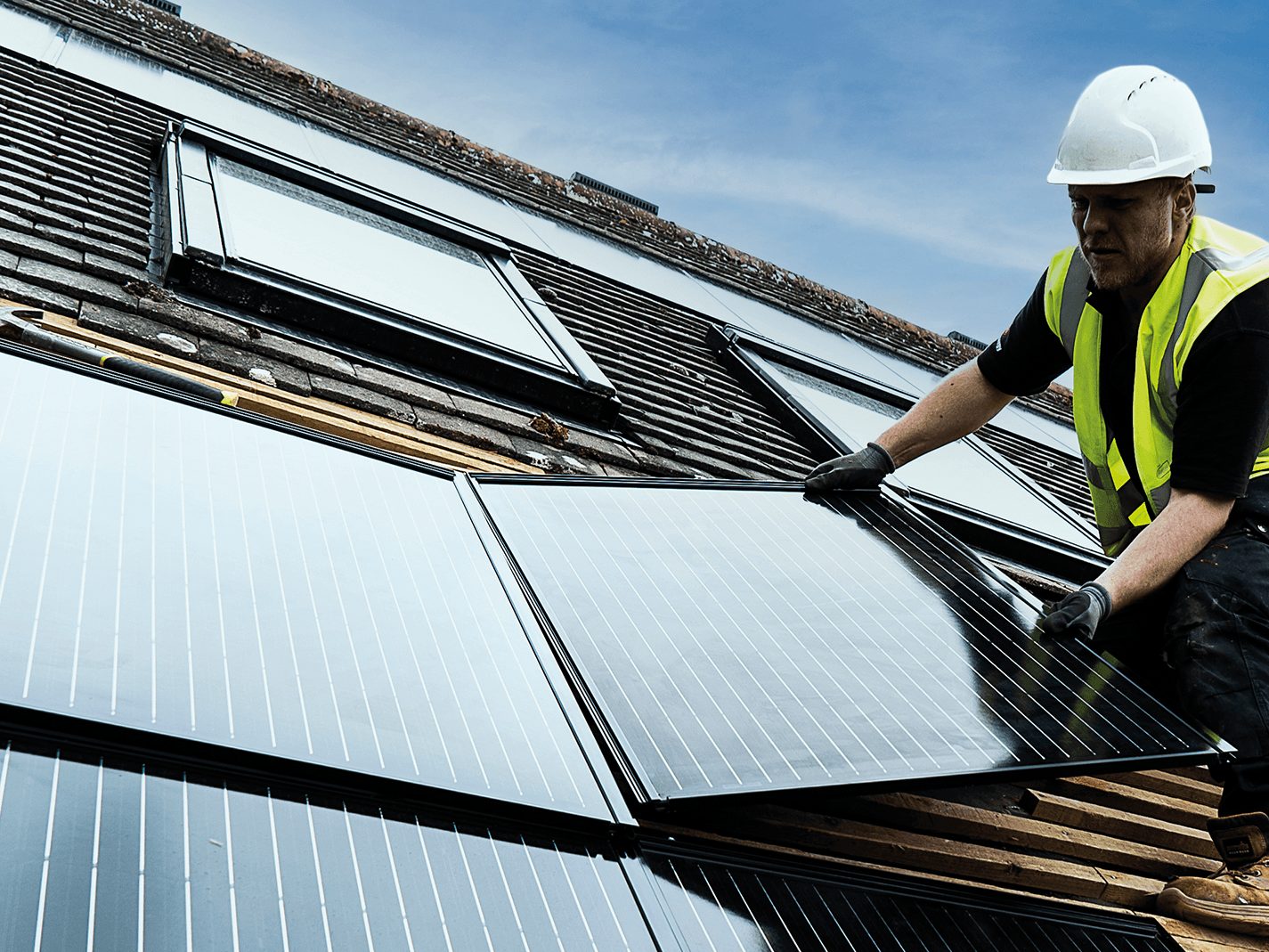
To completely solve the problem of stepping on broken tiles and grinding tiles, a solution called "replacement tile" is now popular on the market.
This is actually an aluminum alloy or composite material plate with exactly the same shape and size as the original tile, which comes with connection points for photovoltaic brackets.
When installing, directly remove the original clay tile or cement tile and replace it with this "fake tile."
1. This replacement tile is very strong. People can step on it without any problem, and it can withstand a local pressure of 2000 pounds per square inch.
2. The waterproof performance is excellent because the connection point is an integrally formed raised structure and comes with a rubber sealing ring, so water cannot get in at all.
3. Although the material cost of this replacement tile is more expensive than ordinary hooks, costing about $25 to $45 each, a set of systems may cost an extra $1,000 to buy accessories.
4. However, it saves a lot of manual grinding time and can increase installation speed by 30% to 50%.
Can also use adhesive
For certain special flat tile roofs, or cases where the owner absolutely does not allow removing tiles, there is a non-invasive option—chemical anchoring.
This solution does not need to find the wooden beams underneath, nor does it need to lift the tiles.
It uses a special metal base with a huge surface area, directly glued to the tile surface with high-strength structural adhesive, or clamps the edge of the tile with special clamps.
However, this solution is highly controversial.
First, its wind resistance depends on the firmness of the tile itself. If the tile is just hung on the batten and not nailed down, when a strong wind comes, the photovoltaic panel will fly away together with the tile.
Secondly, the aging speed of structural adhesive is unknown. Although the manufacturer claims it can be used for 20 years, under extreme temperature differences, the risk of adhesive layer failure is much higher than that of mechanical bolts.
Therefore, this plan is usually only used as an alternative option in low wind pressure areas like Florida or on concrete slab roofs where the structure cannot be found, and the loan approval departments of most banks do not like this installation method.