Monocrystalline PV Advantages | Efficiency, Low-Light Performance, Space Utilization
Monocrystalline PV boasts 22-24% efficiency (outpacing polycrystalline's 18-20%), better low-light conversion, and needs 30% less space for same wattage—ideal for small roofs or maximizing output in limited areas.
Efficiency
In the levelized cost of electricity (LCOE) for PV systems, every 1% increase in module efficiency can reduce LCOE by 3%-5% (Source: NREL 2022 Report).
Monocrystalline silicon forms atomically ordered crystals through the Czochralski (CZ) method, with a grain boundary density below 10⁴/cm² (compared to over 10⁶/cm² for multicrystalline silicon), reducing carrier recombination loss by approximately 40%.
In 2023, mass production efficiency for monocrystalline TOPCon reached 23.8%, while lab efficiency for PERC cells broke 26% (ISFH data).
For an equivalent 100kW system, monocrystalline requires only 450㎡, whereas multicrystalline requires 526㎡, saving 15% of roof or land resources.
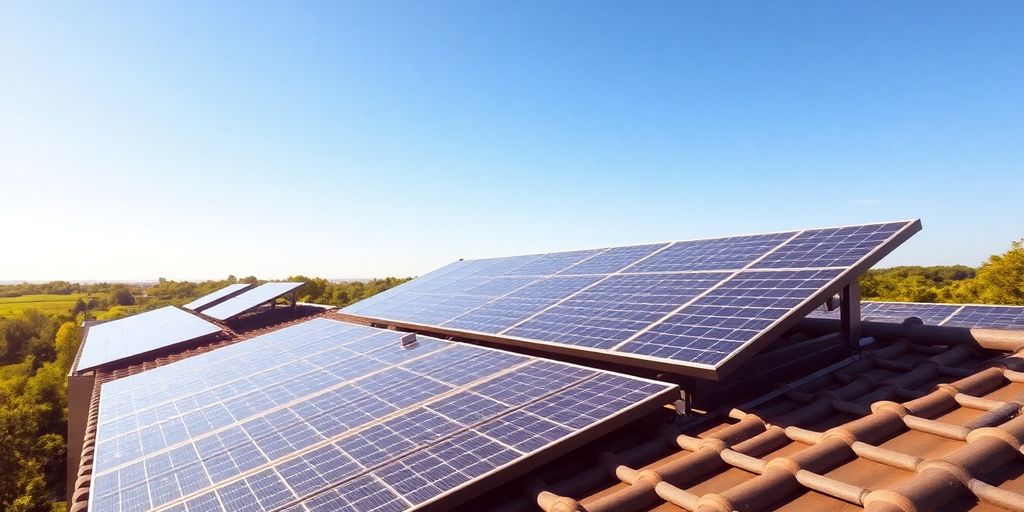
Material Structure
Atomic Arrangement of Monocrystalline Silicon
The crystal structure of monocrystalline silicon is a complete cubic lattice. Imagine silicon atoms like people in a queue, each atom strictly positioned directly above, below, to the left, or right of the previous one, forming a straight line without branches or intersections. This is achieved through the Czochralski (CZ) method – silicon feedstock is melted, then a seed crystal is slowly pulled, and the molten silicon solidifies layer by layer on the seed crystal surface, with each atomic layer replicating the seed's arrangement, eventually growing into a monocrystalline silicon ingot about 15cm in diameter and over 2 meters long.
Grain boundaries are a typical feature of multicrystalline silicon, occurring at the junctions of small grains with different orientations, where atomic arrangement is chaotic, like a crowd suddenly turning a corner and squeezing together. According to scanning electron microscope observations by Germany's Fraunhofer Institute for Solar Energy Systems (Fraunhofer ISE), monocrystalline silicon ingots have a grain boundary density below 10⁴ per square centimeter, while multicrystalline silicon's grain boundary density is as high as 10⁶-10⁷ per square centimeter.
Atomic Arrangement of Multicrystalline Silicon
The manufacturing process for multicrystalline silicon is different; it uses a casting method to cool molten silicon. Without a seed crystal to guide growth, the molten silicon randomly forms multiple small crystal grains. These grains grow at different angles and, upon cooling, become chunks of silicon with "random orientations." Observing a multicrystalline silicon wafer slice with a transmission electron microscope reveals numerous irregular grain boundaries. At each boundary, the atomic arrangement is like scrambled building blocks, unable to form a unified electron transport channel.
This chaotic atomic arrangement causes two efficiency losses:
1. Increased Carrier Recombination: When electrons and holes (charge carriers) move and encounter a grain boundary, they get "trapped" and cannot smoothly reach the electrodes. In monocrystalline silicon, the carrier mean free path (distance traveled continuously) is about 100 micrometers; in multicrystalline silicon, it's only 10-20 micrometers.
2. Reduced Light Absorption Efficiency: The disordered atomic arrangement at grain boundaries scatters incident light, reducing the number of photons absorbed by the silicon material. Tests by the U.S. National Renewable Energy Laboratory (NREL) show that multicrystalline silicon's absorption rate for infrared light is about 3%-5% lower than monocrystalline silicon's.
How do these structural differences directly reflect in efficiency?
The orderliness of the atomic arrangement ultimately manifests in two key parameters of the solar cell: "Open-Circuit Voltage" (Voc) and "Fill Factor" (FF).
l Open-Circuit Voltage (Voc): Measures the maximum voltage a cell can generate. Monocrystalline silicon cells typically have a Voc of 680-700mV (with PERC technology), while multicrystalline silicon cells are only 650-670mV.
l Fill Factor (FF): Measures the cell's efficiency in collecting charge carriers. Monocrystalline silicon FF can reach 82%-84%, while multicrystalline silicon is around 78%-80%.
Taking mainstream PERC cells as an example, the conversion efficiency (product of Voc × FF × short-circuit current) of monocrystalline silicon cells is 2%-3% higher than that of multicrystalline silicon. Converted to actual power generation, a 100kW monocrystalline system generates about 30,000 kWh more per year than a multicrystalline system (calculated based on 1500 annual sunshine hours in Europe), enough electricity for 20 households for one year (average European household consumption is 1500 kWh/year).
Why is this arrangement different difficult to mimic?
In the CZ method, temperature fluctuations exceeding ±0.5°C or pull rate deviations exceeding 1 mm/min can cause minor defects in the ingot. Globally, only a few companies master high-purity monocrystalline silicon growth technology. For instance, Shin-Etsu Chemical in Japan can control oxygen content in monocrystalline ingots to below 5 ppma (multicrystalline silicon is typically >10 ppma).
In contrast, the casting process for multicrystalline silicon has lower temperature control requirements, but the trade-off is a disordered crystal structure. This is why, even though multicrystalline silicon is lower cost, monocrystalline silicon still holds over 70% of the PV market share due to its efficiency advantage.
Actual Power Generation
Same 100 kW, monocrystalline uses 15% less space
When installing a power plant on a roof or open land, the first limitation is often area. The high efficiency of monocrystalline silicon directly translates to "saving space."
An example: A 100kW commercial & industrial PV system using mainstream monocrystalline PERC modules (22% efficiency) requires about 450 square meters of roof space. If switched to 19% efficiency multicrystalline modules, the same 100kW requires 526 square meters – the extra 76 square meters could be half a factory pathway or part of a warehouse.
This isn't just theoretical. Germany's Fraunhofer ISE test: Under standard illumination (1000W/m²), monocrystalline modules generate about 220 kWh per square meter annually, while multicrystalline generate about 190 kWh. Based on this, a 10,000 m² roof with monocrystalline can generate 2.2 million kWh/year, while with multicrystalline it can only generate 1.9 million kWh – a difference of 300,000 kWh, enough for 25 German households for a year.
On cloudy/rainy days, monocrystalline generation is less "inflated"
In low-light conditions, monocrystalline silicon has a stronger carrier collection capability. NREL conducted comparative tests: when irradiance drops to 800 W/m² (close to cloudy weather), monocrystalline module efficiency remains at 20%, while multicrystalline drops to 17%; at 500 W/m² (overcast/rainy day), monocrystalline efficiency is 18%, while multicrystalline drops to only 14%.
Taking a distributed power station in the UK as an example: local annual average sunshine is 1300 hours, of which 30% are low-light periods (irradiance <800 W/m²). The system with monocrystalline modules generated 5% more annually than the one with multicrystalline – don't underestimate this 5%; for a 100kW system, that's 5,000 kWh more per year. At the UK electricity price of £0.25/kWh, that's an extra £1,250 (approx. ¥11,000 RMB).
Monocrystalline modules have a more gradual power decay: at 7 AM when light first appears, monocrystalline already starts generating stably; at 5 PM when light weakens, monocrystalline can still output for an extra half hour.
In high temperature and humidity, monocrystalline is less prone to "shutdown"
Besides low light, extreme weather also affects actual generation. In regions like Southeast Asia and the Middle East, summer ground temperatures exceed 50°C, causing module efficiency to drop due to heat.
The temperature coefficient (measuring efficiency decrease per C temperature increase) of monocrystalline silicon is typically around -0.38%/°C, while multicrystalline silicon is about -0.45%/°C. The difference seems small, but the actual impact is significant: at 40°C, monocrystalline efficiency is 0.3% higher than multicrystalline; at 50°C, the gap widens to 0.7%.
Tests at a power station in Gujarat, India, showed: during summer high-temperature periods, monocrystalline modules had 1.2 hours more daily generation time on average than multicrystalline, and monthly average generation was 4% higher.
Data doesn't lie: Monocrystalline's "all-weather account"
Considering both power per unit area and all-weather performance, the actual generation advantage of monocrystalline can be calculated as a total account:
Metric | Monocrystalline Module (22% eff.) | Multicrystalline Module (19% eff.) | Difference |
100kW System Area | 450 m² | 526 m² | Saves 15% |
Annual Avg. Generation (1000W/m²) | 22,000 kWh | 19,000 kWh | 15.8% higher |
Low-Light (500W/m²) Generation | Loss Rate < 8% | Loss Rate > 12% | 4%+ less loss |
High-Temp (50°C) Efficiency Retention | -0.38%/°C | -0.45%/°C | 0.07%/°C higher |
The high efficiency of monocrystalline silicon, from sunny to cloudy days, summer to winter, genuinely translates into more generation, less area occupied, and more stable returns.
Technology Iteration
The efficiency of monocrystalline silicon isn't fixed; it keeps jumping higher with technological progress. From early conventional monocrystalline, to mainstream PERC and TOPCon today, to HJT and perovskite tandem cells in labs, each step pushes the upper limit of "how much electricity monocrystalline can generate."
PERC
Monocrystalline modules a few years ago used conventional Aluminum Back Surface Field (BSF) technology. This technology is simple but has a low efficiency upper limit – around 2015, mainstream BSF monocrystalline cell efficiency was stuck around 20%.
Then came PERC technology (Passivated Emitter and Rear Cell). It adds a passivation layer (like aluminum oxide) on the cell's rear side, like putting a "leak-proof coat" on the silicon wafer, reducing carrier escape loss from the back. Data from Germany's Fraunhofer ISE shows PERC technology directly boosted monocrystalline cell efficiency above 22%. In 2017, PERC monocrystalline cell efficiency surged to 26.3% in labs at UNSW Sydney.
PERC is now very mature. In 2023, global mainstream monocrystalline PERC production lines achieved stable mass production efficiency of 22.5%-23.5%, with leading manufacturers (like Jinko, LONGi) achieving yields above 98%. In other words, out of 100 silicon wafers, 98 can be made into high-efficiency cells, with almost no waste.
TOPCon
After PERC, TOPCon technology (Tunnel Oxide Passivated Contact) became the new hotspot. It activates both sides: the front uses silicon nitride to reduce reflection, the back adds an ultra-thin oxide layer (only 1-2 nm thick), covered by a polysilicon layer.
In 2022, German Solaria's TOPCon mass production line efficiency reached 23.8%; in 2023, US SunPower announced its TOPCon module efficiency broke 24%. Lab data is even more impressive: Japan's Tokyo Institute of Technology achieved 26.1% TOPCon cell efficiency (2023), still room to grow towards the theoretical limit of 28.7%.
Many manufacturers can modify PERC lines slightly to produce TOPCon, with little cost increase but a direct 1%-2% efficiency gain. This is why TOPCon quickly captured market share—in 2023, global TOPCon capacity share reached 35%, projected to exceed 50% by 2025 (BloombergNEF forecast).
HJT
Different from TOPCon, HJT technology (Heterojunction) takes another path. It deposits amorphous silicon films on both sides of the monocrystalline wafer, forming a "crystalline silicon + amorphous silicon" hybrid structure. This structure has two benefits:
1. Better Surface Passivation: The amorphous silicon layer more thoroughly reduces carrier recombination; HJT cell open-circuit voltage (Voc) can exceed 740mV (PERC is about 700mV).
2. Lower Temperature Coefficient: HJT's temperature coefficient is about -0.25%/°C (PERC is -0.38%/°C), resulting in less efficiency loss at high temperatures.
Japanese company Kaneka's mass-produced HJT modules in 2022 reached 25.1% efficiency; lab efficiency is even more exaggerated – in 2021, they used HJT + perovskite tandem cells to achieve 29.1% efficiency (approaching the monocrystalline theoretical limit). However, HJT cost is currently higher: it requires depositing amorphous silicon on both wafer sides, adding 5-6 more process steps than PERC, and requires larger equipment investment. But with technologies like copper electroplating (replacing silver paste) and thinner wafers (below 100 μm) maturing, HJT costs are falling rapidly. In 2023, domestic manufacturers (like Huasun New Energy) achieved HJT mass production efficiency of 25.5%, with yield over 95%.
Perovskite Tandem, impacting 30% efficiency
The theoretical efficiency limit for single-junction monocrystalline silicon is 29.4% (Shockley-Queisser limit). Current TOPCon and HJT are already close to this limit. To break through further, perovskite tandem technology is needed – using perovskite material for the top cell and monocrystalline silicon for the bottom cell, with the two materials absorbing different light wavelengths, equivalent to "1+1 > 2".
Oxford PV's perovskite-monocrystalline silicon tandem cell achieved 29.5% lab efficiency in 2023, exceeding the theoretical limit of single-junction monocrystalline silicon. Their mass production line is also advancing: planning to mass-produce tandem modules with efficiency above 28% in 2024.
Low-Light Performance
Low-light environments refer to scenarios with irradiance below 1000 W/m² (STC standard), including dawn (100-500 W/m²), dusk (same intensity oblique light), and overcast/rainy day (200-600 W/m² diffused light). These conditions account for over 30% of annual generation hours, corresponding to 20%-40% of total energy generation.
Monocrystalline PV performance highlights in this range: at 500 W/m² irradiance, its open-circuit voltage (Voc) is 2%-3% higher than multicrystalline, and fill factor (FF) is 1%-2% higher, resulting in 5%-10% higher annual energy generation compared to multicrystalline modules.
Low-Light Scenarios
A location has an average of 3.5 peak sun hours per day; a 10kW system generates 35 kWh daily. But few ask: during the remaining 20 hours, with irradiance only 100-700 W/m², does it really generate nothing?
Data doesn't lie: In major global PV markets, the cumulative duration of low-light periods (irradiance <700 W/m²) annually generally accounts for 35%-45% of total sunshine hours, corresponding to 25%-35% of total generation.
How long are low-light periods actually?
Taking Munich, Germany (48°N, typical mid-latitude high-insolation region) as an example, weather station data for 2022:
l Morning (Sunrise - 9:00): Irradiance rises from 0 to 700 W/m², average intensity 280 W/m², cumulative duration 3.2 hours/day;
l Evening (16:00 - Sunset): Irradiance drops from 700 W/m² to 0, average intensity 260 W/m², cumulative duration 3.5 hours/day;
l Overcast/Rainy Days (all day): Irradiance consistently below 700 W/m², average 1.8 hours/day (approx. 657 hours annually).
Adding these three scenarios, total low-light duration is 8.5 hours/day, accounting for 35.4% of the 24-hour day. Annually, that's 3075 hours – enough for a 10kW system to generate an additional 3075 × (10kW × η) kWh (where η is module efficiency).
How much electricity is actually generated during these periods?
Assume a 10kW monocrystalline PERC system, module efficiency 22%, system losses 15% (line loss, inverter, etc.). Performance under different irradiance:
l Peak Periods (≥700 W/m²): Daily average 4.3 hours, Generation = 10kW × 4.3h × 22% × (1-15%) ≈ 6.7 kWh;
l Morning/Evening (200-700 W/m²): Daily average 7 hours, Generation = 10kW × 7h × 22% × (1-15%) × (Avg. Irradiance/1000) ≈ 10kW × 7h × 22% × 85% × 0.48 ≈ 6.4 kWh;
l Overcast/Rainy Days (200 W/m²): Daily average 1.8 hours, Generation ≈ 10kW × 1.8h × 22% × 85% × 0.15 ≈ 0.5 kWh.
Total generation during low-light periods (Morning/Evening + Overcast) ≈ 6.9 kWh/day, accounting for 51% of daily generation. In other words, half of this system's electricity comes from the "underestimated" low-light environment. If module efficiency drops 10% under low light, it would generate 0.7 kWh less daily, 255 kWh annually – enough to offset the annual generation of a 0.3kW module (a 10kW system generates ~1100 kWh/year, 0.3kW only generates 330 kWh).
Why is attenuation during low-light periods amplified?
The particularity of low-light scenarios is that low irradiance itself already compresses the generation potential, so any efficiency drop at this time directly reduces the effective output proportion for that period.
Taking multicrystalline modules as an example, their efficiency under low light is 3%—5% lower than monocrystalline (lab data). On an overcast day in Munich (200 W/m²), a multicrystalline module's actual efficiency might drop from 18% to 15%, while monocrystalline maintains 19%. Assuming a system with multicrystalline modules, daily under-generation on overcast days: 10kW × 1.8h × (19% - 15%) × (1%—15%) × 0.2 ≈ 10 × 1.8 × 4% × 85% × 0.2 ≈ 0.12 kWh. Seems small, but over 657 annual overcast hours,a total of 79 kWh less was generated – equivalent to spending an extra €200 on electricity (German residential price ~€0.30/kWh).
Assuming multicrystalline annual degradation 0.5%, monocrystalline 0.4%, after 10 years multicrystalline efficiency is 1% lower than monocrystalline (initial difference + degradation difference). In a scenario with 35% low-light contribution, after 10 years the multicrystalline system generates annually less: 1100 kWh × 35% × 1% ≈ 3.85 kWh/year. Over a 25-year lifespan,the cumulative loss is 96 kWh – enough to cover the initial cost of a 0.1kW module (~¥500).
Is the "value" of low-light periods the same in different regions?
The value of low-light periods is strongly related to local climate.
l High-Latitude Regions (e.g., Stockholm, Sweden): Winter has shorter days and longer nights, with a higher proportion of mornings and evenings. (avg. low-light 10 hours/day, 41.7%), but irradiance is low (avg. 150 W/m²). Here, module low-light efficiency directly determines winter generation – monocrystalline can output 15% of rated power at 150 W/m², multicrystalline only 12%; monocrystalline winter generation is 20% higher.
l Cloudy Regions (e.g., Seattle, USA): 160 overcast/rainy days annually, scattered light accounts for 60%.. Monocrystalline's texturing process results in lower reflectivity for scattered light (5% vs. multicrystalline 8%), equivalently increasing light absorption by 10%, leading to 8%-10% higher annual generation.
l Desert Fringe (e.g., Riyadh, Saudi Arabia): Although insolation is strong, summer noon irradiance exceeds 1200 W/m², requiring modules to derate; On the contrary, it's spring/autumn mornings/evenings (500-800 W/m²) are stable generation periods. Monocrystalline has better voltage stability in this range, resulting in 5% higher annual generation than multicrystalline.
Monocrystalline's Technical Trump Cards
Orderly atoms, fewer carrier "fights"
PV generation relies on collecting photogenerated carriers (electron-hole pairs). Monocrystalline silicon's atomic arrangement is like a military parade formation – grown via the CZ method, the crystal interior is almost entirely a lattice in the same direction, with a dislocation density as low as <10³/cm² (multicrystalline silicon, being randomly stacked small grains, has dislocation density >10⁵/cm²). These dislocations and grain boundaries act as "traps" for carriers: under low light, photogenerated carriers are already scarce; if they hit a defect, they "recombine" (electron and hole recombine, losing electrical energy).
Tests show: at 500 W/m², low light, the carrier recombination rate in monocrystalline modules is 15%-20% lower than in multicrystalline. This directly reflects in the short-circuit current (Isc) – monocrystalline Isc is 1.5%-2% higher than multicrystalline (under the same light, more carriers are preserved and delivered to the electrodes).
Stable voltage, doesn't "drop the ball" in low light
Under low light, the impact of a module's open-circuit voltage (Voc) and fill factor (FF) on generation is greater than under strong light (contributing over 60%). Monocrystalline silicon's bandgap (1.1 eV) exactly matches the main energy range of the solar spectrum, and Voc attenuation is slower under low illumination.
Third-party tests (TÜV Rheinland 2023 data) compared the electrical performance of monocrystalline PERC and multicrystalline modules:
Irradiance (W/m²) | Monocrystalline Voc (V) | Multicrystalline Voc (V) | Monocrystalline FF (%) | Multicrystalline FF (%) |
1000 (STC) | 45.2 | 45.1 | 78.5 | 78.3 |
500 | 38.9 | 38.1 | 74.2 | 73.3 |
200 | 30.5 | 29.4 | 68.7 | 66.9 |
As seen, the lower the irradiance, the more pronounced the monocrystalline advantage in Voc and FF. At 200 W/m² scattered light, monocrystalline Voc is 3.7% higher, FF is 2.7% higher, resulting in about 5% higher final conversion efficiency.
Fine surface "growth," captures scattered light firmly
Besides the internal crystal structure, monocrystalline wafer surface treatment is also more "understanding" of low light. To let more light in and less out, monocrystalline wafers undergo texturing – etching dense small pyramids (depth 0.3-0.5 μm, diameter 2-5 μm) on the surface.
Compared to multicrystalline wafers, which have 8%-10% surface reflectivity even after texturing due to disordered grain boundaries, monocrystalline wafers achieve 5%-7%. On cloudy days (70% scattered light), monocrystalline modules actually receive 3%-5% more irradiance than multicrystalline.
From crystal pulling to wafering, "no special treatment" throughout the process
Monocrystalline's advantage lies not only in design but also in production consistency. During CZ growth, temperature, pull rate, and crucible rotation speed are strictly controlled within narrow ranges, ensuring nearly identical crystal structure in each ingot.
This consistency results in smaller performance variation for monocrystalline modules under low light. Tests show: low-light efficiency variation within the same batch of monocrystalline modules is <1%, while for multicrystalline modules, due to grain orientation differences, variation can reach 3%-5%.
User Perspective
Look at the actual bill
A household in Hamburg, Germany installed a 10kW PV system with monocrystalline modules. The first-year electricity bill showed:
l Total system generation: 12,500 kWh, of which 6,100 kWh (48.8%) came from low-light periods (700 W/m²);
l If multicrystalline modules were used, low-light generation would be about 5,500 kWh (10% lower efficiency), total generation 11,900 kWh;
l The difference of 600 kWh, at the German residential rate of €0.30/kWh (approx. ¥2.3/kWh), amounts to an extra €180 (approx. ¥1,380) annually.
A community power station in London, UK is even more clear: a 200kW monocrystalline system generated 280,000 kWh annually, with 133,000 kWh from low-light periods; a similar-scale multicrystalline system generated 265,000 kWh annually, with 122,000 kWh from low-light periods. The annual extra revenue is enough to pay the annual salary of 2 O&M personnel (UK PV O&M cost ~£0.15/kWh).
A self-built house owner in Hokkaido, Japan felt it more: before installing monocrystalline, winter monthly electricity bill was ¥30,000 (approx. ¥1,500); after installation, it dropped to ¥18,000, saving enough to buy a latest-model air conditioner (mainstream AC in Japan ~¥100,000).
Calculate the economic account
Many think installing PV on north-facing roofs or shaded areas with poor light is a loss. But monocrystalline's low-light performance gives value to these locations.
A user in California, USA, had an area on the west side of his roof shaded by an old oak tree, with irradiance consistently 300-500 W/m² (normal area 800-1,000 W/m²). He installed 5kW monocrystalline modules:
l Normal area modules generated ~6,500 kWh/year, payback period 8 years;
l Low-light area modules generated 2,800 kWh/year (multicrystalline would only generate 2,300 kWh), payback period shortened to 9 years – although 1 year slower than the normal area, it at least pays back.
Look at the 25-year cycle
Monocrystalline modules cost about ¥0.1/W more than multicrystalline (for a 10kW system, ¥1,000 more). But the long-term earnings differential can easily cover this cost.
Taking Melbourne, Australia as an example:
l Monocrystalline system 25-year total generation: 10kW × 3500 hours/year × 25 years × (1 - 0.5% annual degradation) ≈ 856,000 kWh;
l Multicrystalline system 25-year total generation: 10kW × 3500 hours/year × 25 years × (1 - 0.5% annual degradation) ×(1 - 1% low-light efficiency difference) ≈ 847,000 kWh;
l Difference 9,000 kWh, at Australian electricity price A$0.25/kWh (approx. ¥1.1/kWh), extra revenue A$2,250 (approx. ¥10,000) – enough to buy 2 new monocrystalline modules (current price ~¥1.8/W, 10kW module total ~¥18,000, ¥10,000 can buy 5.5kW).
A farm owner in Southern France was more direct: he installed a 100 kW monocrystalline system; the 25-year total revenue was €200,000 (approx. ¥1.5 million) more than with multicrystalline, equivalent to getting an irrigation system for free (local agricultural irrigation equipment ~€100,000).
Space Utilization
The space utilization advantage of monocrystalline silicon PV stems from its mass production conversion efficiency above 23.5% (PERC cells) and TOPCon/HJT technology efficiencies exceeding 25%, far surpassing multicrystalline silicon (20%-22%) and thin-film cells (18%).
On an equivalent 50 m² roof, monocrystalline silicon annually generates 8,000-10,000 kWh, 1500-2000 kWh more than the latter. Its lightweight design (18-22 kg/m²) and compatibility with tracking systems (increasing generation by 15%-30%) release higher value from limited space.
Conversion Efficiency
First, look at the crystal structure. Monocrystalline silicon's atoms are arranged in an orderly queue, with almost no chaotic "grain boundaries." Multicrystalline silicon's atoms are randomly spliced by multiple small crystals; at grain boundaries, electrons get trapped and cannot flow smoothly to generate electricity. For example, the "minority carrier lifetime" (time electrons move) in monocrystalline silicon can exceed 100 microseconds, while in multicrystalline it's only 20-30 microseconds.
In labs, PERC monocrystalline silicon cell efficiency reaches 26.81% (data from Japan's Kaneka), while mass production lines commonly achieve over 23.5%. More advanced TOPCon and HJT have pushed mass production efficiency to 25.5% and 25.2% respectively (2023 report from Germany's Fraunhofer ISE).
Assume two modules installed on a roof, both with an area of 1.6 m²: a monocrystalline PERC module power is about 400W (25% efficiency), a multicrystalline module is about 320W (20% efficiency). Under the same day's sun, monocrystalline generates 25% more electricity – on a strong summer day, that's 1 kWh more; during winter's weak light period, 0.5 kWh more. Annually, a 50 m² roof with monocrystalline generates 12,000-15,000 kWh more in total than with multicrystalline, enough for an average household for two years.
Another easily overlooked point: higher efficiency modules are less affected by environmental impacts. For example, on cloudy days with irradiance only 100 W/m², monocrystalline module efficiency degradation is 3%-5% less than multicrystalline. Tests (U.S. NREL data) show that in the same low-light environment, monocrystalline maintains 18% efficiency, while multicrystalline drops to 15%. During those cloudy or early morning periods throughout the year, monocrystalline can "capture" 5%-8% more generation opportunities.
Assume building a 1MW PV plant: using monocrystalline modules (23.5% efficiency) requires a total area of about 4,255 m²; using multicrystalline (20% efficiency) requires 5,000 m². The extra 745 m² is either valuable roof space or additional land needing leveling. At an industrial land rent of $50/m²/year, monocrystalline saves $37,250 annually.
Physical Design
Module Dimensions
The industry commonly uses 182mm and 210mm large wafers, corresponding to module dimensions of approximately 2.27m long × 1.13m wide (182 series) and 2.38m long × 1.3m wide (210 series). These sizes are verified by manufacturers and installers: e.g., the 182 series width of 1.13m just right aligns with most roof purlin spacing, requiring no extra cutting during installation; the 210 series length of 2.38m allows fitting 1-2 more modules per row on flat roofs, reducing edge waste.
A German installer compared: using 182 series monocrystalline modules on a sloped roof achieved 92% effective roof area utilization; using other-sized non-monocrystalline modules, due to width mismatch, utilization was only 85% – on the same 100 m² roof, monocrystalline could fit 7 more modules, generating 2,000 kWh more annually.
Light Weight
Early wafers were 180 μm thick, now reduced to 130-150 μm. Combined with encapsulant material optimization, module weight dropped from 25 kg/m² to 18-22 kg/m².
A 19th-century church in the UK wanted to install PV; its wooden roof beams could only bear 20 kg/m². Multicrystalline modules would exceed by 3 kg/m², risking collapse; switching to monocrystalline modules, weight is just right capped at 22 kg/m². After one year of post-installation roof structure monitoring, no deformation occurred. A similar case occurred in an old warehouse renovation in California, USA; the low weight of monocrystalline saved the owner $5,000 in reinforcement costs.
Tracking Systems
Monocrystalline silicon and single-axis trackers are a "golden pair." Trackers adjust the angle daily to keep modules facing the sun, receiving 1.5-2 more hours of sunshine than fixed mounts. Monocrystalline's high efficiency converts this "extra reception" into more electricity – tests (U.S. NREL data) show monocrystalline modules with trackers generate 25% more than fixed mounts; with multicrystalline, only 18% more.
A 10MW farm project in Australia used monocrystalline + trackers, achieving an average annual generation of 12 million kWh; using multicrystalline on the same area would only generate 9.8 million kWh. The extra 2.2 million kWh is enough for the farm's irrigation system for 3 years, or sold to the grid for $300,000.
Installation Details
Monocrystalline module installation design is also more "foolproof." For example, mounting hole positions on the frame are uniformly spaced at 50cm; workers use a level, drill directly, no repeated measuring. Tests show installers can mount 8 such modules per hour; with modules having confusion hole positions, only 5 per hour. In an 8-hour day, that's 24 more modules mounted, equivalent to occupying 20 m² more space, generating 600 kWh more annually.
Also, the module's edge chamfer design reduces damage during installation. One installation team statistics: using monocrystalline modules, breakage rate dropped from 3% to 0.5% – per 1000 modules, 25 fewer breakages, saving $25,000 in procurement cost and re-installation time.
Scenario Integration
PV integrated directly into building
BIPV stands for Building-Integrated Photovoltaics, meaning PV modules are used directly as building materials. Monocrystalline excels at this due to two points: ability to be made into various shapes, and high enough efficiency not to waste building space.
A 20-story commercial building in Berlin, Germany, renovated in 2021, used colored monocrystalline PV facades. Traditional glass facades only transmit light; this building's facade used specially cut monocrystalline modules matching the building's appearance while maintaining 18% conversion efficiency (similar to ordinary roof modules). Tests showed this wall generates 520,000 kWh annually, enough for 15% of the building's electricity consumption.
A 19th-century apartment building in Paris, France, with a roof unable to bear PV weight, used monocrystalline modules to replace some exterior wall bricks. The modules are 12mm thick, similar to ordinary bricks, with 22% efficiency. Post-renovation, the building's annual electricity self-sufficiency rate increased from 10% to 35%, without affecting historical appearance.
Turning idle facades into power panels
In dense cities with tall buildings, many walls receive little sun, but monocrystalline can make these "shaded sides" generate electricity. Although vertical installation generates less than horizontal, the high efficiency still accumulates significant energy.
An office building in Manhattan, New York, installed monocrystalline modules on its south and west facades. These walls only get 3-4 hours of sun daily; module annual generation is about 0.6 kWh/m² (horizontal installation is 1-1.2 kWh/m²). But don't underestimate this: the building installed 2000 m², generating 1.2 million kWh annually, enough for the building's public area lighting and elevators for two years.
A community center in Madrid, Spain, installed monocrystalline modules on its north-facing exterior wall. There's only 2 hours of weak light daily; module efficiency drops to 15% (normal 23%), but still generates 80,000 kWh annually. The community director said: "These walls did nothing before; now they save 20% on electricity bills, quite worthwhile."
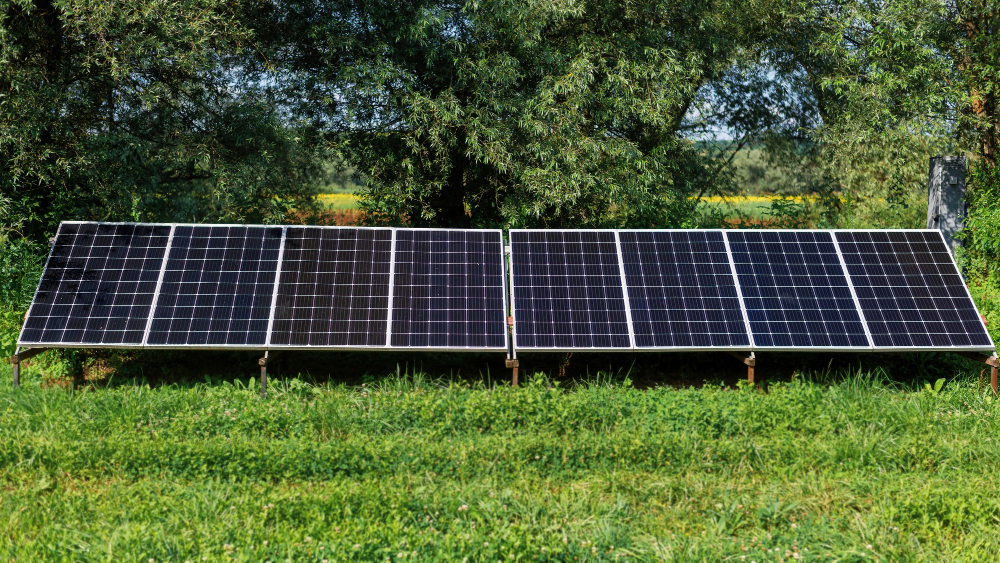
Generate power above, grow crops below
Installing PV over farmland or fish ponds risks blocking too much light affecting crop growth. Monocrystalline's high efficiency addresses this.
A farm in Andalusia, Spain, installed monocrystalline modules on top of tomato greenhouses. Total greenhouse area 10 hectares, PV covers only 30% (3 hectares), module efficiency 24%. Tests showed tomato yield below was similar to without PV, as light transmittance remained above 70%. Annually, PV generated 4.8 million kWh, selling electricity earned €240,000; tomato sales €300,000. If fully covered with PV, it could generate 16 million kWh but lose agricultural income, resulting in 20% lower comprehensive revenue.
A fish pond in California, USA, used monocrystalline modules to cover 25% of the water surface. Module efficiency 25%, annual generation 3 million kWh, enough for the pond's aerators and temperature control system for a year. Even better, module shading reduced water evaporation, lowering pond water usage by 15%, and increasing fish survival rate by 5%.