How Often Do Solar Panels Need Cleaning | Frequency, Environment, Efficiency
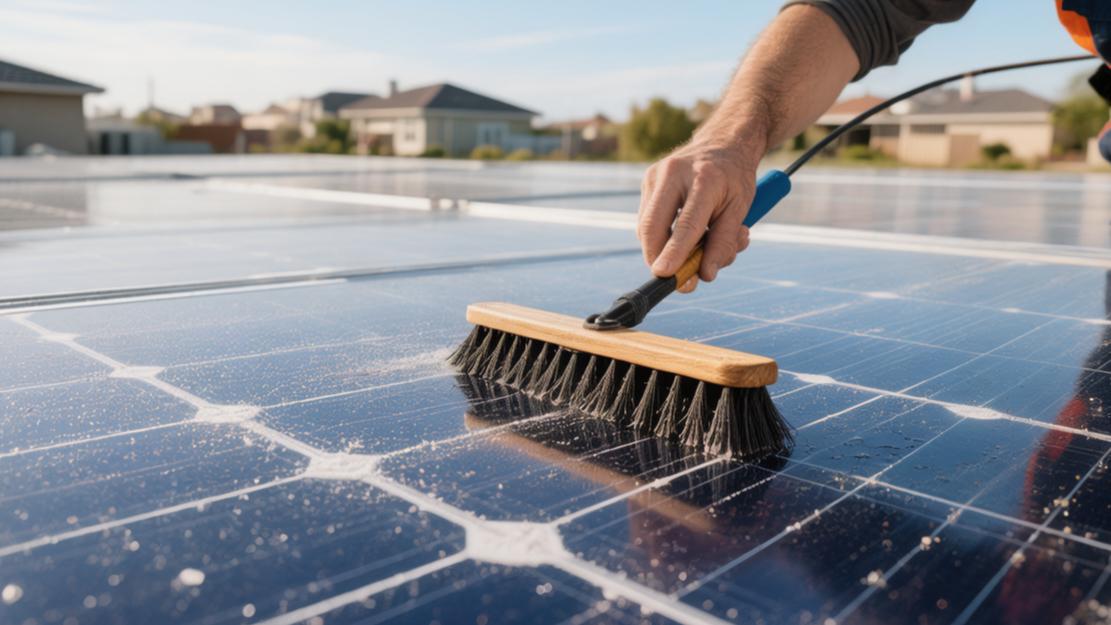
Solar panels are generally cleaned once every 6 months, but in environments with more dust or rain, the cleaning frequency needs to be increased to once every 3 months.
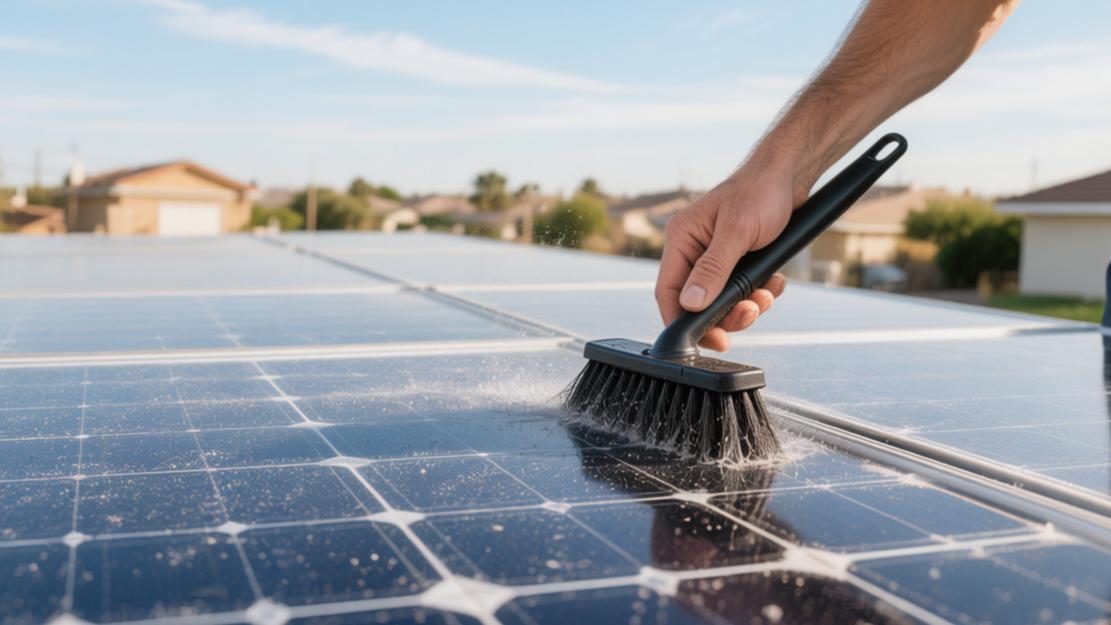
Regular cleaning can improve panel efficiency, reduce power loss by 5%-25%, and ensure the panel maintains more than 90% working efficiency for a long time.
Frequency
Calculation Cycle
A residential-grade power generation equipment with an installed capacity of 10 kW, if operating in a flat area without rainfall intervention for 30 consecutive days, the dust accumulation on the panel surface will reach 0.6-0.8 grams per square meter, at which point the overall photoelectric conversion efficiency of the system will decline from the nominal 21% to 19.5%, and the actual deviation of output power reaches 7%.
Stretching the non-intervention timeline to 90 days, the superimposed thickness of particles on the outermost glass surface will break through 1.2 mm, the light transmittance loss exceeds 14%, leading to the original theoretical power generation of about 40kWh per day to shrink to 34.4kWh.
Calculated according to the frequency of performing 1 physical wipe every 30 days, 12 maintenance operations need to be completed each year, which can strictly control the average annual efficiency attenuation within the baseline of 3%. If the maintenance interval is extended to once every 90 days, the annual cleaning frequency is significantly reduced to 4 times, and the corresponding overall annual power generation loss rate will rise to the range of 9%-11%.
Targeting commercial arrays with an installed capacity of more than 100 kW, for every 15-day increase in cleaning interval duration, the total power generation loss of a single month will increase geometrically by about 150-200 kWh. An operation and maintenance data model spanning 5 years shows that by shortening the annual average cleaning cycle from 180 days to 60 days, within the 25-year full life cycle of the system, the probability of module hot spot effect occurrence will decrease from 12% to about 4.5%.
Look at Rainfall
A single rainfall exceeding 25 mm and lasting for 45 minutes of moderate rain level weather, the natural water flow's gravity scouring kinetic energy can take away 75%-85% of loose sand and soil attachments on the glass surface. If this intensity of precipitation maintains a stable occurrence frequency of 2-3 times per month, the manual cleaning intervention cycle can be safely postponed from the original 45 days to 120 days.
When the intensity of natural rainfall is less than 5 mm/hour, the weak water flow cannot form an effective scouring surface tension, instead it will condense 0.3 grams of dust per square meter into mud-spot-like attachments. The mud-spot effect will cause the local area's light transmission obstruction rate to suddenly increase by 4%-6% in just 24 hours, forcing the originally set 90-day routine maintenance plan to be executed ahead of schedule to the 15th-20th day. Statistics of arid climate zones where the number of consecutive days without effective rainfall reaches 60 days, the electrostatic adsorption effect on the panel surface will stubbornly increase the attachment strength of micro-particles by 300%.
In this extreme dry operating state, if a conventional water washing frequency of only 2 times per year is still maintained, the peak daily power generation by the 3rd month of operation will quickly drop below 75% of the nominal total capacity. Located in a rainy area with a total annual rainfall flow of 1200-1500 mm, as long as one actively avoids the high-density season where the concentration of pollen particles in the air exceeds 500 grains/cubic meter, the power deviation of the system running at full load for 180 consecutive days without cleaning can still be maintained at a small fluctuation range of around 5%.
Tilt Angle
The geometric parameters of the panel's physical installation determine the stay time length and absolute accumulated weight of pollutants per square meter surface with an 85% correlation probability. When power generation equipment adopts a flat-lay installation specification of less than 10 degrees, the gravity natural sliding coefficient approaches the extremely low value of 0.1, and more than 90% of airborne suspended matter will eventually be permanently deposited on the panel surface. This near-horizontal array system must execute a high-frequency cleaning plan of once every 25-30 days, otherwise the average daily power generation yield by the 40th day of operation will suffer a cliff-like drop of 18%.
Adjusting the tilt angle parameter into the common standard design interval of 15-25 degrees, the natural sliding ratio of dust due to its own weight will then climb to 40%-50%. Cooperating with the natural airflow, the physical effect of local wind speeds greater than 4 m/s, the fixed frequency of manual cleaning can be completely relaxed to once every 60-75 days, and the annual cleaning single item expenditure budget can save about 40%.
For high-latitude region arrays with tilt angles set above 35 degrees, the gravity deflection effect makes it impossible for more than 80% of dry particles to achieve stable attachment, and the maintenance-free operation cycle under a conventional sunshine environment is infinitely stretched to 150-180 days. Under the same 5 m/s wind speed test condition, for every 5-degree increase in the tilt angle indicator, the time consumed to accumulate 0.5 grams of standard test dust per square meter will be delayed by about 12-15 days.
Environment
High Wind and Sand
In dry areas with annual precipitation of less than 250 mm, suspended sand and dust particles are the biggest obstacle depriving equipment of power generation. Gust wind speeds usually stay in the range of 6-10 m/s, leaving about 1.5-2.2 grams of fine sand and soil deposits per square meter of glass surface every day. In the case of no external intervention for 30 consecutive days, the light transmittance will quickly fall by 18%-25%.
In order to maintain the rated operating voltage of the system, the inverter will frequently adjust the maximum power point tracking (MPPT), causing the average daily power generation to drop from the expected 150 kWh to below 115 kWh. Sand grains contain a large amount of quartz modules with a hardness reaching Mohs scale level 7. If rubbed for a long time in blowing sand weather with wind speeds exceeding 12 m/s, the anti-reflection coating will be worn with micro-scratches about 0.5-1.5 microns deep. In order to suppress the permanent light loss rate brought by scratches to within 1.5%, the physical cleaning frequency must be raised to perform a single cycle every 15-20 days.
· The hardness of rotating bristles on automated cleaning equipment needs to be strictly controlled between Shore A 30-40 degrees.
· The machine moving speed of each cleaning is maintained at 0.5-0.8 meters/second to prevent sand grains from producing hot spot damage under high-speed friction.
· Investing in an automated dry cleaning robot with a cost of 4500-6000 currency units can reduce the 6.5% surface wear rate generated by manual cleaning to 0.8% within 3 years.
· The sand accumulation cleaning height at the bottom of the panel needs to be maintained at more than 50 mm from the lower frame to prevent the risk of local short-circuit fire caused by sand and soil burial.
By the Seaside
In the installation area within 5 kilometers of the coastline, the sodium chloride concentration in the air is maintained at a high level of 0.04%-0.07% all year round. With the sea breeze blowing, salt spray with strong corrosiveness will attach to the surface of photovoltaic modules and the aluminum alloy frame joints at a speed of 0.01 mm per hour. After salt crystals absorb moisture from the night air, the surface light transmittance will drop sharply by 8%-12% in just 15 days.
Seabird droppings are also high-incidence obstacles in this environment. The coverage area of a single seagull excrement is about 15-35 square centimeters, and its pH value is in the strong acidic range of 3.5-4.5. If strong acidic obstructions are not rinsed for more than 7 days, the outermost anti-reflective coating will undergo irreversible chemical dissolution, and a single module with a nominal power of 450W will therefore generate a local power loss of 15%-25%.
· Low-pressure rinsing with fresh water with a TDS value lower than 200 ppm is required every 30 days to thoroughly wash away salt residues.
· The water pressure must be limited between 0.2-0.3 MPa to prevent high-pressure water columns from flushing salt grains into the silicone sealing grooves at the bottom of the frame and causing water seepage.
· An additional financial budget equivalent to 0.5% of the total system cost must be reserved each year to purchase neutral surfactants to neutralize the acidic substances of bird droppings residues.
· The resistance value of the frame grounding wire needs to be measured and compared every 90 days to prevent salt spray corrosion from causing the grounding resistance to soar above 4 ohms.
Next to Factory Areas
The concentration of sulfur dioxide and nitrogen oxides floating in the air often breaks through 80 μg/m³, mixed with unburned hydrocarbons, it will condense into a black oily dirt layer about 0.1-0.2 mm thick on the glass. The dissolution rate of pure water for heavy attachments is only less than 15%.
Operating equipment in this state for 45 days, the photoelectric conversion efficiency will slide from 21% to 16.5%. Since the oil stain layer has strong heat absorption characteristics, the actual operating temperature of the panel at noon will be 15-22℃ higher than the ambient temperature, causing an additional 2.5%-3.8% thermal attenuation loss, and the daily total electricity output drop can reach 20%.
· A cleaning solution containing non-ionic surfactants needs to be introduced every 45-60 days, with the aqueous solution blending concentration controlled at 1%-1.5%.
· The dissolution time after spraying needs to wait for 3-5 minutes, allowing the agent to fully emulsify the 0.15 mm thick grease layer before performing physical wiping.
· If the water temperature during rinsing can be preheated to 35-40℃ using solar energy, the overall decontamination efficiency can be improved by about 40%-55% compared to room temperature cold water.
· The dust filter of the inverter needs to be replaced or water-washed every 60 days in a dust environment to ensure the cooling air volume is maintained above 85% of the rated parameters.
Operating Environment Type | Suggested Cleaning Interval Time | Monthly Transmittance Attenuation Predicted Value | Surface Main Attached Pollutants | Cleaning Solution Blending and Intervention Requirements | Predicted Water Consumption per Megawatt per Cleaning |
Dry and Windy Sand Area | 15 - 20 days | 15% - 22% | Quartz sand, dry soil | No liquid required, use high-frequency dry brushing | 0.0 tons (using dry cleaning robot) |
Marine High Salt Spray Area | 25 - 30 days | 8% - 14% | Sodium chloride salt crystals, acidic bird droppings | TDS <200 ppm pure fresh water | 4.5 - 6.0 tons |
Heavy Industry Processing Factory Area | 45 - 60 days | 10% - 18% | Hydrocarbon oil mixture, sulfides | 1% concentration weak alkaline cleaning stock solution | 7.0 - 9.5 tons |
Large-scale Agricultural Farm | 30 - 45 days | 5% - 9% | Plant pollen, pesticide aerosols | Room temperature tap water rinsing | 3.5 - 5.0 tons |
High Latitude Ice and Snow Area | Determined by snowfall frequency | 20% - 100% | Snow cover, frozen condensation layer | Hot water strictly prohibited, use soft scraper | 1.0 - 2.5 tons |
In the Farm
During the spring pollen outbreak period of about 60 days, the number of pollen particles per cubic meter of air climbs rapidly, with particle sizes mostly distributed between 15-100 microns. Since the pollen shell contains a large amount of natural sticky proteins, after attaching to the panel and being slightly moistened by morning dew, it will form a translucent yellow film layer with an extremely high light transmission obstruction rate. This yellow film layer will cause the overall system output power to drop by 6-9% within just 14 days. The amount of dust raised by large agricultural tractor machinery during soil turning and sowing is 4-5 times higher than usual, and aerosols containing pesticide chemical residues will also fall with the monsoon and stick firmly to the array surface.
· In the peak season when pollen concentration breaks a thousand, the original 90-day maintenance frequency needs to be shortened to a single full-coverage water wash every 30 days.
· Pesticide residues are mostly slightly acidic or slightly alkaline chemical reagents. A comprehensive frame corrosion insulation test needs to be done every 6 months to ensure the system leakage current is strictly maintained within the safe threshold of 10 mA.
· For organic particle matter with a diameter exceeding 20 microns, the nozzle tilt angle of water flow rinsing needs to be maintained at 15-20 degrees to obtain the best physical stripping shear stress.
· Once the weed height below the panel exceeds 40 cm, mechanical mowing operations must be arranged immediately to prevent plant leaves from causing local physical obstruction of the bottom modules, triggering hot spot temperature rise failure.
Snowy Days
In high-latitude regions during the long winter operation cycle of 120-150 days, snowfall thickness and frozen crystals are the main variables determining equipment power output performance. When the thickness of snow covering the glass surface reaches 3 cm, the solar radiation transmittance will instantly drop to zero, and the output power of the overall array drops to 0 W. The physical static load brought by snow is usually around 15-25 kg/square meter.
Failure to clean for a long time will lead to the aluminum frame's bearing micro-deformation exceeding 2 mm. Snow water slowly melts during the day and re-freezes into a 1-3 mm thick hard ice layer after the night temperature drops below -5℃. The physical characteristic of 10% volume expansion will generate a strong outward squeezing stress on the glass panel and the surrounding sealant, causing the probability of photovoltaic glass micro-cracks to soar by 15%.
· When the snow thickness breaks through 5 cm, the manual snow removal procedure needs to be started quickly. Select a special telescopic rod with a soft rubber scraper, and the contact surface pressure cannot exceed 15 kilopascals.
· It is strictly forbidden to use warm water with a temperature exceeding 25℃ to forcibly melt the ice layer below -10℃ on the panel. Instant cold and heat temperature differences exceeding 35℃ will cause large areas of glass layer to shatter.
· Set the system tilt angle above 45 degrees. With the help of working waste heat emitted from the back of the photovoltaic panel, 70% of the snowfall can naturally slide down under gravity before the accumulated thickness reaches 2 cm.
· Snow removal operations need to avoid the early morning hours with the lowest temperature, and be arranged between 12:00 noon and 14:00 in the afternoon. At this time, the adhesion between ice/snow and the glass surface is at the daily lowest of 0.5 Newtons/square centimeter.
Efficiency
Calculating Conversion Rate
A 400W monocrystalline silicon module with a standard size of 1.75 square meters, under factory standard test conditions (light intensity 1000 W/m², ambient temperature 25℃), its nominal photoelectric conversion efficiency is usually strictly set in the range of 20.5% to 21.5%.
When a uniform dust layer with a thickness of only 0.25 mm accumulates on the outermost high-transmittance tempered glass surface of the panel, incident light will undergo severe physical scattering and refraction deviation when penetrating this layer of micro-particles. This micro-scale optical interference will cause the overall transmittance of the glass panel to drop directly from the originally designed 95% to 87%.
The 8% rigid loss in transmittance will cause the number of electron-hole pairs that can be successfully excited inside the silicon wafer to decrease proportionally. Reflected in electrical parameters, the short-circuit current (Isc) value of the entire module will irreversibly decrease by about 7.2%.
Scaling this loss ratio up to a 15kW residential roof array, the theoretical energy output during a 5.5-hour full-load operation period per day should have been 82.5kWh. Affected by this 0.25 mm micro-dust physical obstruction, the actual grid-connected output electricity will be stubbornly compressed to 76.5 kWh. If calculated according to the local grid buy-back marked price of 0.15 currency units per kWh, the daily book cash flow loss reaches 0.9 currency units.
Continuing to operate for 90 days without arranging any physical intervention, the cumulative lost power generation will reach 540 kWh, equivalent to a direct financial loss of 81 currency units. By this time, the absolute weight of dust deposited on the surface has likely broken through 1.8 grams per square meter, and the surface reflectivity of the transmission spectrum within the optimal absorption frequency band of 400-800 nanometers will abnormally rise by about 14.5%.
Local Obstruction Account
When birds flying in the sky leave excrement with a coverage area of only 25 square centimeters on the panel, this non-transparent stain covering less than 0.15% of the total module area will trigger an extremely disproportionate cliff-like power plunge. The individual cells inside the module are all arranged in series, usually consisting of 60 or 72 silicon crystals connected head-to-tail via conductive silver paste and metal welding ribbons. If this 25 square centimeter bird dropping completely covers just two of the cells, the internal resistance of the blocked area will instantly soar to more than 300 times that of the normal operating state.
In order to force a strong current through this high-impedance physical block, one of the three bypass diodes connected in parallel in the junction box at the back of the module will be forced to turn on immediately. Once the diode triggers the forward conduction mechanism, a total of one-third of the power generation blocks of the module will be actively short-circuited and cut off by the system, causing the actual working voltage of the entire 400W module to drop instantly from the conventional 31.5V to around 21V. In an independent branch circuit composed of 12 modules of the same specification connected in series, the voltage drop of a single panel will forcibly lower the actual total output power of this entire string with a 4.8 kW rated power by 12%-18%.
A single bypass diode staying in a forward-conducting full-load working state for a long time will have its own dissipated heat rise geometrically, with the surface working temperature easily breaking through 85℃. Maintaining this local high-voltage short-circuit state for more than 400 consecutive hours, the silicon junction temperature of the diode body will exceed the physical melting limit of 150℃ and permanent thermal breakdown will occur, causing the entire panel to completely lose its power generation capability.
Temperature will disrupt
The dust and dirt layer not only blocks light from entering at the optical level, but is also an excellent physical thermal blanket at the thermodynamic level. The thermal conductivity of dry soil and sand mixture is only 0.25 W/(m·K), much lower than the 1.1 W/(m·K) heat dissipation standard originally possessed by photovoltaic glass. During the high-intensity sunshine period from 12:00 noon to 14:00 in the afternoon, cell cells that have absorbed as much as 800 W/m² solar infrared thermal energy must rely on the outer glass surface to rapidly radiate heat to the surrounding ambient air.
When a heavy dirt layer reaching a thickness of 1.5 mm firmly covers the top of the glass, the upward heat conduction dissipation path is severely blocked. Under natural test conditions with an ambient air temperature of 30℃, the actual operating temperature of the backplate of a panel with a clean and unobstructed surface usually fluctuates around 50℃.
For a module of the same specification covered with 1.5 mm of dirt, its actual operating temperature will rapidly climb to the 62℃-65℃ range due to heat accumulation. Monocrystalline silicon materials on the market generally have a fixed temperature attenuation physical coefficient of -0.35%/℃. For every 1 degree Celsius that the operating temperature exceeds the 25℃ standard test baseline, the overall power generation will be forcibly adjusted downward by 0.35%.
The additional 15℃ abnormal temperature rise on the dirty panel surface will trigger an additional 5.25% pure thermodynamic power attenuation. Calculating the 5.25% thermal attenuation superimposed with the 8% physical obstruction attenuation caused by the decrease in transmittance, the actual output power of a single panel during the noon peak period will drop sharply from the nominal 400W to around 295W, and the overall efficiency loss at a single point in time approaches 26.2%.
Lifespan and Decay
The wet soil accumulated here for many years exhibits extremely strong micro-conductive physical properties, especially in high-humidity water vapor environments where the relative air humidity exceeds 85% in the early morning. Serial cells with high voltage differences of 500V or even 1000V will generate a huge potential difference with the aluminum frame that must be grounded.
The mud water layer with a thickness exceeding 5 mm acts as a weak conductive medium at this time, leading to a large amount of free sodium ions undergoing abnormal electric field migration from the inside of the glass to the surface of the cell. Although this invisible leakage current is only a tiny 2-5 microamps, accumulation over days and months will trigger extremely serious Potential Induced Degradation (PID).
Continuing for 18 months without performing a thorough brush wash of the mud at the bottom of the frame, the first-year attenuation rate indicator of the photovoltaic module will accelerate from the factory test commitment maximum limit of 1% to more than 2.8%.