How Many Types of Solar Modules Exist | Classification, Technology Differences
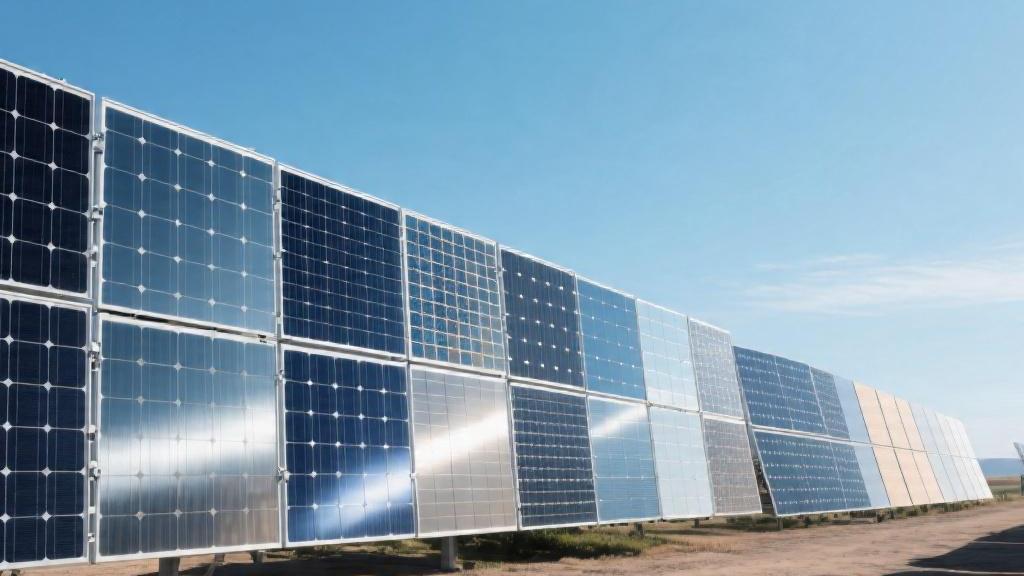
Photovoltaic modules mainly divide into 3 categories: monocrystalline (efficiency 18%-22%), polycrystalline (15%-17%), thin-film (10%-13%).
Can through appearance color and power density distinguish, when selecting types according to area and cost match application.
Classification
Silicon wafer foundation
P-type cells (PERC) in silicon wafer dope boron element, although the process is simple and the cost is low, at 0.1 USD/watt, but there is obvious initial light-induced degradation (LID), first year degradation rate usually at 2% around. Compared to this, N-type cells (such as TOPCon, HJT) through doping the phosphorus element, thoroughly eliminated the boron-oxygen complex-caused degradation, first-year degradation can be controlled within 1%, and carrier lifetime compared to P-type high out 10 times.
From size specifications, currently, the market is ruled by two kinds of large silicon wafers: 182 mm (M10) and 210 mm (G12). 210mm module's light-receiving area compared to the early period's 158mm elevated about 40%, on equal area's bracket, through using large size modules, can reduce 10%-15% combiner box and DC cable usage amount.
· Monocrystalline silicon (Monocrystalline): Purity extremely high, laboratory efficiency record already exceeded 26.8%, mass production average efficiency at 23.5% around.
· Polycrystalline silicon (Polycrystalline): Efficiency only 18%-19%, because the high temperature under performance power drop magnitude (temperature coefficient about -0.41%/℃) is too large, currently only occupies the insufficient 2% low-end market.
· Silicon wafer thickness: Mainstream thickness already from 170μm thinned to 130μm-150μm, every thin 10μm can reduce about 3% silicon material cost, but to production line's broken piece rate control put forward higher requirements.
Cell structure
TOPCon (Tunnel Oxide Passivated Contact) is 2026's absolute main force, its mass production efficiency distributed at 24.8%-25.8% between. Its structure characteristic is on the back side adding one layer 1-2 nanometers of ultra-thin silicon dioxide layer. This layer film can let electrons smoothly pass through, at the same time block hole recombination, the open-circuit voltage elevating to 730 mV above.
Another kind of high-end route is HJT (Heterojunction), it deposits amorphous silicon wafer both sides of a monocrystalline silicon wafer, due to production temperature controlled at 200℃ below (traditional process needs 800℃ above), silicon wafer internal thermal stress extremely small. HJT module's temperature coefficient performance is extremely excellent, usually is -0.26%/℃, in an environment temperature exceeding 40℃ desert area, its unit power power generation amount compared to conventional modules high out 6%-8%.
· Bifaciality: TOPCon module's bifaciality is usually 80%-85%, HJT can then reach 90% above, while traditional PERC is only 70%.
· Silver paste usage amount: HJT current silver paste consumption amount about 150 mg/piece, through copper electroplating technology can reduce to 0 mg, TOPCon then maintains at 80 mg around.
· Process steps: HJT only needs 4 steps core process, TOPCon needs 12-14 steps, this decides GW level equipment investment amount (CAPEX) difference.
Packaging method
Single glass module adopts 3.2 mm tempered glass cooperating with polymer backsheet, weight relatively light, approximately 12 kg/㎡, suitable for bearing capacity at 15 kg/㎡ below factory roofs. Double glass module (2.0 mm + 2.0 mm glass) then cancelled backsheet, front and back sides uniformly by glass protected, this makes module's mechanical load capacity reach 5400 Pa (front side) and 2400 Pa (back side). Double glass packaging's water blocking rate approaches 0, can effectively avoid PID (Potential Induced Degradation) effect, in humidity exceeding 85% coastal areas, its power generation lifespan compared to single glass module extended 5 years above.
· Weight comparison: Single glass module every piece about 28-30 kg, double glass module then reaches 32-35 kg, to bracket's strength requirement increases 5%-8%.
· Lifespan guarantee: Single glass module usually provides 25 years power warranty, double glass module then commonly provides 30 years linear power warranty, annual average degradation rate about 0.4%-0.45%.
· Frame material: Mainstream adopts 6005-T6 aluminum alloy, film thickness of 15μm above, to ensure in salt spray environment for 30 years not corrode.
Conductive connection
Half-piece technology (Half-cut) through laser, the whole piece cell divides into two, makes single piece current reduce 50%. Besides, multi-busbar (MBB/SMBB) technology through adding fine dense ribbons (16 roots or even more) replaces traditional 5-root thick main busbars, shortening the current on the fine grids transmission path, not only reducing 2% shading area, but also greatly enhancing module to micro-cracks tolerance degree.
· Shingled technology (Shingled): The cell pieces cut open and like tiles overlap, completely cancel ribbons, light-receiving area utilization rate elevated 5%, space utilization efficiency reaches 95% above.
· Ribbon specifications: Currently popular diameter 0.25mm-0.3mm circular ribbon, utilize its circular arc surface secondary reflection principle, the light ray re-reflect back cell piece surface.
· CTM loss: Excellent connection process can the cell to module power loss (CTM) control at -0.5% within, even realize 1% above power gain.
Performance degradation
Long-term operation inside, module faces LID (Light Induced Degradation), LeTID (Light and elevated Temperature Induced Degradation) and PID (Potential Induced Degradation) three big challenges. N-type module due to base properties, naturally possesses 0 LID characteristic. But in high voltage systems (1500V system), module frame and cell pieces between potential difference will lead to charge migration, causing output power sudden drop. Through adopting POE film packaging (cross-linking degree >80%) and high resistance backsheet, high performance modules can the PID degradation control at 1% within.
· Degradation data: High quality modules require 1,000 hours double 85 test (85℃ temperature, 85% humidity) after, power degradation smaller than 2%.
· First year loss: P-type module first year usually loses 2%-2.5%, N-type module usually lower than 1%, at 25th year, N-type module's remaining power compared to P-type high out about 5%.
· Dynamic load: In -40℃ to 85℃ cold hot cycle test inside, cycle times need to reach 200 times above, in order to verify solder joints' mechanical reliability.
Various sizes
Currently, the mainstream market "golden sizes" are divided into residential and ground power station two categories. Residential modules in order to be convenient for single person carrying, size usually controlled at 1722 mm x 1,134 mm around, weight at 22 kg below, power approximately is 430 W-450 W. Large ground power station modules then pursue extreme power, size commonly reaches 2,384 mm x 1,303 mm, single piece area about 3.1 square meters.
· Container loading: 210mm module adopts vertical packaging, one 40-foot high cube (40HC) can load about 600-720 pieces, total installed capacity about 400kW-480kW.
· Area power ratio: Currently, high efficiency module's unit area power has already reached 225 W/㎡, compared to five years ago's 180 W/㎡, land utilization rate has increased 25%.
· Bracket adaptation: Module width from 1.0 meters increased to 1.3 meters, making fixed bracket's steel usage amount at unit wattage under diluted about 5%-10%, greatly lowered early construction cost (CAPEX).
Technology Differences
Who can generate more electricity
N-type cells adopt phosphorus-doped silicon wafer, electrons act as carriers, its lifetime compared to P-type cells is high out 10-15 times. This makes N-type modules in early morning or evening such weak light environments still able to maintain 90% above linear output. Currently, 182mm specification's 72 pieces layout module, if adopt TOPCon technology, power commonly at 585W-605W, while adopt HJT technology then can reach 620W-640W. At the same 1,000 square meters installation area, using higher efficiency modules can reduce 12% bracket steel usage and 8% DC combiner box quantity.
Conversion efficiency performance:
· P-type PERC: Mass production efficiency about 23.0%-23.3%, power upper limit limited by 24.5% theoretical value.
· N-type TOPCon: Mass production efficiency at 24.8%-25.5%, single piece module compared to PERC generates about 15W-25W.
· N-type HJT: Mass production efficiency has already broken through 25.8%-26.2%, laboratory efficiency has already stepped toward 30% big gate.
Low light illumination gain: Weak light conditions under, N-type module's power generation time compared to P-type module every day more out about 15-20 minutes, at one year 365 days cycle under, this part extra gain can cumulatively contribute 1.5% annual power generation amount.
Afraid or not afraid of high temperature
When the environment temperature reaches 35℃ time, the module's surface working temperature usually soars to 65℃ around. The traditional P-type module temperature coefficient is generally -0.34%/℃. Every 1℃ increase, output power then loses 0.34%. While HJT module relies on a symmetrical structure and extremely low temperature coefficient (-0.24%/℃ to -0.26%/℃), in tropical regions, it displays extremely strong stability. Below table compares different technologies at high temperature environments under power performance:
Technology type | Temperature coefficient (Pmax) | Environment temperature 35℃ time power loss (Assume module 70℃) | 25 years cumulative high temperature power generation gain |
P-type PERC | -0.34%/℃ | 15.3% | Benchmark value |
N-type TOPCon | -0.29%/℃ | 13.05% | +2.5% |
N-type HJT | -0.24%/℃ | 10.8% | +4.8% |
In Saudi Arabia or Australia, such sunshine intensity large, temperature high regions, HJT module due to thermal loss relatively low, its per watt power generation amount compared to traditional modules high out about 6%-9%, this makes at 40℃ high temperature environment under, system's investment payback period can shorten 0.8 years to 1.2 years.
The back side also has use
In desert, snow land, or coated with white high reflection film roofs, back side light's utilization can greatly lower levelized cost of energy. Current TOPCon module bifaciality has already been elevated to 80%-85%, while HJT module relies on its natural symmetrical structure, bifaciality can reach 90%-95%. Compared to this, traditional P-type bifacial module bifaciality is only 70%.
· Backside gain data: At albedo is 70% snow land environment under, bifaciality 90% module can bring 20%-30% extra electricity amount growth.
· Installation height impact: Module installation off ground height from 0.5 meters elevated to 1.5 meters time, back side's uneven shading will reduce, gain following it elevates 3%-5%.
· Reflection medium difference: On ordinary grassland (albedo 20%), back side gain usually at 5%-8%; on white stone land or reflection film on, gain can stabilize at 15% above.
Degradation fast or slow
P-type cells because boron-oxygen complex's existence, in the initial period's few hours receiving light will occur obvious light-induced degradation (LID), first year degradation rate usually at 2.0%-2.5%. While N-type cells naturally have LID immunity, first-year degradation can be controlled at 1.0%. Besides, light and elevated temperature induced degradation (LeTID) in high efficiency modules inside also is a must pay attention to technology difference point. High quality module manufacturers will the annual average degradation rate press down to 0.4% below.
Degradation rate comparison:
· P-type PERC: First year 2%, subsequent every year 0.55%, 30th year end remaining power approximately is 83.1%.
· N-type TOPCon: First year 1%, subsequent every year 0.4%, 30th year end remaining power can reach 87.4%.
· N-type HJT: First year 1%, subsequent every year 0.375%, 30th year end remaining power approaches 88.1%.
Anti-PID ability: At 1500V system voltage, adopting POE film packaged modules, its PID (Potential Induced Degradation) after power loss should be smaller than 2%, while low-end modules may at operating 5 years after appear 10% above cliff-style power drop.
Solder seam inside's tricks
Currently, mainstream already from 5 busbars (5BB) evolved to 16 busbars (16BB) even super multi-busbar (SMBB) technology. SMBB utilizes a diameter of only 0.25 mm fine circular ribbon replaced thick flat ribbon. This alteration not only reduced the cell piece's front side's shading area by about 1.5%-2%, but also utilized the circular surface's secondary reflection to increase light ray absorption. More advanced technology such as zero busbar (0BB) connection, through glue sticking or spot welding process thoroughly cancelled busbar, the silver paste consumption amount reduced 30 mg-50 mg, at the same time reduced about 0.5% internal resistance loss.
· Internal resistance loss: Adopting SMBB technology module, its internal current transmission path shortened 50%, power elevated 5W above.
· Anti-crack performance: Fine dense ribbon distribution provided more current channels, even if cell pieces encounter hail or wind load after appearing tiny micro-cracks, due to the current path being dense, the whole piece module's power drop magnitude can be controlled at 1% within.
· Spacing optimization: High density packaging technology (such as small spacing or shingled) the piece spacing from 2mm reduced to 0.5mm even negative spacing, at equal size, under increased 5% light-receiving area, single piece module power elevates 15W-20W.
Can use how many years
Currently, the mainstream trend is from single glass backsheet structure turning to double glass structure. 2.0mm+2.0mm semi-tempered glass cooperating POE/EVA neutral film, not only provided higher mechanical load strength (front side supports 5400Pa, back side 2400Pa), but also possessed approaching zero water vapor transmission rate.
Working in a humidity greater than 85% environment under floating power stations or coastal projects is extremely crucial, its 30-year power guarantee period compared to traditional single glass module is more than 5 years. This extra 5-year power generation period is equivalent to increased total investment return's 15%-20%.
· Mechanical load data: At wind speeds reaching 120 km/h in typhoon edge regions, double glass module's anti-amplitude strength compared to single glass elevated 30%, can effectively lower cell piece's breakage probability.
· Weight and construction: Double glass module compared to single glass heavy about 3-5 kg, at installation stage, every megawatt (MW)'s bracket input and manual carrying fee will increase about 2%-3%, but at full life cycle's power generation revenue inside, this part expenditure usually at operation's 4th-5th year then can be recovered.
· Waterproof anti-salt: At salt spray test level reaching 8th level's situation under, double glass module's electrical parameters drift rate compared to single glass module low 40%, greatly extended seaside power station's effective operation time.