Can Portable Solar Panels Run an AC Unit | Power Needs, Limitations
Portable photovoltaic power about 100W-400W, normal air conditioner needs 800W above, needs multi-board + energy storage inverter match.
Suggest prioritizing driving small power equipment, or pair with cell shave peak use more stable.
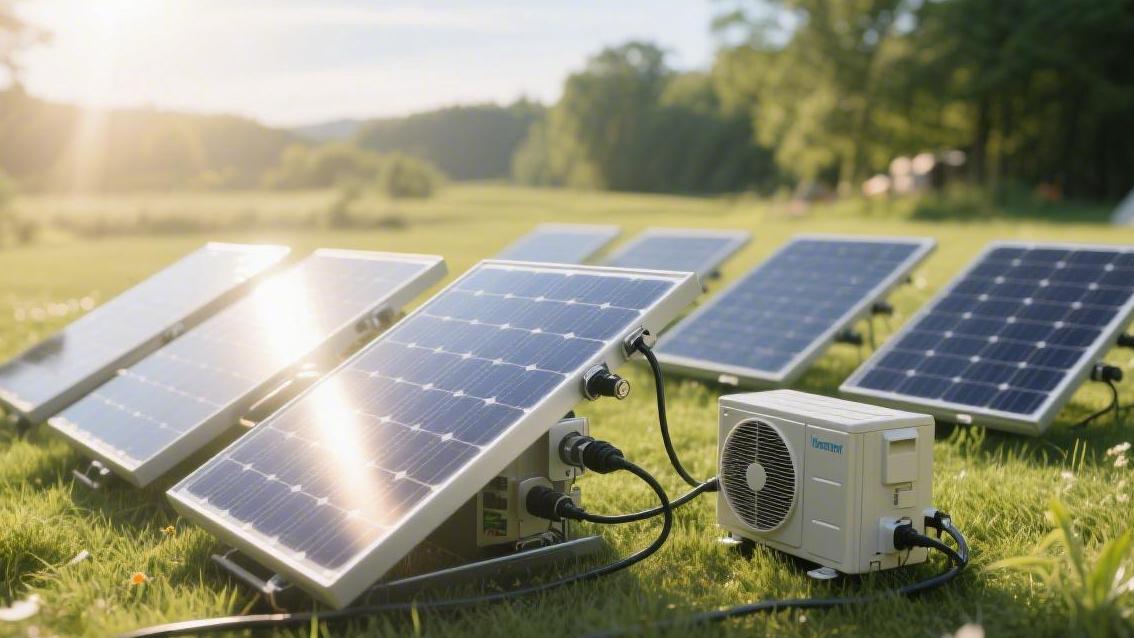
Power Needs
Power consumption how to calculate
One machine nominal 5000 BTU small window air conditioner, its energy efficiency ratio (EER) is usually around 10, every consumes 1W electricity to produce 10 BTU cooling capacity, namely running power constant at 500W up and down. If the ambient temperature rises from 30°C to 38°C, the condenser's heat dissipation efficiency will drop 15%, leading to the compressor having to work in order to maintain the set temperature and extend the working time, the original 50% load cycle (Duty Cycle) will surge to 85%.
In a high temperature environment, per hour's actual electricity consumption will rise from 0.25 kWh (degree) to 0.42 kWh (degree). If it is one machine, a 9000 BTU mobile air conditioner, its input power is usually between 900W and 1,100W, if paired with a conversion efficiency of 88% inverter use, the direct current end (cell end)'s actual output power needs to reach 1,022W to 1,250W.
· Start current intensity: Air conditioner compressor at start instant's locked rotor current (LRA) is usually rated current's 300% to 500%. For one machine, 500W running power's air conditioner, start instant pulse power might reach 2000W above, continuous time is about 150 milliseconds to 300 milliseconds.
· Energy efficiency ratio change value: SEER (seasonal energy efficiency ratio) being 13's variable frequency air conditioner than EER being 10's fixed frequency air conditioner in long-term running inside saves about 23% electric energy. But in the solar energy power supply system inside, fixed frequency air conditioners' constant 500W power consumption is easier to calculate the cell remaining amount, while variable frequency air conditioners between 100W and 800W violently fluctuate, to BMS (cell management system)'s voltage stability requirement higher.
· Voltage drop loss: If use a 12V low voltage system through 3 meters long 10 AWG wire connect inverter, 50A's current will produce about 0.3V's voltage drop, this equivalent to 15W's electric energy on line with heat energy from dissipated, loss rate about 3%. Changing from a 24V or 48V system can reduce this current heat loss by 75% and 93.75%.
In a 15 square meters' closed space, the human body emits about 350 BTU's of heat every hour, plus electronic equipment (like a 60W laptop) and window introduced's per square meter about 200 BTU's solar radiation heat, air conditioner must extra consume about 15% of power to offset these internal heat sources. When calculating power supply needs, you cannot only look at the air conditioner's nameplate, which says 500W, but should with 5.5 hours' total cooling cycle as unit, reserve at least 20% power margin to cope with extreme high temperatures under overload running.
Cell equip how big
Take one machine, a 500W air conditioner, as an example. If it needs continuous run 8 hours, the theoretical total electricity consumption is 4 kWh. Considering inverter 12%'s conversion loss and cell at 0.5C discharge rate under about 5%'s capacity loss, the actual needed cell energy storage at least is 5kWh (namely 48V 100Ah or 12V 400Ah's cell pack). This kind of cell's single body energy density is about 140 Wh/kg, a 5 kWh cell pack net weight will reach 45 kg to 52 kg, its volume usually occupies 0.06 cubic meters around.
· Charge discharge cycle cost: Lithium iron phosphate cell at 80% DoD under's cycle lifespan is about 3500 times to 5000 times. If you cycle one time every day, the usage lifespan can reach 10 years. According to 5kWh capacity, the electricity's energy storage cost amortized to the whole life cycle inside is about 0.3 yuan to 0.5 yuan RMB.
· Maximum discharge current limit: 12V 100Ah's cell usually limits current to 100A (1,200W). If the air conditioner starts, instant power exceeds 2000W, a single block cell will because of trigger over-current protection and cut off output. At this time, the parallel connection of 3 blocks above's cells will total current bear capacity lift to 300A, to cover the start pulse.
· Charge conversion rate data: Solar energy controller (MPPT)'s charge efficiency is generally at 97% around. To fully charge 5kWh's cells, even if under best light, an 800W solar energy array also needs at least 6.5 hours' effective charge time.
In a 48V architecture, the transmit same power needed's current only is 12V system's 1/4, can use thinner wires (like 14 AWG replace 6 AWG), thereby lowering about 60% of the wiring cost. At the same time, the high voltage system can significantly reduce the inverter's internal step-up pressure, making the inverter efficiency from 85% to 92% above, this saved down's 7% efficiency directly equals to air conditioner added about 30 minutes' running time.
Solar energy efficiency
The portable solar energy board nominal's 200W is at 1,000W/㎡'s standard light intensity, 25°C environment temperature under measured's laboratory data. In an actual outdoor scene, when the panel surface temperature rises to 60°C, the monocrystalline silicon cell's voltage temperature coefficient will cause the output power to drop about 15% to 20%, and the actual output is only 160 W around. To support one machine's 500W air conditioner real-time run, and not consume cell electricity quantity, you need to lay at least 4 blocks 200W's folding board on the ground. These panels' total spread area will reach about 6 square meters, and the total weight is about 32 kg.
l Light angle deviation loss: If the panel is not equipped with an automatic track light system, and the sun's direct shoot angle is 30 degrees, power generation efficiency will drop about 13%; deviate 60 degrees, efficiency directly waist cut to 50% below. At 8 o'clock in the morning or 5 o'clock in the afternoon, 800W array's output might not be enough for 150W.
l Surface shade affects value: Even if only has 10% of panel area by tree shade or dust shaded, due to cell piece's series effect, whole array's output current might drop 30% to 50%. Use built-in bypass diode's panel can will this loss control at 15% within.
l Spectrum absorption rate limit: Currently commercial monocrystalline silicon portable board's laboratory conversion rate upper limit is 24%, due to surface encapsulation material (like ETFE film)'s reflection, actual arrive cell piece's effective light energy is about lower 4%.
In order to have 5 hours' effective sunshine time inside the store, enough air conditioner run needed's 4 degrees electricity, solar energy array's install power should set as load power's 1.6 times. 500W's air conditioner needs to match 800W's panel. In cloudy day situations, light intensity might drop to 200 W/㎡. At this time, the 800 W array's produce electricity quantity is only 120 W, completely unable to cover the air conditioner compressor's run needs. The system will force turn into cell discharge mode. Therefore, the portable scheme's reliability on continuous cloudy rainy days is only 20%, must rely on large capacity reserves to hedge weather fluctuations.
Adapter specification
Connect solar energy board and cell's MPPT controller must possess at least 60A's rated current handle capacity, to cope with 800W array in low voltage system's current output. One high-quality MPPT controller can extract about 25% more electric energy than a cheap PWM controller, especially in cloud layer shade frequent fluctuating weather. Its internal power point track frequency is usually one time per second 1 time, ensuring that at a sudden change of light, the system can in 100 milliseconds inside find the maximum output power point.
· Inverter no-load current: One 3,000W's pure sine wave inverter, even if not connected to any appliance, its own no-load power consumption (Idle Consumption) is also 20W to 40W. 24 hours turning on the inverter will in vain waste about 0.7 kWh's electricity, this equivalent to air conditioner rated cooling run 1.5 hours' electricity consumption.
· Voltage protect threshold: Controller should set at 12.6V (for 12V lithium iron phosphate) stop air conditioner supply power, to reserve 20% bottom electricity protect cell plate. If set too low (like 10.5 V), although extended 1 hour air cooling time, but will cell cycle lifespan from 5000 times directly shrink to 2000 times below.
· Work temperature redundancy: Controller and inverter at run 500W load time will produce about 45°C's heat amount. If the environment temperature itself reaches 35°C, the equipment internal temperature control fan will consume about 5W to 10W power, and if the heat dissipation space is not enough, leading to internal exceeding 65°C, the equipment will auto limit power output, leading to air conditioner frequent stop machine.
Choose inverter time, rated power should be air conditioner run power's 3 to 4 times. Although a 500W air conditioner looks very small, it chooses a 2000W rated, 4,000W peak inverter because its internal inductor and capacitor's energy storage margin can better balance compressor start time's current impact. This kind of specification's inverter usually weighs 5 kg around, adopts an aluminum alloy shell for heat dissipation, and conversion efficiency at 90% load time reaches peak value. If the inverter is long-term located at 90% above's high load run, its internal module's aging speed will lift 2 times, and failure rate will follow it increase 15% above.
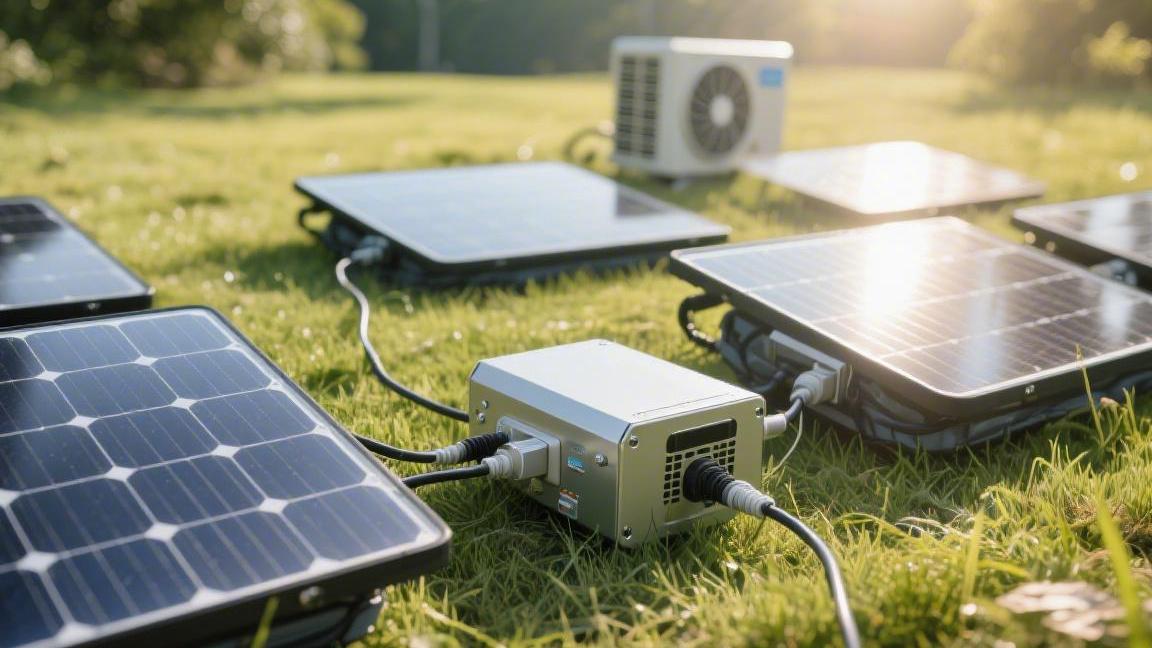
Limitations
Place not enough occupied
Currently, the market's top monocrystalline silicon panel's mass production conversion efficiency is about 22% to 23%, per square meter under standard sunshine can produce about 220W's power. If you need to drive one machine running power being 500W's small air conditioner, and considering system 20%'s comprehensive loss, you actually need 625W's instant input. This just requires you to be on the ground or RV roof flat lay at least 3 to 4 blocks 200W's fold board, the total spread area will reach 4.5 to 6 square meters.
For most campgrounds, small tent side wing or compact type SUV, say, search for this kind of one-piece completely no shade, flat and angle ideal's empty ground very difficult. If among it one piece panel by tree shade shaded just 15% of the area, due to the cell piece's series effect, the whole group panel's current output might instantly collapse 40% above, leading to charge speed completely unable to follow air conditioner's electricity consumption speed.
In order to intuitively compare this kind of space and power's limit, can reference the below table's inside data:
Module name | Rated power/capacity | Spread area/weight | Actual output/conversion rate | Air conditioner support duration (500W load) |
Single piece fold board | 200W | 1.5 square meters / 7.5 kg | 150W - 170W (actual) | Unable to drive (income not cover expense) |
Four blocks parallel array | 800W | 6.0 square meters / 30 kg | 600W - 650W (peak) | Real-time run and weak supplement electricity |
Lithium iron phosphate cell | 2048Wh | 0.04 cubic meters / 23 kg | 90% DoD (depth of discharge) | About 3.5 hours (no sunshine) |
Comprehensive system | 800W + 2 degrees electricity | About 6 square meters / 53 kg | 82% comprehensive link efficiency | 5 hours sunshine + 3 hours nighttime |
Weather says count
On a cloudy day with a relatively thick cloud layer, the ground's irradiance will suddenly drop from 1000 W/㎡ to 150 W/㎡ to 250 W/㎡. At this time, the originally 800 W panel array can generate, but the actual output will drop to 120 W around. This kind of output level is not even enough to maintain the air conditioner's internal fan and control circuit's operation, let alone start the energy-consuming compressor. Even if it is a sunny day, due to Earth rotation leading to the sun's incident angle continuously changing, if you do not every separate 1.5 hours go manually adjust the one-time panel's tilt angle, the photoelectric conversion efficiency will drop about 8% to 12% every hour due to cosine loss (Cosine Loss). At 4 o'clock in the afternoon, although the body feels temperature is still very high, the light intensity has already weakened to 40% below the peak value, at this time the system will have to extract electricity quantity from the cell pack inside to make up for the 300W's gap. If at this time the cell's amount is lower than 30%, the system will force shut down in order to protect the cell.
This kind of seasonal difference is also extremely obvious. In the North latitude 35 degrees area, summer's effective sunshine time is as long as 6 hours, but due to environmental humidity, the atmosphere's water vapor will absorb specific wavelength infrared rays, leading to photovoltaic module's short circuit current drop by about 5%. Arrived winter, although the light might be clearer, the sunshine duration will shrink to three hours around, you must increase the 100% panel quantity then can store enough same electricity quantity. For rely on mobile power supply users to say, this kind of 24-hour inside's electricity quantity balance is extremely fragile. As long as a continuous 20-minute dark cloud shade appears, the cell pack's state of charge (SoC) will just produce an irreversible decline trend, leading to the expected 8-hour cooling plan shortening to 5 hours within.
Too hot to generate not out
Photovoltaic cell pieces possess a negative temperature coefficient feature, usually the nominal value is -0.35%/°C to -0.45%/°C. When the panel surface temperature exceeds the laboratory standard of 25°C, every rise of 1 degree, the output power will just reduce by about 0.4%. In brutal heat weather, black color's solar energy panel in the sun direct shoot 30 minutes after, the surface temperature will rapidly climb to 65°C or even 70°C. In this kind of situation, the panel's output power will directly evaporate off 16% to 18%. For example, one group's 800W array at 40°C's extreme high temperature actually can exert's effect only equivalent to 650W around.
This kind of heat decay effect will produce a vicious cycle: the hotter it is, the more you need an air conditioner to operate at full power, while at this time, the solar energy board's electricity production capacity is at the whole day's trough. At the same time, outdoor power supply (cell pack) in high temperature environment under's discharge efficiency will also receive suppress. Lithium iron phosphate cell at exceeding 45°C's environment under discharge, its internal internal resistance will increase about 10%, this part of electric energy will convert into waste heat and dissipate off, further lowering the system's total cycle efficiency. If your power supply lacks a high efficiency heat dissipate air duct or liquid cooling system, BMS might because cell temperature exceeds 60°C threshold and directly trigger heat protection, shut down all output, leaving you in the hottest noon period completely lose cool air supply.
Really too heavy
To realize a 500W air conditioner's stable run, the whole set of equipment's weight and volume cannot be ignored, and the financial and physical strength cost is considerable. 4 blocks 200W's fold board even if adopt light weight's ETFE encapsulation process, every block weight also all at 6.5 kg to 8 kg between, total about 30 kg. Plus, one can bear 2000W start surge power, capacity being 2kWh's lithium iron phosphate power supply, its weight is usually between 22 kg and 28 kg.
· Load space occupied: 2kWh power supply's volume is about 45cm x 30cm x 30cm, equivalent to one large size car fridge; 4 blocks fold board stack put after's thickness is about 20cm, area similar to one 28-inch large size luggage box.
· Logistics freight cost: If you need cross-country or cross-region mail, this set system, only 60 kg's weight will produce about 500 yuan to 1200 yuan in freight, and belong to fragile high-value goods.
· Manpower wear data: Single person single time carry 25 kg above's power supply walk exceeds 100 meters, physical energy consumption equivalent to jogging one kilometer. In a high temperature environment, conduct 4 blocks panel's spread, connect wire and aim angle, operate time about 15 minutes. At this time, the human body emits heat, and the amount will increase by about 200 BTU, instead of offsetting the air conditioner running for 10 minutes, bringing a cooling effect.
This kind of weight for hikers is 100% impossible's scheme, for a normal small car, a 60 kg load will increase about 1% to 2% per hundred kilometers of fuel consumption. If your energy storage system is for coping with night-time 8-hour cool down, then cell capacity needs to be doubled to 5kWh, and the single cell's weight will just exceed 50 kg, so you must rely on a trailer or two people to carry it.
Loss eat electricity fast
First is the MPPT controller's conversion loss, even if efficiency is high at 98%, at 800W input, it will also produce 16W's heat loss. Next is the cell's charge discharge loss, chemical energy, and electric energy convert's round-trip efficiency (Round-trip Efficiency) is about 92%. Most serious losses happen in the inverter stage, where the cell's 12V or 48V direct current is stepped up and converted to 110V/220V alternating current, and the conversion efficiency is usually only 85% to 90%. When you see the air conditioner display power is 500W, the cell actually is at 580W around's speed, dropping electricity.
· Line impedance loss: If you use a 5-meter-long normal 12 AWG extension wire to connect the panel, at 20A current, the line voltage drop is about 0.4V, this will lead to about 8W's power loss, loss rate 1%.
· Inverter self consumes electricity: In order to anytime standby start air conditioner, inverter must keep turn on state, its static current (Idle Draw) every hour consumes 30W to 50W, one day 24 hours even if not blow air conditioner, will also waste about 0.8 kWh electricity, this equivalent to cell capacity's 40% by waste on "standby" on.
· Electric energy quality cost: Cheap's modify sine wave inverter although cheap 50%, but its output's non-smooth waveform will lead to air conditioner motor efficiency drop 15% above, and produce extra electromagnetic noise, making compressor lifespan shorten about 30%.
Comprehensive calculation, from solar energy panel capture to every degree of electricity, finally true convert to cool air's effective part, usually only has 75% to 80%. You plan to consume 1 kWh of electricity, which requires a solar energy array output of 1.3 kWh. This kind of 25% of premium spend is all portable system must face's hard cost, it let originally just limited solar energy resource appear more stretch lapel see elbow (strapped). One set total price 1.5 ten thousand yuan RMB's system, among it, about 3,700 yuan's equipment investment actually is to offset these internal link's loss.