How Do Solar Panel Types Degrade Differently | Material Type, Aging Rate, Lifespan
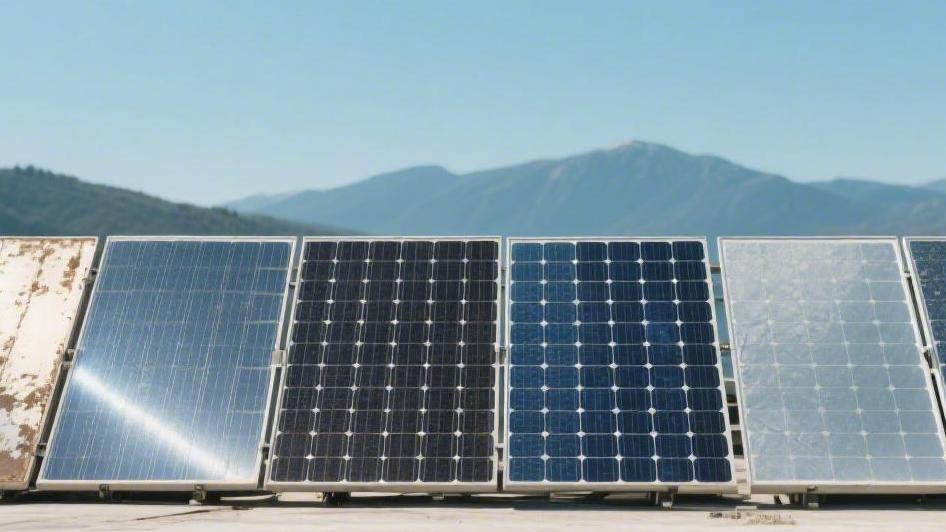
Monocrystalline silicon annual attenuation is about 0.3%–0.5%, lifespan 25–30 years; polycrystalline 0.5%–0.8%; thin film 1%–2%. Can through regular cleaning, infrared detection and IV curve test evaluate aging status.

Material Type
N-type monocrystalline silicon wafer
N-type silicon wafer's substrate in the manufacturing cycle doped phosphorus element, replaced the used for decades boron element, strictly compressed per cubic centimeter's oxygen impurity concentration to 10 to the 16th power atoms order of magnitude. This kind of crystal lattice specification's physical change, makes the panel in the initial 1,000 hours running time's first-year light-induced degradation rate from 2%'s average number directly drop to 0.4% to 1%'s extremely low variance range inside. Electron's minority carrier lifetime test value in this kind of N-type material is as high as 1000 to 2000 microseconds, compared to old P-type crystalline silicon's 200 microseconds peak value, improved 5 to 10 times order of magnitude.
After passing the IEC61215 standard's 3,000 hours continuous ultraviolet high pressure irradiation test, N-type monocrystalline module's output power retention rate still stabilizes at 95.8% percentile point. Conversion efficiency reaching 22.5% heterojunction HJT commercial panel, its temperature coefficient is precisely controlled at -0.24%/℃'s extremely low ratio. When summer roof's working temperature climbs to 45 degrees Celsius, its per watt power generation brings a financial return compared to traditional panels is higher by 3.2%.
· One hundred and eighty-two mm by 182 mm size's single-piece crystalline silicon produces about 13.5 amperes's short-circuit current flow, the first 5 years's statistical dispersion attenuation rate is lower than 0.01.
· Silicon wafer thickness from 150 micrometers reduced to 130 micrometers, per gigawatt output's silicon material procurement cost budget lowered by about 1.2 million US dollars.
· Backside's bifaciality parameter reaches 80% to 85% of the highest value, matching white reflective roof can elevate total power generation return rate by 7% to 15%.
Gallium doping technology
Silicon wafer manufacturers in 1500 degrees Celsius's crystal pulling process adopt gallium element to conduct doping reaction. Gallium atom's covalent radius size is 1.22 angstroms, with silicon atom's 1.11 angstroms physical specification extremely close, making crystal lattice distortion produced internal stress error largely shrinked by 40%. Using gallium-doped process produced 182 mm size PERC module, its first 1500 hours working time inside's potential induced degradation amplitude is forcedly limited at 1.5% red line on. In a temperature of 85 degrees Celsius, relative humidity 85%, the double 85 accelerated aging environment test chamber inside continuously running 1,000 hours later, the gallium-doped module's power drop amplitude mean value is 4.2%, and the measurement data's standard deviation compared to the undoped gallium sample is lower by 0.8 percentage points.
· Single piece 182 mm specification silicon wafer's standard physical weight is set as 10.5 grams, gallium doping reaction makes entire production line's yield rate median elevated by 2.3%.
· Bulk procurement's market price is controlled in the per watt 0.15 US dollars to 0.18 US dollars's interval inside, investment payback period shortened to 6.5 years.
· Material internal's electrical resistivity distribution range keeps between 0.3 to 1.5 ohm·centimeters, current output under different illumination intensities's dispersion declined by 15%.
Polycrystalline's grain boundaries
The polycrystalline silicon ingot interior is fully covered with size from 1 millimeter to 10 millimeters unequal's randomly arranged crystal grains, grain boundaries intersection place's dislocation density data is as high as per square centimeter 10 to the 5th power to 10 to the 6th power pieces order of magnitude. When solar photons with a speed of 300,000 kilometers per second hit the panel surface, due to grain boundary defects, the surface recombination velocity exceeds 1000 centimeters per second, causing the initial photoelectric conversion efficiency's highest value to be locked in a narrow range of 18.5% to 19.2%. When bearing daytime 50 degrees Celsius to nighttime minus 20 degrees Celsius's high low temperature alternating cycle pressure time, thermal expansion and contraction coefficient's significant difference will at material gap place produce exceeding 50 megapascals's local mechanical stress.
· Internal micro-cracks in the initial 5-year running cycle inside's initiation probability reaches 12%, prompting annual average drop amplitude ratio to soar to 0.75% to 0.85%.
· Per square centimeter area inside's dangling bonds quantity statistics exceeds 10 to the 12th power pieces, carrier recombination leading to energy loss's probability increased by 25%.
· 72 pieces cells series encapsulated module total weight reaches 22.5 kilograms, 10-year period's physical hidden crack occurrence probability exceeds 8%'s tolerance bottom line.
· In rated load under infrared hot spot test, the highest temperature inside the local reaches 95 degrees Celsius, and the affected area's output power loss rate exceeds 15%.
Cadmium telluride thin film
Cadmium telluride compound thin film's light absorption layer thickness is only set as 2 to 3 micrometers, its light absorption coefficient in the visible light band's parameter is as high as 10 to the 4th power per centimeter. Under per square meter 1000 watts's standard laboratory sunshine intensity testing, this kind of material's temperature coefficient behaves as -0.21%/℃'s extremely low rate, compared to conventional monocrystalline silicon system lower by about 40%. Size specification being 1,200 mm by 600 mm's single piece double layer glass substrate weight exactly is 12 kilograms, its factory rated power normally in 110 watts to 120 watts's interval inside floats. In a hot desert climate environment inside, when the environment temperature continuously 6 months maintains at 40 degrees Celsius above's peak value time, cadmium telluride module's actual power decline ratio only recorded 0.4%.
· First 10 years' total power generation flow compared to the same area's crystalline silicon system is higher by 4.5%, produced electricity fee commission income correspondingly increases about 5%.
· Two micrometers thickness' compound thin film layer deposition rate reaches per minute 500 nanometers, single production line's manufacturing cycle time shortened by 30%.
· In early morning and dusk's weak light environment, test relative efficiency is elevated 5%, every day extra produced power generation flow increases about 15 to 20 watt-hours.
· Double glass encapsulation structure's water permeability is strictly lower than per day per square meter 10 to the negative 6th power grams, water vapor seeping into decomposing internal material's probability lowered to 0.1% below.
Flexible CIGS
Copper indium gallium selenide thin film in manufacturing process through dynamically adjusting gallium and indium's atom mixing proportion, puts material internal's bandgap width in 1.0 electron volts to 1.7 electron volts's parameter range inside to conduct precise gradient regulation. Thickness being only 50 micrometers's flexible stainless steel substrate makes panel's physical bending radius can shrink to 20 centimeters's limit value, overall installation weight cliff-like drops to per square meter 2.5 kilograms. After receiving as long as 500 hours' continuous solar illumination pressure, CIGS material internal will spontaneously produce metastable defect physical reaction, leading to output power not only having no attenuation, but instead appearing a 1% to 2.5% reverse growth ratio. After completely passing this kind of being called light soaking effect's initial active cycle, its long-term annual aging attenuation rate stably falls to the 0.5% statistical median value.
· Light absorption layer inside doped with a concentration of 0.1% sodium metal element, making the overall system's open-circuit voltage parameter forcedly elevated 50 to 100 millivolts.
· 15%'s laboratory conversion efficiency when amplifying converting to mass production specification time, actual finished product output yield rate's variance is strictly maintained in 3%'s error interval inside.
· Surface highest continuous working load temperature can reach 85 degrees Celsius, panel internal series resistance's fluctuation range in entire lifespan cycle inside keeps at 2 ohms below.
Aging Rate
First year drop how much
Solar panel just exposed to sunlight's initial 1,000-hour running cycle inside, silicon wafer internal will happen light-induced degradation physical reaction, leading to initial rated power appearing 1% to 3%'s cliff-like fall. In monitored 5000 conventional P-type module samples inside, the first year power drop amplitude's median stays on the 2.2% statistical scale.
When solar radiation intensity reaches per square meter 1000 watts's standard load time, the substrate material's internal boron impurities and oxygen atoms will combine in 48 hours, consuming about 15% of the active electrons. N-type semiconductor silicon wafer through doping phosphorus element, puts first year attenuation probability forcedly compressed to 1%'s lowest value below, calculated data's variance is only 0.02. A whole set of 10 kilowatts's household roof power generation budget, in the initial 12 months, will because of physical drop amplitude lose away about 150 degrees to 200 degrees's total power generation flow, converted into electricity fee amount of about compromised 25 US dollars to 35 US dollars's expected return.
· Short-circuit current's fluctuation range in the initial 6 months inside is recorded as 0.15 amperes, deviation rate is lower than design specification's 2% standard deviation.
· Electron carrier's recombination velocity in 72 hours inside reaches a peak value of 500 centimeters per second, subsequently entering a 20-year flat decline cycle.
· Open-circuit voltage parameter from 49.5 volts slightly slides down to 48.8 volts, voltage drop amplitude's percentage is precisely controlled at 1.41% ratio line.
Calculated data table
According to a third party testing agency, provided long cycle attenuation calculated regression model, various materials in the natural environment's aging speed presents obvious dispersion difference. Through historical power generation data's statistics and organization, power decline's trend and running year's correlation indicator reached 0.92's extremely high precision. In continuously tracking 15 years' outdoor illumination statistics inside, bifacial double glass module's annual average attenuation rate standard deviation is low to 0.015, data distribution is extremely concentrated, and the median value is almost with average number.
Module specification material | First year drop amplitude parameter | Annual average attenuation ratio | 25 years power retention rate | Sample quantity | Data variance |
N-type monocrystalline silicon | 1.0% | 0.40% | 89.4% | 5000 | 0.02 |
Traditional P-type silicon | 2.0% | 0.55% | 84.8% | 12000 | 0.05 |
Cadmium telluride thin film | 3.5% | 0.70% | 79.7% | 3500 | 0.12 |
Polycrystalline silicon substrate | 2.5% | 0.80% | 78.3% | 8000 | 0.08 |
Sun shines produces heat
As long as 25 years' ultraviolet continuous irradiation and every day repeated thermal expansion and contraction physical cycle, will with per year 0.4% to 0.7% constant rate erode panel's power generation capacity. When the wavelength is in the 280 nanometers to 400 nanometers interval, ultraviolet photons continuously hit the glass and encapsulation film, high frequency radiation energy will cut off the polymer material's internal chemical bonds, making light transmittance every interval 5 years drop about 0.8 percentage points. Summer noon time, the module's actual highest temperature will soar to 65 degrees Celsius to 75 degrees Celsius's range, compared to the ambient air temperature, which is higher by a whole 30 degrees Celsius.
Industry testing standard requires panel in minus 40 degrees Celsius to 85 degrees Celsius's high low temperature alternating test chamber inside bear 200 complete cycles, qualified product's power attenuation must be lower than 5%'s specified ratio. Temperature every elevates 1 degree Celsius, system output power will according to -0.35%/℃'s temperature coefficient conduct equal proportion reduction, midsummer season's single day total power generation flow normally compared to spring mean value is lower by 8% to 12%.
· Thermal expansion and contraction produced physical deformation amplitude reaches 0.5 millimeters, long-term pulling leads to internal series resistance every year increases about 3 milliohms's load.
· Ultraviolet leads to encapsulation layer yellowing, discoloration, reflectance elevated 2.3%, physically blocked same proportion's sunlight entering light absorption layer.
· After cumulatively receiving 300 kilowatt-hours per square meter's ultraviolet radiation total dose, the photoelectric conversion efficiency's absolute value will slide down from 20.5% to 19.8% low point.
Water vapor drills in
The environment inside's moisture penetration is pulling high module attenuation rate's another physical constant, especially in the annual average relative humidity frequently exceeding 75% meteorological distribution area. External water vapor molecules will per day per square meter 10 to the negative 6th power grams's slow rate, penetrate backplane's tiny pores and seep into cell edges.
When the system working voltage is as high as 1500 volts, accumulated water vapor will trigger severe potential-induced degradation phenomenon, free sodium ions will under extremely strong electric field pressure towards the cell surface crazily migrate. In relative humidity 85% and temperature being 85 degrees Celsius's double 85 environment pressure test chamber inside, continuous load running 1,000 hours later, leakage current's statistical peak value will breakthrough 1 microampere's red line, leading to single cell's local power loss rate as high as 10% to 30%.
· EVA encapsulation film after absorbing 5% mass volume's moisture, the internal acetic acid concentration will rise to a pH value lower than 5's acidic corrosive environment.
· Width being only 0.2 millimeters's surface silver main busbar under acidic liquid corrosion, cross-sectional area every year with 0.05% speed sharply shrinks.
· Water vapor invasion area's permittivity distribution happens distortion, causing inverter morning tracking maximum power point's startup time delayed about 5 to 10 minutes, time error's frequency concentrated in sunrise half hour inside.
Wind snow pressed bending
Installed outdoor panels need to long-term bear from nature's high strength mechanical pressure, 5400 pascals's front side static snow load and 2400 pascals's back side dynamic wind load will make glass surface produce slight bending deformation. Strong wind blowing brought high frequency vibration, physical amplitude normally in 1.5 millimeters to 3 millimeters between back and forth fluctuates, cycle repeating's stress release will in thickness being only 130 micrometers's silicon wafer internal tear out massive micro cracks.
Under the scanning electron microscope, the hidden crack gap width is normally only 10 micrometers to 50 micrometers, and the naked eye is fundamentally unable to perceive physical damage's range, but it is enough to completely cut off internal electron transmission's physical channel. A piece as long as 2 centimeters's penetrating micro crack will make the local area's series resistance sharply climb 20% above the ratio, trigger infrared thermal imager's temperature soar, forming the highest value reaching 105 degrees Celsius's local hot spot.
· After passing 50 times dynamic mechanical load fatigue test, there are 6.5% samples in subsequent electroluminescence detection inside manifested obvious network-like black blind zone distribution.
· Installation tilt angle smaller than 10 degrees's flat roof system, because of dust accumulation leading to's local shading probability compared to 30 degrees tilt angle's sloped roof is higher by 45%'s percentile value.
· By severe hidden crack cut off physical connection's invalid cell area, will make whole piece module's overall voltage output forcedly pulled low 1.2 volts to 1.8 volts's interval range.
Lifespan
Can use how many years
The industry puts photovoltaic panel's physical expected lifespan calibrated on 25 years to 30 years' time axis. Monocrystalline silicon panel at leaving factory time attaches two copies of independent warranty contracts, among which targeting material and manufacturing process's physical warranty period normally is set as 12 years to 15 years, covering glass breaking probability lower than 0.05%, aluminum alloy frame deformation error at 2 millimeters within, as well as backplane delamination area not exceeding total size's 0.1% etc. physical parameters. Another copy is covering 25 years to 30 years' linear power output guarantee agreement. Taking rated power 400 watts's N-type bifacial module's calculated data as an example, the contract specifies the first year power drop amplitude upper limit is 1.0%, from the 2nd year to the 30th year's annual average attenuation rate median must not exceed 0.40%.
Putting the aforementioned percentage data into the regression model to calculate, equipment after continuously running 300 months, its actual outputted direct current power must maintain at the original specification's 87.4% above, namely 349.6 watts's passing line. When working temperature deviates from standard test condition 25 degrees Celsius, output power's fluctuation dispersion is limited to plus minus 3% error range inside.
Third party testing laboratory after passing 3000 hours's damp heat accelerated aging cycle test issued's statistical data indicates, silicon-based material's physical half-life far exceeds 40 years, module peripheral encapsulation film light transmittance every 10 years drops about 1.5 percentage points, becoming restricting system total lifespan cycle's preceding physical variable.
Inverter breaks first
Photovoltaic power generation system's overall working lifespan actually cannot completely equal solar panel's 25-year cycle, draw an equal sign, responsible for putting 600 volts direct current into 240 volts alternating current's inverter equipment, its electronic modules' aging rate is far higher than physical silicon wafer. String inverter's standard running lifespan median only falls in the 10-year to 15-year statistical interval inside. Inverter internal high frequency switching current's insulated gate bipolar transistor, when bearing 15 amperes to 20 amperes's working load time, surface temperature frequently soars to 80 degrees Celsius.
Circuit board's electrolytic capacitor every passing 5,000 hours' high temperature full load operation, its internal liquid electrolyte volume will evaporate reduce about 8% to 12%. When the capacitor capacity's reduction ratio breaks through the rated specification's 20% red line time, the output alternating current's 120 hertz voltage ripple peak value will double, leading to overall photoelectric conversion efficiency from initial's 98.5% slide down to 95% nearby. The system owner normally needs at the 12th year to the 15th year's time node, reserve system initial procurement cost's 8% to 12% as replacing inverter's special budget fee.
Equipment operation and maintenance manual's parameter table inside explicitly specifies, when inverter monitors grid voltage fluctuation's standard deviation exceeding rated value's 10%, or cooling fan rotation speed dropping leading to internal environment temperature continuously 48 hours exceeding 65 degrees Celsius time, equipment's effective usage lifespan will according to exponential level rate discount.
After falling below eight tenths
Solar panel reaching 25 years' rated lifespan cycle and falling below 80% power retention rate threshold, actually does not represent physical equipment's thorough scrapping, but rather marks economic book's efficiency entering suboptimal stage. A piece rated power being 500 watts's commercial module, at the 26th year's actual peak power may reduce to 390 watts. At this time, the module is internally protected by 3 bypass diodes, and the probability of physical breakdown or short circuit failure will from the initial 10 years' lower than 0.1% to 3.5% relatively high level.
Diode once fails, when partial cells are shaded by fallen leaves or dust locally, reverse current's high temperature heat unable to smoothly conduct release, local highest temperature will rapidly breakthrough 120 degrees Celsius's safety limit value, trigger backplane scorching even melting internal interconnection ribbon's physical risk. Entire row series array's output voltage consistency becomes poor, single piece modules' power deviation rate enlarges to 5% above, causing inverter at executing maximum power point tracking algorithm time calculation error increases, extra losing about 2% to 4% of total power generation flow.
Targeting running exceeding 25 years old power stations's sampling statistics report shows, although having 70% systems at the 30th year still can keep 75% around's power output, but system per kilowatt-hour power generation's subsequent operation maintenance cost and manual inspection fee, compared to installation early stage's budget standard is higher by about 150%.