Why Build Floating Solar Farms | Land Use, Efficiency, Water Savings
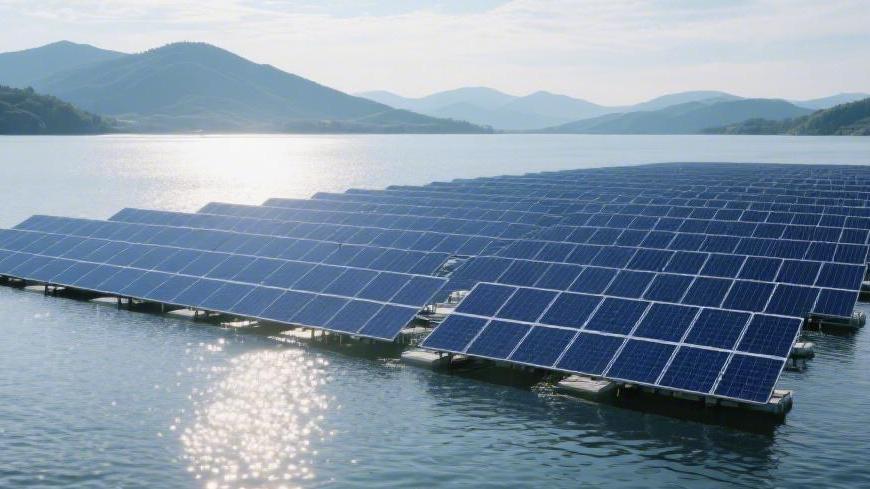
Floating photovoltaics do not occupy arable land, water body cooling makes efficiency increase about 15%;
Covering water surfaces can reduce 70% evaporation and inhibit algae, using an anchoring system to fix, achieving land and water resources dual saving.
Land Use
Land Prep Fee
Facing undulating uneven terrain, engineering machinery needs to cut slopes exceeding 15 degrees, fill flat depths exceeding 0.5 meters, and potholes, ensuring installation module elevation angle tolerance controlled within ±2 degrees inside. Cleaning one hectare of shrubs and tree stumps' average mechanical operation cost about 1,200 dollars to 1800 dollars. Meeting rock texture layer or bearing capacity lower than 80 kilopascals (kPa) soft soil, construction team also needs to drive underground 1.5 meters to 2.5 meters deep micro-pore cast-in-place piles to fix steel brackets.
Per megawatt installation capacity's civil engineering cost usually fluctuates between 40,000 dollars and 60,000 dollars. A water-on photovoltaic system completely skips terrain modification. High molecular material made floating bodies rely on buoyancy suspended on the water surface. As long as the water depth is greater than 1.5 meters, the anchoring mooring system's installation fee is compared to land pile-driving operation cheaper 30% to 45%.
In order to reach the same installation capacity, land and water-on in the land preparation stage have huge differences:
· Site leveling cycle: Land 10 MW project needs 20 days to 30 days using excavators operation; water-on project leveling earthwork time consumption is 0 days.
· Vegetation cleaning fee: Land per hectare needs spend 1500 dollars around; water-on environment has no vegetation, this item budget is 0 dollars.
· Bracket foundation depth: Land ground pile depth in 1.2 meters to 2.5 meters varying; water surface system relies on weight blocks sinking into water bottom or shore side pile-driving pulling tight 30 mm diameter steel cables.
· Dust treatment water consumption: Land construction period every day needs to consume 10 tons to 20 tons of water used for road surface dust suppression; water surface construction completely does not produce dust pollution.
Protecting Agriculture
Global, over 45% suitable light areas and high-yield farmlands in geographic distribution highly overlap. Various places' agricultural land nature change approval carries strict quota limits, approval time consumption often long, as 18 months to 36 months, varying. Developers take second best on C-grade or D-grade poor quality soil to build plants, approval process only needs 3 to 6 months, but poor quality land is often distance from main trunk substation exceeds 20 kilometers.
Pulling one 110-kilovolt high-voltage transmission line, per kilometer, needs consume about 250,000 dollars to 350,000 dollars in material and labor fees. Taking solar panels arranged on water company's irrigation storage ponds or hydropower station's dam upstream, with existing grid connection points' physical distance usually less than 5 kilometers, shaved 80% above line extension investment, at the same time protected food crops' planting area.
Photovoltaic panels' light transmittance lower than 5%, installed on farmland above will lead to below soybean or corn's photosynthesis rate cliff-like fall, per-mu yield decrease magnitude reaches 60% to 80%. Water-on arrangement not exist with crops competing for light flux problem.
Layout Rate
In the north latitude 30 degrees to 40 degrees interval, for ensuring Winter Solstice day morning 9 o'clock to afternoon 3 o'clock, front and back row modules not mutually block, two rows of steel brackets between need leave 4 meters to 7 meters physical gap. Setback distance makes actual photovoltaic module coverage area only can occupy total land area's 40% to 55%. Water-on photovoltaic's design is even more compact. The water surface is an absolutely horizontal surface, no terrain undulation produces shadow variables, floating body modules can adopt a 10-degree to 15-degree small tilt angle back-to-back arrangement structure. Compact layout takes panels' effective coverage density improved to 70% to 85%.
In one area, 100,000 square meters of abandoned quarry lake surface above, able to arrange 12 MW photovoltaic modules; while in the same area, land above, limited by shadow setback distance, width requirement reaching 4 meters above fire passages and inverter room safety distance, at most only can install 8 MW to 9 MW capacity. Installation density's increase thinned every one watt's development cost, electrical cable routing length shortened 25%, DC side line voltage loss reduced about 0.3%.
Settlement Difference
In annual rainfall exceeding 800 mm regions, rainwater flushing triggers foundation soil loss, photovoltaic bracket's horizontal height difference exceeds 5 cm, and module's aluminum alloy frame will bear extra torque pressure. When mechanical pressure value exceeds 2400 Pascals (Pa), silicon wafer internal producing micro-crack probability surges 400%, triggering module hot spot effect, leading to single panel output power in 3 to 5 years within attenuate 10% above.
Water bodies' fluidity and floating body material's flexible connection dissolved stress conduction. High density polyethylene (HDPE) floating bodies rely on rubber hinges to connect, able to adapt to high as 2-meter wave amplitudes. Even if the water level in the dry season and rainy season between appears 10 meters or even 15 meters vertical drop fluctuation, the anchoring system can also through length redundancy automatically adjust, all photovoltaic panels received mechanical pull force always maintain at yield strength's 15% below, modules' annualized power attenuation rate is stably controlled at 0.4% low position interval.
Efficiency
Solar silicon wafers in the absorbing photons converting into electrons process middle, produce high as module total absorbed energy 70% waste heat. In summer noon, the environment's air temperature reaches 35℃ time, and the land photovoltaic panels' surface working temperature surges to 65℃ to 70℃. Monocrystalline silicon cell's temperature coefficient fixed at -0.35%/℃ around. The environment temperature exceeds 25℃ Standard Test Condition (STC) 1℃, module's output power produces 0.35% physical attenuation.
Taking the same batch of 550 Watt (W) photovoltaic modules installed on the water surface, the water body's specific heat capacity reaches 4182 J/(kg·℃), compared to dry sand soil's 800 J/(kg·℃) higher by 5 times higher, making the huge water body one natural constant temperature cooling source. Open water surface's wind speed average compared to same latitude land higher 1.5 m/s to 2.5 m/s, accelerated panel back side air convection heat dissipation. Monitoring instruments recorded data indicates that floating arrays' actual operating temperature compared to land arrays is lower by 8℃ to 15℃.
In continuous strong light irradiation peak time period, water-on photovoltaic modules' peak output power will not like land modules happen heat accumulation caused power sudden drop, one nominal power as 550 Watt module, under land high temperature may only output 460 Watt, in water surface environment can stable at 500 Watt above. Single panel every day extra 0.2 degree (kWh) to 0.3 degree electricity output. Cooling effect brought absolute power generation gain magnitude, in equator near high temperature regions reaches 5% to 8% interval.
Operating Environment Physical Parameters | Land PV Array | Floating PV Array | Variation Difference / Ratio |
Medium Specific Heat Capacity (J/(kg·℃)) | ~800 (Dry soil) | 4182 (Fresh water) | +422.7% |
Summer Peak Panel Temperature (℃) | 65.0 - 70.0 | 50.0 - 55.0 | -15.0 ℃ |
550W Module High Temp Actual Output (W) | ~460.5 | ~502.8 | +42.3 W |
Annualized Average System Efficiency (PR value) | 78.5% | 83.2% | +4.7% |
Backplate Air Convection Wind Speed (m/s) | 1.0 - 2.5 | 3.5 - 5.0 | +2.5 m/s |
Less Dust
Dry land environment middle's floating dust on panel glass surface forms one layer thickness from 0.1 mm to 0.5 mm varying dust coverage film. Light transmittance obstruction leads to monthly average 2% to 4% surface area accumulation soiling loss (Soiling Loss). Photovoltaic O&M teams in desert or plain regions, every year must use high pressure water guns or automated brushing robots to proceed with 4 to 6 deep cleaning operations, every time single megawatt (MW) cleaning budget in 800 dollars to 1200 dollars.
Floating photovoltaic power plants built on lakes, large reservoirs, or drinking water treatment ponds, surroundings lack large areas exposed to mud, air middle's solid particulate matter concentration compared to land surges down 60% to 80%. Water surface evaporation produced trace water vapor at dawn time on panel surface, which condensed into a thickness of about 0.05 mm tiny dew drops, dew following 10 degrees to 15 degrees installation tilt angle sliding down time, took away glass surface's part fine dust. The natural self-cleaning mechanism takes module water-dust blocking loss rate pressed low to 0.5% to 1% category.
Every year, only need arrange 1 to 2 times manual inspection flushing, per megawatt cleaning water consumption from land's 15 cubic meters/time surges down to extremely low value, cleaning O&M cost plummeted 70%. Panel surface due to dust accumulation producing local overheating hot spot effect probability synchronously dropped about 45%, extended diode bypass physical life.
Soiling and O&M Cleaning Parameters | Land System Average | Water-on System Average | Saving or Optimization Magnitude |
Monthly Dust Accumulation Loss Rate (%) | 3.5% | 0.8% | -2.7% |
Manual/Mechanical Cleaning Frequency (Times/Year) | 5 | 1.5 | Reduce 70% |
Cleaning Single Water Consumption (m³/MW) | 15.0 | < 1.0 (Take below water) | Reduce 93% above |
Annual Cleaning Total Budget ($/MW) | $5,000 | $1,200 | Save $3,800 |
Glass Transmittance Attenuation Median (%) | 4.2% | 1.1% | Improve 3.1% |
Low Line Loss
Large photovoltaic power plants internal laid total length reaching tens of thousands meters DC transmission cables. Copper and aluminum alloy wires' resistivity following environment temperature's climbing presents a linear rise. Buried in land surface soil, middle power cables, in summer ground surface temperature breaking through 50℃ time, cable internal current carrying capacity bears pressure, resistance heating triggered DC line loss (DC Loss) often breaks through 1.5% to 2.0% set tolerance value. Floating power plants' combiner boxes and cable bridges mostly fit high density polyethylene (HDPE) floating bodies laid, the distance from the cool water surface is only 20 cm to 40 cm physical gap.
Water surface evaporation's latent heat absorption took away cable outer insulation sleeve surface heat, transmission cables' operating temperature year-round maintained below 30℃. Cross-sectional area as 4 square mm regular photovoltaic DC cable, under 30℃ environment resistance value is 4.95 ohms/km, temperature rising to 60℃, resistance value expands to 5.60 ohms/km. Temperature suppression makes water surface array from panel end to inverter end transmission resistance reduced 11% to 13%.
Inverter executing Maximum Power Point Tracking (MPPT) algorithm time, DC input voltage's fluctuation variance from ±15 Volts narrowed to within ±5 Volts, AC/DC conversion accuracy improved 0.15 percentage points. The whole power plant's comprehensive system efficiency, benefited from electrical loss reduction, in the original design life of 25 years, within continuous upwards float 0.4 to 0.6 percentage points. Every 10 MW installation capacity, every year toward the grid end, extra outputs about 60,000 degrees (kWh) to 80,000 degrees AC electricity, with every degree of electricity 0.1 dollar grid settlement currency amount calculate, single year extra increase 6,000 dollars to 8000 dollars book turnover.
Water Savings
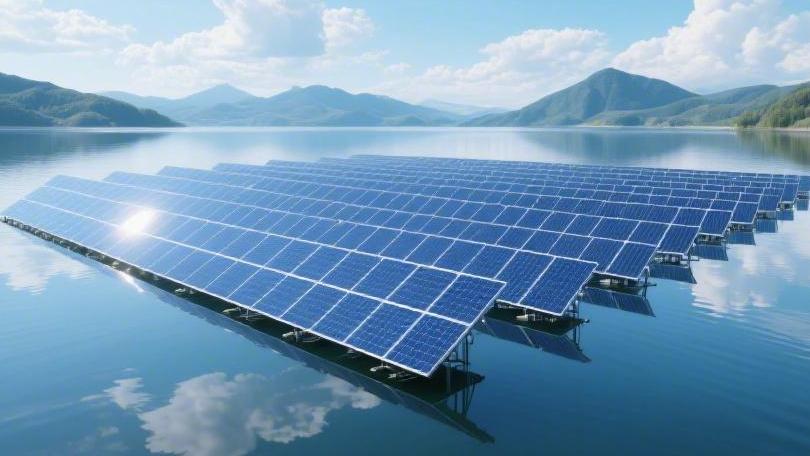
Laid on reservoir surface solar modules physically blocked 60% to 80% short-wave radiation direct hit. Occupying an area of 10 hectares, the water-on photovoltaic array, every day can take water surface absorbed solar energy heat from per square meter about 15 Megajoules (MJ) reduced to between 3 Megajoules and 4 Megajoules. Losing heat source after, surface water body molecules escaping into air kinetic energy reduced 45.5% above. Combining Penman-Monteith evaporation model data, every covering 1 Megawatt (MW) photovoltaic module, its below 10,000 square meters water surface every year can intercept about 15,000 cubic meters to 25,000 cubic meters of liquid water.
Agricultural irrigation storage ponds in the dry season natural evaporation loss rate often high as total storage volume's 20% to 30%, while installed 50% coverage rate floating body panels after, storage pond water level falling speed from daily average 8 mm slowed to daily 3.2 mm low position interval.
According to California state agricultural water, the procurement price per cubic meter is 0.15 dollars to 0.25 dollars. One installation capacity as 15 MW lake surface power plant, only relying on reducing water evaporation amount, every year, then can win back nearly 105,000 dollars water purchase budget fee for the farm owner. Photovoltaic system long as 25 years physical protection mechanism, in whole project life cycle cumulatively saved over 5 million cubic meters of fresh water resources, converted into gravity mass reached 5 million tons.
When wind blows across a flat water surface, floating on the water surface, high density polyethylene (HDPE) floating body square matrix manufactured height between 0.3 meter and 0.5 meter aerodynamic obstacles. Wind speed tester at module surface above 1 meter place measured airflow speed as every second 4.5 meters, but at module below close to water surface 5 cm place airflow speed plummeted to every second 0.8 meters below. Wind speed attenuated 82.2%, deprived dry air taking away water surface saturated water vapor's physical kinetic energy, further taking evaporation correlation coefficient pressed low 0.15 to 0.22.
Cooling High Humidity
Water surface temperature every rise 1℃, its surface saturated water vapor pressure will increase about 6% to 7%. In an environment where the temperature reaches 35℃ on a hot summer afternoon, unprotected open-air shallow water pond surface water temperature often climbs to 28℃ to 32℃ peak. Floating at the water surface above 15 cm, silicon-based solar panels intercepted the infrared waveband, making the panel directly below the surface water temperature forced anchored in 22℃ to 24℃ range. Nearly 8℃ temperature difference bonus, makes water surface's actual water vapor pressure far lower than 25 hectopascals (hPa) theoretical highest value.
Humidity sensors in photovoltaic module backplate and water surface between micro-environment within, measured local relative humidity long-term maintain at 85% to 95% high position, compared to square matrix peripheral open water surface above 60% relative humidity higher at least 25 percentage points.
Humidity difference decrease leads to water molecules' diffusion rate appeared 35% to 40.5% negative growth. In annual rainfall lower than 400 mm, a dry desert edge belt, one surface area of 5 square kilometers drinking water reservoir if laid 75% area photovoltaic floating bodies, its dry season absolute storage volume compared to before covering extra 2.8 million cubic meters.
Even at night, the temperature falling to 15℃ time, plastic floating bodies and photovoltaic brackets also slowed water body heat toward atmosphere radiation speed, day-night water temperature fluctuation's variance from 5.2 narrowed to within 1.8. Thermodynamic distribution's concentration extremely reduced water body vertical rolling toward convective evaporation catalysis effect, total evaporation volume's statistical error range was narrowed to ±4.5% extremely low interval within.
Less Growing Green Algae
When the total phosphorus concentration in water exceeds 0.02 mg per liter, and the transmitted light illuminance is greater than 2000 Lux, cyanobacteria's cell volume in 24 to 48 hours can achieve doubling growth. Floating photovoltaic array's opaque silicon wafers and high molecular material backplates, take shooting into underwater 1 meter depth light intensity peak from 90,000 Lux cliff-like shaved to less than 500 Lux.
Photosynthetically Active Radiation (PAR) waveband light transmittance fell below 2.5% survival bottom line, water middle micro-algae's photosynthesis rate reduced 85% to 90.5%. Chlorophyll-a concentration monitoring index in array installation after 30 days within, from per liter 45 micrograms plummeted to per liter 8 micrograms below.
Water quality monitoring station's quarterly data report shows, covering water surface's Biochemical Oxygen Demand (BOD5) from per liter 12.5 mg dropped to per liter 4.2 mg, water body Dissolved Oxygen (DO) lowest value from per liter 2.5 mg rebounded and stabilized at per liter 6.0 mg above.
Algae density's plummet for tap water treatment plants cut off 30% to 45% liquid chlorine disinfectant procurement budget. Coarse filtration workshop internal multi-media filters' backwash frequency from every 12 hours cleaning once, extended to every 48 hours or even 72 hours cleaning once. Filtration sand tank's water pump load current dropped 15.5%, every day saved 120 degrees (kWh) to 150 degrees plant-used electricity.
Reducing casting copper sulfate etc. algaecide agents, let every 10,000 tons of raw water's purification treatment cost fall 25 dollars to 40 dollars. One daily treatment capacity as 100,000 tons medium water plant, one year 365 days running down, water quality improvement brought comprehensive operation and maintenance fee saving amount high as 1.105 million dollars to 1.408 million dollars.
Dissolved oxygen concentration's median improved 1.2 percentage points, making reservoir bottom 0.5 meter to 1.5 meter water area within anaerobic bacteria breeding probability dropped 75%, hydrogen sulfide and ammonia nitrogen's release amount synchronously reduced 60.3%. Water treatment workshop's sedimentation pond sludge discharge amount in 12-month observation cycle reduced 220 tons, sludge dewatering machine's operating wear fee reduced 18%.