How to Choose Commercial Solar Panels | Output, Application
Choose commercial solar panels need look at power at 400–600W, efficiency 20% above, according to roof area calculate installation capacity, every 10㎡ about install 1 kW, at the same time consider inverter matching and annual degradation rate lower than 0.5% more stable.
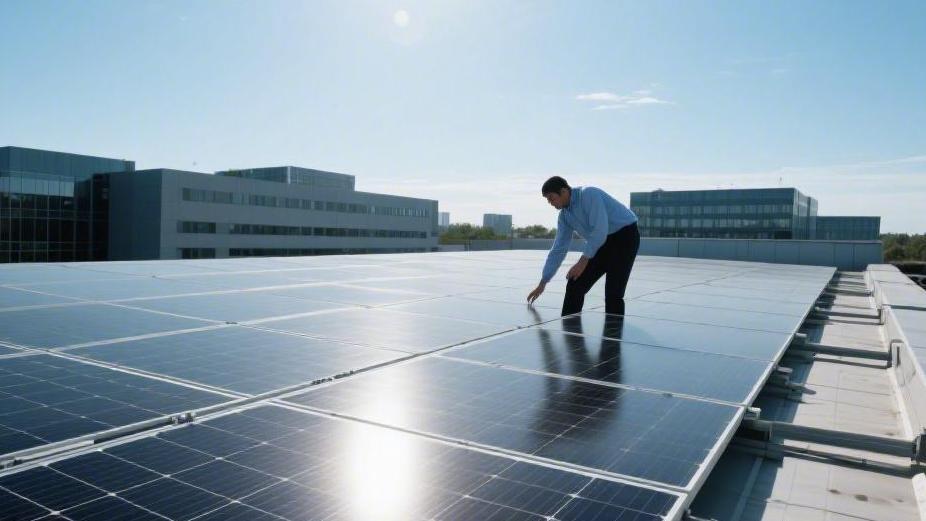
Output
Real Power Generation
Manufacturer on specification sheet marked 550W or 600W peak power, is under light intensity 1,000W/m², cell temperature 25℃, air mass 1.5's laboratory standard test conditions (STC) measured reference value. After installing panels on a commercial building roof, the actual operation environment's average light intensity is often only 800 W/m², when the environment temperature is at 20℃, the panel's internal actual absorbed heat after's temperature will soar to 43℃ to 45℃'s nominal operating cell temperature (NOCT).
Under this working condition, one piece nominal 600W module, its actual output power will usually lose 24% to 26%, real effective peak drops to 440W to 456W range. When evaluating actual power generation output, not only need to look at the panel's conversion efficiency from 21% improved to 22.5%, but also need to calculate the whole string array's system comprehensive loss rate. This part of power loss usually accounts for 13% to 15% of the total rated capacity.
· Panel surface's dust and dirt shading, in rainfall lower than monthly 50 mm arid regions, will lead to monthly power decline rate of 3% to 7%, if roof installation tilt angle is lower than 10 degrees, accumulated dust brought electricity loss rate will climb to 12%.
· DC cable in long-distance transmission's voltage drop must be controlled within 1.5% to 2%, if cable cross-section area from standard 4 square millimeters reduces to 2.5 square millimeters, transmission resistance increase will lead to daily electrical energy loss rate exceeding 3.5%.
· Module and module between's manufacturing tolerance usually between 0 to +5W fluctuates, take current difference reaching 0.5 amperes panels series connect in the same one string within, produced wooden bucket effect will consume whole string 1.5% to 2.5% output power.
Calculate Temperature Difference
Temperature is a pull down module output power's physical parameter, monocrystalline silicon panel's power temperature coefficient generally fluctuates between -0.34%/℃ to -0.38%/℃. When summer noon sunlight directly shines, the black backplate's PV module surface temperature can reach 65℃, compared to 25℃'s test baseline temperature, higher by 40℃. Take this 40℃'s difference value and multiply by -0.35%/℃'s coefficient, get panel under high temperature's power degradation proportion high as 14%.
Take one piece nominal work voltage 41.5V, work current 13.1A 540W panel as an example. Under 65℃'s high temperature roasting, its open circuit voltage temperature coefficient is about -0.27%/℃. The actual work voltage will suddenly drop to 36 V around this time. This time, the panel's instantaneous output power will fall below 465 W. N-type TOPCon cell technology's temperature coefficient is optimized to -0.29%/℃, in the same 65℃ roof environment, its power loss rate can be compared to traditional P-type module reduce 2.4 percentage points, in the north latitude 30 degrees to 40 degrees between sunshine time exceeding 1500 hours region, this temperature difference coefficient's fine-tuning can make the system's total power generation increase 1.8% to 2.2% throughout the year.
Bifacial Earn
Flat roof and ground commercial projects middle change to bifacial dual-glass modules, can use back area to receive surrounding environment's reflected light, take overall output power improve 5% to 15%. Bifaciality parameter usually calibrated in the 70% to 85% range, back side receiving 100W/m² radiation time, can produce equivalent to front side 70W to 85W electricity. Reflective surface's albedo data determines the back side gain amount's upper limit, laying white TPO waterproof coiled material's roof albedo high as 60% to 80%, while ordinary gray concrete roof albedo only 15% to 25%.
· When the module's bottom distance from the ground's installation height reaches 0.5 meters to 1 meter, and the front and back row array's spacing pull apart to 2.5 meters, the back side received scattered light flux can reach per square meter 120W to 150W.
· On an albedo 70% white roof, configure a nominal power 580W bifacial module, according to a 12% back side gain rate, single piece panel's equivalent output peak power will pull up to 649.6W.
· Dual-glass structure adopts 2.0 mm thickness front and back double layer tempered glass, take module's anti-mechanical load ability to improve to front 5400 Pascals, back 2400 Pascals standard, take hail impact or strong wind caused cell micro-crack probability reduced by 40%.
Prevent Degradation
PV module in putting into grid-tied operation front 12 months will experience light-induced degradation (LID), conventional P-type module first year power decline in 2% to 2.5% range within. From 2nd year start to 25th year, module will with every year 0.45% to 0.55% linear rate continuous decline, 25 years operation cycle end time's final retained power about initial rated value's 84.8%. Upgrade to N-type cell after, first year light-induced degradation rate compressed to within 1%, subsequent annual degradation rate also dropped to 0.4%, after 25 years, absolute output power can still maintain at 87.4% scale line on.
In a system nominal voltage of 1000V or 1500V, commercial array within, potential induced degradation (PID) will lead to sodium ion migration toward the cell surface if not adopt anti-PID encapsulation film (for example, POE material, its water vapor transmittance rate lower than 0.1 g/m²·day), panel in relative humidity exceeds 85%, environment temperature 60℃ working condition under operation 3 years after, power generation power will plummet 15% or even 30%.
Match Inverter
Module output DC needs through inverter convert to commercial AC, currently mainstream commercial string inverter's highest conversion efficiency can reach 98.7%, weighted operating efficiency between 98.0% to 98.3%.
In order to maximize the inverter's actual utilization hours, the system design DC/AC ratio is usually set between 1.2 and 1.35, namely, for one unit rated capacity 500 kW inverter, configure 600 kW to 675 kW PV panels. In the morning and evening, the radiation amount is 200 W/m² to 400 W/m² low illumination time period, 1.3 DC/AC ratio can let the inverter early 45 minutes reach 200 V lowest startup voltage, and take single day's full load operation time pull long 1.5 to 2 hours.
When noon light reaches 1,000 W/m², panel output DC power will exceed inverter's maximum AC conversion upper limit, this part of forcibly clipped power (Clipping Loss) accounts for whole year total power generation's 1.2% to 2.5%. Combining panel every year 0.5% power degradation rate, system operation to 5th year time, DC output peak naturally decreases about 4.5%, this time 1.3 DC/AC ratio can exactly offset panel degradation difference value, let inverter continue maintain 99% above peak load conversion state, take initial hardware equipment's capital utilization rate improve 18%.
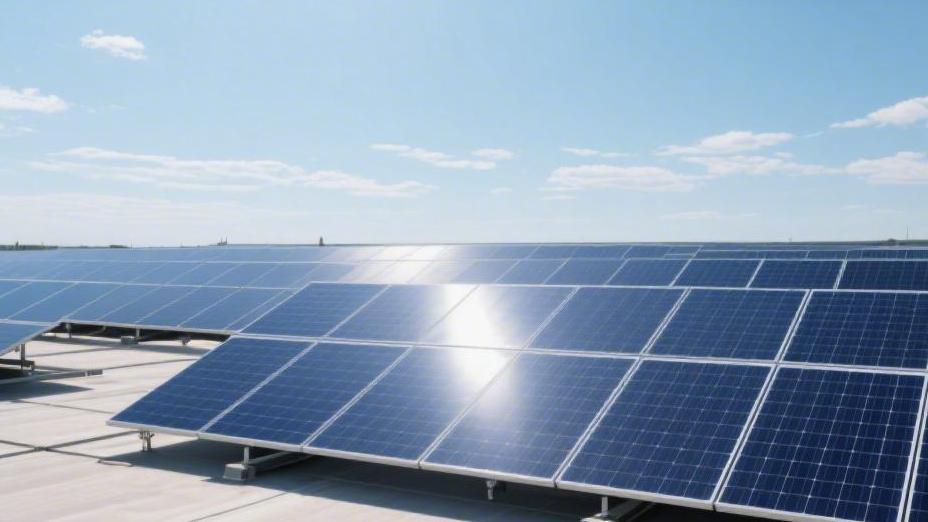
Application
Roof Stable or Not
Standard industrial metal roof usually composed of thickness 0.4 mm to 0.6 mm color steel tiles, its designed dead load margin often only has per square meter 15 kg around. While one set contains 580W panels, aluminum alloy guide rails, stainless steel fasteners, and cable trays system, every square meter will increase the roof's static weight by 12 kg to 18 kg. If the factory building is located in a wind speed year-round exceeding 25 meters/second coastal region, the system also must bear dynamic wind pressure load, this requires roof purlin spacing must be controlled between 1.2 meters and 1.5 meters.
For those roofs that are over 12 years old and already show rust signs, reinforcement treatment must be carried out before installation. Reinforcement costs usually account for 5% to 8% of the overall budget. Otherwise, under heavy snow weather, every square meter of increased 20 kg snow load might lead to structure deformation or even collapse.
Roof Type | Bearing Capacity ($kg/m^$2) | Recommended Module Density ($W/m^$2) | Suggested Useful Life |
Concrete flat roof | 150 - 300 | 180 - 220 | 30 years above |
Trapezoidal color steel tile | 15 - 25 | 140 - 160 | 10 - 15 years |
Jiaochi type 3 metal roof | 20 - 35 | 150 - 170 | 15 - 20 years |
Asphalt shingle roof | 30 - 50 | 130 - 150 | 15 - 20 years |
Enough or Not
If a logistics warehouse's average electricity consumption is 2000 kWh per day, while the daytime peak time period (morning 9 to afternoon 4) electricity consumption accounts for 65%, then designing a system with a capacity of 350 kW is most cost-effective. According to every 1 kW installation capacity, every year generates 1,300 kWh. This system can generate 455,000 kWh of electricity in one year, which can exactly offset most high-price commercial electricity fees.
In calculating installation area time, because of the need to reserve 1 meter wide fire passage and maintenance corridor, the roof's actual effective utilization rate is usually only 60% to 75%. One piece size is 2.2 meters by 1.1 meters, 550W panel, counting spacing and bracket, actual every 1 kW needs occupy about 7.5 square meters of roof space. If an enterprise's transformer capacity is only 500 kVA, while the PV installation amount wants to get to 800 kW, then an anti-backflow device must be installed, extra power limit must be taken to internal consumption, to prevent current reverse flow into the grid leading to transformer protective tripping.
Parking Carport
Using factory area idle parking lot transform to PV carport is currently improve land output ratio's high efficiency means, this application not only can generate electricity, but also can take parking space below's environment temperature reduce 8°C to 12°C. One standard parking space size is 2.5 meters by 5.5 meters, upper can side-by-side install 3 pieces 600W modules, single parking space's installation capacity can reach 1.8 kW.
If a building has 50 parking spaces, a commercial PV carport, the total installation amount is about 90 kW, and every day, it can generate 360 kWh of electricity. Cooperating with 4 units 60kW DC fast charging piles, these power can meet 10 units pure electric vehicles from 20% power charge to 80% demand. Although PV carport's steel structure support cost compared to roof bracket is higher by 40% to 60%, per watt cost will rise to 4.5 yuan around, but considering its brought vehicle value preservation and charging revenue, its overall investment recovery period usually can maintain in 5.5 years to 6.5 years between.
Scenario Type | Unit Area Capacity ($W/m^$2) | Initial Investment (Yuan/Watt) | O&M Frequency (Times/Year) |
Roof distributed | 140 - 160 | 3.2 - 3.6 | 2 - 4 |
PV carport | 100 - 120 | 4.5 - 5.2 | 4 - 6 |
Building integrated (BIPV) | 80 - 110 | 6.0 - 8.5 | 1 - 2 |
Ground centralized | 60 - 90 | 3.0 - 3.4 | 6 - 12 |
Equip a Cell
If an enterprise's peak-valley electricity price difference reaches per kWh 0.7 yuan above, configuring one set 100 kW/200 kWh energy storage system is very necessary. This set of cells can at PV generation most fierce noon time take not used up power store up, wait until afternoon 6 to evening 9's electricity price highest peak time period then release out use, this "peak shaving and valley filling" operation every day can save an enterprise about 140 yuan electricity fee expenditure.
Currently, lithium iron phosphate cells' cycle life is generally at 6000 times. If we proceed with 1.5 times complete charge discharge cycles every day, the cell system can be used for 10 years to 12 years. In system integration time, energy storage inverter's bidirectional conversion efficiency must reach 97% above, and depth of discharge (DoD) is usually limited at 90%, to prevent cell over-discharge leading to cell irreversible capacity degradation.
Tough or Not
In order to guarantee panel can work full 25 years, module must pass IEC 61,701 salt spray corrosion test and IEC 61,215 mechanical load test. In the relative humidity long-term exceed 80% tropical region, must choose bifacial dual-glass module, because glass's water permeability rate is almost zero, can effectively prevent water vapor penetration caused by cell snail trail phenomenon. Besides, the inverter's protection level must reach IP66, even if you use a high-pressure water gun all-round spray, the internal circuit will not enter water.
For dust density relatively large industrial zone, panel surface should spray plate one layer hydrophilic nano coating, this coating can reduce PV panel's surface tension by 30% above, let rain water can easily take away 90% above surface dust, thereby take because of dirt caused annual power generation loss from 8% drop to within 2%.