What Challenges Does Solar Aquaculture Face | How Can They Be Solved
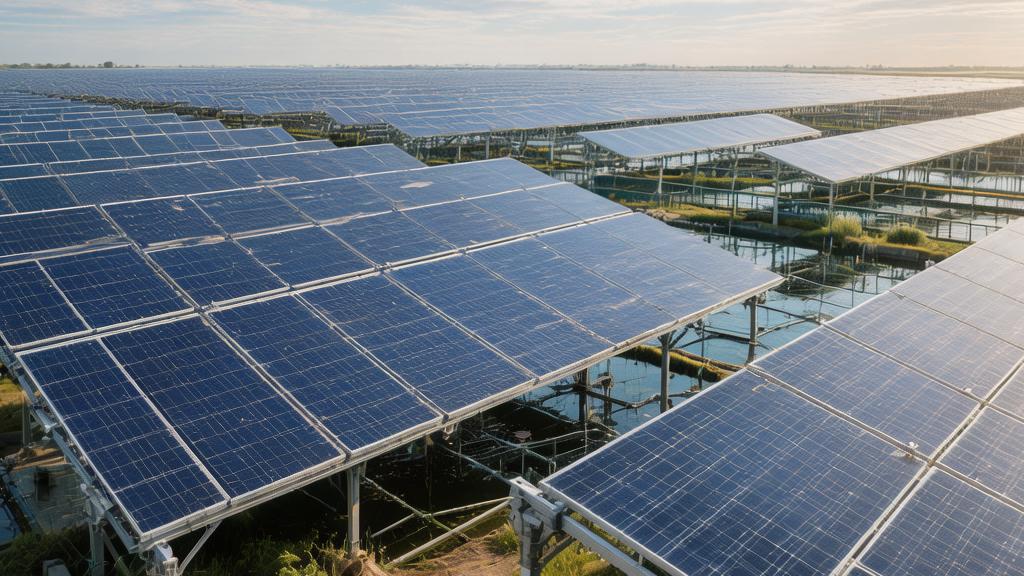
The core challenge of aquavolatics—solar installed over fish farming water—is the higher upfront construction cost, which is typically 10% to 15% above comparable ground-mounted projects. Densely packed panels can also block too much sunlight, disrupting the ecological balance of underwater algae and fish.
To address these issues, modern projects usually adopt a wide-spacing, elevated layout, preserving at least 30% light transmittance to sustain aquatic photosynthesis.
At the same time, operators increasingly rely on IoT-based 24/7 water-quality monitoring and floating robotic cleaners to reduce long-term operation and maintenance costs.
Power Supply
Calculate the Load
In a standardized 10-hectare solar aquaculture farm, power-load calculations have to be extremely precise.
The water surface is equipped with 40 paddlewheel aerators rated at 2.2 kW each. Running from 8:00 p.m. to 8:00 a.m. for 12 hours per day, they consume as much as 1,056 kWh daily.
During daylight hours, 20 automatic feeders rated at 0.75 kW each operate for a total of 4 hours per day, consuming a fixed 60 kWh.
The low-power monitoring network—including water-quality probes, video cameras, and dissolved-oxygen sensors—has a combined load of 0.5 kW and runs continuously for 24 hours, using 12 kWh per day.
Once random loads such as wind vanes and pump sets are included, the average daily electricity demand across the full 10-hectare site reaches 1,200 kWh, with peak load approaching 110 kW under full operation.
During the peak solar window from 11:00 a.m. to 2:00 p.m., every 1 MW of installed PV capacity can deliver about 900 kW of instantaneous output, fully covering the farm's daytime electricity shortfall.
At night, when there is no solar generation, the site relies entirely on grid import or cell discharge.
Motor startup surge current typically reaches 5 to 7 times the rated operating current and lasts about 0.3 to 0.5 seconds.
To prevent high inrush current from blowing distribution-cabinet fuses, the aerators are programmed for staggered startup, with a 5-second interval between each unit.
Under normal daily operation, the site power factor remains between 0.83 and 0.88. A 30 kVAR reactive power compensation cabinet raises it to 0.96.
Choose a Larger Inverter
The water-surface environment remains at a high relative humidity of 85% to 95% for long periods. A conventional indoor inverter with only IP20 protection can suffer mainboard short-circuit corrosion after just 3 months of installation.
Projects therefore require IP66-rated outdoor string inverters. Their housings are pressure-cast from 6063 aluminum alloy, with a thickness of 4.5 mm, and are tested for more than 480 hours of salt-spray corrosion resistance.
The inverter's MPPT operating voltage range is locked between 200 V and 1000 V, allowing each PV string to connect 20 to 22 modules in series.
At an ambient temperature of 45°C, a compliant inverter should still maintain 100% full-load output without derating, with measured conversion efficiency reaching 98.4%.
If the grid voltage suddenly drops to 80% of nominal, an inverter equipped with low-voltage ride-through capability can stay connected and continue operating for at least 150 milliseconds, helping stabilize the grid connection.
The internal IGBT modules switch at 16 kHz, reducing high-frequency electromagnetic noise that could disturb fish below the water surface.
The cooling fan uses a magnetic-levitation brushless DC motor with a rated continuous service life of 60,000 hours.
Communication ports include RS485 and Ethernet as standard, with a data sampling rate of once per second and cloud-upload latency below 200 milliseconds.
Build a Large Cell Bank
Assuming 3 consecutive sunny rainy days, the full 10-hectare site needs 3,600 kWh of usable stored energy.
A standard 48 V, 280 Ah rack-mounted cell module has a theoretical storage capacity of 13.44 kWh. With actual DoD strictly limited to 80%, each module provides about 10.7 kWh of usable power.
The full site therefore requires 340 cell modules in parallel, stacked into 20 standard cell cabinets measuring 600 mm × 800 mm × 2000 mm each.
The BMS keeps cell-voltage deviation within 20 mV, while cell temperature probes sample temperature 10 times per second.
With one full charge-discharge cycle per day and an ambient temperature maintained at 25°C, cell cycle life can reach 6,500 cycles, ensuring more than 15 years of operation while still retaining over 70% of original capacity.
The cell room is equipped with two industrial precision air conditioners, each rated at 3 HP, keeping the indoor temperature stable year-round at 23°C ± 2°C.
The fire-protection system uses heptafluoropropane gas suppression, with discharge completed in under 10 seconds and extinguishing concentration set between 8% and 10%.
A 1.2-meter maintenance aisle is left between cell clusters, and the bottom of each cabinet is fitted with insulated rubber pads rated for a 2-ton point load.
Water Conditions
Monitor pH Carefully
With the PV array covering 65% to 75% of the water surface, large-scale physical shading blocks UV penetration through the water column, reducing the density of phytoplankton responsible for photosynthesis and carbon-dioxide uptake by about 40%.
During the peak light period from 2:00 p.m. to 4:00 p.m., weakened photosynthetic oxygen production causes carbon-dioxide consumption in the water to drop sharply by 50 mg/L, expanding the daily pH fluctuation from the normal 0.5 units seen in unshaded water to 1.2 to 1.5 units.
In a standard 10-hectare aquavoltaic zone, if pH remains below the slightly acidic threshold of 6.5 for 72 consecutive hours, the oxygen-carrying capacity of hemoglobin in bottom-dwelling fish begins to decline at a rate of 20%.
Even when online probes show dissolved oxygen still meeting the acceptable threshold of 5 mg/L, cultured fish may still display physiological signs of oxygen stress, and daily dry-feed intake can fall by 35% to 45%.
To bring pH back into the slightly alkaline target range of 7.2 to 7.8, each hectare of water surface requires a fixed monthly input of 150 kg of quicklime.
The purchased calcium oxide must have a purity of at least 90%, and application should be scheduled between 9:00 a.m. and 10:00 a.m. for even distribution across the pond.
Immediately after dosing, a 3 kW paddlewheel aerator must be switched on to stir the water forcefully for 45 minutes, ensuring that the vertical pH deviation between the surface and a depth difference of 1.5 meters stays within 0.2 units.
Watch Dissolved Oxygen Closely
After large-area shading is installed, the water's natural oxygen production from photosynthesis drops by about 3.5 grams per cubic meter per day.
At night, however, respiration by aquatic animals and bottom-dwelling oxygen-consuming microorganisms remains steady at 0.8 to 1.2 grams per cubic meter per hour. As a result, dissolved oxygen between 3:00 a.m. and 5:00 a.m. can quickly fall below the safe threshold of 4 mg/L, dropping into a low-oxygen range of 1.8 to 2.2 mg/L.
Sensor probes are suspended at depths of 60 cm and 120 cm below the surface, and the communication module sends data to the control terminal every 5 minutes, with transmission delay below 150 milliseconds.
When readings fall below 3.5 mg/L, the AC contactor inside the control cabinet closes within 0.2 seconds, automatically starting the bottom microbubble aeration system.
Each hectare is equipped with 22 micro-aeration pipes totaling 110 meters in length. When the Roots blower reaches an outlet pressure of 0.03 MPa, it injects 80 liters of compressed air per minute into the deeper water layers.
Test Depth (cm) | Average Dissolved Oxygen During Light Hours (10:00–14:00) (mg/L) | Average Dissolved Oxygen During No-Light Hours (02:00–06:00) (mg/L) | Increase After 1 Hour of Full Bottom Aeration (mg/L) |
30 | 6.8 | 2.5 | 1.2 |
60 | 5.4 | 2.1 | 1.8 |
120 | 4.1 | 1.6 | 2.4 |
180 | 3.2 | 1.1 | 2.7 |
Temperature Control Matters
The physical shading effect of PV modules can lower peak summer surface-water temperature by as much as 4.2°C, while the winter wind-blocking and insulation effect can keep bottom-water temperature 1.5°C to 2.1°C higher than in nearby unshaded water.
This altered thermal gradient significantly disrupts the water body's natural vertical thermal stratification, increasing the frequency of cold bottom-water upwelling by about 30%.
For every additional 10 days that water temperature remains below 18°C, the total growth cycle of tropical warm-water fish can be delayed by 15 days, while monthly feed conversion ratio deteriorates from a normal 1.3 to 1.6.
In a 5-hectare high-density flow-through farming pond, a full air-source heating and cooling heat-pump system rated at 150 kW has been installed.
When the ambient temperature falls below 10°C, the heat pump runs at full load with a COP of 3.5, consuming 42 kWh of grid electricity per hour and heating 200 cubic meters of circulating water by 2.5°C per hour through the heat exchanger.
The heat exchanger uses titanium alloy corrugated tubes with a wall thickness of 1.2 mm and a pressure tolerance of up to 0.8 MPa.
Operating continuously 24 hours a day, the system keeps the entire pond at a tightly controlled 22°C ± 0.5°C, which lies in the active feeding range for fish.
System Maintenance
Clean the Solar Panels
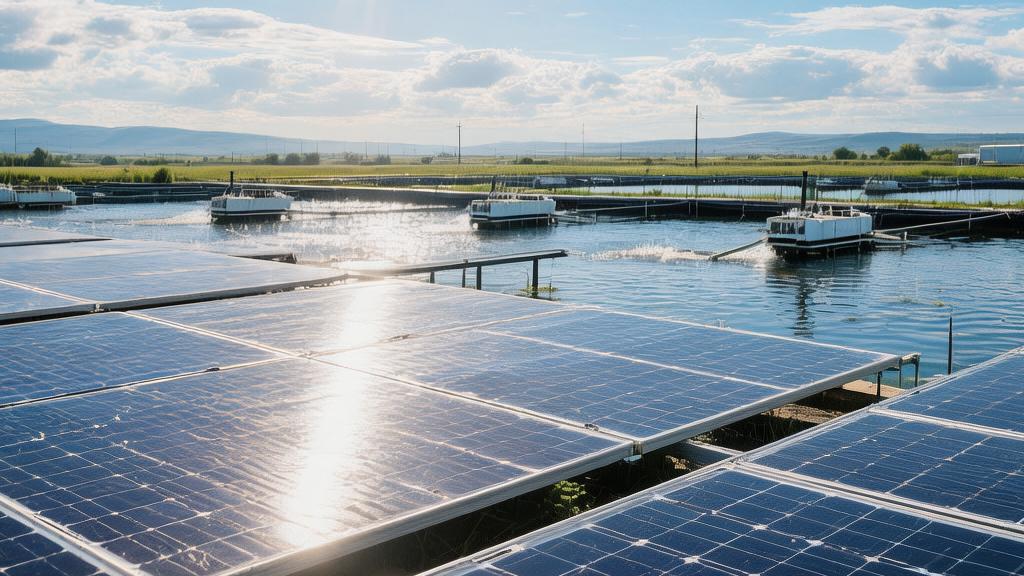
The high-humidity environment above the water, combined with floating dust, forms muddy scale deposits 0.15 mm to 0.3 mm thick on the glass surface of PV modules.
Shading from bird droppings can cause local cell temperature to spike above 85°C, cutting the output of a single module by 12% to 18% within 48 hours.
The O&M team schedules a cleaning operation every 14 days, using tracked waterless cleaning robots.
Each robot weighs 22 kg, with ground pressure controlled at 0.08 MPa, and climbs module arrays tilted at 15 degrees at a constant speed of 12 meters per minute.
The front roller brush rotates at 800 rpm, and the nylon bristles are 0.4 mm in diameter, enabling the robot to remove 98.5% of surface deposits in a single pass.
When dust accumulation reduces module light transmittance by 6%, the economic return from cleaning reaches its peak. For a 10 MW installation, the total cost of one robotic cleaning cycle—including power, depreciation, and labor—is 450 currency units, yet it can recover 140,000 kWh of generation losses over the following 14 days, producing a highly favorable benefit-cost ratio of 31:1.
Inspect Corrosion on the Mounting Structure
Metal pipe piles fixed in the water remain submerged long-term in slightly alkaline water with a dissolved oxygen concentration of about 6 mg/L, while the air-water interface stays in a highly active oxidation-reduction zone.
The design thickness of the hot-dip galvanized coating is 85 microns, but under continuous wave impact, annual physical wear reaches 4.5 to 6 microns.
Maintenance crews use a coating-thickness gauge to inspect the support structure in the 30 cm zone above the waterline once every quarter, randomly sampling 200 points each time.
If readings fall below the warning threshold of 45 microns, the surface must be recoated immediately with an epoxy zinc-rich primer offering an adhesion strength of 5 MPa, preventing electrochemical corrosion of the steel substrate.
When wind speed over the water reaches 18 m/s, aerodynamic uplift on the windward PV matrix subjects M12 stainless-steel bolts to alternating tensile stress as high as 4.5 kN. Recalibrating all load-bearing bolts to the rated torque of 65 N·m with a digital torque wrench rated to 100 N·m can reduce the probability of structural deformation across the metal framework by 92%.
Test the Underwater Cables
The DC collection cables laid at a depth of 1.5 meters are protected by 3.5 mm thick high-density polyethylene insulation, yet they face daily risk of physical damage from underwater crustaceans.
As the insulation material absorbs water molecules, its dielectric constant gradually rises from 2.3 to 2.8, increasing the cable's capacitive effect to ground.
Every 180 days, O&M technicians use a 2500 V DC megohmmeter to perform insulation withstand testing on the main cables, with the acceptance threshold strictly kept above 200 MΩ.
If leakage current to ground at any single point exceeds the set threshold of 30 mA under 1000 V DC operating voltage, the relay inside the control cabinet must disconnect that string within 0.5 seconds.
Underwater cable joints are sealed with double-layer heat-shrink tubing, and the polyurethane waterproof compound inside must achieve 100% void-free encapsulation.
Across a water-temperature fluctuation range of 15°C to 25°C, differences in thermal expansion coefficients create a small displacement of 0.02 mm per °C. If the voltage drop across the resistance at both ends of a cable joint exceeds 0.15 V, that indicates the copper core inside has already begun to oxidize.