Monocrystalline vs. Polycrystalline Solar Panels | 3 Key Differences Between
Monocrystalline and polycrystalline solar panels have three core differences: first is efficiency, as monocrystalline silicon has higher purity with conversion rates typically reaching 20%-22%, while polycrystalline is around 15%-17%;
Second is appearance. Monocrystalline is mostly pure black with rounded corners, while polycrystalline appears blue with a fragmented texture;
Finally, cost and space: monocrystalline is higher in price but occupies less space for the same power, while polycrystalline offers a better price advantage.
Suggestion: Choose monocrystalline if roof space is limited; choose polycrystalline if pursuing high cost-performance and area is sufficient.
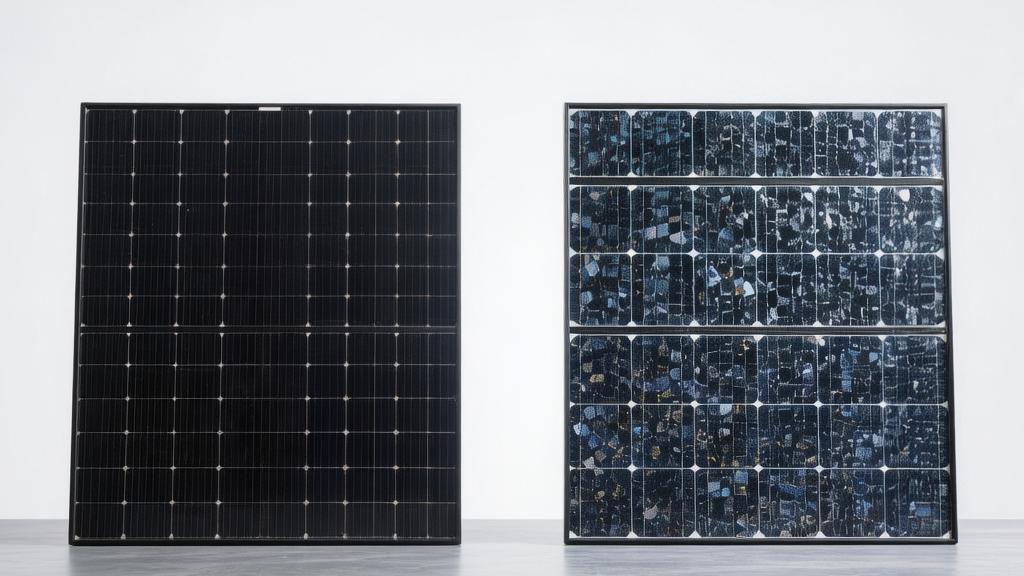
Efficiency and Space Requirements
Standard Test Conditions (STC) define a light intensity of 1,000 W/m², a cell surface temperature of 25°C, and an air mass of AM 1.5.
Under these parameters, monocrystalline arrays—leveraging N-type TOPCon or HJT heterojunction cell structures—maintain a stable photoelectric conversion efficiency in the range of 21.5% to 24.2%.
A standard monocrystalline module using 144 half-cut cell technology, measuring 2278 mm by 1,134 mm, reaches an output power of 540 W to 575 W.
Polycrystalline silicon, due to higher electron recombination losses at grain boundaries, usually sees its maximum efficiency plateau at 17.5% under the same test environment.
Within the exact same physical area of 2.58 m², the output power of a polycrystalline panel only reaches 380 W to 410 W.
The 135 W power difference results in a 15.6% decrease in absolute power generation per square meter.
· An 8 kW residential photovoltaic system requires the purchase of 14 units of 570 W monocrystalline modules to meet an 8,000 W load requirement.
· If 380 W polycrystalline modules are used, the purchase quantity increases to 21 units for a total power of 7,980 W.
· The open-circuit voltage (Voc) of a single monocrystalline module is 49.5 V, and the short-circuit current (Isc) reaches 14.3 A, which is fully compatible with mainstream micro-inverters on the market having a rated input current of 15 A.
Calculating Area
14 monocrystalline modules require 36.12 m² of net panel area, whereas 21 polycrystalline modules reach a surface area of 54.18 m².
The available south-facing roof area of suburban detached houses is generally between 45 m² and 50 m².
The 54.18 m² net area of the polycrystalline array exceeds the physical limits of a conventional roof.
Construction teams must reserve gaps of 15 mm to 20 mm between adjacent modules to account for thermal expansion and contraction, and leave a 914 mm fire access width at the ridges and eaves according to the National Electrical Code (NEC).
· Accounting for a 15% installation hardware buffer zone, the actual space occupancy of an 8 kW monocrystalline system expands to 41.5 m², which fits perfectly within a 45 m² roof.
· The actual required layout space for an 8 kW polycrystalline system expands to 62.3 m², resulting in an area deficit of 17.3 m².
· For narrow roofs with limited space, using monocrystalline modules with a 22.5% conversion rate can output a power density of 225 W/m², while 16.5% polycrystalline modules only provide 165 W/m² of power.
Temperature Accounting
Once the surface temperature exceeds the 25°C baseline, the voltage of the cell modules shows a linear downward trend.
Dark, light-absorbing monocrystalline silicon arrays can see surface temperatures climb to 65°C during summer middays.
The power temperature coefficient (Pmax) for N-type monocrystalline silicon remains at -0.30%/°C.
Compared to the standard 25°C environment, a 40°C temperature rise brings a 12% power loss, reducing the actual output of a 570 W monocrystalline panel to 501.6 W.
The power temperature coefficient of polycrystalline panels fluctuates between -0.38%/°C and -0.41%/°C.
The same 40°C temperature rise causes a polycrystalline panel to lose 15.2% to 16.4% of its output power, meaning an original 380 W panel only outputs 317.6 W at 65°C.
· In a summer billing cycle lasting 120 days, assuming an average daily peak sunlight of 5.5 hours, each monocrystalline panel generates 0.18 kWh more electricity per day than a polycrystalline one.
· The difference in thermal stability during high-temperature summer periods allows an 8 kW monocrystalline system to produce approximately 302.4 kWh of additional AC power over four months.
· When receiving reduced DC voltage under high temperatures, the MPPT tracking efficiency of the monocrystalline system still maintains 98.5%, while the low voltage input of the polycrystalline system causes inverter conversion efficiency to drop by 0.4%.
Observing Degradation
In the first year of equipment operation, Light-Induced Degradation (LID) causes the output power of P-type polycrystalline modules to drop immediately by 1.5% to 2.0%.
N-type monocrystalline modules control the first-year degradation rate to within 1.0% through gallium-doping processes.
From year 2 to year 25, the annual linear degradation rate of monocrystalline modules is strictly locked between 0.40% and 0.45%, while the annual degradation rate of polycrystalline modules fluctuates around 0.55% to 0.65%.
By the 25-year warranty milestone, monocrystalline modules can promise that 87.4% to 89.2% of their rated power remains effective.
The degradation curve for polycrystalline modules often falls to 81% to 83.5% by the 25th year.
· For an 8 kW system with a first-year generation of 11,000 kWh, after 300 months of operation, the cumulative power generation of the monocrystalline configuration reaches 256,000 kWh.
· In the same 300-month cycle, the cumulative total output for the polycrystalline configuration is approximately 238,500 kWh, a difference of 17,500 kWh.
· Calculated at a feed-in tariff of 0.15 USD/kWh, monocrystalline panels create 2625 USD in additional absolute electricity revenue over their lifecycle due to lower degradation rates.
Choosing Racking
A 2.58 m² monocrystalline panel weighs 27.5 kg; aluminum alloy rails, L-feet, and stainless steel mid-clamps add an extra load of 3.2 kg/m², making the roof bear a static pressure of 13.8 kg/m².
When a polycrystalline system requires 21 panels to reach 8 kW, the net weight of the entire PV array climbs from 385 kg to 577.5 kg.
The additional 18.06 m² of laid area requires 45% more aluminum structural modules.
· Based on a market procurement unit price of 0.12 USD/W for PV racking hardware, the massive physical area of the polycrystalline system results in 320 USD extra in the hardware bill of materials.
· The overall construction time for the polycrystalline system increases by approximately 3.5 man-hours due to the 7 extra panels and supporting rails.
· At an installation labor rate of 45 USD per hour, the extra labor cost due to the larger physical area reaches 157.5 USD.
Testing Low Light
Ambient irradiance often drops below 200 W/m² in the early morning, evening, or during cloud cover.
Monocrystalline silicon cells possess higher parallel resistance and lower reverse saturation current, allowing string inverters to reach the startup voltage threshold 30 to 45 minutes earlier.
A string inverter with an input voltage range of 200 V to 800 V needs 14 series-connected monocrystalline panels to provide 546 V of open-circuit voltage, crossing the MPPT (Maximum Power Point Tracking) working line as early as 6:30 AM.
The 21 polycrystalline panels in series have higher internal resistance and severe voltage drops, meaning they must wait until irradiance exceeds 250 W/m² at 7:15 AM to achieve grid synchronization.
· In a 365-day work cycle, the advantage of low-light wake-up time allows the monocrystalline system to increase annual AC power output by 4.2%.
· When faced with snow cover up to 5 mm thick, the higher local current concentration of monocrystalline panels allows the surface temperature to reach the melting point above 0°C faster, with a melting rate 18% faster than polycrystalline.
· In heavy fog with only 15% ambient light transmittance, monocrystalline modules maintain a faint output of 3% rated power, while polycrystalline output current often falls below the inverter's 0.5 A detection limit, resulting in power-off sleep mode.
Aesthetics and Manufacturing Process
Pulling Crystal Ingots
The manufacturing starting point for monocrystalline silicon panels is a quartz crucible filled with 99.9999% high-purity polycrystalline silicon scrap, melted in a sealed vacuum furnace at 1500°C.
A cylindrical monocrystalline silicon ingot weighing 150 kg takes 48 to 72 hours to form using the Czochralski (CZ) method.
During the pulling process, a seed crystal is lifted at a constant rate of 1.5 mm to 2.0 mm per minute while the furnace body rotates at a frequency of 10 to 15 revolutions per minute, ensuring the internal silicon atoms are arranged in a perfect lattice structure with 0-degree deviation.
This slow growth cycle, consuming 1200 kWh of electricity, results in an internal electron mobility of 1,350 cm²/V·s, significantly reducing internal resistance losses.
A monocrystalline furnace valued at 150,000 USD has an annual capacity of approximately 15 tons of monocrystalline silicon rods under 365 days of continuous operation.
After diamond wire cutting, the 150 kg monocrystalline silicon rod is sliced into standard wafers with a thickness of only 130 to 150 microns. The cutting loss rate per millimeter is strictly controlled within 15 microns, ensuring that each kilogram of high-purity silicon can produce about 62 monocrystalline cells of 182 mm specification.
Pouring into Molds
Polycrystalline silicon manufacturing skips the time-consuming pulling step, instead pouring 1,000 kg of molten silicon into a square quartz casting furnace measuring 1.2 m by 1.2 m.
After 50 hours of directional solidification cooling, with the temperature dropping steadily at a gradient of 20°C per hour, a massive polycrystalline silicon square ingot is finally formed.
This mass casting process compresses the processing time for 1,000 kg of raw material by 40%, reducing the production electricity cost per watt from 0.05 USD to 0.03 USD.
The melt crystallizes in different areas simultaneously, creating tens of thousands of tiny grains ranging from 1 mm to 10 mm in size. The grain boundary thickness reaches 0.1 microns, causing polycrystalline silicon's electron mobility to drop to between 400 and 500 cm²/V·s.
The 1,000 kg polycrystalline square ingot is cut by a band saw into perfect square wafers with a side length of 156.75 mm, maintaining an overall yield rate of 98.5%.
Trimming Shapes
182 mm monocrystalline silicon wafers retain the physical geometric characteristics of the original cylindrical silicon rod, with the four corners showing rounded chamfers with a radius of 2.5 mm.
When 144 half-cut monocrystalline cells are assembled into a standard 2,278 mm by 1,134 mm module, diamond-shaped white gaps occupying about 0.8% of the total area are formed at the chamfers.
Because polycrystalline wafers are sliced from square ingots, they have 90-degree right-angle edges. When assembling a standard 72-cell module measuring 1956 mm by 992 mm, the surface arrangement achieves 100% physical coverage.
To reduce the breakage rate of 40-micron diamond wires, the average bending strength of monocrystalline wafers must reach 150 MPa, while the mechanical pressure threshold for polycrystalline wafers during cutting is relaxed to 120 MPa, with an overall wire breakage rate 1.2 percentage points higher than the monocrystalline process.
The weight of a single monocrystalline cell before lamination is approximately 10.5 g. The surface needs to be coated with a 70 nm thick silicon nitride anti-reflective film, a process that increases light penetration by 4.5% and reduces internal carrier recombination probability by 12%.
Surface Color
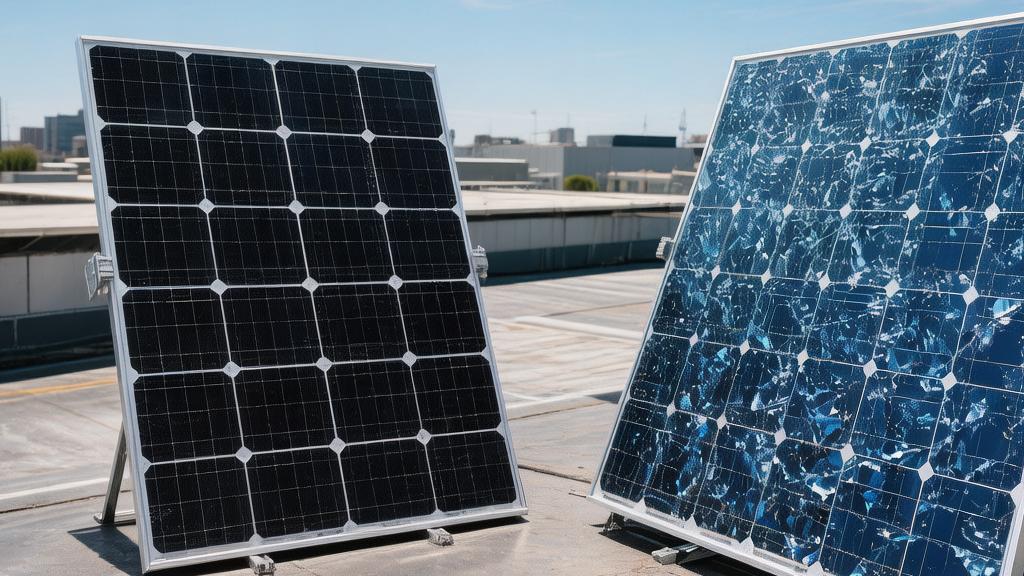
Monocrystalline panels appear uniformly pure black or deep blue-black, with the color deviation rate across the 2.58 m² surface strictly controlled within 2%.
This uniform dark tone possesses a 95% visible light absorption rate, with absolute reflectivity of sunlight on the monocrystalline surface dropping to between 4.8% and 5.2%.
Due to the random arrangement of tens of thousands of grains, polycrystalline panels exhibit a light blue texture similar to marble patterns or ice crystals. The light refraction angle deviation between different crystal planes reaches 15 to 25 degrees.
A 1.94 m² polycrystalline module has a visual color difference ratio as high as 12% to 15%. Under midday irradiance of 1,000 W/m², the overall light reflectivity reaches 11.5% to 13.0%, resulting in about 65 W of solar radiation energy being completely lost rather than converted into electricity.
Return on Investment
Calculating Power Generation
In the first year of operation, a 10 kW monocrystalline array, under an average daily effective sunshine intensity of 5.2 hours, has its system loss rate controlled at around 14.5%, with an expected annual AC power output of 16,245 kWh.
For a polycrystalline system under the same meteorological parameters and latitude coordinates, the system's comprehensive loss rate reaches 16.8% due to a higher temperature coefficient and poorer low-light response.
The total AC output of a polycrystalline array in the first year typically stays at 15,800 kWh, which is 445 kWh less usable power than the monocrystalline system.
Entering the 10th billing year, the statistical variance of light-induced degradation and hot spot effects begins to expand.
The annual average linear degradation rate of monocrystalline panels is locked at 0.42%, with actual power in the 10th year remaining at 95.2% of the factory rated value.
That year's power output drops to 15,465 kWh.
The annual average degradation rate of polycrystalline panels fluctuates around 0.65%. After 120 months of operation, the power retention rate drops to 92.1%, and annual power generation falls to 14,551 kWh.
Over the full 25-year lifecycle, a significant deviation appears in the integral area of cumulative system power generation.
By the end of the 300th month, the monocrystalline array has delivered a total of 378,500 kWh of energy to the grid.
The cumulative total output of the polycrystalline array is 352,200 kWh.
The absolute difference of 26,300 kWh constitutes the underlying data sample for calculating long-term financial returns.
Offsetting Bills
Based on the average residential electricity price of 0.16 USD/kWh published by the U.S. Energy Information Administration (EIA), a monocrystalline system can offset a 2,599.2 USD electricity bill with 16,245 kWh of power in its first year of grid connection.
The 15,800 kWh output of a polycrystalline system in the first year corresponds to a bill reduction of 2,528 USD. The first-year bill balance difference is 71.2 USD.
Introducing a 4.5% compound annual growth rate for retail electricity prices over the past decade:
By the 10th year, the purchase price per kWh swells to 0.24 USD.
At this time, the 15,465 kWh generated by the monocrystalline system can hedge against 3,711.6 USD of electricity expenses.
The 14,551 kWh of the polycrystalline system can only offset 3,492.2 USD. The revenue difference for the 10th year alone expands to 219.4 USD.
Over its design life, the monocrystalline system cumulatively avoids 114,850 USD in electricity expenses.
Under the same electricity price inflation frequency and degradation rate model, the polycrystalline system cumulatively offsets a total of 106,120 USD in electricity bills.
The two materials, under the leverage of the electricity price inflation coefficient, produce an absolute revenue deviation of 8,730 USD.
Comparison Parameter (10 kW capacity) | Monocrystalline Panel Array | Polycrystalline Panel Array | Data Difference |
First Year Power Generation | 16,245 kWh | 15,800 kWh | +445 kWh |
Tenth Year Power Generation | 15,465 kWh | 14,551 kWh | +914 kWh |
25-Year Cumulative Output | 378,500 kWh | 352,200 kWh | +26,300 kWh |
First Year Bill Offset | 2,599.2 USD | 2,528.0 USD | +71.2 USD |
25-Year Cumulative Bill Offset | 114,850 USD | 106,120 USD | +8,730 USD |
Federal Tax Credit
The U.S. Federal Investment Tax Credit (ITC) policy allows for a 30% personal income tax deduction based on the total cost of equipment and construction.
Assuming a final contract quote for a 10 kW monocrystalline system, including permit fees and grid connection costs, is 26,000 USD.
The 30% credit amount is equivalent to a 7,800 USD tax refund, compressing the homeowner's net out-of-pocket budget to 18,200 USD.
A polycrystalline system of the same scale has a final contract quote falling at 22,500 USD.
The 30% tax credit translates to 6,750 USD, reducing the actual net investment to 15,750 USD.
The initial net capital gap between the two is 2,450 USD.
Dividing the 18,200 USD net investment by the first-year revenue of 2,599.2 USD for the monocrystalline system yields a static payback period of 7.00 years.
For the polycrystalline system, dividing the 15,750 USD net investment by the 2,528 USD first-year revenue results in a static payback time of 6.23 years.
In terms of capital recovery speed, the polycrystalline configuration achieves positive cash flow 9.2 months earlier.