How Much Does a 5KW Solar System Cost?
The average market price for installing a high-standard 5KW residential photovoltaic system is approximately RMB 15,000 to 30,000.
This cost includes high-efficiency monocrystalline silicon modules, branded inverters, and professional installation services.
What to Expect
Power Generation Capacity
Under ideal lighting conditions, a 5KW solar system can generate an average of 18 to 25 kWh of electricity per day.
This figure is not fixed; it is highly dependent on the solar resources of your location.
For example, in areas with abundant sunshine, the annual power generation can typically reach over 7,000 kWh. Considering weather fluctuations, daily output might surge to 30 kWh in summer, while in winter or on rainy days, it may drop below 10 kWh.
Power generation efficiency is also influenced by hardware quality and installation angle.
Current monocrystalline silicon modules generally have conversion efficiencies above 20%, which means you can obtain more power output with the same light-receiving area.
Season | Average Daily Generation (kWh) | Influencing Factors |
Spring | 20 - 24 | Suitable temperatures, high panel conversion efficiency |
Summer | 25 - 30 | Longest sunshine duration, but high temperatures may cause minor efficiency losses |
Autumn | 18 - 22 | Sunshine duration gradually shortens, sunlight angle changes |
Winter | 8 - 15 | Shortest sunshine duration, low solar altitude angle |
Roof Space Requirements
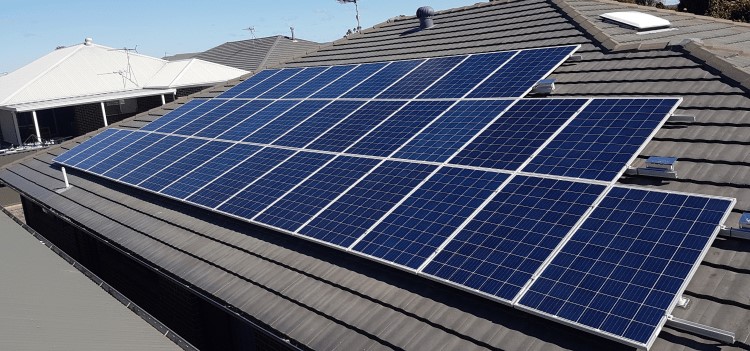
Installing a 5KW system typically requires preparing 25 to 35 square meters of usable roof area.
This area calculation is based on the current mainstream 400W to 550W high-power photovoltaic panels.
If you choose single 400W modules, a total of 13 to 14 panels are needed.
The dimensions of each panel are approximately 1.7 meters long and 1.1 meters wide; when arranging them, gaps between modules and safety maintenance walkways at the roof edges must also be reserved.
During installation, the orientation and tilt of the roof are key determinants of space utilization.
In the Northern Hemisphere, a south-facing roof receives the maximum total daily radiation.
If there are obstructions on the roof, such as chimneys, surrounding trees, or tall buildings, the installation area might increase because shadow zones need to be avoided to prevent the "hot spot effect" from damaging cell cells, or power optimizers need to be added to reduce the negative interference of shadows on the total system output.
Core Modules
The entire system consists of photovoltaic modules, inverters, racking systems, and power distribution protection devices.
Photovoltaic modules are responsible for converting light energy into direct current (DC), while the inverter is the regulation hub of the entire system, responsible for converting DC into alternating current (AC) that can be used by household appliances.
In a 5KW system, common configurations involve using a single 5KW string inverter or installing micro-inverters behind each panel.
Core Module | Primary Function | Expected Lifespan |
Monocrystalline Modules | Capture sunlight and generate current | 25 - 30 years |
String Inverter | Power conversion and system monitoring | 10 - 15 years |
Aluminum Alloy Racking | Fix modules, withstand wind and snow loads | 30+ Years |
Distribution Box & Cables | Provide overcurrent protection and power transmission | 20+ Years |
The racking system must possess extremely strong corrosion resistance, typically adopting anodized aluminum alloy or stainless steel materials to ensure no rusting occurs in harsh outdoor environments.
The cables need to be specialized photovoltaic DC cables, which possess stronger UV resistance and anti-aging capabilities, enabling them to withstand long-term exposure.
Installation Timeline
From contract signing to the system officially powering up, the physical installation process is actually very fast.
Professional construction teams can usually complete all hardware mounting and electrical wiring within 1 to 2 days.
The first day is mainly for fixing the racking and laying the modules, while the second day involves inverter installation, conduit wiring, and grid-connection commissioning of the distribution cabinet.
What truly consumes time is the preliminary site survey and the subsequent grid connection application.
Before installation, engineers need to assess the roof structure to ensure its load-bearing capacity can support the weight of the entire system.
After installation is complete, the local utility company typically sends personnel for an on-site inspection and to swap in a smart meter that supports bi-directional metering.
Only after the utility company passes the acceptance inspection and issues a "Permission to Operate" (PTO) notice does the system officially go into operation.
Maintenance Effort
A solar system is static power generation equipment with no internal moving parts, so the failure rate is extremely low.
The main daily maintenance task is keeping the panels clean.
In areas where it does not rain for a long time, the accumulation of dust, bird droppings, or fallen leaves on the panel surface will obstruct light entry, leading to a drop in power generation of about 5% to 10%.
It is generally recommended to perform a simple rinse with clean water every six months or annually.
Monitoring software is the primary means of managing the system.
Through a mobile app, you can view the hourly power generation and system operating status in real-time.
If the inverter detects voltage abnormalities or a mismatch in current on a certain string, it will automatically issue an alert.
As the years of use increase, photovoltaic modules will experience natural degradation; the industry standard power warranty is usually no more than 2% degradation in the first year, and about 0.5% annually thereafter, meaning the system can still maintain over 80% of its initial capacity after 25 years.
Key Factors Influencing Cost
Module Grade
The brand and technical type of the photovoltaic panels determine the bulk of the base quote.
Currently, mainstream monocrystalline silicon panels on the market are divided into different tiers based on conversion efficiency and degradation rates.
Tier-1 brand panels typically use N-type technology, with conversion efficiencies reaching between 21% and 23%.
Although the price per unit is 15% to 20% higher than second-tier brands, their performance in low-light environments is superior, and the power guarantee level after 25 years is higher.
If you choose panels with lower power density, to achieve a total capacity of 5 KW, you are forced to install a greater quantity, which additionally increases the costs of racking, rails, and installer man-hours, leading to a rise in total expenditure.
High-efficiency panels save roof space.
Premium brands offer longer warranties.
Technological generation gaps affect total power generation.
The physical specifications of the PV panels also impact logistics costs.
Although large-format panels have high power per unit, the risk of breakage during transportation and handling is greater, and they have specific requirements for roof load distribution.
If it involves cross-border transport or long-distance delivery, packaging specifications and shipping insurance costs will also be amortized into the unit price of every watt.
Currently, the unit price per watt for tier-1 products generally remains between $0.60 and $0.90, while high-end customized products may exceed $1.10.
Inverter Scheme
As the hub of power conversion, the choice of inverter technology path significantly affects total cost.
Common string inverters are relatively affordable and suitable for open roofs with no obstruction.
This scheme connects all panels in series, managed uniformly by a single machine.
If your roof has shading from chimneys or trees, to ensure efficiency, you may need to adopt micro-inverters or power optimizers.
Micro-inverters are installed behind each panel; although the cost per watt is about 25% to 40% higher than the string type, they enable module-level monitoring and extend the overall system lifespan to over 20 years, reducing the frequency of future equipment replacements.
String schemes suit simple roofs.
Micro-inverter technology solves shading issues.
Conversion efficiency determines electricity revenue.
The protection rating and heat dissipation design of inverters also carry a premium.
Equipment with higher IP ratings can operate stably in extreme high temperatures or humid environments, reducing losses in internal capacitors and power semiconductors.
For a 5KW system, the market price of a high-quality string inverter is approximately $1,000 to $1,800, while a full set of micro-inverters might double this portion of the expenditure.
Choosing equipment with built-in arc fault protection and rapid shutdown functions, although increasing the initial investment, complies with stricter building safety regulations.
Construction Difficulty
The specific environment of the installation site is the most variable part of the cost structure.
Construction on tile roofs is the most complex; workers need to lift tiles to install specific hooks and perform multi-layer waterproofing, which consumes more than 30% more man-hours compared to drilling and installing on flat color steel or metal roofs.
If the house height exceeds two stories, additional rental of scaffolding or cranes is needed to transport materials to high places; these machinery rental fees and high-altitude work allowances will be directly calculated into the installation fee.
The location of the meter box and wiring distance also affect cable consumption; extending DC cables and laying conduits not only increases material costs but also generates voltage drop, requiring higher specification cables to offset the loss.
Tile roof construction requires more labor.
High-altitude work increases equipment costs.
Wiring length affects wire gauge.
The need for roof structural reinforcement sometimes also pushes up the budget.
If an assessment finds that old roof purlins or beams cannot withstand the additional static load of approximately 15 to 20 kg per square meter, structural reinforcement must be performed first.
For roofs with extremely steep slopes, workers need to wear more complex fall protection rigging, and construction speed will drop significantly.
In some regions, if the existing home electrical panel needs to be upgraded to accommodate the 5KW current load, the cost for electricians can be as high as $500 to $1,500.
Cell Capacity
Whether to configure an energy storage system is currently the cause of huge price disparities in 5KW systems.
If a standard 5KW grid-tied system is equipped with a 10kWh lithium cell bank, the total cost typically doubles directly.
The cell bank involves not only the cost of the storage cells themselves but also requires matching with a hybrid inverter capable of bi-directional charging and discharging.
Currently, Lithium Iron Phosphate (LFP) batteries are the mainstream choice, with a price range typically between $400 and $700 per kWh.
While choosing a larger capacity cell can achieve a higher degree of energy self-sufficiency, it significantly lengthens the investment payback period of the entire project, as the cycle life of batteries is usually only 10 to 15 years, meaning the cell may need to be replaced once within the lifecycle of the PV panels.
Storage configuration doubles the cost.
Lithium cell type affects cycle counts.
Hybrid inverters have higher unit prices.
The choice of installation location also affects the cost of the cell portion.
If the cell is installed outdoors, a thermostatic enclosure with heating or cooling functions is needed to prevent extreme temperatures from causing a decline in lithium ion activity or shortened lifespan.
Additionally, to achieve backup functionality during power outages, an automatic transfer switch and a critical load sub-panel need to be installed; these extra electrical modules and labor costs make the system more complex.
Administrative Procedures
Regulatory requirements and approval processes in different regions generate hidden costs.
Grid connection applications usually involve structural engineer stamps, electrical drawing designs, and access permit fees from the local utility company.
In areas with strict management, such as administrative approval and permitting fees, may account for 5% to 10% of the total budget.
If local laws mandate that licensed electricians must perform the entire operation, labor costs will be much higher than ordinary technicians.
To ensure system compliance, construction insurance covering the installation period and long-term third-party liability insurance must also be purchased; although these compliance expenditures are not reflected in the hardware, they are necessary prerequisites for project realization.
Design drawings need expert review.
Utility companies charge grid connection fees.
Licensed workers command higher wage levels.
The amount of policy subsidies directly offsets the final net cost. Federal tax credits or local green energy incentive programs can offset 20% to 30% of the total investment.
However, applying for these subsidies often requires hiring professional consultants or preparing a large amount of supporting materials, and the documentation processing fees generated therein also need to be calculated.
Net metering policies vary by region; if the sell-back price is low, users may tend to install more complex monitoring systems to optimize self-consumption rates, thereby increasing system integration fees.
Warranty Length
Long-term service guarantees usually exist in the form of a premium. Standard equipment warranties typically only cover hardware failures and do not include the labor costs for disassembly, transportation, and re-installation.
If you choose an "all-inclusive warranty" that includes labor or extend the warranty period to 25 years, installers usually charge an additional risk fee of $500 to $1,000 in the total price.
High-quality installers will provide regular system inspections and panel cleaning services; although such long-term O&M contracts increase the initial contract amount, they reduce the risk of serious failures caused by invisible cracks or cable aging in the future.
All-inclusive warranties reduce subsequent expenses.
O&M contracts ensure power generation efficiency.
Brand reputation determines after-sales quality.
Subscription fees for monitoring platforms are sometimes included in the system price.
High-level monitoring software can provide real-time weather comparison data and failure warnings, helping users judge whether a drop in power generation is due to weather reasons or hardware damage.
Choosing an installation service provider that is financially sound and has a long operating history is crucial, because if the service provider goes out of business, even if the hardware manufacturer provides a warranty, finding new technicians for on-site claims processing will incur high travel and diagnostic fees.
Payback Period
Calculation Method
For a 5KW system, the initial investment usually includes hardware costs, labor for installation, and grid connection fees.
If the total expenditure is $12,000 and the available local tax credit covers 30%, then the actual investment drops to $8,400.
The first part of the return is money saved from "self-consumption," which depends on your daytime electricity usage and the local tiered electricity rates.
The second part is the fees paid to you by the utility company for excess electricity generated by the system that exceeds real-time household demand and is fed into the grid via a bi-directional meter.
Zone Type | Initial Net Investment (Reference) | Avg Annual Savings/Revenue (Reference) | Estimated Payback Period |
High Rate Zone | $9,000 | $1,800 | Five Years |
Medium Rate Zone | $10,000 | $1,400 | 7 - 8 Years |
Low Rate Zone | $11,000 | $1,000 | 11 Years |
In most mature markets, residential electricity prices have a natural growth of 3% to 5% annually. As time goes by, every kWh generated by the solar system becomes more valuable, thereby effectively shortening the payback cycle.
Local Electricity Rates
In some areas with extremely high retail electricity prices, the cost per kWh can reach $0.30 or even higher.
In this case, the value of the 20 kWh generated daily by a 5KW system is very substantial.
If your electricity consumption is high and frequently triggers the utility company's high-tier rates, the financial attractiveness of installing solar multiplies because the system first offsets the most expensive portion of the electricity bill.
Electricity billing models in different regions also affect returns. Some places adopt "Net Metering" policies where the price you sell to the grid is the same as the price you buy from the grid, essentially turning the grid into a free large cell.
However, in other places, the price at which the utility company purchases surplus electricity is far lower than the retail price.
In this scenario, if the electricity generated by the system cannot be consumed during the day, the payback time will be elongated.
Rate Strategy | Settlement Method | Impact on Payback |
1:1 Net Metering | Sell Price = Buy Price | Extremely favorable, fastest payback |
Avoided Cost/Low Feed-in | Sell Price < Buy Price | Requires increased self-consumption ratio to maintain returns |
Tiered Rates | Higher unit price for more usage | Faster payback for high-consumption households |
If your area frequently adjusts base electricity fees (fixed charges) while lowering energy charges (per kWh), solar returns may be diluted to some extent, because no matter how much electricity you generate, that portion of the fixed monthly fee cannot be waived.
Daytime Usage
A 5KW system reaches peak generation at noon. If no one is home at this time and the local sell-back price is low, a large amount of cheap electricity will flow back into the grid.
Conversely, if you can schedule high-power appliances like washing machines, dishwashers, or water heaters to run during the day, or charge an electric vehicle during the day, the value of every kWh of self-produced electricity is equivalent to the full retail price you would have otherwise paid to the grid.
For households unable to adjust usage habits, configuring a small-capacity energy storage cell can save the surplus daytime electricity for use at night, thereby reducing the purchase of expensive evening electricity from the grid.
Although batteries increase the initial investment, in areas with large price differentials, they often maintain a reasonable payback cycle by increasing total savings.
Through smart home management systems, users can monitor generation curves in real-time and adjust loads.
For example, turning on the air conditioner to pre-cool rooms at 2 PM when sunlight is strongest is much more economical than turning on the AC after sunset.
Data indicates that for every 10% increase in self-consumption rate, the payback time can be shortened by an average of 6 to 10 months.
Policy Incentives
Besides the most common Federal Investment Tax Credit (ITC), many local governments or municipal halls also offer additional cash rebates or tradable green energy credits (SRECs).
These credit quotas are usually issued based on the actual power generation of the system. You can sell them to the market to utility companies that need to fulfill environmental obligations, thereby obtaining additional annual cash income.
Although your property value increases due to the installation of the solar system, your property tax bill generally does not increase as a result.
In certain extreme cases, combining all subsidies and rewards, a user's initial net expenditure might be only half of the list price, and the payback time can even be compressed to under four years.
Incentive Type | Acquisition Method | Impact on Cash Flow |
Tax Credit | Deducted from personal income tax when filing | Significantly reduces initial cost (one-time) |
Cash Rebate | Disbursed by government after installation | Directly supplements cash flow |
Green Credits (SRECs) | Earned continuously based on generation | Increases annual net operating income |
As solar installation costs decrease, many governments are gradually lowering subsidy ratios, so completing grid connection during the policy window is very important for locking in financial returns.
System Aging
The power generation efficiency of photovoltaic panels degrades slightly every year, typically with a decline of about 0.5% annually after the first year.
By the 10th year, the system's output may be only about 95% of the initial value.
When calculating long-term payback, this year-on-year decrease in production must be taken into account.
As the core module for power conversion, the lifespan of an inverter is usually between 10 and 15 years.
During the entire operation of the system, you may need to budget a fee for replacing the inverter.
If this expenditure occurs within the payback cycle, it will instantly push the break-even point back by about a year.
Additionally, if the system is installed in a dusty or arid region, regular cleaning and maintenance costs, although not high per instance, will also consume a portion of the returns when accumulated over the long term.
Maintenance Item | Frequency | Estimated Cost |
Panel Cleaning | 1 - 2 times/year | Depends on DIY or outsourcing |
Inverter Replacement | Once every 10 - 15 years | $1,000 - $1,500 |
Electrical Inspection | Once every five years | $200 - $400 |
Some high-end brands offer warranties that cover not only parts but also the labor costs for replacement, which is equivalent to buying insurance in advance, ensuring the accuracy of payback cycle predictions.
Home Value Increase
According to multiple real estate market surveys, homes equipped with a paid-off 5KW solar system typically sell for 3% to 4% more than comparable ordinary homes.
For buyers, moving in and immediately enjoying low electricity bills is very attractive, making solar systems more of an improvement investment rather than purely consumption.
This appreciation can be realized when selling the house, sometimes even directly covering the residual value that hasn't yet been paid back through electricity savings.
If you decide to sell the house five years after installation, even if the electricity savings haven't yet reached the initial investment amount, you can still achieve overall profitability through the increased property price.
Value Dimension | Form of Expression | Nature of Impact |
Book Return | Monthly electric bill reduction | Direct, Continuous |
Asset Return | Home appraisal value increase | Indirect, One-time |
Risk Avoidance | Locking in future energy costs | Long-term, inflation-proof |
For the mainstream 5KW configuration, it is neither too small to be ineffective nor so large that it negatively impacts roof aesthetics, making it one of the system specifications with the best liquidity in the secondary market.