What types of solar panels are used to heat hot water
Mainstream solar collectors are divided into Flat Plate and Evacuated Tube types.
Flat plate collectors use copper-aluminum composite absorbing plates with a photothermal conversion rate of about 75%.
Their structure is robust and pressure-resistant, making them suitable for building-integrated installation.
Evacuated tube types utilize double-layer high borosilicate glass vacuum layers for insulation, resulting in extremely low heat loss. They can produce hot water above 60°C even in severe cold at -30°C.
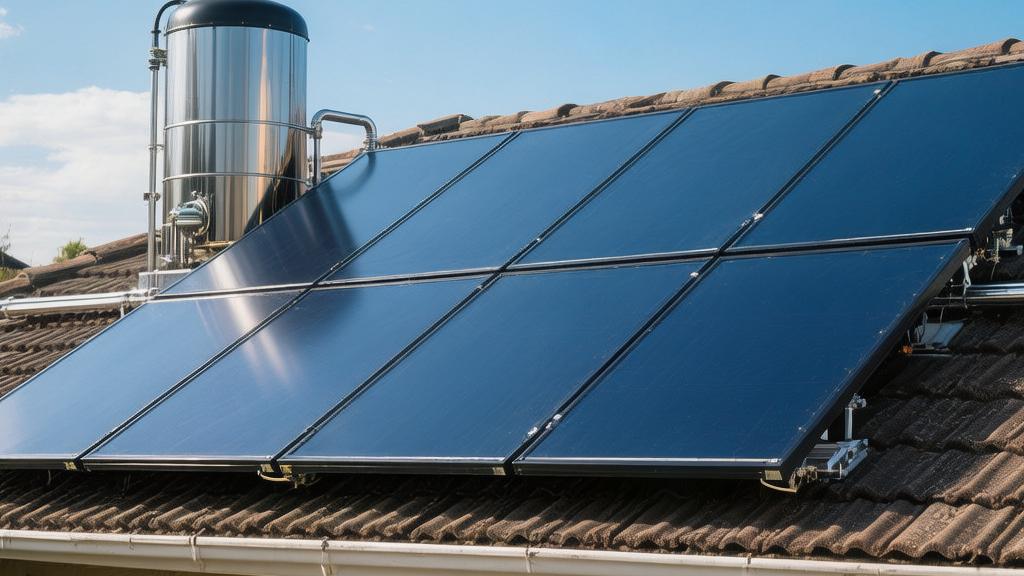
Flat Plate Collectors
The Plate in the Middle
Currently, over 90% of high-performance flat plates on the market use copper-aluminum composite structures or all-copper structures.
The surface of the absorbing plate is coated with a blue film suction layer only a few microns thick through the Physical Vapor Deposition (PVD) process.
This layer typically has an absorption rate of over 95% for sunlight, while its own emissivity, which dissipates heat outward, can be controlled below 5%.
In terms of welding technology, modern panels mostly use laser welding or ultrasonic roll welding, with a welding point coverage of 100%. This ensures that the thermal resistance is nearly zero when heat is conducted from the absorbing sheet to the internal pipes.
The internal pipes are usually copper tubes with a diameter of 10 mm. The fluid velocity inside the tubes is typically controlled between 0.5 and 1.5 liters per minute to ensure that heat is fully carried away.
· Absorption Parameters: The blue film layer is usually 95% ± 2%, while the black chrome coating is about 91%.
· Emissivity Values: Excellent products can reach 4% to 6%, while ordinary coatings are above 10%.
· Welding Strength: The bonding strength of laser welding is usually greater than 150 MPa, ensuring no weld detachment for 20 years.
· Pipe Specifications: A standard 2 m² panel typically contains 7 to 9 vertical pipes with a spacing of 100 mm to 120 mm.
Outer Wind Shield
Ordinary glass has a higher iron content, leading to light reflection and absorption, whereas the light transmittance of ultra-white glass can usually reach over 91.5%.
The thickness of this glass layer is generally 3.2 mm or 4 mm, and its strength is sufficient to resist hailstones with a diameter of 25 mm flying at a speed of 25 m/s.
To increase the sealing between the glass and the frame, manufacturers use EPDM (Ethylene Propylene Diene Monomer) rubber strips.
This rubber maintains elasticity at high temperatures of 150°C and low temperatures of -40°C, preventing rainwater from penetrating the interior and causing oxidation of the absorbing layer.
· Transmittance Comparison: Ultra-white glass is 91.5%, while ordinary glass is about 85% to 88%.
· Pressure Resistance: The cover plate can typically withstand a frontal pressure of 2400 Pa, equivalent to a snow load of 240 kg per square meter.
· Iron Content Requirement: The iron content must be lower than 150 ppm (150 parts per million) to ensure transparency.
· Operating Temperature Difference: Under direct sunlight, the inner surface temperature of the glass may reach 80°C, while the outer surface is only 30°C due to ambient wind cooling. This 50°C temperature difference requires the glass to be tempered to prevent thermal cracking.
How to Keep the Back Warm
The most commonly used materials are CFC-free polyurethane foam or rock wool boards with a thickness of 30 mm to 50 mm.
The thermal conductivity of polyurethane is very low, only about 0.022 W/(m·K), which ensures that even in late autumn, the heat loss from the back can be reduced to below 5% of the total energy.
The entire frame is usually composed of 6063-T5 aluminum alloy profiles, with an anodized surface and a film thickness exceeding 10 microns, ensuring no rust for 15 years in coastal high-salt spray environments.
· Insulation Thickness: The back insulation layer is usually 40 mm to 50 mm, and the side insulation layer is 15 mm to 20 mm.
· Bulk Density Indicators: The bulk density of glass wool is typically between 40 kg/m³ and 60kg/m³, and the density of polyurethane foam is 35 kg/m³ to 45kg/m³.
· Frame Strength: The wall thickness of the aluminum alloy is usually between 1.2 mm and 1.5 mm, with an overall wind resistance rating of over Grade 10.
· Backplate Material: The backplate at the bottom usually uses 0.3 mm thick embossed aluminum plate or galvanized plate for support and moisture resistance.
Can It Really Save Money
From the perspective of return on investment, a system including two flat plate collectors, a 200-liter water tank, and a circulation pump station usually requires a total investment between 8,000 and 15,000 RMB.
In areas with moderate light conditions (annual sunshine duration of around 2,200 hours), this system can produce heat equivalent to about 2500 kWh of electricity annually.
Calculated at a commercial electricity price of 0.8 RMB/kWh, it can save 2,000 RMB per year, with a payback period of about 5 to 7 years. A huge advantage of the flat plate system is its pressure-bearing capacity.
Since the interior is a closed metal circuit, it can withstand operating pressures as high as 0.6 MPa to 1.0 MPa.
· Lifespan: If not subjected to physical damage, the design life of such systems is usually 25 to 30 years.
· Operating Pressure: The system test pressure is typically 1.5 MPa (about 15 kg of pressure), with a normal working pressure of 0.3 MPa.
· Water Production Capacity: On a sunny summer day, a 2 m² panel can produce 40 to 60 liters of 55°C hot water per hour.
· Stagnation Temperature: If water does not circulate, the dry-sun temperature inside the panel can reach over 200°C, so high-temperature resistant circulation pumps must be used.
Evacuated Tube Collectors
Glass Tube Specifications
The most common specification on the market is a collector tube with a diameter of 58 mm and a length of 1800 mm.
A single glass tube weighs approximately 2.1 kg to 2.5 kg, and the glass thickness is usually between 1.6 mm and 2 mm.
To ensure long-term outdoor operation, this high borosilicate glass must be heat-treated so that it can withstand the direct impact of 25 mm diameter hailstones at a speed of 20 m/s without breaking.
When installing arrays, the spacing between each tube is usually maintained at 7 cm to 8 cm, which ensures light intake at noon and reduces wind load through the gaps between tubes in the morning and evening.
· Transmittance Data: The solar transmittance of this glass is typically greater than 0.89 to 0.91.
· Average Heat Loss: The heat loss coefficient (U-value) is only 0.5 to 0.8 W/(m²·°C), whereas ordinary flat panels are usually above 3.5.
· Pressure Resistance: Although the glass tubes themselves do not bear pressure, the manifolds paired with them usually need to withstand a working pressure of 0.6 MPa.
· Single Tube Power: Under vertical sunlight, the instantaneous peak power of a single 58 x 1800 specification tube is about 60 W to 90 W.
The Film Inside
Modern processes mostly use triple-target magnetron sputtering technology to deposit multi-layer composite films such as Aluminum-Nitrogen/Aluminum (Al-N/Al) or Stainless Steel-Copper (SS-Al-N/Cu) on the glass surface.
This film has a huge "appetite," with an absorption rate as high as 94% to 96% for light in the 0.3 micron to 3 micron waveband of the solar spectrum.
More importantly, it is very "stingy"; at a high temperature of 100 degrees Celsius, its outward thermal radiation (emissivity) is only 4% to 6%.
This extremely high absorption-to-emission ratio means that even on cloudy days with weak sunlight, the temperature inside the tube can be more than 30 degrees Celsius higher than the ambient temperature.
Even in stagnation (no water flow), the temperature of the absorbing sheet inside the tube can quickly rise to 200 degrees Celsius or even 250 degrees Celsius.
After working continuously at such high temperatures for 100 hours, the degradation of the coating's absorption rate typically does not exceed 1%.
Heat Pipe Transmission
In high-end evacuated tube systems, heat is not conducted directly by water in the tube, but through a copper "heat pipe" filled with a heat transfer medium.
The interior of the heat pipe is evacuated to a micro-vacuum and contains a small amount of water, alcohol, or specific fluorocarbons as a phase-change working fluid.
When sunlight heats the bottom of the evacuated tube, these working fluids boil and vaporize at around 25 to 30 degrees Celsius, carrying a huge amount of latent heat as they rush toward the condenser end at the top of the heat pipe.
The condenser end is inserted into the main water manifold, and after releasing heat to the water, the medium condenses back into liquid and flows back to the bottom along the tube wall.
· Startup Speed: The startup time for this phase-change heat transfer is extremely short, usually starting heat transfer within 2 minutes after sunlight exposure.
· Transfer Efficiency: The equivalent thermal conductivity of a heat pipe is hundreds or even thousands of times that of a solid copper rod of the same diameter.
· One-way Characteristic: The heat pipe has good "one-way thermal conductivity"; it transfers heat quickly during the day, and at night, because the liquid no longer vaporizes, it almost never dissipates heat from the water tank back to the sky.
· Dry Connection: Because water does not enter the glass tube, the breakage of a single glass tube will not cause the entire system to leak, and replacement can be done without shutting down the system.
Not Afraid of Freezing in Winter
Even if the outdoor wind reaches Grade 6, the heat loss caused by wind cooling has a negligible impact on the temperature rise inside the tube.
Under the same light conditions, when the ambient temperature drops from 20 degrees Celsius to 0 degrees Celsius, the efficiency of a flat plate collector may drop by 30% to 50%, while the efficiency drop of an evacuated tube is usually less than 10%.
Furthermore, the circular tube surface design allows it to capture direct light at all angles, with an average daily heat absorption time about one hour to 1.5 hours longer than flat structures.
Regarding snow accumulation, due to their cylindrical shape, small amounts of snow will automatically slide off through the gaps of the evacuated tubes.
Even if covered by heavy snow, as long as weak sunlight passes through the snow layer to reach the absorption film, the slight heat generated can cause the surface temperature of the glass tube to rise slightly, melting the bottom of the snow layer and allowing it to slide off.
In contrast, flat plate collectors often require manual cleaning once covered by heavy snow to resume work.
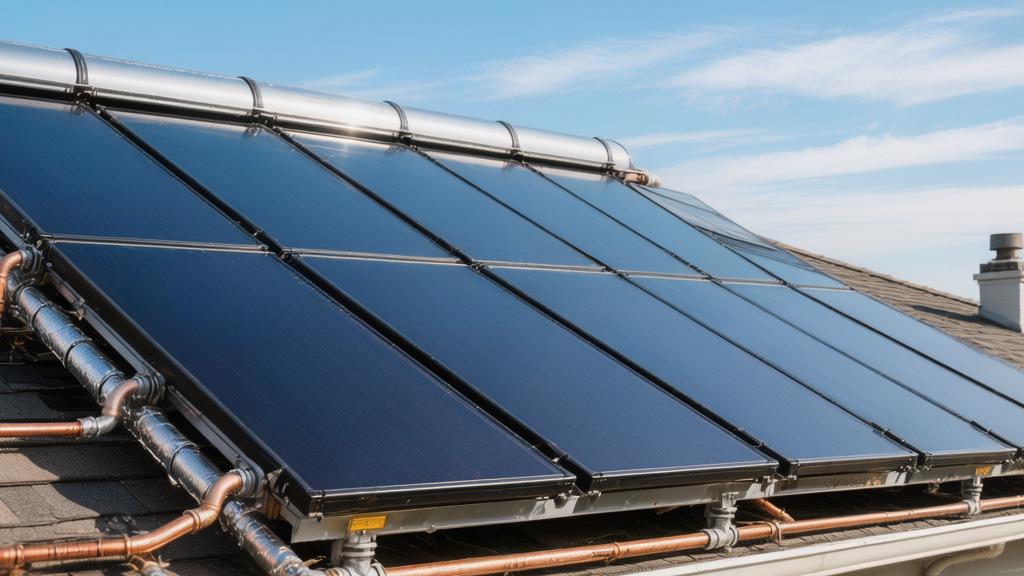
Thermodynamic Panels
How These Panels Work
These panels are usually made of anodized aluminum and are very light, with a single 1.7 m x 0.8 m panel weighing only about 8 kg.
The panel has precise serpentine channels pressed inside, where refrigerant (usually R134a or R410a) enters in a liquid state, boils rapidly, and transforms into gas after absorbing heat from the air.
Since the thermal conductivity of aluminum is as high as 237 W/(m·K), this structure can capture extremely tiny temperature differences.
In actual operation, even if it is only 5 degrees Celsius outside, these panels can still maintain a heat exchange efficiency of over 50%.
In the system cycle, the gaseous refrigerant is sent to a small compressor for compression, a process that causes the refrigerant temperature to instantly soar to 70 to 90 degrees Celsius.
Then, these high-temperature gases enter the heat exchanger inside the water tank, transferring heat to the domestic water and raising the water temperature to 55 degrees Celsius.
This "direct refrigerant heating" method reduces the energy loss of secondary heat exchange, allowing the system's Coefficient of Performance (COP) to stabilize between 3.0 and 5.0 in the annual average environment, meaning 1 unit of electricity can generate 3 to 5 units of thermal energy.
Operating Parameter Name | Specific Value/Range |
Typical Panel Size | 1700mm x 800mm x 20mm |
Single Panel Weight | 7.5kg - 8.5kg |
Recommended Installation Tilt | 15 degrees to 90 degrees (even vertical installation) |
Refrigerant Evaporation Temperature | -20 degrees Celsius to -35 degrees Celsius |
Annual Average System COP | 3.2 - 4.5 |
Compressor Rated Power | 350W - 600W |
Maximum Water Production Temperature | 55 degrees Celsius - 60 degrees Celsius |
Works Even When It's Dark
Unlike traditional evacuated tube or flat plate collectors that completely "stop working" after sunset, thermodynamic panels can still work at 3 AM.
Since it primarily absorbs heat from the ambient air, wind speed has a significant boosting effect on its efficiency.
If the wind speed increases from 1 m/s to 4 m/s, the heat exchange capacity of the panel can increase by about 40%, because the flowing air can more quickly replenish the thermal energy absorbed from the panel surface.
Even on rainy days, because the specific heat capacity of water is much larger than that of air, rain falling on the panel surface provides more intensive energy, making the heat production speed even faster than on a dry cloudy day.
Ordinary solar water heaters need huge water tanks to store hot water produced during the day for night use, whereas thermodynamic panel systems can start whenever needed.
For a family of four, only one or two such panels are needed to ensure more than 200 liters of 50 degree Celsius hot water at any time, 24 hours a day.
Because it is no longer restricted by light intensity, its installation position is also very flexible; it can be hung on a north wall, placed flat on a garage roof, or even installed in shady areas with no sunlight year-round.
Is It Worth It
From an economic standpoint, the initial installation cost of a thermodynamic solar system is usually between 25,000 and 45,000 RMB, which includes the compressor unit, a special water tank, and outdoor panels.
Taking the heating of 200 liters of water from 15 degrees Celsius to 55 degrees Celsius as an example, an ordinary electric water heater requires about 9 kWh of electricity, while the thermodynamic panel system only needs 1.8 to 2.5 kWh.
Based on daily hot water consumption, it can save about 2,500 kWh of electricity per year compared to pure electric heating.
· Energy Saving Rate Statistics: Compared to electric heating systems, annual electricity expenditure can be reduced by 70% to 80%.
· Maintenance Frequency: As a closed refrigeration system, it requires almost no maintenance except for checking the compressor operating current once every 2 years.
· Equipment Lifespan: Aluminum panels have no moving parts and can last up to 25 years; compressor lifespan is usually 10 to 15 years.
· Environmental Benefits: It can reduce carbon dioxide emissions by about 1.2 tons per year, equivalent to planting 60 trees.
· Installation Budget: A single-panel system starts at about 28,000 RMB, while a large-capacity dual-panel system is around 42,000 RMB.
Pipeline length is generally recommended to be controlled within 15 meters to reduce the pressure drop of the refrigerant during transport.
If the pipeline is too long, for every additional 1 meter, the system efficiency will drop by about 1.5%.
At the same time, because it relies on temperature difference for heat exchange, the panel surface may frost during operation.
The system must have an automatic defrosting function, usually achieved through reverse cycling or stopping the compressor to use ambient heat for natural defrosting.
In high-humidity areas, the defrosting cycle is approximately 3 to 5 minutes for every 40 minutes of operation.