What can a 100w solar panel power?
A 100W solar panel produces ~400Wh daily (4hrs peak sun). It can run 5W LED lights (80hrs), charge 3 phones (5W each), or slowly fill a 12V/30Ah cell (with controller, ~13hrs), powering small off-grid devices efficiently.
Understanding 100W Output
Manufacturers rate panels under Standard Test Conditions (STC), which is a laboratory ideal: 1,000 watts per square meter of sunlight (equivalent to bright, direct sun on a clear day) hitting the panel at a perfect 90-degree angle, and at a specific cell temperature of 25°C (77°F). In the real world, these conditions are rarely met simultaneously. The panel's actual output is a dance between sunlight intensity, the angle to the sun, temperature, and cloud cover. On a perfect, cool, sunny day, you might see 85 to 95 watts for a few hours. On a hot, hazy day, or when the sun is low in the sky, output can easily drop to 30-50 watts.
The most practical way to think about a solar panel's output is in terms of daily energy production, measured in watt-hours (Wh). This is the key to understanding what you can actually power. You calculate it by multiplying the panel's power by the hours of peak sun it receives.
A 100W panel receiving a realistic average of 4 to 5 hours of strong, direct sunlight per day will generate approximately 400 to 500 watt-hours (0.4 - 0.5 kWh) of energy daily.
For example, a modern laptop might consume 50 watts per hour during use. If you ran it for two hours, that would use 100 watt-hours of your daily 400-500 Wh budget.
Device | Average Power Draw (Watts) | Estimated Daily Run Time from 400 Wh | Energy Used (Wh) |
LED Light Bulb | 10W | 6 hours | 60 Wh |
Laptop | 50W | 4 hours | 200 Wh |
Wi-Fi Router | 6W | 10 hours | 60 Wh |
32-inch LED TV | 35W | 3 hours | 105 Wh |
Smartphone Charge | 5W per charge | 4 full charges | 20 Wh |
You need a solar charge controller to manage the power flow and prevent overcharging a 12V cell, which acts as the essential energy reservoir. This system allows you to store the 400-500 Wh generated during the day for use at night or during cloudy periods. Inverters, which convert the cell's DC power to AC for standard household plugs, also introduce an energy loss of about 10-15%. Therefore, your usable daily energy is slightly less than what the panel produces. The panel's voltage is also a key factor; most 100W panels have a Vmp (Voltage at Maximum Power) of around 18V, which is ideal for charging a 12V cell system through a charge controller.
Phone and Laptop Charging
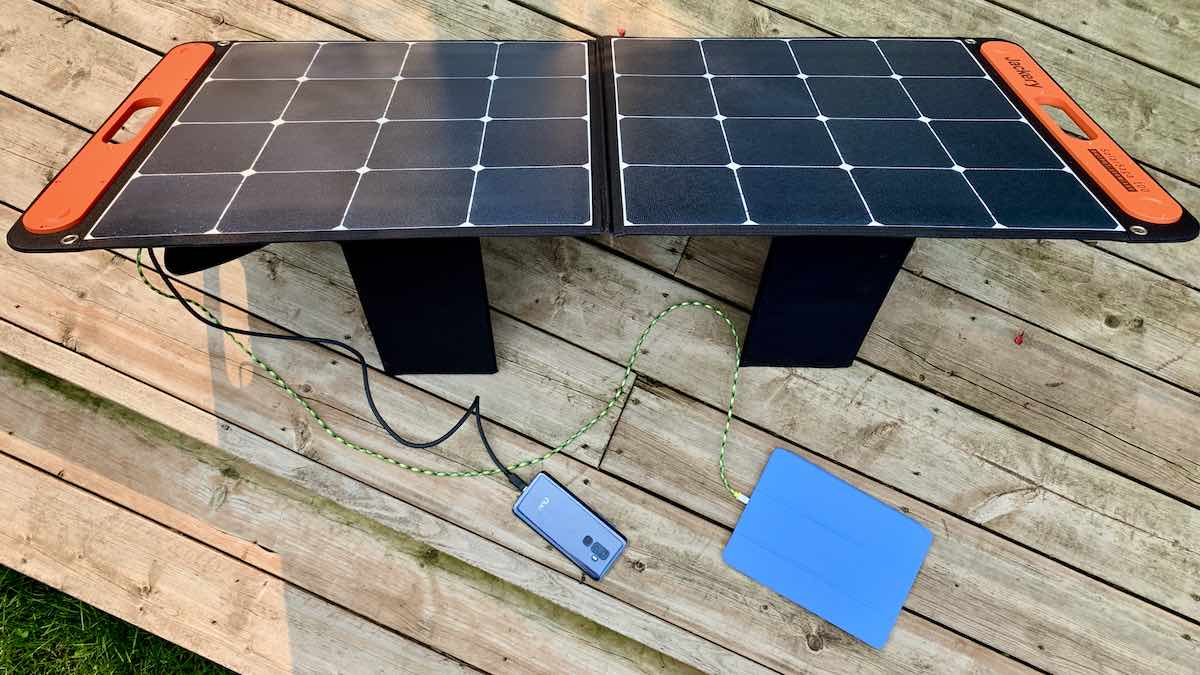
Keeping your essential electronics powered is the most practical and reliable use for a 100-watt solar panel. Whether you're camping, dealing with a power outage, or just working remotely, a 100W panel provides a significant and consistent energy stream for modern devices. Consider that a typical smartphone has a cell capacity of around 15 watt-hours (Wh), and a modern laptop like a MacBook Air has a cell of about 50 Wh. Compared to the 400-500 Wh of energy a 100W panel can generate on a good day, the power requirements for charging these devices are relatively small.
You must channel the energy through a 12-volt cell via a solar charge controller. This system stores the solar energy, making it available on-demand and providing a steady voltage for your devices. A common and efficient method is to use a 12V car port (cigarette lighter port) charger for your devices. These chargers plug directly into your power station or cell setup and convert the 12V DC to the 5V DC needed for USB. This DC-to-DC conversion is highly efficient, with 85-90% of the energy from the cell making it to your device. For example, to charge a 15 Wh phone with 90% efficiency, the system draws approximately 17 Wh from the cell. If you use an inverter to create standard household AC (Alternating Current) plugs, you introduce a significant 10-15% energy loss during the DC-to-AC conversion. Charging the same phone through an inverter might use 19 Wh or more from your cell.
From a full 400 Wh day, you could theoretically charge a 15 Wh phone over 26 times or a 50 Wh laptop 8 times. In reality, you'll be doing a mix of activities. A realistic daily scenario might include fully charging a 13-inch laptop (50 Wh) once, charging two smartphones (30 Wh total) once each, and running a 10W LED light for 3 hours (30 Wh). This totals 110 Wh, which is well within your 400 Wh budget, leaving plenty of capacity for a small 12V cooler or other accessories. The charging speed for individual devices is determined by their maximum power intake. Most modern phones with fast charging can draw 18 to 25 watts. A 100W panel, even under suboptimal sun, can easily sustain this rate alongside other small loads.
For a laptop that draws 65 watts from its charger, the solar panel can power the charger directly during sunny periods, with excess energy simultaneously trickling into the cell. This setup ensures that even power-hungry devices can be operated and charged effectively. The system's 20-amp charge controller can handle a peak input of over 250 watts, providing ample headroom for the 100W panel's maximum output of about 18 volts and 5.5 amps.
Lighting and Small Fans
A typical LED bulb consumes a mere 5 to 10 watts of power, while a 12-inch DC fan might use between 15 and 30 watts depending on its speed setting. Compared to the 400-500 watt-hours of energy a 100W panel generates daily, the energy demands of these devices are minimal.
An individual LED bulb producing light equivalent to a 60-watt incandescent bulb uses only about 10 watts of power. This means for every hour it's on, it consumes just 10 watt-hours from your cell. If you have three 10-watt bulbs running for 4 hours each in an evening, your total energy consumption for lighting is only 120 watt-hours (3 bulbs x 10W x 4h = 120Wh). This represents less than 30% of your total daily energy budget from the panel, leaving the majority of your 400+ Wh for other uses.
Small fans are the other half of the comfort equation. A high-quality 12-inch DC fan might have three speed settings: low (15W), medium (20W), and high (30W). The difference in energy consumption between speeds is significant. Running the fan on high speed for 5 hours would use 150 Wh, while running it on low speed for the same duration uses only 75 Wh—a 50% reduction in energy usage for a still-substantial airflow.
Appliance | Power Draw (Watts) | Quantity | Daily Use Time | Total Daily Energy Consumption |
LED Bulb | 10W | 3 | 4 hours | 120 Wh |
12-inch DC Fan (Low Speed) | 15W | 1 | 6 hours | 90 Wh |
Total Estimated Daily Load | | | | 210 Wh |
This 210 Wh load is a very sustainable figure for a 100W solar system. Even on a day with only 4 hours of strong sunlight, generating roughly 400 Wh, you are using just over half of your available energy. This provides a crucial buffer for less sunny days and allows for the system's inefficiencies.
A 20-amp charge controller typically has a self-consumption of around 5-10 watts, and there are minor energy losses (5%) within the wiring and during cell charging and discharging. Therefore, your net usable energy is closer to 380 Wh from a 400 Wh generation day. This calculated load also leaves approximately 170 Wh of surplus energy, which can be used to charge a phone (15 Wh), power a Wi-Fi router (6W for 5 hours = 30 Wh), or even run a small, efficient 12V cooler for a few hours. The key to maximizing runtime is to use the lowest effective settings; turning a fan from high to medium speed can reduce its power draw by 33%, dramatically extending your cell life.
Weekend Camping Essentials
A 100-watt solar panel is the perfect power companion for a weekend camping trip, effectively replacing a noisy generator or a pile of disposable cell packs. Its daily energy harvest of 400-500 watt-hours (Wh) is ample for running the core electronic essentials that enhance comfort and safety off-grid, without the complexity of a larger system. The goal is to power devices that preserve food, provide light, facilitate communication, and add a touch of convenience, all within a realistic energy budget. For a typical 2-night, 3-day trip, a fully charged 50Ah deep-cycle cell (providing about 600 Wh of usable energy at a 50% depth of discharge) paired with the 100W panel will easily maintain your power supply, assuming you get an average of 4-5 hours of good sun per day.
The key to a successful setup is selecting efficient, 12-volt DC-powered appliances to avoid the 15-20% energy loss of an inverter. A practical system for two to three campers would include the following essentials, chosen for their low energy footprint:
l A 12-Volt Portable Cooler: Unlike traditional AC coolers that can draw over 50 watts when the compressor runs, an efficient DC-powered cooler consumes about 35-45 watts, but only cycles on about 40-50% of the time. Over 24 hours, this translates to an average consumption of approximately 600 Wh.
l LED Camp Lanterns and String Lights: A bright 10-watt LED lantern used for 4 hours each evening consumes 40 Wh. A set of 20 LED string lights drawing 5 watts run for 5 hours adds just 25 Wh.
l Smartphones and a Small Bluetooth Speaker: Charging two smartphones (each with a 15 Wh cell) once daily uses 30 Wh. A 10-watt speaker played for 2 hours adds 20 Wh.
l Vent Fan for a Tent: A small 12V tent fan drawing 8 watts running for 8 hours overnight uses 64 Wh.
The total estimated daily energy consumption for this setup is approximately 779 Wh (600 + 40 + 25 + 30 + 20 + 64). While this exceeds the daily output of the solar panel, the system is designed around the energy storage in the cell. The 50Ah cell starts the trip with 600 Wh of usable energy. The 100W panel generates 400+ Wh during the day, which is used to recharge the cell and power daytime devices.
RV/Car Cell Maintenance
The primary threat to a cell during inactivity is parasitic drain—the small, constant power draw from devices like a vehicle's alarm system, clock, or an RV's LP gas detector. These drains are small individually, but cumulative, typically drawing between 0.02 to 0.05 amps (20 to 50 milliamps). Over 24 hours, this can add up to a loss of 0.5 to 1.2 amp-hours (Ah). In a week, a standard 100Ah lead-acid deep-cycle cell can be drained to a level that causes sulfation, permanently damaging its capacity. A 100W panel, connected through a solar charge controller, provides a continuous trickle charge that directly counters this drain, keeping the cell consistently between 85% and 100% state of charge and extending its service life by 2 to 3 years.
A 100W panel on a bright day can produce a maximum of about 5.5 amps of charging current (100W / 18V = ~5.5A), which is an ideal maintenance and trickle-charge rate for most 12V batteries rated between 50Ah and 200Ah. The core modules required for a reliable setup are straightforward:
l A 10-amp Solar Charge Controller: This essential device regulates the 13.6V to 14.4V charging voltage, preventing overcharging. A PWM (Pulse Width Modulation) controller is adequate for this simple application, costing around 20to40.
l Direct Cell Connection: Using 10-gauge or 12-gauge solar extension cables to connect the controller directly to the cell terminals ensures minimal power loss over a distance of 10-15 feet.
l Proper Panel Orientation: For maintenance, the panel can lie flat on the roof, but angling it towards the south (in the Northern Hemisphere) at 15 to 30 degrees can increase daily energy harvest by 15-25% by capturing more winter sun.
Even on a completely overcast day, a 100W panel might still generate 10-20% of its rated power, or 10-20 watts. This equates to approximately 0.8 to 1.6 amps of charging current, which is often enough to compensate for the 0.5A daily parasitic drain and still put some energy back into the cell.
Over a 7-day period in winter, with an average of just 2 peak sun hours per day, the system can still generate around 140 watt-hours per day (200W * 2h * 0.35 efficiency buffer = 140Wh), or roughly 11-12 amp-hours. This output significantly outpaces the typical 3.5-8.4 Ah of weekly parasitic drain. The key metric is the cell's resting voltage. A fully charged cell reads 12.7V.