What Factors Influence the Cost of Solar Installations | System Size, Type, Roof Characteristics
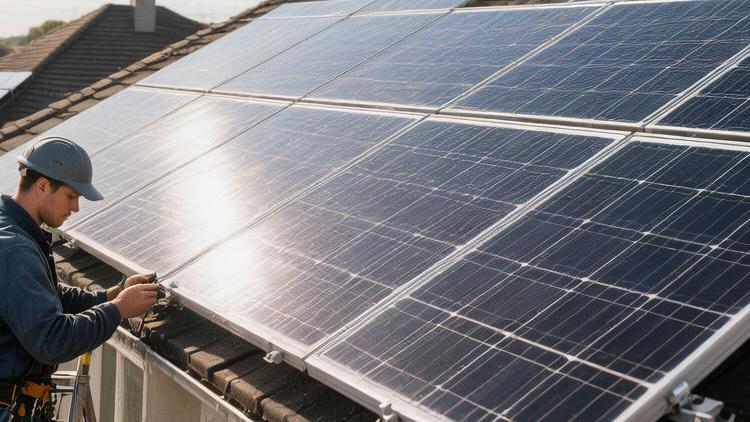
Solar installation costs are primarily determined by system size, equipment type, and roof condition.
Current market average prices are between $2.50 and $3.50/watt, with a typical 6 kW home system costing about 1.5 to 20,000 dollars before tax (the larger the system size, the lower the cost per watt usually is).
In terms of equipment, although high-efficiency monocrystalline panels are slightly higher in price than traditional polycrystalline, the long-term power generation return is better.
In addition, the pitch and material of the roof directly affect construction difficulty; steep roofs or those requiring extra structural reinforcement usually lead to an increase in labor costs of 15% to 25%.
System Size
Calculate Electricity Consumption
The average annual electricity load for American households maintains a level of 10,600 kWh.
Allocated to every 24 hours a day, a standard residence with 2000 square feet of usable area typically consumes 29 kWh of electrical energy.
A central air conditioner with a power of 3500 watts running at full load for 8 hours in summer will generate 28 kWh of additional power consumption per day.
To 100% offset the 10,600 kWh annual electricity expense, installers usually recommend households configure an installed capacity between 6.5 kW and 8.5 kW solar array.
You check the electricity bills for the past 12 months and find the 3 peak electricity consumption months occurring in summer and winter, which can reduce the system capacity estimation error rate to within 5%.
Assuming the average monthly electricity bill is 180 dollars, calculated at a utility electricity price of 0.15 dollars per kWh, 1200 kWh of electricity is consumed each month.
A monthly average load of 1,200 kWh, in areas where the average daily sunshine duration reaches 4.5 hours, requires configuring a set of photovoltaic hardware combinations with an actual output power reaching 8.8 kW.
· In areas where sunshine conditions reach meteorological standards, 1 kW of installed capacity can produce 1,300 kWh to 1500 kWh of electrical energy annually.
· A three-story single-family villa equipped with 2 constant temperature pool water pumps will see the total annual electricity consumption index fluctuate upward by 4,000 kWh to 5000 kWh.
· Replacing all 20 old-fashioned incandescent bulbs indoors with 9-watt LED energy-saving lamps will immediately downwardly adjust the total annual power consumption data by at least 600 kWh.
Deconstruct Wattage
The rated output power of a single mainstream monocrystalline photovoltaic module has increased to the 400 watts to 450 watts range.
To build an 8 kW total system, you need to physically install 20 pieces of 400-watt specification solar panels on the roof.
Each 400-watt module is about 65 inches long and 39 inches wide, with a single piece footprint reaching 17.5 square feet.
20 panels assembled together occupy a total of 350 square feet of available installation space on the roof.
The weight of a single panel is controlled between 45 pounds and 50 pounds, and 20 panels will add a total of 1000 pounds of static physical load to the roof truss.
According to a tilt angle of 30 degrees and standard test conditions of 180 degrees due south, the 8 kW system can produce 11,500 kWh of DC power in the first year.
After processing through an inverter with a conversion efficiency as high as 97%, the total AC power eventually input into the household distribution box is approximately 11,150 kWh.
Photovoltaic modules experience a 0.5% physical degradation annually; when running to the 25th year, the actual power generation of the 8 kW array will fall back to 85% of the first-year factory data.
Scale Effect
Purchasing a small photovoltaic system below 5 kW, the comprehensive installation quotation per watt usually rises to 3.20 dollars to 3.50 dollars.
When you increase the total installed capacity to specifications above 10 kW, the average unit price per watt will be pulled down to the 2.60 dollars to 2.80 dollars range.
Applying for a grid-connection permit from the local municipal department has a fixed administrative fee of 300 to 500 dollars; this fixed expense accounts for 3% in a 5 kW budget, while in a 10 kW budget it only accounts for 1.5%.
An installer sends a standard construction team consisting of 4 electricians; whether installing 15 pieces or 25 pieces of panels, the equipment depreciation fee and vehicle fee per visit remain at around 800 dollars.
Purchasing more than 30 solar panels in bulk, distributors give a 10% to 15% downward discount on the wholesale unit price.
The total cost of a 5 kW system usually falls near 16000 dollars, while the total price of a 10 kW system with doubled capacity only needs 27,000 dollars; while the installed capacity increases by 100%, the total bill only increases by 68.7%.
· The early fixed communication cost of a 3 kW micro-system usually consumes 15 hours of the installer's labor time, raising the labor unit price by 20%.
· Increasing the number of modules on the procurement list from 10 to 20 pieces, the 500 dollars freight generated by a single logistics transportation is completely diluted by 50%.
· Large residential systems with total power exceeding 15 kW can trigger a factory rebate ratio of up to 18% in the equipment procurement stage.
Type
Monocrystalline Panels
85% of residential projects in the market adopt monocrystalline photovoltaic modules.
Monocrystalline silicon wafers are cut from a single silicon crystal with a purity reaching 99.999%, appearing as a uniform deep black in appearance.
Under standard test conditions (light intensity 1,000 W/m², temperature 25 degrees Celsius), the photoelectric conversion efficiency of the latest generation N-type monocrystalline panels is stable in the 22.5% to 23.8% range.
A 72-cell half-cut module using 182 mm M10 silicon wafers, with physical dimensions of 89.6 inches long and 44.6 inches wide, can reach a factory rated output power of 540 watts to 550 watts.
The first-year photoelectric degradation rate of N-type monocrystalline panels is controlled within 1%, and the annual linear degradation rate from the 2nd to the 30th year is only 0.4%.
When running for the 30th year, monocrystalline panels can still maintain 87.4% of the factory power rating value.
The temperature coefficient of monocrystalline panels is usually -0.26%/C, meaning for every 1 degree Celsius the ambient temperature exceeds the 25 degrees Celsius standard line, its actual output power only decreases by 0.26%.
Purchasing an 8 kW N-type monocrystalline system, the pure hardware procurement cost is between 0.90 dollars to 1.10 dollars per watt, and the final installation unit price including labor and miscellaneous fees is approximately 2.95 dollars per watt.
Choose Polycrystalline
Simplified manufacturing processes make the production cost of polycrystalline panels decrease by 15% to 20%, with pure hardware procurement quotations only needing 0.60 dollars to 0.75 dollars per watt.
The photoelectric conversion efficiency of polycrystalline silicon hovers between 15% and 17%.
Under the same physical area, the output power of polycrystalline panels is 70 to 90 watts lower than monocrystalline.
Assembling a 10 kW system, using monocrystalline only requires 25 pieces of 400-watt panels, occupying 437.5 square feet of usable roof area.
Changing to 300-watt polycrystalline panels, the number of panels will rise to 34 pieces, and the physical space occupied will expand to 595 square feet.
The 9 additional panels will increase the roof weight load by 420 pounds.
The annual degradation rate of polycrystalline modules is as high as 0.7%, and the design operating life is usually set at 20 years.
The temperature coefficient of polycrystalline is -0.35%/C; under the 105 degrees Fahrenheit summer heat, the power output loss will be 3% to 4% higher than monocrystalline.
The rail brackets and labor hours required to install 34 polycrystalline panels will consume 70% of the 0.15 dollars hardware price difference saved per watt.
Thin-film Modules
The thickness of Cadmium Telluride (CdTe) or Copper Indium Gallium Selenide (CIGS) thin-film batteries is only 1 to 2 mm, and the overall weight is as low as 3.5 pounds per square foot.
Thin-film modules allow a maximum bending curvature of 30 degrees, often used for light metal roofs with load-bearing capacity lower than 5 pounds per square foot.
The photoelectric conversion efficiency of thin-film batteries is only 10% to 13%.
To reach 8 kW of total output power, a thin-film system needs to lay an area of 850 to 1,000 square feet.
Thin-film materials have a 12% higher power generation probability in low-light environments than crystalline silicon materials.
Within one hour each after sunrise in the morning and before sunset in the evening, the actual current output of thin-film modules can be 10% to 15% higher than monocrystalline.
The hardware procurement unit price of thin-film modules is between 0.40 dollars to 0.65 dollars per watt.
Its annual degradation rate is as high as 1%, and the product warranty cycle is usually shortened to 10 to 15 years.
Installing a 50 kW thin-film system on a commercial flat-roof warehouse, relying on automated roller laying operations, can compress the installation labor cost per watt to 0.20 dollars.
Roof Characteristics
Roof Orientation
In the geographical environment of the Northern Hemisphere, a roof facing due south and reaching an azimuth of 180 degrees can capture 100% of the peak solar radiation amount, thereby outputting the maximum kWh of electricity specified on the factory nameplate.
Deploying a 10 kW capacity photovoltaic system on a residence with a south-facing roof surface can stably produce 13,000 kWh to 14,500 kWh of AC power annually.
Deviating from the due south azimuth will cause the photoelectric conversion efficiency to experience a quantifiable drop; roofs with a 90-degree azimuth to the east or a 270-degree azimuth to the west will suffer a 15% to 20% hard shrinkage in total annual power generation.
To compensate for the 20% power generation loss gap brought by the East-West orientation, homeowners must increase 4 to 6 solar panels with a rated power of 400 watts in physical space to expand the total system scale; the hardware procurement budget will consequently rise by 1600 dollars to 2400 dollars.
Roofs facing due north can only receive 50% to 60% of effective solar radiation; laying standard monocrystalline panels on north-facing roofs will cause the financial investment return period to be indefinitely extended to more than 18 years, which lacks financial feasibility from the perspective of budget yield.
Calculate Tilt Angle
The ideal roof installation tilt angle is located in the 30 degrees to 45 degrees range, which translates to a roof pitch of approximately 7:12 to 10:12 in architectural standards, allowing peak summer sunlight to penetrate photovoltaic glass panels at a perfect 90-degree vertical angle.
Constructing flat-roof buildings with a pitch of 0 to 10 degrees, the installation team must utilize commercial-grade metal brackets to artificially elevate the panels to a tilt angle above 20 degrees.
Introducing elevation metal brackets will cause the material cost per watt to rise by 0.15 dollars to 0.25 dollars, leading to the total bill for an 8 kW system to swell by 1,200 dollars to 2000 dollars.
When the roof pitch crosses the 45-degree steep red line or reaches the 12:12 extreme tilt, the constructor must mandatory initiate high-altitude fall protection safety plans and set up specific scaffolding.
The contractor will overlay a steep terrain operation surcharge of 0.20 dollars to 0.30 dollars per watt on top of the standard quotation; within a standard construction period of 3 working days, the pure labor salary item will involve an additional expenditure of 1600 dollars to 2400 dollars.
Latitude coefficients require the installation tilt of photovoltaic panels to be consistent with the geographical latitude value of the house location or fluctuate within 5 degrees; in Los Angeles at 35 degrees North latitude, setting the panel tilt angle in the 30 degrees to 40 degrees range can lock the photoelectric conversion efficiency of the entire system at the highest standard line above 98.5% year-round.
Pick Roofing Material
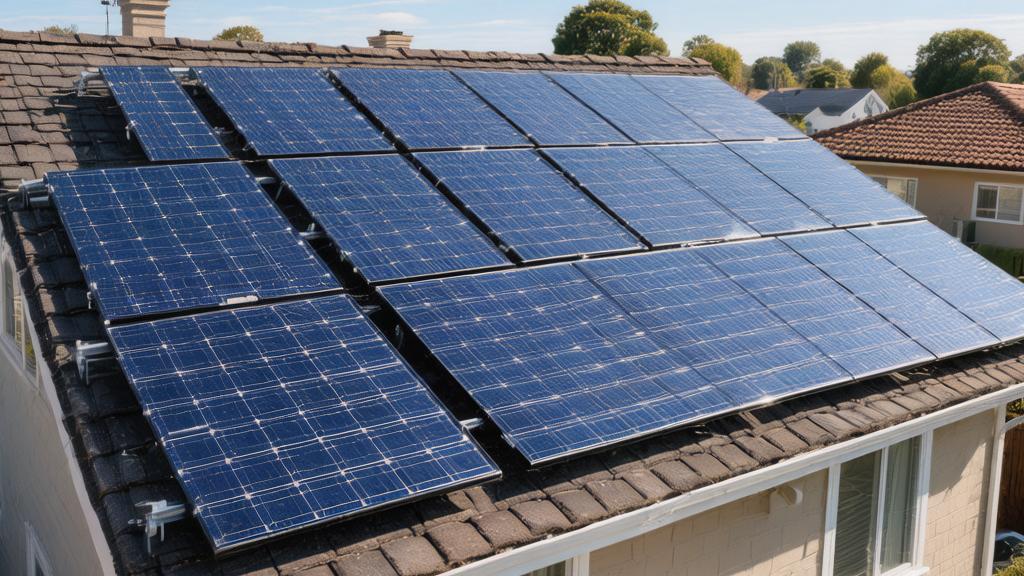
Standard asphalt shingle composite roofs represent the lowest construction threshold in the solar industry; 4 skilled electricians take 10 to 15 minutes to complete a single drilling and waterproof flashing plate fixation using standard lag bolts.
Assembling an array containing 25 panels on an asphalt shingle roof will not generate any form of material surcharge.
Standing seam metal roofs use specialized S-5 non-penetrating clamps to tightly bite onto the metal raised seams, completely excluding the physical risk of rainwater leakage and compressing the entire mechanical installation process time by 20% to 30%.
Operating construction on concrete tiles or Spanish clay tiles is extremely labor-intensive; technicians must extremely slowly remove single clay tiles, install extended metal bases, and cut replacement flashing plates made of metal material.
Fragile tile handling procedures will push the labor installation rate up by 0.50 dollars to 1.00 dollars per watt, forcing homeowners installing a 10 kW system to pay an extra 5,000 to 10,000 dollars in the physical fixation stage alone.
Wood shake roofs present extremely high fire hazards and have a 50% probability of fracturing and crumbling when subjected to personnel stepping; 95% of formal solar contractors in the US explicitly prohibit drilling operations on such materials in their operating specifications.
The metal rail system carrying 20 monocrystalline panels will exert a static physical load of 3 to 4 pounds per square foot on the roof truss; before starting work, it is necessary to coordinate with a structural engineer for calculation to ensure the roof load-bearing redundancy is greater than the architectural safety minimum threshold of 5 pounds per square foot.