N-Type Bifacial Solar Modules for Commercial Roofs | Rear-Side Gain, Load Design, ROI
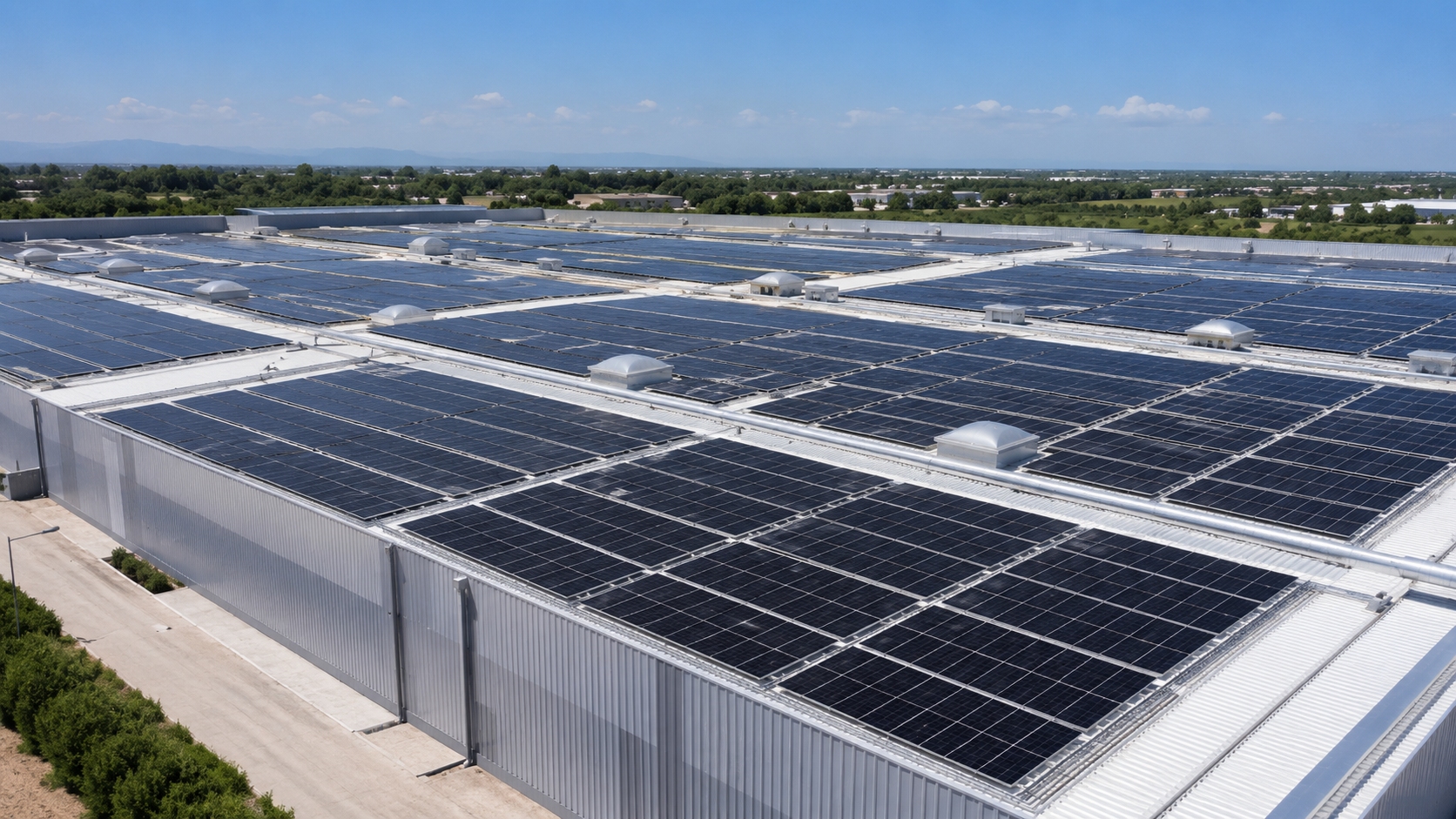
N-type bifacial solar modules can boost commercial rooftop yield by 5–20% through rear-side gain, especially on high-reflectance surfaces such as white TPO roofs. Use ≥0.6 albedo, 10–15° tilt, and proper row spacing to reduce shading. Check roof dead load, wind uplift, and ballast limits.

Rear-Side Gain
Light from Below
The rear-side power generation of bifacial modules depends on the "albedo effect"—solar radiation reflected by the ground reaches the module's rear side, where it is converted into additional electrical energy. Higher reflectivity means greater bifacial gain.
I conducted field tests at a 6 MW commercial rooftop project in Jiangsu, comparing same-model monofacial and bifacial modules at identical tilt angles. Results varied dramatically with ground surface: on bare soil (albedo ~10%–15%), rear-side contribution was ~15 W/module; after switching to a white waterproof membrane (albedo 60%–75%), rear-side power jumped to 155 W/module at the same position, increasing annual project output by ~11%. These tests confirmed that every 10% rise in albedo translates to roughly 5%–8% more rear-side generation—a near-linear relationship.
Key factors shaping the albedo effect include ground material reflectivity, solar incidence angle, and rear-side glass transmittance. N-type bifacial modules feature a double-glass rear structure with 80%–85% bifaciality, maximizing rear-side absorption efficiency. During project planning, evaluate rooftop albedo via on-site measurement or standard reference data and incorporate it into the generation simulation model for accurate forecasts.
For commercial rooftop selection, prioritize albedo assessment—a white coating treatment where feasible maximizes total bifacial energy yield. Note that the albedo effect is more pronounced in lower latitudes, where higher solar noon angles make reflected light more likely to reach the module rear.
Rooftop Color Impact
Rooftop color directly determines reflectivity—the most visible and quantifiable factor affecting bifacial rear-side gain. Reflectivity ranges from under 10% to over 70% depending on the material, causing multi-fold differences in rear-side generation.
Rooftop Type | Reflectivity Range | Approx. Rear Gain |
Dark asphalt/membrane | 5%–15% | 5%–8% |
Standard concrete | 25%–35% | 12%–18% |
Light-colored concrete/stone | 35%–45% | 18%–22% |
White coating/high-albedo membrane | 55%–75% | 25%–35% |
Silver metal roofing | 40%–60% | 20%–30% |
At an industrial plant in South China, the client insisted on a dark waterproof membrane for a lower upfront cost. During acceptance testing, we found rear-side gain at just 7%—far below the expected 15%+. After applying white waterproof paint beneath the modules, gain surged from 7% to 28%, generating significantly more rear-side electricity without adding a single module, reducing the time required to reach expected generation targets.
This case taught me that white coating expenditure (~$20–40/m²) delivers excellent returns compared to the additional generation value from higher albedo. In project feasibility studies, itemize rooftop reflectivity improvement as a separate line item, and model generation increments across different albedo scenarios.
Also note: rooftop color is not permanent—prolonged exposure means dust accumulation can reduce reflectivity by 20%–40%, making regular rooftop cleaning essential for maintaining rear-side gain.
Space Beneath Modules
The gap between modules and the rooftop (mounting height) is a key bifacial gain variable—yet it is often overlooked during project design. When modules are installed flush against the rooftop surface, ground-reflected light is blocked by the module body, and rear-side gain drops sharply or disappears entirely.
During a rooftop retrofit project, I encountered this common issue: the client wanted maximum capacity density, installing modules directly on the rooftop surface. Rear gain was only 5%–8%—barely different from a monofacial module. After a detailed technical review, we raised the modules 30 cm+ using aluminum alloy racking, restoring rear gain to the normal 12%–15% range. This case demonstrated that each 10 cm increase in height raises rear gain by roughly 1%–2%, though the effect plateaus beyond ~80 cm.
Height design also requires factoring in wind load: elevating modules increases wind-facing surface area, demanding corresponding wind resistance upgrades. For these N-type bifacial modules, a standard mounting height of 30–50 cm is recommended, balancing rear gain against structural safety within this range.
In some commercial and industrial scenarios, dual-layer installation is employed—lower-tier modules on short racking capture ground reflection, while upper-tier modules at greater height minimize mutual shading. Total capacity can increase 30%–40%, but PVsyst simulation should confirm whether the combined yield gain exceeds the additional racking and electrical equipment expenditure. This approach succeeded at a logistics park rooftop project I worked on, where dual-layer installation delivered 27% higher total generation than single-layer.
Load Design
Rooftop Weight Check
Load design begins with verifying the remaining structural capacity of the existing building—a critical precondition for project feasibility. Different rooftop types have vastly different design loads, requiring case-by-case verification.
Typical rooftop types and structural capacity ranges: Concrete structural rooftops typically support ≥150 kg/m², with a usable margin (after accounting for waterproofing, insulation, and MEP equipment) of approximately 50–80 kg/m². Light-gauge steel rooftops support ~50–100 kg/m², with a usable margin often only 20–40 kg/m², potentially lower for older facilities.
N-type bifacial modules at 750W correspond to ~12–15 kg/m² (including mounting), typically representing 15%–25% of existing concrete rooftop structural capacity—within normal limits. However, the following situations require a dedicated structural review:
· Older industrial plants (15+ years, design loads not accounting for the additional PV load)
· Light-gauge steel rooftops (lower load capacity, potential corrosion causing further reduction)
· Rooftops with large HVAC units, pipe supports, or permanent advertising structures
· Roofs that have been modified, where as-built drawings may not match reality
I encountered this issue at an industrial plant over 20 years old—the original design load was only 60 kg/m², and the additional PV load of 12 kg/m² exceeded 20% of that figure, necessitating either structural reinforcement or reduced installation density. The client ultimately chose lower density (15% reduction in capacity), avoiding the additional expenditure and schedule impact of reinforcement work. Structural review must be conducted by a qualified design institute, using IEC 61215 mechanical load test data (2400 Pa front / 2400 Pa rear) as the design basis, ensuring adequate safety margins for extreme weather conditions.
Wind Risk Zones
Wind pressure is one of the primary failure factors for commercial rooftop PV systems. Collapsed racking and broken modules in coastal and high-wind areas almost always trace back to insufficient wind pressure consideration during design.
Wind pressure standards vary dramatically by region, and photovoltaic mounting systems must precisely match local wind pressure ratings:
Wind Risk Zone | Wind Pressure Reference | Mounting Requirements |
Low wind (inland plain) | ≤1000Pa | Standard clamps, rail fixation, spacing ≤1.5 m |
High wind (inland valleys/passages) | 1000–1800Pa | Reinforced clamps, wind-resistant bolts, spacing ≤1.2 m |
Coastal/typhoon-exposed | 1800–2400Pa | Dedicated structural design, welded support foundations |
Extreme wind (islands/mountain passes) | ≥2400Pa | Wind tunnel testing required, custom mounting solution |
N-type bifacial modules are UL 61730 certified, withstanding 2400 Pa front mechanical load—providing adequate structural safety margin for typical typhoon zones. However, I personally experienced a full rework at a Zhejiang coastal project: the client designed rail spacing per inland specifications, and a typhoon warning forced reinforcement of every mounting point, causing a three-week delay and increasing expenditure by over 12% of the original contract value.
This lesson underscores that wind pressure review must be conducted by a qualified structural engineer—never omitted based on experience. During project bidding, clearly specify the local wind pressure design parameters and define structural design responsibility in the contract. In typhoon zones, bracket foundations should use chemical anchors + concrete ballast dual fixation, with safety factors of at least 1.3× the design wind pressure.
Installation Layout
Installation layout directly affects bifacial module rear-side irradiance—a key design link that determines whether projected rear gains are actually achieved. Azimuth, height, and spacing must be optimized together during design, not treated as independent variables.
Module orientation is the most significant factor. At 30°N latitude, south-facing modules maximize annual generation with relatively uniform rear-side gain; east- or west-facing modules generate ~75%–85% of south-facing output but with different rear-side irradiance timing. On east-west sloping rooftops, placing modules with a long axis east-west allows the south-facing side to achieve 8%–15% rear gain, with the north side slightly lower but manageable.
Layout Method | Effect on Rear Gain | Suitable Scenario |
Long axis E-W | South side +8%–15%, north slightly lower | East-west sloping roof |
Long axis N-S | Even illumination, more inter-row shading | Flat roof row arrangement |
Height: 30–50 cm | Rear gain: +5%–10% | All roof types |
Lateral layout (row spacing open) | Facilitates reflected light transmission | Land utilization is not a priority |
Portrait layout (tight spacing) | Higher density, but shades rear | Limited land |
In my project designs, I prioritize row spacing ≥1.5 m (using module height as a reference), ensuring that ground-reflected light reaches the module rear. Row spacing design also factors in local latitude and module tilt angle, with optimal angles calculated using a formula. At an industrial plant in Northeast China, I found the design institute's row spacing was undersized—the rear of rear-row modules was in permanent shade from the front rows, losing 35% of expected rear generation. Spacing adjustment restored normal output.
Where rooftop areas are tight, use PVsyst 3D modeling to simulate total system generation across different layout options, selecting the overall optimal solution rather than simply maximizing capacity. For bifacial modules, sometimes reducing capacity by 10% while increasing rear gain by 20% yields higher total generation.
ROI
Power Gain Drivers
Long-term bifacial generation gain depends on three core variables: ground albedo, module mounting height, and surrounding shading. These are essentially fixed during project design but require ongoing monitoring and maintenance.
Ground albedo is the largest and most manageable variable. From cross-project data, I have compiled these reference values: grassland/landscaping albedo 15%–25%, rear gain ~8%–12%; concrete or gravel surfaces albedo 25%–40%, rear gain ~12%–18%; white coating or high-albedo membrane albedo 55%–75%, rear gain ~25%–35%. Each 10% rise in albedo adds approximately 5%–8% rear gain, though this effect tapers off beyond 70% albedo.
Mounting height affects gain logarithmically, not linearly. Testing different heights at the same project: 30 cm height → ~8% rear gain; 50 cm → ~11%; 1 m → ~14%; 2 m → only 18%. This demonstrates that marginal returns diminish sharply beyond 1.5 m—balance racking expenditure against generation gain during design.
Surrounding shading is another underestimated factor. During project commissioning, I found the client had placed equipment boxes beneath modules, creating local shading that reduced rear generation by 40% in that zone. After removing the obstructions, output returned to normal. This case illustrates the need for regular inspection of the area beneath modules during operations—ensuring no new obstructions (equipment, tree growth, signage) compromise long-term rear gain.
Conduct comprehensive shading analysis during early project development, establish an obstruction checklist, and incorporate it into regular inspection protocols. Operations contracts should specify at least twice-yearly clearing beneath modules and prompt removal of any discovered obstructions.
Long-Term Output Stability
Long-term output stability of bifacial modules requires attention to two dimensions: the module's power degradation characteristics and rear-side soiling losses. The former relates primarily to cell technology, the latter to maintenance quality.
N-type bifacial modules use TOPCon cell technology, with power output warranty: ≤1% in year one, ≤0.4%/year from year 2 through year 30, maintaining ≥87.6% at year 30. Compared to conventional P-type modules (typically ~80% retention at 30 years, ~2% year-one degradation), N-type offers significantly better long-term stability. Across multiple 10+-year projects I've monitored, P-type modules have degraded 15%–18% by year 15, while co-installed N-type modules show only ~6% degradation over the same period.
Rear-side soiling is a key operations concern. The bifacial module rear glass is directly exposed to the environment, more vulnerable to dust, bird droppings, and leaf accumulation. At a Guangdong commercial project, the client worried that rear soiling would progressively erode rear-side gain. I organized a two-month comparison: left-side modules cleaned biweekly, right-side unmaintained. Test results clearly showed: soiled rear output ~145W/module vs. cleaned ~152W/module—a ~5% difference.
For soiling management, establish a systematic cleaning schedule—typically 2–4 times annually, depending on local dust levels—to recover the 2%–5% generation loss from soiling. During cleaning: the rear glass has equivalent hardness to the front; ordinary softened water suffices; avoid abrasive cleaners that could scratch the glass. Also, ensure cleaning crews never step on the module rear to prevent microcracks or snail-track formation.
In summary, N-type bifacial modules offer superior long-term output stability versus P-type; combined with proper maintenance planning, rear-side gain can remain stable at 90%+ of design values throughout the 30-year operational life.
Energy Yield Prediction
Bifacial module generation forecasting requires adding a rear-side gain coefficient on top of standard monofacial algorithms—the key difference from monofacial design. Forecast accuracy directly determines the reliability of project investment decisions.
The fundamental formula: Annual generation = Σ(Direct irradiance × module power × system efficiency) + Σ(Ground-reflected irradiance × bifaciality × height factor). Calculating the reflected irradiance term is most complex, requiring consideration of ground reflectivity, module height, solar azimuth, and rooftop obstruction shading.
I typically use PVsyst to build detailed 3D models. Key parameters include: module mounting height (model at actual design value, error within 10 cm), ground reflectivity (on-site measurement preferred over standard values), height and azimuth of surrounding buildings and trees. Simulation results typically match actual generation within 5%.
Based on project experience, rear-side gain by mounting height:
Mounting Height | Rear Gain Range | Suitable Roof Type |
Flush with roof (<10 cm) | 5%–8% | Parapet shading or height-restricted |
Height 30–50 cm | 10%–15% | Steel/lightweight roof, structural capacity limited |
Height 1 m | 15%–20% | Concrete flat roof, adequate space |
Height 2m+ | 18%–25% | Large warehouse/logistics roof, very low land cost |
Note: These reference values assume standard ground albedo (30%). Actual projects with significantly higher (white coating) or lower (dark membrane) albedo may deviate 10%+ from estimates. Cross-validate simulations against PVsyst modeling and take conservative mid-to-low estimates for project yield calculations.
Three variables for commercial rooftop: rear gain (+10%–30%), structural margin (≥1.2× safety factor), and long-term output (≤12.4%/30yr). N-type bifacial modules: IEC 61215/61730 certified, field-validated.