Is it better to put solar panels on the roof or on the ground
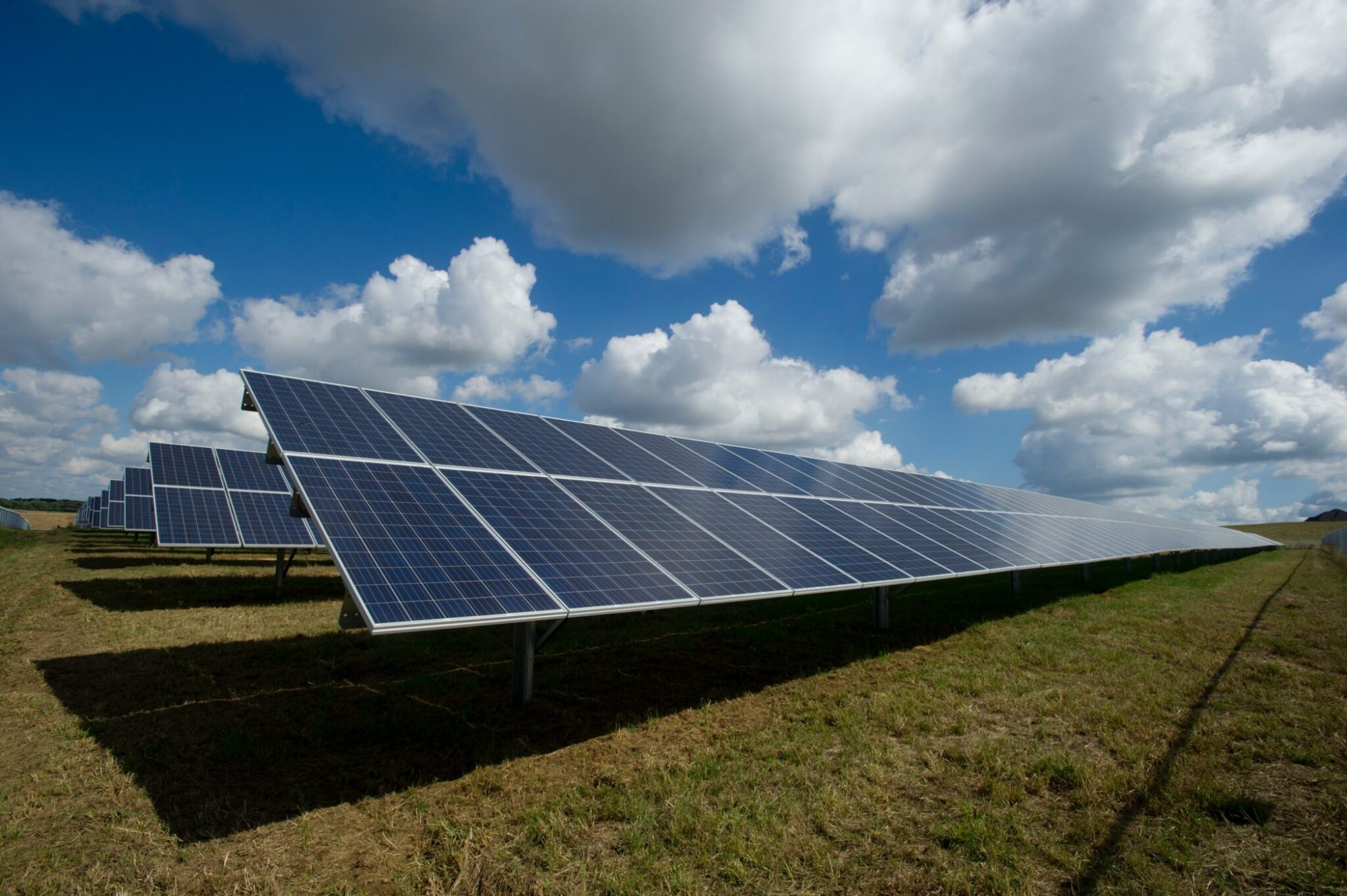
Roof-mounted installations save more space, while ground-mounted installations, with their optimal tilt angle adjustment and superior ventilation and heat dissipation, can increase power generation efficiency by approximately 15% to 25%, making them the professional choice for high returns and low-cost O&M when land is sufficient.
Energy Efficiency
In actual operation, for every 1°C increase in the temperature of the solar cells, their output power decreases by approximately 0.35% to 0.45%. This is known as the power temperature coefficient.
In rooftop installations, because the back ventilation gap is typically less than 10 centimeters, heat tends to accumulate between the modules and the roof surface.
When the ambient temperature is 35°C in summer, the actual operating temperature of rooftop solar cells often soars to 65°C to 75°C.
In contrast, ground-mounted modules are usually positioned at a height of 0.5 to 1.5 meters above the ground.
With smooth air convection on all sides, the cell temperature is typically 10°C to 15°C lower than that of rooftop panels.
Due solely to the power loss caused by this temperature rise, the rooftop solution experiences a 3.5% to 6.75% greater drop in efficiency compared to the ground solution.
For a 10 kW system, this temperature difference can result in an annual power generation gap of approximately 400 to 800 kWh.
Temperature Index Comparison | Flush Rooftop Installation | Elevated Ground Installation | Performance Difference Explanation |
Average Operating Temperature | 65°C - 75°C | 50°C - 60°C | Ground mounting has better ventilation and significant cooling. |
Power Degradation Coefficient | -0.39% / °C | -0.39% / °C | Physical property of the same module type. |
High-Temperature Efficiency Loss | 15.6% - 19.5% | 9.75% - 13.65% | Rooftop loss is approximately 6% higher. |
Avg. Annual Generation Difference | Baseline | + Approx. 5% | Ground returns are higher in long-term operation. |
The degree of alignment in tilt and orientation can affect system efficiency by 5% to 20%.
Most residential roofs slopes are fixed, typically between 15 and 30 degrees, and the orientation is limited by the building's architectural structure.
If the roof orientation deviates from true south by 30 degrees, the annual power generation loss is approximately 3% to 5%; if it faces east or west, the loss expands to 15% to 20%.
Ground installations offer immense flexibility, allowing the brackets to be adjusted to the optimal tilt angle based on latitude data.
For example, in a region at 30°N latitude, fixing the brackets between 28 and 32 degrees and strictly calibrating them to true south ensures that the annual solar radiation received is maximized.
Furthermore, ground installations more easily avoid shadows from surrounding buildings or trees during early morning or late evening.
Even if only 3% of the area is shaded, the activation of bypass diodes can lead to a voltage drop of over 25% for the entire string, thereby reducing the inverter's tracking efficiency.
Angle & Orientation Loss Rate | True South (0°) | 30° Deviation from South | True East / True West |
Optimal Tilt (e.g., 30°) | 0% (Baseline) | -4.2% | -18.5% |
Low Tilt (e.g., 10°) | -6.5% | -9.8% | -14.2% |
High Tilt (e.g., 45°) | -3.8% | -8.1% | -25.6% |
The application of bifacial modules is another means of improving the efficiency of ground stations, which is nearly impossible to achieve with rooftop installations.
Bifacial modules absorb sunlight not only from the front but also from the back by capturing ground-reflected light (Albedo).
On ordinary grass, the ground reflectivity is approximately 10% to 15%, while on ground covered with white gravel or reflective coatings, the reflectivity can increase to 25% to 30%.
This rear-side gain can contribute an additional 5% to 15% to the system's current output.
Assuming a front-side output of 550W, the actual equivalent output of a single module on ground with good reflective conditions can reach over 600W.
Rooftops cannot generate this rear-side gain because the installation distance is too close and the backsheets are often opaque.
Additionally, while DC cable runs are longer for ground systems, voltage drop can be kept under 1% by increasing the cable diameter (e.g., from 4mm² to 6mm²). In contrast, although rooftop cables are shorter, inverters are often installed in high-temperature environments.
Inverter conversion efficiency triggers over-temperature derating protection above 45°C, which can limit output power to 80% of the rated value or even lower.
Environmental Albedo | Corresponding Material | Extra Rear-Side Gain | Estimated 25-Year Total Gain |
0.10 - 0.15 | Green Grass / Soil | 5% - 8% | Approx. 15,000 kWh (10 kW) |
0.20 - 0.30 | Grey Concrete | 8% - 12% | Approx. 22,000 kWh (10 kW) |
0.60 - 0.80 | White Coating / Snow | 15% - 25% | Approx. 40,000 kWh (10 kW) |
Soiling Loss during long-term operation also cannot be ignored. Accumulations of dust, bird droppings, or fallen leaves can create hot-spot effects, shortening cell life and reducing efficiency.
Cleaning frequency for ground installations can be maintained at once per month because operators can work directly from the ground. A single cleaning takes about 20 minutes and costs very little.
Rooftop installations involve high-altitude work, and the difficulty and safety risks cause most users to reduce cleaning frequency to once every six months or even once a year.
According to experimental data in moderately dusty areas, if periodic cleaning is not performed, the light transmittance of the panel surface decreases by 0.5% to 1.0% per month, with cumulative efficiency losses potentially reaching over 10% after one year.
Through high-frequency maintenance, ground installations can consistently maintain surface cleanliness above 98%, thereby generating approximately 12% more total electricity than rooftop systems over a 25-year lifecycle.
Accessibility Maintenance
Climbing Up and Down
Over a 25-year operating cycle, the frequency of physical contact with equipment far exceeds what most people expect.
Rooftop installations typically involve working at heights of 5 to 12 meters, requiring maintenance personnel to be equipped with fall protection systems that meet OSHA or equivalent standards.
The purchase cost for a full set of safety gear ranges from 1,500 to 3,000 RMB.
For pitched roofs with a slope exceeding 25 degrees, the risk factor and time required to manually handle a 550W module weighing 28 kg and measuring 2.5 square meters is over 60% higher than on level ground.
Ground installations completely avoid these height risks. The lower edge of the brackets is typically set between 0.6 and 1.5 meters, allowing maintenance personnel to reach over 95% of the fastening bolts while standing on the ground.
Data shows that during routine semi-annual fastener inspections, checking 100 bolts on a ground system takes only 40 minutes, whereas a rooftop system requires over 150 minutes due to limited mobility and frequent switching of safety tethers.
In an environment where labor costs 200 RMB per hour, the expenditure difference for a single comprehensive inspection exceeds 360 RMB.
· High-Altitude Work Risk: The probability of fall accidents increases exponentially at heights above 4 meters, and insurance premiums are 15% higher.
· Space Limitation: The gap between rooftop modules is typically only 2 cm, providing less than 0.1 square meters of foot space, which makes it very easy to accidentally damage the internal grid lines of monocrystalline silicon cells.
· Material Transport Difficulty: Moving damaged modules down from a height of 10 meters requires renting a small crane or lift, with a daily rental fee of approximately 800-1,200 RMB.
Replacing Parts Costs Money
The average design life of electronic modules in a PV system, particularly string inverters, is 10 to 15 years, meaning they must be replaced at least once during the solar panels' lifespan.
Inverters in rooftop installations, due to their proximity to eaves or installation in attics, face ambient temperatures that are year-round 5°C to 8°C higher than ground environments, leading to a 10% to 15% increase in the failure rate of internal electrolytic capacitors.
When a fault occurs and a 30 kg inverter needs to be replaced, the ground solution requires only two workers and 1.5 hours; the rooftop solution requires over four hours because a temporary operating platform must be built on the slope.
From a long-term financial modeling perspective, "extra labor costs" due to difficult maintenance access account for 3% to 5% of the initial investment over 25 years.
Furthermore, the damage rate for fuses and surge protectors in DC combiner boxes during thunderstorm seasons is about 2%. Ground-mounted systems can be repaired within 30 minutes of a fault discovery, minimizing downtime.
On a roof, because tiles are slippery after rain and cannot be accessed immediately, the average repair downtime extends by over 48 hours. For a 10 kW system generating 50 kWh per summer day, a single delayed repair results in a loss of 100 kWh in revenue.
· Inverter Failure Rate: For every 10°C rise in temperature, the lifespan of electronic modules is halved. Good ventilation on the ground can extend equipment life by 2-3 years.
· Spare Part Turnover Speed: The straight-line transport distance from a ground warehouse to the installation point is usually within 20 meters, taking less than 3 minutes.
· Downtime Loss Calculation: Calculated at 0.5 RMB/kWh, the average annual generation loss for rooftop systems due to repair delays is approximately 150-300 RMB.
Dusting Frequency
In arid or dusty regions, failing to clean the panels for 30 days can result in a drop in power generation of 8% to 12% due to surface dust accumulation.
The advantage of ground installation is that it can be cleaned as frequently as a car, using a long-handled soft brush (3-4 meters long) combined with ordinary tap water pressure (above 3 bar).
For a 10 kW ground system, a single person can complete the cleaning in 25 minutes using about 50 liters of water.
In contrast, rooftop cleaning requires solving the challenge of bringing a water source to a high location; for every 10 meters of vertical height, the pump pressure must increase by an additional 1 bar.
Due to the safety risks of high-altitude cleaning, most users are forced to reduce cleaning frequency to once per quarter or even twice a year.
Based on a comparison of tracking data between two systems of the same capacity, a ground system cleaned once a month produces approximately 940 kWh more total annual electricity than a rooftop system cleaned twice a year.
Over 25 years, this difference in electricity revenue accumulates to more than 11,000 RMB.
· Efficiency Decay from Dust: An average daily efficiency decay of 0.3%. Long-term neglect leads to local overheating and hot spots, with temperatures potentially exceeding 100°C.
· Cleaning Resource Consumption: Due to high water runoff on roofs, water consumption for the same area is 40% higher than on the ground.
· Tool lifespan: Operations in ground environments are gentler, and the wear rate of brush heads is 50% lower than when working on rough tiles.
Fast Fault Finding
When using a handheld infrared thermal imager to scan the back of the modules, the ground system allows for a 100% capture of the cells' thermal signals because the line of sight is basically parallel to the module plane.
In rooftop systems, the shooting angle of handheld imagers often has a deviation of over 45 degrees due to the installation tilt, causing errors of 5% to 10% in emissivity readings and making it easy to miss developing hazards.
When checking for insulation aging in DC cables, the conduits on ground brackets are at eye level.
Maintenance personnel can inspect all wiring for a 10 kW system by walking just 100 meters.
Rooftop cables are usually hidden in the 10 cm gap between the modules and the roof surface, making visual inspection almost impossible without removing the panels.
This lack of visibility during inspections means the detection rate for electrical faults in rooftop systems after 10 years is 30% lower than in ground systems, increasing the potential probability of electrical fires.
Although this probability is very low (approx. 0.01%), the cost of damage to the building structure if one occurs is over 50 times higher than for a ground system.
· Inspection Coverage: Visual visibility for ground systems is 100%, while for hidden rooftop wiring, it is less than 20%.
· Thermal Imaging Accuracy: The resolution of close-up (1.5 m) shots on the ground is 9 times higher than long-distance (over 5 m) shots on a roof.
· Risk Prevention Cost: Ground systems can eliminate over 90% of poor contact risks with just a 200 RMB simple annual test.
Aesthetics and Space Utilization
Space Occupancy
Using the currently mainstream 550W monocrystalline silicon modules as an example, the physical dimensions of a single panel are typically 2,278mm by 1,134mm, covering an area of approximately 2.58 square meters.
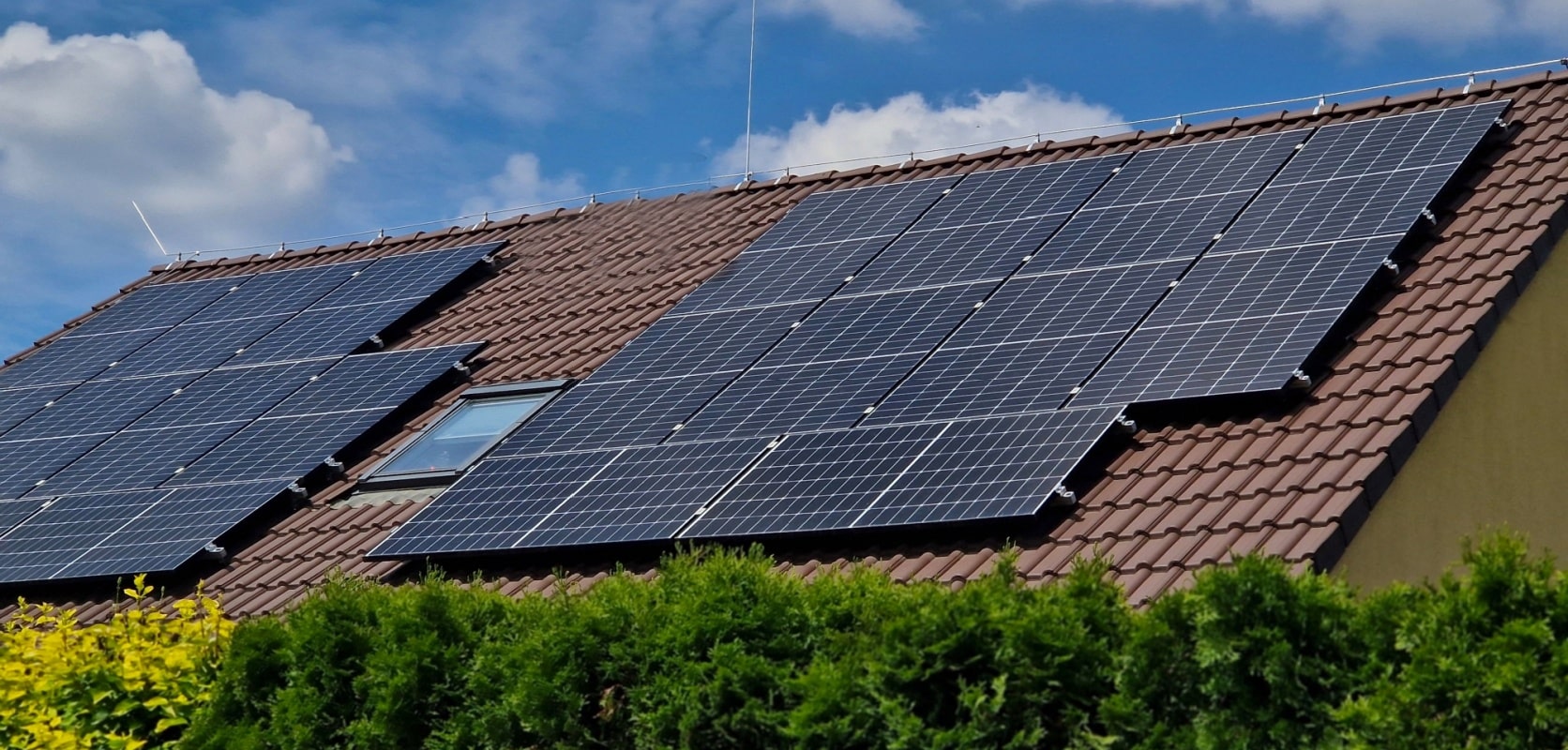
A standard 10 kW (kilowatt) residential system requires 18 to 20 modules, occupying only 46 to 52 square meters of physical projected area on a roof.
Taking into account drainage gaps between tile edges and mounting bracket fixing points, the actual rooftop resource consumed is less than 55 square meters.
In comparison, to prevent shading between rows during noon on the winter solstice, the spacing between rows for ground-mounted systems usually needs to be 1.8 to 2.5 times the height of the bracket.
The same 18 panels often require 120 to 150 square meters of level land on the ground, meaning the space consumption rate is 1.5 to 2.2 times higher than rooftop installation.
"The 'encroachment' on space by ground systems is often more than three times that of rooftop systems."
For a typical residence with a total lot size of 400 to 600 square meters, if this extra 100 square meters of land were converted into outdoor parking, a small lawn, or a storage room, the difference in market valuation could reach tens of thousands of RMB.
Furthermore, ground systems require clearing surface shrubs and laying a 5 to 10 cm thick layer of anti-weed gravel during construction, a process that significantly reduces the soil fertility of that area in the short term.
Rooftop solutions completely avoid affecting the original function of the land, allowing the building's "fifth facade" to generate economic returns without sacrificing any surface activity space.
Visual Appeal
All-Black Modules currently hold more than a 60% share of the high-end market. The frames, backsheets, and even the conductive busbars of these modules undergo a blackening process.
Although this process adds 0.05 to 0.1 RMB to the procurement cost per watt, when they are mounted flush against a dark-colored pitched roof, the visual thickness is only about 10 cm, allowing them to almost merge with the building structure.
DC cables for rooftop installations are typically routed directly indoors through professional waterproof pass-through boxes, leaving no exposed conduits on the exterior and creating a strong sense of integration.
In contrast, ground-mounted arrays need to maintain a height of 0.6 to 1.2 meters above the ground to prevent rain splashing and weed shading.
The highest point of the entire assembly often exceeds 2.5 meters, creating a physical barrier in the yard that obstructs visual transparency.
"An all-black rooftop solution can increase the visual integrity of a building by 25%."
Ground brackets are usually made of aluminum alloy or hot-dip galvanized steel.
Under strong noon sunlight, the reflective glare from metallic brackets can reach over 2500 candelas, which can easily cause interference for second-floor bedroom windows.
Moreover, because ground systems require combiner boxes and inverter stands, the length of externally visible 1-inch (25.4 mm) diameter metal electrical conduits (EMT) often reaches over 10 meters.
For residents pursuing a high quality of life, the "invisible power generation" of rooftop installation is more in line with modern minimalist renovation standards.
Best Use of Land
The operating cycle of a solar system is usually 25 to 30 years.
Once ground installation is chosen, this hundred-plus square meter plot of land cannot undergo any civil engineering modifications—such as house extensions, swimming pool excavation, or new underground drainage pipes—for the next quarter-century.
During the construction phase, ground systems require excavating spiral piles to a depth of 0.8 meters or pouring concrete bases.
Each base has a volume of approximately 0.15 cubic meters, and a full system needs 12 to 20 such pillars, posing a potential risk to existing underground sewage networks and irrigation lines.
"The loss of flexibility in land use usually accounts for 10% of the implicit costs of ground installation."
Rooftop installation involves no foundation work and is secured to roof beams or columns using stainless steel hooks or clamps.
If the resident wants to expand the garage or plant trees in the yard 10 years later, the panels on the roof will not be an obstacle.
Additionally, for locations with high land prices, preserving the integrity of the ground surface maintains multiple future possibilities for the property.
According to research, in yards of the same area, properties that retain complete green space have a potential buyer pool that is about 30% broader during resale than properties where half the space is occupied by a solar array.
Property Value
Based on back-testing data from 100,000 second-hand housing transactions, residences with rooftop solar systems installed typically have an average closing price 3.5% to 4.1% higher than non-PV properties, and the average closing period is shortened by approximately 15 days.
Buyers tend to view rooftop solar as a fixed energy-saving value-add for the property, similar to an upgraded central AC system or high-tech insulation.
Since the system is installed on the roof, buyers do not feel the yard has become smaller; instead, they are more inclined to purchase due to lower electricity bills.
"Buyers' willingness to pay a premium for invisible energy systems is 18% higher than for exposed equipment."
Appraisers may only factor in the residual value of the second-hand equipment for ground-mounted systems rather than counting it as full home equity.
Furthermore, because ground systems occupy a large amount of outdoor social space, buyers with pets or children may view this as a usage limitation.
Overall, rooftop installation clearly outperforms ground installation in enhancing asset liquidity and market competitiveness.