How Can You Boost Home Solar Efficiency | Placement, Maintenance, Storage
Improving home solar energy efficiency can be approached from three aspects: placing photovoltaic panels on the roof facing south tilted at 30° can increase production by about 15%; cleaning the panel surface once every half year can improve power generation by 5%-10%; equipping a 5 kilowatt-hour home energy storage system can improve the utilization rate by about 20%.
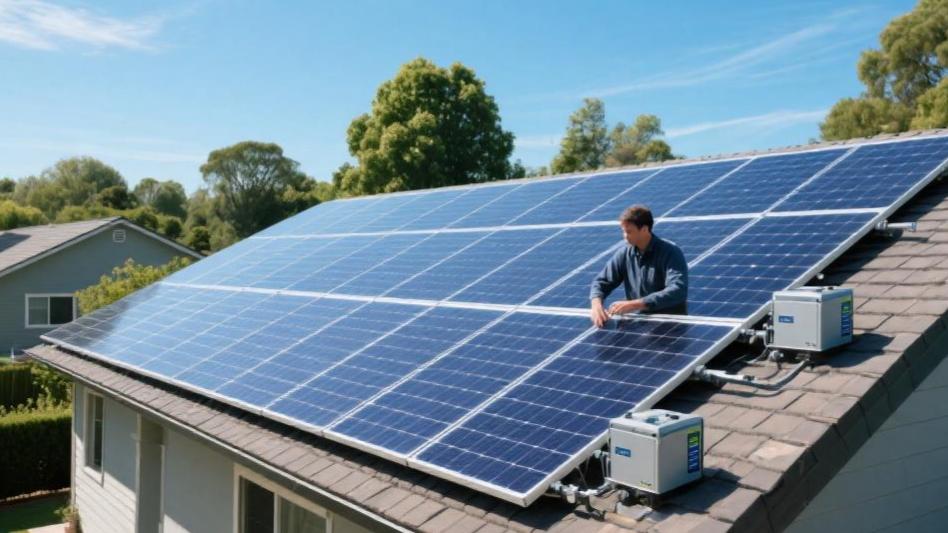
Placement
Look at orientation
In most regions of the Northern Hemisphere, setting the azimuth angle of photovoltaic panels at due south 180 degrees can capture 100% of the theoretical peak sunshine. If roof structure limitations lead to installing biased to the east or biased to the west, every 15 degrees the azimuth angle deviates from the due south direction, the system's total annual power generation will drop by about 3% to 5%. In the initial design phase, the calculation step of solar trajectory simulation software is essential, capable of controlling the error rate of the installation angle to within 2 degrees.
· Panels installed facing due east or due west, the average daily amount of radiation received is lower than the due south face, the overall conversion efficiency is usually only 80% to 85% of the due south direction.
· When panels face west, the light utilization rate between 2 pm and 5 pm in the afternoon increases significantly, the peak output power is about 15% higher than the due south direction. In regions implementing time-of-use electricity pricing, the power output during the afternoon peak period can lower the entire summer's electricity bill by 20% to 30%.
· Panels installed facing east produce electricity fastest between 6 am and 9 am in the morning, and can, after the cell is depleted for one night, rapidly recharge the energy storage equipment at a rate of 2 kilowatts to 3 kilowatts per hour.
Panel tilt degree
The installation tilt angle of the panel determines the density of receiving solar radiation. A fixed tilt angle is usually recommended to be set within the range of floating 5 degrees up and down from the local latitude. For example, in a region with a latitude of 40 degrees, setting a tilt angle of 35 degrees to 45 degrees can achieve annual output maximization.
· In order to meet the self-cleaning effect brought by rainwater washing, the minimum tilt angle of the panel cannot be less than 10 degrees. An excessively low tilt angle will lead to surface water accumulation, the sand and mud patches left after the moisture dries, will make the panel's light transmittance drop by 4% to 6% within 3 months.
· For flat-roofed houses, using adjustable brackets can lower the angle by 15 degrees in summer, increasing the direct radiation area of high-latitude sunlight; and raise the angle by 15 degrees in winter, to capture the radiation of the low-latitude sun.
· Arranging angle adjustment work 2 times per year, consuming about 40 minutes each time, can make the annual total power generation extra improve by 4.5% to 5.5%.
Leave enough distance
The shadow safety distance between arrays must be precisely calculated based on the sun's altitude angle at 12 noon on the Winter Solstice, any 0.5 square meters of local shading will make the power of the entire circuit compromised by more than half.
· The distance between the front and rear two rows of brackets needs to be maintained between 1.5 times and 1.7 times the height from the ground of the highest point of the front row modules. If the front row panel's height from the ground is 1 meter, the rear row panel needs to be moved backward out of a 1.5-meter gap.
· The dimension from the outermost side of the panel array to the roof edge must retain a physical buffer zone of at least 40 centimeters to 60 centimeters.
· When encountering gusts reaching a wind speed of 30 meters per second, the local wind pressure in the roof ridge and edge areas will be 1.5 times to 2 times higher than the roof center position, reserving a buffer distance of more than 40 centimeters, can reduce the probability of the panels being lifted and destroyed under extreme weather by more than 80%.
Calculate load bearing
Photovoltaic panels plus aluminum alloy brackets, counterweight blocks and DC distribution boxes will bring a continuous 25 years of static load pressure to the roof structure. One monocrystalline silicon module with standard dimensions of 1722 millimeters by 1134 millimeters, and a rated power of 410 watts, its own weight is approximately between 21.5 kilograms and 22 kilograms.
· Flat roofs adopting cement counterweight blocks for non-penetrating installation, the added static load per square meter will reach 25 kilograms to 35 kilograms. Sloped roofs adopting color steel tile clamps or guide rail drilling fixation, the added weight per square meter is kept at 12 kilograms to 15 kilograms.
· Before laying panels, one must verify the architectural drawings to confirm the remaining load-bearing capacity per square meter of the roof is greater than 40 kilograms, to be able to accommodate the fully loaded weight of the entire system.
· When the service life of the original asphalt waterproof layer exceeds 10 years, before installing panels, spending 3000 yuan to 5000 yuan to re-lay waterproof coils is very necessary. If, during the 10th year to the 15th year of system operation, due to roof leaking, it is forced to be disassembled and reinstalled, it will generate equipment transfer labor costs and downtime power generation losses exceeding 8000 yuan.
Match inverters
Complex roof structures often need to scatter 20 photovoltaic panels on two or three slope surfaces of different orientations. Adopting a single centralized inverter with a capacity of 10 kilowatts, as long as 4 photovoltaic panels of one of the slope surfaces are situated on the shaded side during the period of 8 am to 10 am in the morning, the current of the entire series circuit will be pulled down, the overall output power loss will reach 25% to 40%.
· Under installation scenarios of multi-orientations or having chimney shading, equipping micro-inverters for every piece or every two pieces of panels can independently track the maximum power point of a single panel, making each panel output current independently within the safe direct current voltage range of 30 volts to 50 volts.
· Purchasing 10 micro-inverters will make the system's initial hardware equipment budget increase by 15% to 20%, the total cost approximately being 4000 yuan to 6000 yuan more.
· Within a 25-year life cycle, micro-inverters can improve the comprehensive power generation of multi-slope roofs by 10% to 15%, the system in the 6th year to the 7th year of being put into operation can just use the extra generated electricity amount to recover the extra spent hardware cost.
Maintenance
Wash panels
Arranging two thorough surface water washes every spring and autumn can make a system with an 8-kilowatt installed capacity maintain a light transmittance of above 98% in the following 6 months. Not cleaning the 0.2-millimeter thickness of dust accumulated on the surface for 3 consecutive months, the average daily power generation of a single panel will drop from 1.8 kilowatt-hours to 1.5 kilowatt-hours. If bird droppings falling on the glass surface stay for more than 15 days, the uric acid modules contained in them will corrode the anti-reflective coating, causing the light refractive index in that area to drop by 4% to 6%.
· Conducting washing operations between 6 am and 7 am in the early morning or after 6 pm in the evening, at this time, the panel surface temperature is between 20 degrees Celsius and 25 degrees Celsius, can avoid the probability of micro-cracks triggered by cold water contacting 60-degree Celsius high-temperature glass increasing to 15%.
· Using a telescopic pole with a soft bristle brush coordinated with a low-pressure water flow where the water pressure is controlled at 0.3 megapascals to 0.5 megapascals, washing a single panel with a dimension of 1.7 square meters usually needs to consume 4 liters to 5 liters of pure water.
· Spending 200 currency to hire a professional team to conduct 1 deep wash, the power generation improvement can produce electrical energy worth 250 currency more in the following 90 days, the investment return rate of a single maintenance reaching 25%.
Check cables
Direct current cables exposed in the outdoor environment going through 4 to 5 years of wind blowing and sun exposure, the tensile strength of the outer insulation sleeve will decay at a speed of 2% per year. Every 180 days, using an infrared thermal imager to conduct scanning on the wire routing trajectory with a total length of 50 meters, can identify in advance abnormal heating nodes with temperatures exceeding 45 degrees Celsius. When discovering the voltage drop at the MC4 connector terminal exceeds 0.2 volts, spending 15 currency to replace it with a new connector, can avoid a single string losing 5% to 8% of transmission efficiency.
· Checking the alternating current output wire materials below the inverter, ensuring the copper core wire diameter is above 6 square millimeters, presses down the line loss rate generated by 10 kilowatts of power running continuously for 8 hours to within 1.5%.
· Cables exposed on the outer side of the metal guide rails are threaded into anti-ultraviolet corrugated pipes with a diameter of 20 millimeters. This physical protection measure costing 50 currency can make the safe service life of the circuits prolonged by 5 to 8 years.
· For the resistance test of the grounding wire ensuring the numerical value is less than 4 ohms, the operating current of the leakage protection switch is set at 30 milliamperes, the trigger response time needs to be less than 0.1 seconds.
Tighten screws
Subjected to the long-term vibration influence of gusts above 15 meters per second, the aluminum alloy briquette nuts fixing the photovoltaic brackets will produce about 10% of mechanical loosening within the first 24 months after being put into operation.
Every spring, using a torque wrench to re-lock the fixing bolts of 8 millimeters diameter to the specified torque of 18 Newton meters, can reduce the probability of modules falling off under extreme weather by 95%. Checking the 40 fixing fulcrums installed on the sloped roof, discovering any piece of waterproof rubber washer with a thickness lower than 2 millimeters appearing aging and cracking, completing replacement within 72 hours.
· Conducting grinding on the surface of carbon steel material parts with a rusted area exceeding 5%, and applying anti-rust primer with a thickness of 0.1 millimeters, the maintenance consuming 2 hours can prevent the corrosion depth from increasing by 0.5 millimeters every year.
· Measuring the gap distance between the panel and the aluminum alloy guide rail, reserving 15 millimeters of expansion space, in order to cope with the metal thermal expansion and cold contraction effect brought by the temperature rising 30 degrees Celsius in summer.
· If the frame grounding continuity resistance value of the entire square array is greater than 0.1 ohms, supplementarily installing barbed grounding spacers at the connections, an accessory with a single cost of only 0.5 currency can ensure a 100% static electricity discharge rate.
Look at data
The monitoring software captures the operating parameters of the inverter once every 5 minutes, accumulating 30 days of log files can reflect 99% of the system's potential hardware failure trends. When the input current of a certain branch circuit containing 10 panels plummets from the usual 8 amperes to 5 amperes, and the duration time exceeds 20 minutes, it represents the appearance of physical shading reaching 30% in area or internal damage to modules.
Monthly comparing the power generation statistics charts of the same period in history, under the condition that the total solar radiation difference is less than 2%, if the monthly output electricity amount dropping magnitude exceeds 7%, initiate a 2-hour on-site hardware troubleshooting procedure.
Monitoring parameter category | Normal reference numerical value | Warning trigger threshold | Inspection cycle frequency | Expected processing time | Potential loss proportion |
Direct current input voltage | 350 volts to 450 volts | Lower than 300 volts | 24 hours | 4 hours | 15% to 20% |
Inverter internal temperature | 40 degrees to 50 degrees | Exceeding 65 degrees | 12 hours | 2 hours | 8% to 12% |
Power grid frequency fluctuation | 49.8 hertz to 50.2 hertz | Deviation greater than 0.5 hertz | 1 minute | 0.1 seconds disconnect | 100% downtime |
Insulation impedance test | Greater than 2 megohms | Less than 500 kilohms | 30 days | 24 hours | Leakage risk 100% |
Daily average peak power | Rated capacity 80% | Continuously 3 days lower than 60% | 7 days | 48 hours | 25% to 30% |
Sweep heavy snow
White snow accumulating to a thickness reaching 5 centimeters will block more than 95% of sunlight penetration, causing the panel's output power during winter days to return to zero. When the air temperature drops to minus 5 degrees Celsius, the bottom of the accumulated snow freezes into an ice layer of 1 centimeter thickness, adding 10 kilograms of extra static load-bearing pressure to every square meter of the roof. Using a dedicated snow removal tool with a length reaching 4 meters and equipped with a rubber squeegee strip, can clear 80% of the obstructions on the surface of a 6-kilowatt system within 30 minutes.
· During snow removal operations, retaining the bottom-most approximately 0.5 centimeters thick thin snow to let it naturally melt, forcibly scraping the ice layer will make the scratch rate of the glass surface rise by 20%, leading to the light transmittance permanently dropping by 3%.
· In extremely cold regions where the snowfall amount exceeds 500 millimeters per year, installing a heating insulation box with a rated power of 50 watts for the inverter lifts the cold start success rate of the equipment under a minus 20 degrees environment to 99%.
· Having selected installation brackets with a tilt angle greater than 35 degrees, the snow layer accumulated on the panel surface after absorbing 50 watts per square meter of weak radiation, will slide off by itself within 2 hours when the air temperature rises back to 2 degrees Celsius.
Trim branches
An oak tree 10 meters away in the southeast direction of the solar energy system, its crown radius will increase by about 0.5 meters every year, bringing a shadow coverage of up to 2 hours per day to the array in the third year. Arranging one vegetation trimming plan every November, sawing off all branches with a height exceeding the roof ridge line by 1.5 meters, retrieves the single-month production loss of about 40 kilowatt-hours caused by shading. Tree leaves drop in large quantities in autumn, piling up in the drainage trough below the array, water accumulation exceeding 5 centimeters will soak the bottom cables, making the occurrence probability of short circuit failures soar by 300% in the subsequent rainy season.
· Spending 150 currency to rent an aerial work vehicle to conduct tree crown trimming lasting for 4 hours, guarantees the photovoltaic panels obtain 6.5 hours of unshaded direct illumination every day within the next 12 months.
· Clearing the withered leaves and pine needles dropped on the back of the panel, vacating a 10-centimeter air circulation path for the heat dissipation space of the module backplane, lets the backplane working temperature drop by 3 degrees to 5 degrees.
· Checking the new vine plants growing out within the 3-meter range around the roof, this type of plant with a growth speed reaching 2 centimeters per day winding around the brackets, will increase the wind-bearing resistance of the equipment by 40% within 30 days.
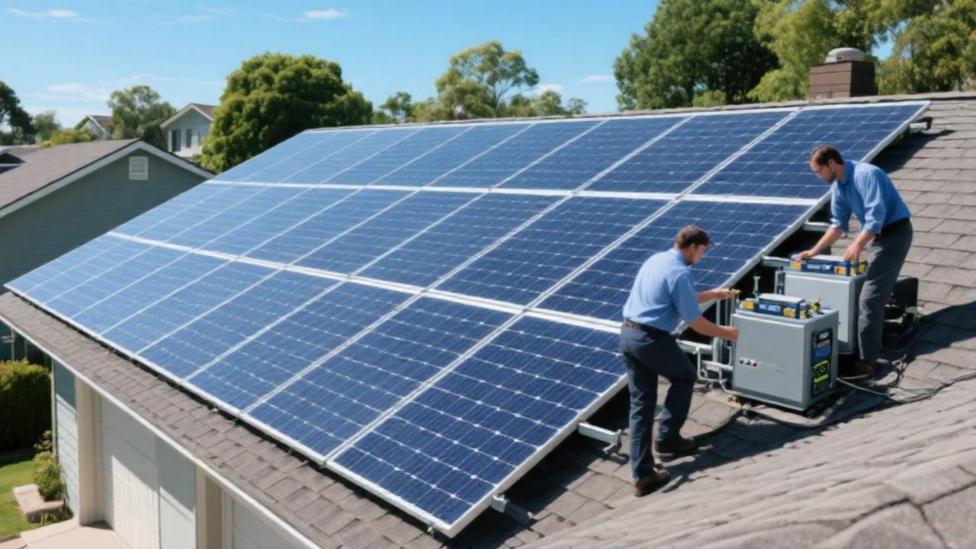
Storage
How big to choose the cell
For a family of four with a daily average power consumption between 20 kilowatt-hours and 25 kilowatt-hours, configuring a lithium iron phosphate cell pack with a physical capacity of 13.5 kilowatt-hours is able to cover up to 60% of the electricity load in the evening from 6 pm to 7 am the next morning. If the daytime peak solar power generation power reaches 6 kilowatts, deducting the instantly consumed 1.5 kilowatts load, the remaining 4.5 kilowatts of power can fully charge an empty cell to a 95% electricity quantity state within a continuous 3 hours.
Blindly purchasing super-large energy storage equipment with a capacity exceeding 20 kilowatt-hours will lead to the initial hardware budget suddenly increasing by 4000 currency units to 5000 currency units, while the excess 5 kilowatt-hours to 8 kilowatt-hours capacity will only be fully activated in less than 15% of the days throughout the year, the investment return cycle of idle assets will be infinitely stretched from the standard 7.5 years to more than 12 years.
Statistical variance shows, when matching the cell rated capacity to the interval of 50% to 60% of the single-day total power consumption, the system equipment utilization rate is as high as 88%, and the energy storage cost amortization decline magnitude of capital per unit kilowatt-hour reaches 12%.
Leave some bottom electricity
Setting the daily discharge lower limit of the lithium iron phosphate cell at the remaining 20% electricity quantity water level, the cell can stably complete 6000 times to 8000 times of standard charge and discharge cycles, converted into service life, it is approximately between 15 years and 18 years. When the depth of discharge is forcibly pulled up to above 95%, being in a state of extremely low electricity quantity for a long time will make the average growth rate of the cell's internal resistance extra increase by 0.4 milliohms per year, the total cycle life will cliff-like shrink to around 2500 times.
Through the cell management system, locking the highest charging threshold at 95%, and jamming the lowest discharging threshold at 15%, letting the available electricity quantity interval maintain at 80% of the total capacity, the total throughput within the lifetime of a single 10-kilowatt-hour cell will climb from 25 megawatt-hours to 48 megawatt-hours.
Setting a charge and discharge interval moat of 15% to 95%, lets the voltage fluctuation dispersion degree of the single cell when operating narrow down to within 0.15 volts, the capacity attenuation rate of the entire life cycle is forcibly suppressed at 1.2% to 1.5% per year.
Control temperature
Under the standard laboratory environment of 25 degrees Celsius, the energy conversion efficiency of the energy storage system can maintain at the highest level of 96%. When the air temperature of the installation area climbs to 40 degrees Celsius, the side reaction rate inside the cell will increase by two times, leading to the available capacity appearing a 2.5% permanent loss per year.
Under the extremely cold conditions of minus 10 degrees Celsius in winter, the electrolyte viscosity significantly increases, the rate of lithium ions penetrating the separator plummets by 60%, forcibly conducting high-current charging will trigger severe lithium plating phenomenon, causing an irreversible physical short circuit risk.
Every time the environmental temperature deviates from the 25 degrees Celsius standard line by 10 degrees Celsius, the median cycle life of the energy storage equipment will shrink by 15%. Equipping an active air-cooled thermal management module with a power of 300 watts can restrict the maximum temperature difference inside the cell pack to within 3 degrees Celsius.
Calculate charging and discharging well
For an energy storage module with a rated capacity of 100 ampere-hours, adopting a 0.5C rate, which is 50 amperes of current to conduct charging and discharging, is able to control the heat accumulation speed on the cell surface to within a rise of 0.1 degrees Celsius per minute. Frequently using high rates of 1C or even 1.5C to drive high-power electrical equipment of up to 8 kilowatts will lead to the heat generated by the internal ohmic resistance magnifying geometric progression, making the overall thermal loss of the system soar to 8% to 10%.
Limiting the daily maximum output current to within 60 amperes not only can shrink the voltage drop during the power transmission process to within an error range of 1.5%, but also can effectively avoid the cell pole piece material peeling phenomenon caused by large current impacts.
Recording a running frequency statistics sample of 60 days, maintaining over 90% of the discharging process in the medium-low rate interval of 0.3C to 0.5C, can let the remaining state of health of the energy storage equipment by the 10th year steadily stay above the passing line of 75%.
Choose a good location
Installing the energy storage cabinet with a total weight reaching 120 kilograms to 150 kilograms in a cool indoor area not exceeding 2 meters away from the inverter, can maximally press down the line loss rate generated by the direct current connection cables to within 0.5%. If forced to choose outdoor installation, the protection level of the equipment must reach the IP65 standard, in order to resist the long-term oxidative corrosion on the metal terminals from the damp air with a relative humidity exceeding 85%.
Being exposed to a totally unshaded sun-baked face will let the peak temperature of the metal casing surface rapidly break through 55 degrees Celsius at 2 pm in the afternoon, radiant heat transferring into the cell compartment will make standby power consumption increase by 15 watts to 20 watts. When planning an installation position in a garage or basement, it is necessary to ensure a physical buffer space of at least 30 centimeters is reserved all around the equipment, to guarantee an air convection flow rate of no less than 2 cubic meters per minute.
Shortening the physical distance between the cell and the inverter, using a pure copper conductor with a cross-sectional area reaching 25 square millimeters, when transmitting 50 amperes of direct current can stabilize the voltage deviation at 0.05 volts, reducing nearly 150 kilowatt-hours of invalid electrical energy evaporation every year.
Calibrate regularly
After the cell management system continuously runs for 120 days to 150 days, the state of charge parameter calculated by the software will accumulate about 3% to 5% of statistical error. Executing a complete deep charge and discharge calibration procedure every 6 months, that is slowly discharging the electricity quantity to 10% and then charging it fully to 100% at a constant speed, is able to help the algorithm re-correct the baseline of the maximum capacity, pulling the accuracy of the electricity quantity display back to above 98%.
The module inside the cabinet formed by connecting 16 single cells in series, after going through 200 times of high-intensity charging and discharging, the voltage difference between the cells may expand to above 50 millivolts. Starting the passive balancing function, utilizing resistors to consume away about 200 milliamperes of weak current from the high-voltage cells, takes 72 hours to re-compress the voltage deviation of all cells to within 15 millivolts.