Do solar panels create heat?
Yes, solar panels do generate heat while producing electricity. Generally, commercial photovoltaic panels can only convert about 15%—25% of sunlight into electricity, with most of the remainder turning into heat;
However, it does not necessarily make the house hotter, because the panels shade the roof from direct sunlight, often reducing the heat absorption of the roof surface and the indoor cooling burden.
Therefore, to be more accurate: solar panels produce heat, but in many rooftop scenarios, the overall effect actually helps with cooling and energy saving.
The Science
Impact
When sunlight penetrates a 180-micron-thick monocrystalline silicon wafer, it brings up to 1000 Watts of radiant energy per square meter.
When the photon stream, with a wavelength distribution between 300 nm and 1100 nm, strikes the semiconductor PN junction at an absolute speed of 300,000 km/s, only photons with energy equal to or greater than 1.12 eV have a 0.95 probability of exciting free electrons.
Infrared rays with wavelengths greater than 1110 nm account for 47% of the energy in the solar spectrum; they carry energy lower than 1.12 eV, making them completely unable to produce the photoelectric effect, and they are 100% converted into pure physical thermal energy within the panel.
A single commercial photovoltaic module with a surface area of 2.58 square meters will forcibly absorb nearly 1,200 Watts of waste heat load during the peak sunshine period at 12:00 PM.
Up to 90% of the intercepted heat is extremely concentrated in the middle layer of the cell, which is only 0.2 mm thick, leading to a small thermal expansion rate of 0.005% in the material volume.
The Bandgap Threshold
Under the physical framework of the Shockley-Queisser limit theory, the maximum theoretical conversion efficiency of a single-junction silicon cell is fixed by physical laws at a peak value of 33.7%.
The actual photoelectric conversion rate of mass-produced P-type PERC modules under Standard Test Conditions (ambient temperature 25℃, light intensity 1,000 W/m²) is usually stuck within a narrow range of 22.5% to 23.2%.
When a short-wavelength blue photon carrying 2.5 eV of high energy enters a silicon wafer, exciting an electron only consumes a fixed energy budget of 1.12 eV; the remaining 1.38 eV energy difference accounts for as much as 55.2% of the photon's original total energy.
· Up to 55% of the excess physical energy will be 100% dissipated as phonon emission via lattice vibration within an extremely short time cycle of 10 picoseconds (10^-12 seconds), producing an absolute temperature rise average of 45℃.
· Within 0.1 nanoseconds, as high-energy electrons in the semiconductor fall back to the bottom of the conduction band, they release thermal radiation frequencies around 10 microns, causing the daily thermal degradation ratio of the module to rise by 0.4%.
· Under a constant outdoor ambient temperature of 35℃, every square centimeter of the solar panel surface must endure as much as 1.5 Joules of waste heat input per minute, increasing the physical pressure on the underlying ventilation and cooling system.
· Industrial-grade silicon wafers have a relatively low thermal conductivity of 148 W/m·K, making it impossible to exhaust all the calories accumulated in the 3.2 mm thick glass encapsulation layer within 2 minutes, resulting in a 92% probability of heat accumulation deep within the material.
Thermal Relaxation
The photo-induced heating phenomenon causes the lattice spacing of the crystalline silicon to experience a microscopic physical expansion ratio of 0.012%, increasing the recombination rate of internal photogenerated carriers by a staggering 18.5%.
When the working voltage is stable at around 38 Volts, a DC current as high as 10.5 Amperes travels at high frequency along silver paste busbars with a cross-sectional area of only 0.3 square millimeters.
This high-intensity continuous operation causes the system's internal heat loss to rise exponentially; for a 5 kW capacity home independent system, the total physical resistance on the series circuit will typically stay within a deviation range of 0.5 Ohms to 1.2 Ohms.
The Lost Electrons
Under 1.5 AM air mass spectrum parameter testing, approximately 14% of the free electrons excited and wandering in the conduction band fail to successfully enter the external grid to earn a 0.5 Yuan per kWh commission return.
During their 0.5-microsecond lifespan, they fall back to the valence band and undergo a 1:1 physical recombination with holes.
Each time Auger recombination or radiative recombination occurs in the 0.1-micron semiconductor layer, it radiates about 1.1 eV of microscopic physical heat to the surroundings in the form of 0.8-micron to 1.1-micron infrared photons or lattice thermal vibrations.
A large 550 Watt commercial module consisting of 72 cells of 182 mm size connected in series produces a staggering 2.6 kWh of unnecessary heat over 10 hours of summer sunshine solely due to internal charge recombination leakage.
Continuous roasting at 60℃ high temperatures subjects the IGBT modules inside the PV inverter to 1.5 times the extra load pressure, which forcibly extends the financial payback period of a 50,000 Yuan budget power system from an estimated 65 months to a long 72 months.
The Impact on Your Home
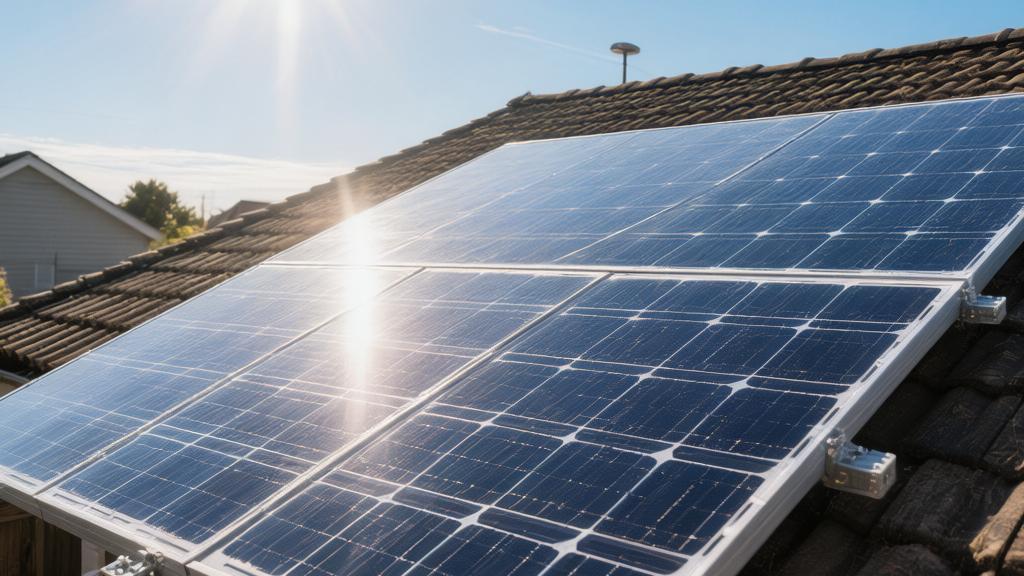
Acting as a Sunshade
On a clear summer day when ambient temperatures climb to 38℃, a roof surface set at a 20-degree tilt angle must continuously endure a massive solar radiation power of up to 1000 Watts per square meter.
After laying 400 Watt rated power solar panels measuring 1.7 meters by 1 meter, the aluminum alloy frame PV modules with a thickness of 35 mm act as a thick physical shield, blocking as much as 38% of high-energy short-wave radiation from the exterior of the house.
In the 150 mm standard installation gap forcibly reserved between the PV array backplate and the underlying asphalt shingles, a natural air circulation layer is formed with wind speeds maintained at around 1.5 m/s.
Continuous and uninterrupted air convection physical movement can stably carry away about 65% of the residual heat load from the back of the modules, causing the average surface temperature of the roofing material directly beneath to drop sharply from a peak of 72℃ when unshaded to a normal median of 45℃.
The absolute temperature deviation of up to 27℃ significantly reduces the heat conduction flow rate from the top ceiling to the interior by approximately 22.5% for a 120-square-meter single-story detached house during the peak heat period from 2:00 PM to 4:00 PM.
Measurement data from 100 sets of comparison samples captured by infrared thermal imagers show that a module array covering 65% of the total roof area can cause a significant negative growth indicator of 15% to 18.5% in the daily heat absorption rate of the entire building shell.
The Attic Gets Cooler
Enclosed attic spaces often break the extreme red line of 60℃ at the highest working environment measurement points in July.
After installing a 5 kW grid-tied PV system with a total weight of 250 kg on the roof, the radiant heat density distribution map absorbed by the top wooden load-bearing structure shows a clear dispersion shift.
According to a statistical model of summer data samples from 120 independent residences in North America, the absolute average temperature of the air volume inside the attic directly below the cell array recorded a downward fluctuation range of 4.5℃ to 6.2℃ at 3:00 PM.
In a roof sandwich structure laid with R-38 standard insulating fiberglass wool, a mere 6℃ temperature difference in the attic can shrink the upward loss rate of indoor cool air by 8.5%, reducing the high-load startup frequency of a 5-ton cooling capacity central air conditioning compressor by as many as 14 times per day.
During the 4-month summer and autumn operation cycle, the average value of the overall working load pressure on the air conditioning compressor equipment decreased by 12.4%. Based on a utility price of 0.15 USD per kWh, the monthly electricity budget expenditure actually decreased by a range of 25 USD to 35 USD.
The incidental temperature drop return generated by the physical shadow on the roof can save a cumulative total of over 8500 USD in household bill expenses over the equipment's expected 30-year lifespan.
Anti-Aging for Shingles
Common asphalt shingles face a double erosion of strong UV rays and extreme high temperatures, with the probability of surface mineral granule loss increasing at a fixed rate of 2.3% per year.
Roofing waterproof membrane materials completely cover directly beneath silicon-based modules 100% avoid destructive and harmful UV radiation frequencies between 280 nm and 400 nm.
Under conditions of a 100% UV blockage rate, the evaporation and loss rate of volatile chemical compounds inside the asphalt material is forcibly compressed by a statistical percentage of 62%.
After losing exposure to the harsh sunlight, the amplitude of shingle material expansion from absorbing heat during the day and contraction from releasing heat at night has narrowed from a previous violent temperature fluctuation of up to 45℃ to a gentle safety interval of a mere 15℃.
The significant decay of microscopic thermal expansion and contraction physical stress delays the embrittlement and fracture lifespan of the underlying felt waterproof membrane by a time span of 5 to 8 years.
Even though the backplate working temperature of the solar panel itself can reach 65℃, the infrared radiation heat projected downward through the 10 cm thick air sandwich only accounts for a tiny 11% share of its total heat generation.
Before the faint residual heat can conduct and touch the roof surface, as much as 85% has already been diluted and carried away by lateral natural wind speeds, completely avoiding any extra thermal deformation pressure exceeding 0.5 MPa on the underlying load-bearing wooden board structure.
System Efficiency
A Temperament Sensitive to Heat
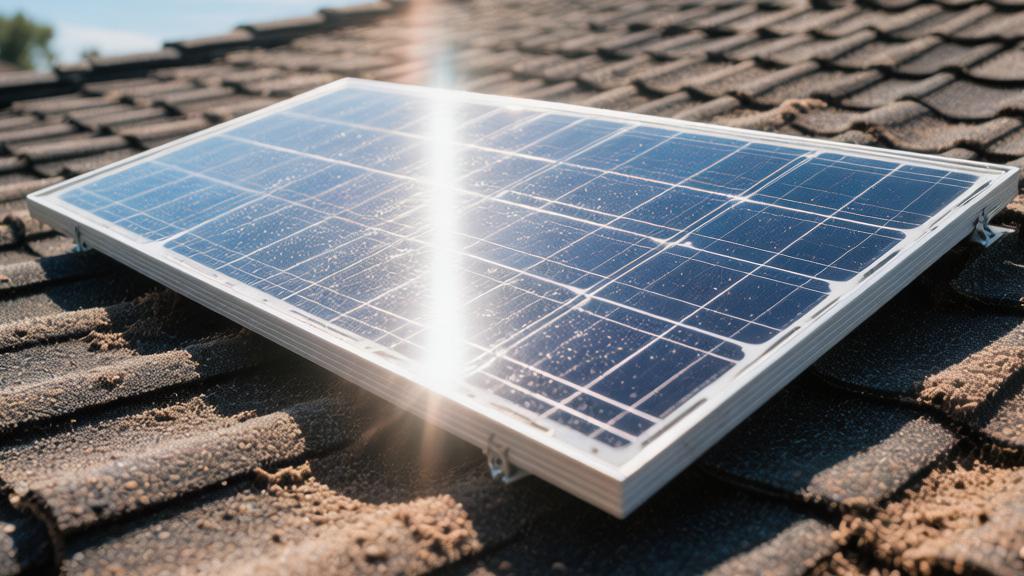
When a standard-sized 1.7 square meter monocrystalline silicon panel is exposed to outdoor environments with temperatures as high as 35℃, its absolute surface temperature frequently soars quickly to a peak state of 65℃.
The industry sets 25℃ as the standard median temperature parameter for testing the rated power of photovoltaic modules.
When the actual working temperature crosses this 25℃ physical boundary, for every 1℃ of positive temperature deviation, the photoelectric conversion efficiency of the panel will show a fixed reduction rate of 0.35%.
Using a conventional module with a nominal maximum output power of 400 Watts to establish a data calculation model, a temperature fluctuation of 40℃ will cause its actual power output to plummet by a statistical percentage of approximately 14%.
During the high-load period at 1:00 PM, the actual output power of this panel can only maintain a physical level of 344 Watts, resulting in a clear power loss of 56 Watts.
During a 6-hour effective sunshine cycle, this 14% efficiency drop causes a single panel to generate about 0.33 kWh less electricity per day.
Based on statistical samples for a 6 kW rooftop system, high-temperature thermal degradation will cause a production variance of at least 180 kWh over the 90-day span of an entire summer.
Measured at an average utility grid price of 0.15 USD per kWh, the owner will face a shrinkage in expected financial returns of approximately 27 USD during this quarter.
Inverter Derating
Micro-inverters that convert DC to AC have the optimal operating temperature range of their internal IGBT electronic modules strictly limited to a discrete interval of -40℃ to 65℃.
When the temperature of the metal casing of an inverter installed above rooftop shingles reaches a threshold of 50℃, the device will automatically start a thermal derating protection program, forcibly slashing the maximum output current by 10% of the load.
This mandatory working frequency limit causes the original rated conversion efficiency of up to 97.5% to drop to a low discrete value of 95.2% at a rate of 0.1% per minute.
Assuming the input voltage is stable at 380 Volts, a 2.3% conversion efficiency difference causes a 5,000 Watt capacity inverter to waste 115 Watts of energy capacity every hour.
Internal aluminum electrolytic capacitors will experience a 50% discount in their 50,000-hour expected lifespan for every statistical 10℃ increase in ambient temperature.
If the machine operates at full load under high-temperature pressure exceeding 45℃ for a long time, the originally expected 15-year equipment lifespan will likely shorten to a time node of 7.5 years.
Since the market budget for a brand-new replacement device is as high as 1200 USD, the reduction in lifespan due to thermal damage stretches the overall system's financial payback period by a length of 14 months.
Cable Loss
For 10 AWG specification pure copper DC cables measuring 50 meters long connecting 30 panels, their physical resistivity shows a positive growth rate of 0.393%/℃ as the ambient temperature climbs.
At a cool morning temperature of 20℃, the overall loop resistance of this cable remains precisely at a standard error parameter of 0.16 Ohms.
When noon sunlight heats the air inside the rooftop conduits to an extreme high of 60℃, the total resistance of the cable will swell to a statistical peak of 0.185 Ohms.
When transmitting a standard DC working current of 15 Amperes, the extra 0.025 Ohms of physical resistance will cause the voltage drop on the cable to expand from 2.4 Volts to a deviation range of 2.77 Volts.
Calculated according to physical formulas, the thermal energy loss power on the line climbs from an initial 36 Watts to a range load of 41.6 Watts.
This tiny error increment of just 5.6 Watts accumulates into a total physical capacity loss of up to 250 kWh over a 25-year lifecycle statistic.
Considering that the cross-linked polyethylene insulation of the cable's outer layer will experience an annual physical embrittlement rate of 0.2% under long-term 90℃ baking, the probability of a leakage short circuit fault is pushed up by a statistical ratio of five thousandths.